 Salesforce
 5 MIN READ


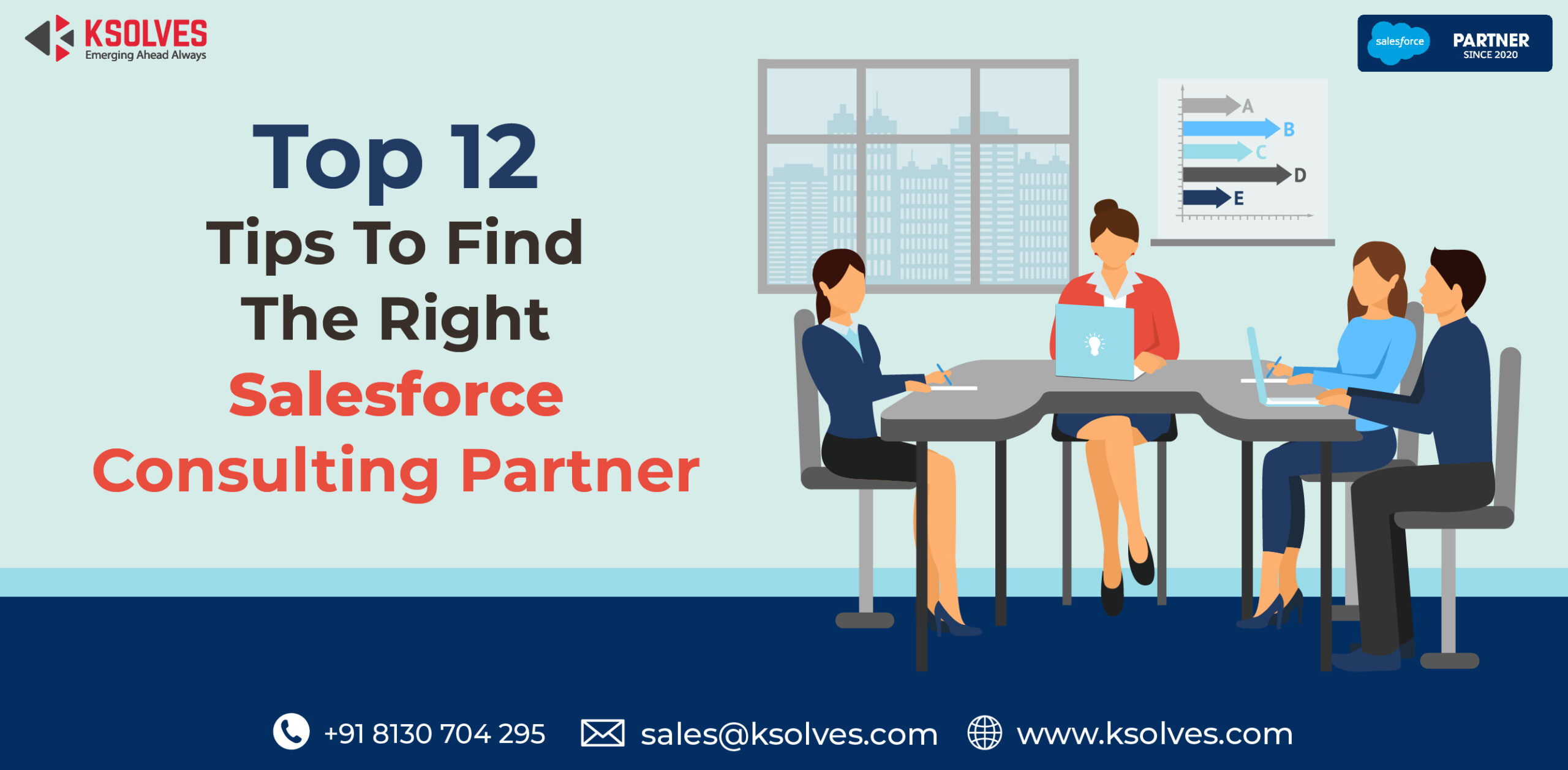
Did you know that poor CRM implementation can cost businesses more than just their technology investment? It can also result in disconnected customer information, inefficient sales processes, missed opportunities, and frustrated employees.
Salesforce offers a powerful ecosystem of tools to manage customer relationships, automate business processes, improve sales performance, and deliver personalized customer experiences. However, purchasing Salesforce licenses does not automatically guarantee business success. The real value comes from implementing the right features, connecting existing systems, and aligning the platform with your business objectives.
This is where choosing the right Salesforce consulting partner becomes important.
Imagine a manufacturing company planning to implement Salesforce Sales Cloud. Its primary requirement is to manage leads, track distributor relationships, and automate sales reporting.
However, a generic implementation may not address its complex approval processes, regional sales operations, or ERP integration requirements. An experienced Salesforce implementation partner understands these business challenges and builds a tailored solution around them.
So, how do you identify a partner who understands your business rather than simply offering technical implementation? Here are 12 practical tips to help you make an informed decision.
What Does a Salesforce Consulting Partner Actually Do?
A Salesforce consultation partner is an organization that helps businesses plan, implement, customize, integrate, and optimize Salesforce solutions.
Their responsibilities go beyond setting up a CRM platform. They understand your existing business processes, identify operational gaps, recommend suitable Salesforce products, and develop a roadmap for achieving your objectives.
Their work may include:
- Business requirement analysis: Understanding your sales, marketing, service, and operational challenges.
- Salesforce implementation: Configuring the platform according to your business requirements.
- CRM customization: Developing custom objects, workflows, dashboards, and business functionalities.
- System integration: Connecting Salesforce with ERP, accounting, marketing, and other enterprise applications.
- Data migration: Moving existing customer information while maintaining data quality and consistency.
- Employee training: Helping employees understand and effectively use the platform.
- Ongoing optimization: Improving the system through dedicated Salesforce-managed services as business requirements evolve.
A suitable partner should be able to explain not only what needs to be implemented but also why a particular solution makes sense for your organization.
Top 12 Tips to Find the Right Salesforce Consulting Partner
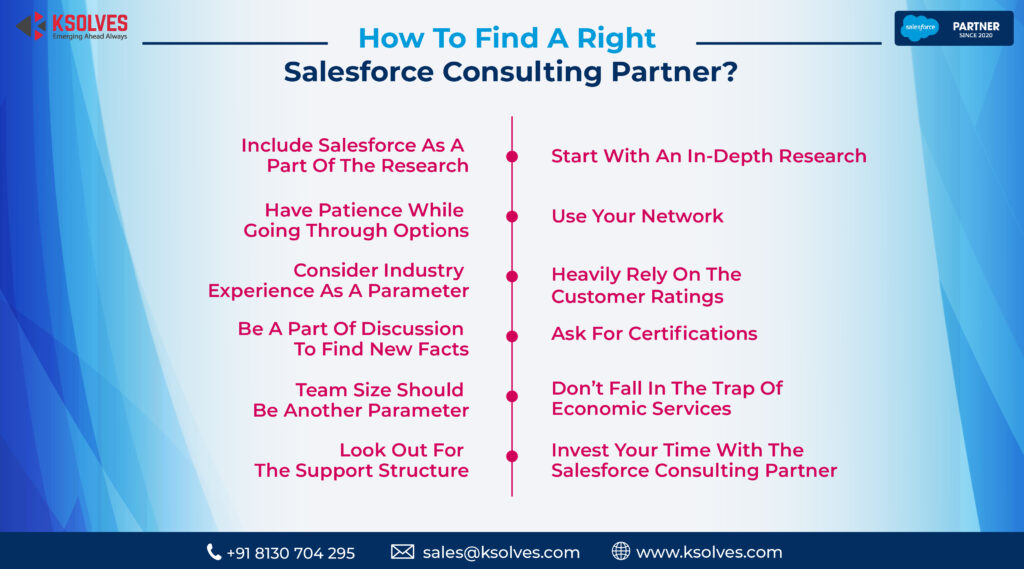
1. Evaluate Their Experience With Your Salesforce Products
Salesforce has multiple products designed for different business requirements. A company implementing Sales Cloud may have very different expectations from an organization adopting Agentforce or Data Cloud solutions.
Therefore, do not evaluate a partner based only on its overall Salesforce experience. Check whether its team has successfully worked with the specific Salesforce products you need.
What should you evaluate?
- Experience with your required Salesforce Cloud.
- Knowledge of standard Salesforce features and limitations.
- Ability to customize existing functionality.
- Experience with multi-cloud implementations.
- Understanding of Salesforce licensing and product dependencies.
Example: A financial services company planning to implement Service Cloud may need case management, customer verification, escalation rules, and secure access to customer information. A partner with relevant Service Cloud experience will be better positioned to understand these requirements.
Decision-maker tip: Ask the shortlisted partner to explain how it would approach your proposed implementation before discussing the commercial proposal.
2. Look for Industry-Specific Implementation Experience
Every industry has different customer expectations, operational challenges, and compliance requirements.
A retail organization may prioritize customer loyalty and personalized promotions, while a manufacturing company may need distributor management, inventory visibility, and ERP integration. This makes industry-specific expertise an important selection criterion.
|
Industry |
Important Salesforce Requirements |
|
Manufacturing |
Distributor management, sales forecasting, ERP integration |
|
Healthcare |
Patient engagement, secure data access, service management |
|
Banking and Finance |
Customer onboarding, case management, compliance processes |
|
Retail |
Customer personalization, loyalty programs, omnichannel engagement |
|
Education |
Student lifecycle management, admissions, communication automation |
A Salesforce consulting company familiar with your industry can identify potential implementation challenges earlier and recommend suitable solutions. Ask for case studies that demonstrate how the partner addressed business problems similar to yours.
3. Examine Their Salesforce Implementation Case Studies
A company’s website may contain impressive service descriptions, but actual project experience provides more meaningful evidence.
Review its Salesforce implementation case studies to understand the complexity of its previous projects. Do not stop at checking which Salesforce products were used, look at the business problem, implementation approach, technical challenges, and measurable results.
Ask questions such as:
- How many customer records were migrated?
- Which existing applications were integrated?
- How were duplicate customer records handled?
- Did the implementation include automated customer journeys?
- What improvements were observed in reporting or customer service?
- How was employee adoption measured?
Look for measurable outcomes such as reduced manual data entry, shorter case resolution times, improved lead visibility, or fewer duplicate records. A successful implementation is defined by how effectively those features solve business problems.
4. Assess Their Customization and Development Capabilities
Salesforce offers extensive standard functionality, but businesses often require additional capabilities to support unique processes. For example, a logistics company may need custom shipment tracking, automated delivery notifications, and approval workflows connected to its existing transportation management system.
Your partner should understand when standard Salesforce functionality is sufficient and when custom development is necessary.
Evaluate their knowledge of:
- Apex development.
- Lightning Web Components (LWC).
- Salesforce Flow automation.
- Custom objects and validation rules.
- Salesforce APIs and REST integrations.
- Experience Cloud customization.
- Application development and third-party AppExchange integrations.
However, more customization does not always mean a better solution. An experienced team should prioritize standard Salesforce capabilities wherever possible and recommend custom development only when it provides genuine business value. This approach helps control maintenance costs and makes future platform upgrades easier.
5. Check Their Data Migration and Integration Expertise
Data migration is one of the most critical parts of any CRM transformation project. Businesses often maintain customer information across spreadsheets, legacy CRM platforms, ERP systems, marketing applications, and internal databases.
Moving this information into Salesforce without proper planning can create duplicate records, incomplete customer profiles, and reporting inaccuracies. Before selecting a partner, evaluate its ability to manage the complete Salesforce data migration and integration process.
Important areas to discuss include:
- Data profiling and cleansing.
- Duplicate record identification.
- Field mapping and transformation.
- Data validation protocols.
- Historical data migration strategies.
- API-based integrations.
- Integration monitoring and error handling.
The new Salesforce environment must provide sales representatives with relevant customer information without requiring them to switch between applications. A capable partner should propose an integration strategy that maintains consistent information across systems.
Decision-maker tip: Ask for a sample data migration and integration plan before approving the project.
6. Verify Certifications and Technical Team Expertise
Salesforce certifications provide a clear indication of an individual’s knowledge and understanding of the platform. However, checking only the number of certifications held by a company is not enough. You should understand whether the actual team assigned to your project has the relevant expertise.
Some key certifications to look for:
- Salesforce Administrator
- Salesforce Platform Developer
- Salesforce Sales Cloud Consultant
- Salesforce Service Cloud Consultant
- Salesforce Data Cloud Consultant
- Salesforce Application Architect
- Salesforce System Architect
Also, evaluate the experience of solution architects, business analysts, developers, integration specialists, and project managers.
An important point: The person presenting your proposal may not be the person managing your implementation. Always ask to meet the proposed delivery team to assess whether they understand your business requirements.
7. Evaluate Their Approach to Salesforce Security and Data Governance
Customer data is among the most valuable assets of any organization. Security should be part of the implementation discussion from the beginning.
A Salesforce environment may contain sensitive customer details, financial information, internal business records, and employee data. Your technology partner should understand how to protect this information effectively.
Check their knowledge of:
- Role-based access controls (RBAC).
- Profiles and permission sets.
- Organization-Wide Defaults (OWD).
- Field-level security (FLS).
- Data sharing rules and criteria-based sharing.
- Audit trails and monitoring tools.
- Data retention and compliance governance.
Example: A financial services company may require sales representatives to access customer contact details while restricting access to confidential financial data. The partner should be able to design an appropriate permission structure that supports daily operations without exposing sensitive information.
8. Understand Their Project Management and Delivery Approach
Even an experienced Salesforce team can struggle if the project lacks proper planning and communication. Before finalizing a partner, understand how it manages implementation activities.
Ask whether it follows an Agile, Waterfall, or hybrid delivery approach and why that methodology is suitable for your project.
Important project management elements include:
- Clearly defined project milestones.
- Requirement documentation and user stories.
- Sprint planning and progress reviews.
- Testing and quality assurance (QA).
- User Acceptance Testing (UAT).
- Deployment planning and release management.
- Risk management and mitigation plans.
- Regular stakeholder communication.
Example: Suppose your organization plans to implement Salesforce across three departments. A structured delivery approach defines which department goes live first, what integrations are required, how employees will be trained, and how issues will be addressed during deployment.
9. Check Their User Training and Change Management Strategy
A technically successful Salesforce implementation can still fail if employees do not adopt the platform. Sales representatives may continue using spreadsheets, service teams may avoid updating customer cases, and managers may struggle to obtain accurate reports.
This usually happens when employees do not understand the benefits of the new system or have not received adequate training. A good partner should include user adoption and change management in its implementation strategy.
Look for:
- Role-specific training sessions.
- Practical demonstrations and real-world scenarios.
- Custom user guides and documentation.
- Dedicated sandbox training environments.
- Feedback collection mechanisms.
- Post-launch adoption tracking and support.
For example, sales representatives need training on lead management, opportunity tracking, and pipeline reporting. Service representatives require different training focused on case management and omnichannel interactions.
10. Compare Pricing Based on Business Value, Not Just Cost
Budget is an important consideration, but choosing a Salesforce partner solely because it offers the lowest quotation can create expensive problems later.
A low initial estimate may exclude essential activities such as data cleansing, integration testing, employee training, documentation, or post-deployment support.
Instead of comparing only the total project cost, examine what each proposal includes:
|
Cost Consideration |
Questions to Ask |
|
Implementation |
What specific activities and deliverables are included? |
|
Customization |
Are custom development requirements clearly defined? |
|
Integration |
Are third-party connections and APIs included in the scope? |
|
Data Migration |
Is data profiling and cleansing part of the estimate? |
|
Training |
How many role-specific training sessions are included? |
|
Support |
What post-deployment assistance is provided? |
|
Future Changes |
How are scope changes or additional requirements billed? |
Decision-maker tip: Compare the Total Cost of Ownership (TCO) rather than looking at the initial implementation quotation alone.
11. Evaluate Post-Implementation Support and Scalability
Salesforce implementation is not a one-time activity. Your business requirements will change as your customer base grows, new departments adopt the CRM, and additional applications become part of your technology stack.
Therefore, the partner you select should be capable of supporting your organization beyond the initial go-live through long-term Salesforce services.
Discuss their approach to:
- Bug fixing and ongoing troubleshooting.
- Seasonal Salesforce release updates and feature adoption.
- System performance optimization.
- Regular security reviews and audits.
- Continuous user support and training.
- New feature development and roadmap planning.
- System enhancements and integration maintenance.
Example: A growing e-commerce business may initially use Salesforce for customer support. Later, it may want to introduce marketing automation, customer segmentation, and AI-driven engagement. A scalable partner helps extend the existing environment without requiring unnecessary redevelopment.
12. Assess Communication, Transparency, and Long-Term Compatibility
The final decision should not depend entirely on technical skills or pricing. You are selecting a partner that may work closely with your business teams for several years. Communication and transparency are essential.
During initial discussions, evaluate whether the partner:
- Listens carefully to your specific business challenges.
- Explains complex technical concepts in simple, accessible language.
- Provides realistic project timelines and milestones.
- Clearly communicates potential project risks.
- Shares transparent, regular progress updates.
- Welcomes feedback and explores practical alternatives.
- Takes clear ownership of implementation challenges.
A reliable partner will not simply agree with every requirement—they will question unnecessary complexity and recommend standard features when appropriate. For example, if your team requests a complex custom script that Salesforce Flow can handle natively, an experienced consultant will guide you toward the out-of-the-box feature.
Red Flags to Watch Out for When Selecting a Salesforce Partner
While evaluating potential partners, pay attention to warning signs that may indicate project risks:
|
Red Flag |
Why It Matters |
|
Guaranteed results without requirement discovery |
Suggests unrealistic promises and poor planning |
|
No relevant industry or product case studies |
Makes technical experience difficult to verify |
|
Vague or ill-defined project scope |
Often leads to scope creep and unexpected costs |
|
Excessive custom code recommendations |
Increases maintenance overhead and upgrade complexity |
|
Absence of a structured data migration strategy |
Can result in data loss, duplicates, and inaccurate reports |
|
Limited security or compliance discussion |
Exposes sensitive enterprise data to vulnerability |
|
No post-launch support or managed services plan |
Leaves your team without assistance after go-live |
|
Unclear or unverified delivery team assignments |
Creates accountability and quality issues during execution |
Why Ksolves Can Be Your Salesforce Technology Partner
Selecting the right Salesforce partner comes down to finding a team that understands your business challenges and translates them into reliable technology solutions.
At Ksolves, we help businesses unlock the full potential of the Salesforce ecosystem. Whether you need end-to-end implementation, custom development, enterprise integration, data migration, or ongoing optimization, our certified specialists ensure your platform aligns with your long-term business goals.
Whether your goal is to streamline sales operations, elevate customer support, unearth insights with Data Cloud, or deploy autonomous AI agents, having the right technology partner makes all the difference. Contact Ksolves today to discuss your Salesforce requirements with our experts.