



How to Choose the Right Odoo App for Your Business
Odoo
5 MIN READ
April 22, 2026

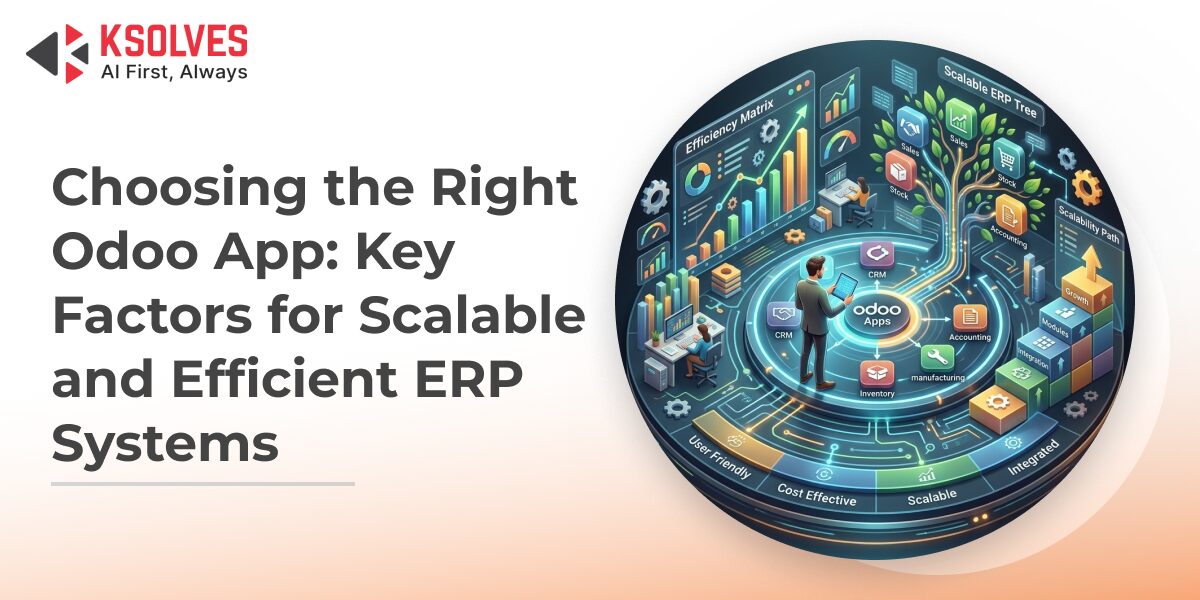
As businesses scale, their systems must evolve just as quickly. What once worked as a basic ERP setup often becomes a bottleneck: lacking flexibility, slowing down operations, and limiting visibility. This is where Odoo changes the game. Its modular architecture, powered by a vast ecosystem of apps, allows organizations to continuously extend and refine their ERP, adding exactly what they need, when they need it.
But with thousands of apps available, the real challenge isn’t access, but it’s selection. The wrong choice can introduce inefficiencies, disrupt workflows, and create long-term technical complications. The right one, however, can unlock automation, improve decision-making, and drive measurable business outcomes.
This guide cuts through the noise. It equips you with a clear, strategic framework to evaluate Odoo apps, so every addition to your system is not just functional, but purposeful, scalable, and aligned with your business growth.
Why Choosing the Right Odoo App Matters
While the Odoo ecosystem offers unmatched flexibility, not every app adheres to the same development, performance, and security standards. Selecting the wrong app is not just a minor technical misstep; it can have a direct and lasting impact on your business operations.
A poorly chosen app can lead to:
- Performance degradation due to inefficient code and heavy database queries
- Upgrade conflicts that complicate or delay future Odoo version migrations
- Data inconsistencies caused by improper integrations or flawed logic
- Security vulnerabilities that expose sensitive business information
In contrast, the right app acts as a force multiplier. It streamlines workflows, integrates seamlessly with existing modules, and supports scalability, ultimately driving higher operational efficiency and delivering sustainable long-term ROI.
Key Factors to Consider When Choosing an Odoo App
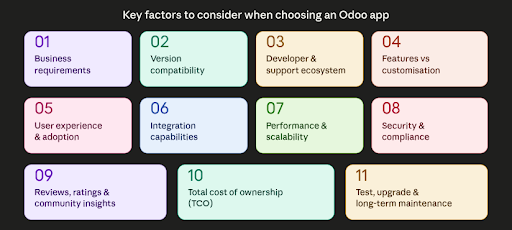
1. Define Your Business Requirements Clearly
Identify Core Business Processes
Start by mapping the processes you want to improve:
- Sales workflows (quotations, CRM automation).
- Inventory management (stock tracking, warehouse operations).
- Manufacturing (MRP, BOM, production planning).
- Finance (invoicing, compliance, reporting).
Map Existing Gaps and Challenges
Identify inefficiencies such as:
- Manual data entry.
- Lack of real-time visibility.
- Disconnected systems.
Prioritize Features Based on Business Impact
Avoid feature overload. Classify requirements into:
- Must-have: Critical for operations.
- Nice-to-have: Enhancements, not blockers.
2. Ensure Compatibility with Your Odoo Version
Check Version Alignment
Apps in Odoo are version-specific. Ensure the app explicitly supports your current version (e.g., Odoo 16, 17, or 18).
Risks of Using Outdated or Unsupported Apps
- Broken dependencies after upgrades.
- Incompatibility with core modules.
- Increased technical debt.
3. Evaluate the App Developer and Support Ecosystem
Assess Developer Credibility
Look for:
- Certified Odoo partners.
- Proven track record.
- Industry-specific expertise.
Review Support and Maintenance Quality
Evaluate:
- SLA commitments.
- Response time.
- Availability of documentation.
Frequency of Updates and Improvements
Apps should be actively maintained with:
- Bug fixes.
- Security patches.
- Version upgrades.
3. Analyze Features vs Customization Flexibility
Avoid Overloaded Applications
Apps with excessive features can:
- Complicate workflows.
- Reduce usability.
- Impact performance.
Check Customization Capabilities
Technically evaluate:
- Code modularity.
- Use of Odoo ORM standards.
- Extensibility via inheritance (_inherit, _name).
When to Consider Custom Development
Choose custom apps when:
- Workflows are highly specific.
- Competitive differentiation is required.
- Off-the-shelf apps introduce unnecessary complexity.
4. Focus on User Experience and Adoption
Importance of Intuitive UI/UX
A well-designed interface improves:
- User adoption.
- Task efficiency.
- Reduced training time.
Evaluate Ease of Navigation and Learning Curve
Check:
- Menu structure.
- Form views and dashboards.
- Workflow simplicity.
Mobile and Cross-Device Accessibility
Ensure compatibility with:
- Odoo mobile app.
- Tablets and remote access scenarios.
5. Assess Integration Capabilities
Compatibility with Third-Party Tools
Ensure seamless integration with:
- eCommerce platforms (Shopify, WooCommerce).
- Payment gateways.
- Logistics providers.
API Availability and Flexibility
Verify:
- REST/XML-RPC API support.
- Webhook capabilities.
- Reliable data synchronization.
Avoiding Data Silos
Apps should integrate cleanly with core modules like:
- CRM
- Inventory
- Accounting
6. Evaluate Performance and Scalability
Application Performance Under Load
Analyze:
- Query efficiency (avoid heavy joins, redundant queries).
- Impact on server resources.
Scalability for Future Growth
Ensure the app can handle:
- Increased transactions
- Multiple users
- Large datasets
Technical Tip: Check adherence to Odoo performance best practices such as batch processing and proper indexing.
7. Ensure Security and Compliance
Data Protection Mechanisms
Check for:
- Secure data handling.
- No exposure of sensitive fields.
Access Control and User Permissions
Evaluate:
- Record rules (ir.rule)
- Access control lists (ir.model.access)
Compliance with Industry Standards
Ensure alignment with:
- GDPR (for EU businesses)
- Industry-specific regulations
8. Leverage Reviews, Ratings, and Community Insights
Analyze Marketplace Ratings
High ratings often indicate:
- Reliability
- Stability
Learn from User Feedback
Look for patterns in:
- Bugs
- Performance issues
- Support concerns
Explore Community Forums and Case Studies
Community insights help uncover:
- Real-world use cases
- Known limitations
9. Understand the Total Cost of Ownership (TCO)
Beyond the Initial Purchase Cost
Consider:
- Implementation effort.
- Customization requirements.
Ongoing Maintenance and Support Costs
Include:
- Annual support.
- Upgrade costs.
Identifying Hidden Costs
Watch for:
- Dependency on other paid apps.
- Infrastructure upgrades.
10. Test Before You Deploy
Importance of a Staging Environment
Always deploy apps in a staging environment before production.
Conduct Functional and UAT Testing
Validate:
- Business workflows.
- Data accuracy.
- Integration behavior.
11. Plan for Upgrades and Long-Term Maintenance
Compatibility with Future Odoo Releases
Ensure:
- Upgrade scripts are available.
- Minimal refactoring required.
Vendor Commitment to Long-Term Support
Choose vendors who:
- Regularly release updates.
- Support multiple Odoo versions.
Supercharge Your Odoo Experience with Ksolves’ App Store
Choosing the right app is only half the equation. The source you choose matters just as much. This is where Ksolves India Limited, an AI-first Odoo development company, stands out with its robust and reliable Odoo app ecosystem on Ksolves Store. Our Odoo apps are built with an AI-driven development approach to deliver smarter, faster, and more efficient solutions.
Ksolves Store: A Curated Library of 70+ Odoo Apps
Ksolves offers a comprehensive portfolio of 70+ Odoo apps on Ksolves Store, designed to address real-world business challenges across industries. These apps extend Odoo’s core capabilities across:
- Sales and CRM automation
- Inventory and warehouse management
- Manufacturing and operations
- Finance and reporting
- Access control and user management
By leveraging AI in the development lifecycle, Ksolves ensures that each app is optimized for real business scenarios, reducing manual effort and enhancing decision-making.
Built for Performance, Scalability, and Reliability
Ksolves’ AI-enabled development approach ensures:
- Optimized performance with efficient code structures.
- Scalable architecture that adapts to growing business needs.
- Upgrade-ready solutions aligned with evolving Odoo versions.
This results in applications that not only function seamlessly but also continuously improve over time.
Our Top-Selling Odoo Apps
- Dashboard Ninja with AI
- Access Manager Ninja
- Odoo WooCommerce Connector with AI
- Odoo Shopify Connector with AI
- List View Manager
- Odoo Gantt View Project
- ReportMate
Check out more apps on the Ksolves Store.
Continuous Support and Intelligent Enhancements
Ksolves integrates AI to enhance product lifecycle management by enabling:
- Faster identification and resolution of issues.
- Data-driven updates and feature enhancements.
- Continuous optimization based on usage patterns.
Alongside this, businesses benefit from:
- Regular product updates.
- Dedicated technical support.
- Ongoing compatibility with new Odoo releases.
Also Read – Using Timesheets & Billing in Odoo for Software Development Teams
Custom Odoo App Development with Ksolves’ AI-Driven Approach
While ready-made apps address many standard use cases, businesses with unique workflows or industry-specific requirements often need more tailored solutions. This is where Ksolves India Limited, an AI-first Odoo development company, brings added value with its AI-driven custom Odoo app development approach.
Built Around Your Business Requirements
Ksolves focuses on developing applications that align precisely with your operational needs. Instead of forcing your processes to fit a generic app, the solution is designed to:
- Reflect your exact workflows.
- Address specific operational challenges.
- Support business-specific compliance and reporting needs.
AI-Driven Development for Smarter Solutions
By integrating AI into its development lifecycle, Ksolves enhances:
- Requirement analysis with better accuracy and faster turnaround.
- Code optimization for improved performance and scalability.
- Automation capabilities to reduce manual intervention.
This results in applications that are not just functional, but intelligent and future-ready.
Scalable, Modular, and Upgrade-Friendly Architecture
Custom apps are developed following Odoo’s best practices to ensure:
- Seamless integration with existing modules.
- High scalability as the business grows.
- Smooth upgrades across Odoo versions.
Faster Development with Improved Accuracy
Ksolves leverages AI-assisted development to:
- Accelerate delivery timelines.
- Minimize development errors.
- Ensure consistent code quality.
End-to-End Support and Continuous Improvement
From ideation to deployment and beyond, Ksolves provides:
- Functional consulting and technical development.
- Rigorous testing and validation.
- Ongoing support and enhancements.
Final Words
Choosing the right Odoo apps is not just a functional decision; it’s a strategic one that directly impacts how efficiently your business operates and scales. From defining clear requirements to evaluating performance, security, and long-term compatibility, every step plays a critical role in building a reliable and future-ready ERP ecosystem around Odoo.
While the marketplace offers a wide range of options, the real value lies in selecting solutions that align with your business goals and technical architecture. Whether you opt for ready-made apps or custom-built solutions, partnering with the right expert, like Ksolves India Limited, ensures that your Odoo environment is not only optimized for today but also prepared for tomorrow.































AUTHOR
Odoo
Vaishali Bhatt is a technical writer at Ksolves with a long history of covering advanced technologies, from Apache Projects to Artificial Intelligence and Machine Learning, with a particular focus on cloud computing and Salesforce in her articles or blogs. Over the course of a career spent in the research and technology arena, she has polished her expertise at breaking down difficult concepts into terms that a layman can understand.
Share with