



3 Different Types Of Machine Learning
Machine Learning
5 MIN READ
April 17, 2026

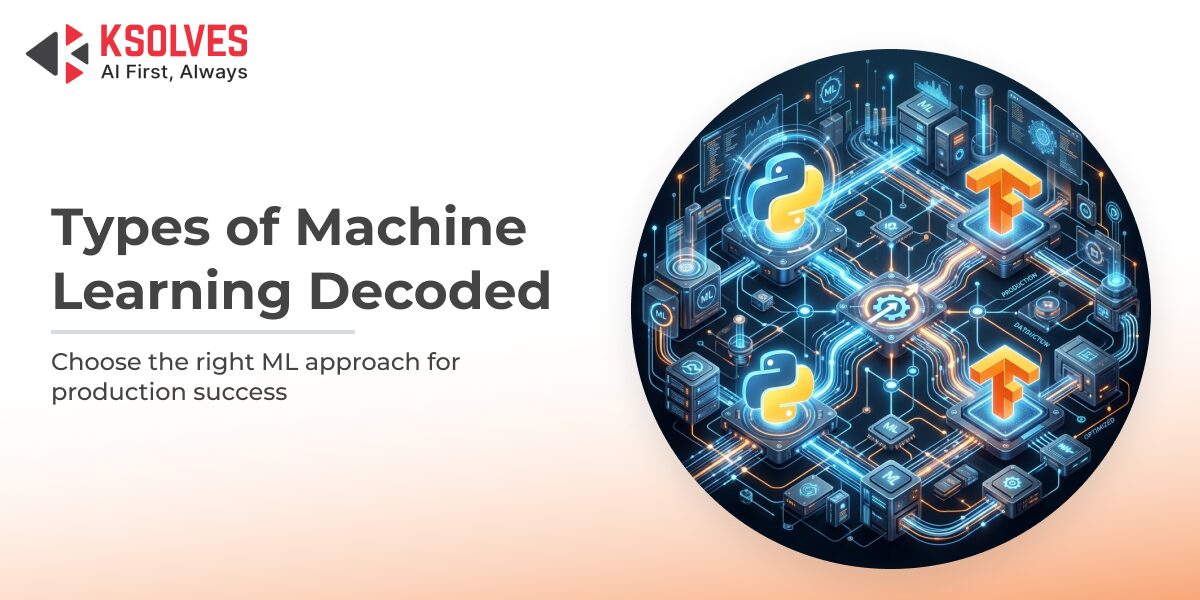
Machine Learning is no longer a technology of the future. It is a core production capability powering fraud detection, demand forecasting, predictive maintenance, and personalization across industries right now. Yet despite its widespread adoption, one problem persists: organizations invest in ML without fully understanding which type of learning their problem actually requires, and that mismatch is one of the leading reasons why only about 22% of ML models ever reach production.
As an AI-first company, Ksolves has worked across enough enterprise ML deployments to know that the choice of learning paradigm matters as much as the quality of data. Before picking a framework or hiring a data science team, the foundational question is simpler: how should your model learn?
This blog covers the three core types of Machine Learning, how each one works, and when to use them to build systems that are accurate, scalable, and production-ready.
What Is Machine Learning?
Machine Learning is a subset of Artificial Intelligence that enables systems to learn patterns from data and improve performance without being explicitly programmed for every scenario. In traditional software development, developers define rules manually. In ML, models infer relationships from historical data by optimizing objective functions such as accuracy, loss, or reward.
As of 2025, 81% of Fortune 500 companies use ML in core enterprise functions including customer service, supply chain optimization, and cybersecurity. ML underpins use cases such as image and video recognition, demand forecasting, anomaly detection, recommendation systems, and predictive analytics. At its core, it replaces static rule-based systems with adaptive, data-driven decision models.
Types of Machine Learning
Modern Machine Learning systems are broadly categorized into five types based on how models learn from data and feedback.
-
Supervised Learning
What It Is
Supervised Learning is the most widely used ML approach, where models are trained on labeled datasets. Each data point includes input features and a known output label.
How It Works
The model learns a mapping function between inputs and outputs by minimizing prediction error during training. Once trained, it generalizes this mapping to unseen data.
Subtypes
- Classification: Logistic Regression, Support Vector Machines, Random Forest, Neural Networks
- Regression: Linear Regression, Gradient Boosting, XGBoost
Technical Use Cases
- Predicts credit risk using historical financial and transaction data
- Identifies customers likely to churn based on behavior and engagement patterns
- Automatically classifies images and extracts text from documents
- Forecasts demand and revenue using historical trends and market data
Supervised learning performs best when high-quality labeled data is available, and target outcomes are well-defined.
-
Unsupervised Learning
What It Is
Unsupervised Learning works with unlabeled data. The goal is to discover hidden structures, patterns, or distributions without predefined outcomes.
How It Works
Algorithms analyze feature relationships and statistical properties to group or transform data based on similarity or variance.
Subtypes
- Clustering: K-Means, DBSCAN, Hierarchical Clustering
- Dimensionality Reduction: PCA, t-SNE, Autoencoders
- Association Rule Mining
Technical Use Cases
- Segments customers into distinct groups based on purchasing behavior
- Detects anomalies in sensor or system data without predefined failure labels
- Identifies hidden usage patterns in large volumes of unlabeled data
- Reduces data dimensionality to improve downstream ML model performance
Unsupervised learning is particularly valuable during exploratory data analysis and early-stage model design.
-
Reinforcement Learning
What It Is
Reinforcement Learning trains agents to make sequential decisions by interacting with an environment and receiving rewards or penalties.
How It Works
The agent learns a policy that maximizes cumulative reward over time using techniques such as Q-learning, policy gradients, or deep reinforcement learning.
Subtypes
- Model-based RL
- Model-free RL
- Deep Reinforcement Learning
Technical Use Cases
- Optimizes robotic movement and control through reward-based learning
- Supports dynamic pricing optimization in controlled or simulated environments, often combined with business rules or bandit-based methods
- Improves resource allocation in logistics and supply chain systems
- Trains agents to make optimal decisions in simulation environments
Reinforcement Learning is computationally intensive but powerful for control and optimization problems involving long-term outcomes.
-
Self-Supervised Machine Learning
What It Is
Self-supervised learning generates labels automatically from raw data, reducing dependency on human annotation.
How It Works
The model creates pretext tasks, such as predicting masked tokens or future sequences, to learn representations from large unlabeled datasets.
Subtypes
- Contrastive learning
- Masked language modeling
- Representation learning
Technical Use Cases
- Learns text representations from large document corpora for NLP tasks
- Pretrains vision models using unlabeled images for faster deployment
- Reduces reliance on large-scale manual audio labeling by pretraining speech representations on unlabeled data
- Enables transfer learning for large-scale foundation models
Self-supervised learning has become foundational for large-scale AI systems such as foundation models.
-
Semi-Supervised Learning
What It Is
Semi-supervised learning combines a small labeled dataset with a large unlabeled dataset.
How It Works
The model learns from labeled examples while leveraging unlabeled data through techniques such as pseudo-labeling and consistency regularization.
Subtypes
- Self-training
- Co-training
- Graph-based methods
Technical Use Cases
- Improves medical image classification using limited labeled scans
- Detects fraud by learning from a small set of confirmed cases
- Identifies equipment faults using partially labeled industrial data
- Enhances prediction accuracy when labeling costs are high
4. Head-to-Head Comparison
| Type | Data Requirement | Feedback | Complexity | Best Fit |
| Supervised | Fully labeled | Explicit | Medium | Predictive tasks |
| Unsupervised | Unlabeled | None | Medium | Pattern discovery |
| Reinforcement | Interaction-based | Reward-driven | High | Control systems |
| Self-supervised | Unlabeled | Auto-generated | High | Representation learning |
| Semi-supervised | Partial labels | Hybrid | Medium to High | Limited-label environments |
5. When to Use Each Type
Choosing the right Machine Learning approach depends on data governance maturity, problem structure, and business objectives – and organizations that skip governance often find their models stalling before reaching production.
- Use supervised learning when historical labeled data exists, and accuracy is critical.
- Use unsupervised learning for exploratory analysis, segmentation, or anomaly detection.
- Use reinforcement learning when decisions affect future states, and rewards are delayed.
- Use self-supervised learning for large-scale model pretraining and representation learning.
- Use semi-supervised learning when labeling costs are high but predictive performance is still required.
ML in Practice: How Ksolves Detected Short Cycling in Compressors
The Problem
Short cycling in industrial compressors causes excessive wear, energy loss, and unplanned downtime. Rule-based systems fail to detect variable cycling patterns under changing load conditions. This is where expert-led ML consulting services become critical in helping organizations choose the right learning approach from the start.
The ML-Driven Solution
As an AI-first company, Ksolves approached this problem not with rule patches or manual threshold tuning, but with an intelligent, data-driven framework built from the ground up. Using time-series sensor data, Ksolves designed an ML pipeline that learns what normal compressor behavior looks like and flags deviations automatically, adapting to changing load conditions without any hardcoded logic. The result is a self-improving detection system that gets smarter as more operational data flows through it.
Business Impact
| Aspect | Outcome |
| Detection Approach | ML-based pattern and anomaly detection |
| Maintenance Strategy | Shift from reactive to predictive |
| Operational Benefit | Reduced energy loss and equipment stress |
This solution demonstrates how domain-aligned ML design enables proactive maintenance and operational efficiency. Read the full case here.
Conclusion
Machine Learning success is not determined by algorithms alone, but by how well the learning approach aligns with your data, problem structure, and business objectives. Each paradigm, whether supervised, unsupervised, reinforcement, self-supervised, or semi-supervised, solves a different class of problems, and treating them as interchangeable often leads to stalled initiatives and unrealized ROI.
In production environments, the real advantage comes from making the right choice early and building around it with the right data pipelines, feedback loops, and deployment strategy. This is where most organizations struggle, not in experimentation, but in translating models into measurable business impact.
At Ksolves, we help enterprises bridge this gap by combining domain expertise with production-grade ML engineering. From identifying the right learning approach to scaling models in real-world environments, we ensure that every ML investment is aligned with performance, reliability, and long-term value.
If you are looking to move beyond experimentation and build ML systems that deliver tangible outcomes, now is the time to take a more structured, strategy-first approach.
Frequently Asked Questions
What is the difference between supervised and unsupervised machine learning?
When should a business use reinforcement learning instead of supervised learning?
How do you choose the right type of machine learning for a business problem?
What is self-supervised learning and how is it different from unsupervised learning?
Why do most machine learning models fail to reach production?
Which company can help implement the right machine learning approach for my enterprise?
Is semi-supervised learning useful when labeling data is expensive?
Have questions about which ML approach fits your business? Contact our team for a free consultation.
 Mayank Shukla
In recent years, machine learning (ML) has evolved from a niche technology into a vital tool across various industries. From […]






























AUTHOR
Machine Learning
Mayank Shukla, a seasoned Technical Project Manager at Ksolves with 8+ years of experience, specializes in AI/ML and Generative AI technologies. With a robust foundation in software development, he leads innovative projects that redefine technology solutions, blending expertise in AI to create scalable, user-focused products.
Share with