Project Name
How Ksolves Used AI to Build a Kafka Load Testing Framework for a Financial Messaging Platform


When a financial platform sends hundreds of thousands of messages per batch across Email, SMS, and WhatsApp, the failure modes are not just technical. A Kafka consumer that falls behind under load means delayed notifications. A status inconsistency means a customer receives a duplicate alert, a missed one-time password, or a transaction confirmation that never arrives.
The client is a large-scale financial communication platform that processes high-volume, batch-driven messages across multiple channels, relying on external vendors for delivery and acknowledgment statuses. Before this engagement, there was no way to validate the platform’s Kafka messaging infrastructure under production-realistic load without using live vendor APIs, which introduced cost, rate limits, and unpredictability at every test run.
Ksolves, an AI-first company, applied AI-assisted development workflows to design and deliver a containerized, Kubernetes-native load testing and mock service framework to eliminate that dependency entirely, enabling full end-to-end validation of the message lifecycle at any volume, without touching a single live vendor API.
The platform came to Ksolves with testing gaps that no combination of unit tests or partial integrations could address:
- No End-to-End Testing Capability: Existing testing was limited to unit or partial integration tests. There was no way to validate the complete message lifecycle, from production through Kafka to downstream consumption, acknowledgment, and status persistence, under realistic load conditions.
- Vendor API Dependency for Any Meaningful Test: Real vendor integrations are costly, rate-limited, and unpredictable under high load. Every attempt to run a meaningful load test risked incurring vendor charges, hitting API limits, or producing results that did not reflect actual production behavior.
- High-Volume Load Simulation at Scale: The platform needed to simulate hundreds of thousands of messages per batch, spanning multiple channels simultaneously, to validate whether the Kafka infrastructure could sustain production volumes without degradation.
- Full Message Lifecycle Complexity: The platform's message states, covering SEND, DELIVERY, OPEN, READ, COMPLAINT, BOUNCE, REJECT, and UNDELIVERED, each required simulation with accurate timing and sequencing to reflect real-world vendor behavior.
- Observability Gaps: There was no unified visibility into message throughput, latency, batch health, or status progression across services. Performance issues could only be identified after they reached production.
- Scalability and Failure Scenario Testing: The system needed to be validated against negative scenarios such as Kafka downtime, slow consumers, database unavailability, and duplicate or corrupted messages, none of which could be safely tested against live infrastructure.
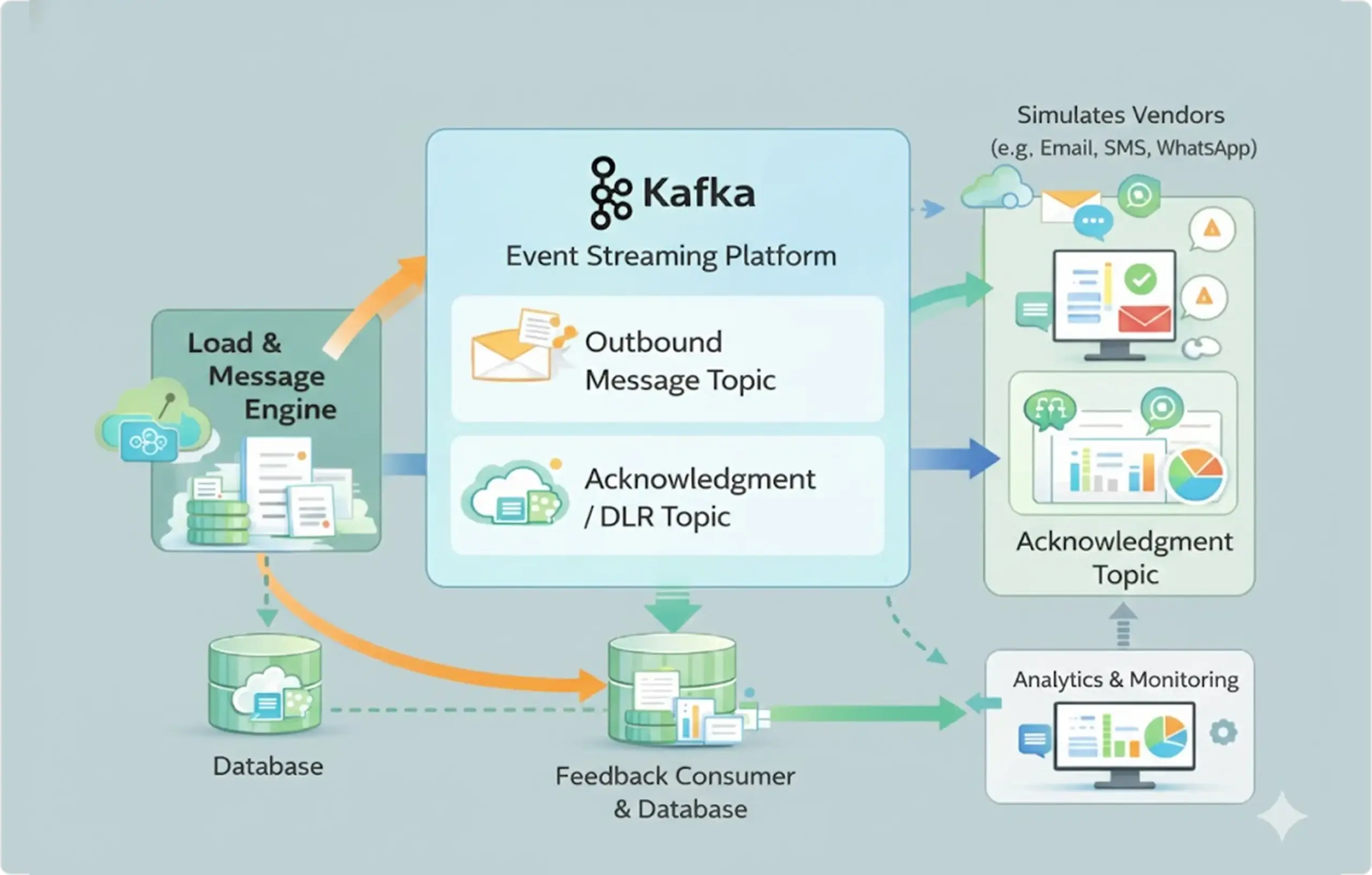
Leveraging an AI-first delivery approach, Ksolves designed and implemented a vendor-agnostic, microservices-based Kafka load testing framework deployed on Kubernetes, covering the full message lifecycle from load generation through acknowledgment, persistence, scheduling, and observability.
- Dynamic Load Generation: Batch-wise message generation using Python Locust, with configurable TPS, batch sizes, and execution delays. Each batch generates unique batch IDs and payload IDs for full traceability across parallel Locust workers on the AWS EKS cluster.
- Kafka Architecture and Message Flow: A structured producer-to-consumer pipeline was implemented: the load generator publishes to an outbound Kafka topic, a mock consumer simulates vendor processing and publishes acknowledgment events back to Kafka, and a feedback consumer persists those acknowledgments to PostgreSQL for reporting and audit.
- Vendor-Agnostic Mock Service: A Python-based mock service simulates real-world vendor behavior across Email, SMS, and WhatsApp channels, including delivery timing, retries, delays, and failure patterns. It supports all message states, covering positive delivery, bounce, reject, complaint, and undelivered scenarios, without any dependency on external APIs.
- Status Persistence and Audit Trail: All message lifecycle stages are recorded in PostgreSQL, maintaining a full audit trail per payload and per batch. This supports both real-time and historical analysis of test runs.
- Lifecycle Scheduler: A scheduler determines the next logical state in the message lifecycle and executes state transitions with controlled delays to accurately mimic real delivery timelines across all channels.
- Observability Dashboards: Apache Superset dashboards provide separate views for technical teams (throughput, latency, batch health, Kafka lag) and business users (delivery rates, status distributions, failure breakdowns), replacing the previous zero-visibility model.
- Kubernetes Scalability and Resilience: Mock services are horizontally scalable using Kubernetes pod replicas. Log rotation and persistence across restarts ensure no data is lost during scaling events or pod failures.
Technology Stack
| Component | Details |
|---|---|
| Load Testing | Python Locust |
| Message Streaming | Apache Kafka |
| Orchestration | Kubernetes on AWS EKS |
| Observability | Apache Superset |
| Status Persistence | PostgreSQL |
| Mock Service | Python |
| Containerization | Docker |
| Channels Simulated | Email, SMS, WhatsApp |
| Message States Covered | SEND, DELIVERY, OPEN, READ, COMPLAINT, BOUNCE, REJECT, UNDELIVERED + failure scenarios |
| Deployment Model | Containerized microservices on AWS EKS |
The framework delivered measurable improvements across test coverage, cost, and production readiness:
- Vendor Costs Eliminated for Load Testing: By replacing live vendor API calls with the mock service, the platform can now run unlimited load tests at any volume with no per-test vendor cost or rate limit constraint.
- Full Message Lifecycle Coverage Achieved: All 9 message states, including positive and negative scenarios, are now fully simulated. The platform has end-to-end test coverage it previously could not achieve with unit or partial integration tests alone.
- Production-Scale Load Validation Enabled: The framework validated the Kafka pipeline under high-volume batch loads, confirming message ordering, data integrity, and throughput consistency before production releases, not after.
- Failure Scenario Testing Made Safe: Negative scenarios including Kafka downtime, slow consumers, and database unavailability can now be tested repeatedly in an isolated environment, with no risk to live infrastructure or vendor relationships.
- Real-Time Observability Established: Apache Superset dashboards now provide continuous visibility into throughput, latency, batch health, and lifecycle progression. The team can identify and diagnose performance issues during test runs rather than after production incidents.
- Repeatable Release Validation Process: The framework gives the engineering team a consistent, automated test harness for every major release, reducing reliance on manual, vendor-dependent validation cycles.
“We had no way to load test our Kafka pipeline without hitting live vendor APIs. The framework Ksolves built changed that completely. We can now simulate the full message lifecycle at any volume, across all channels, at no per-test cost. Our production readiness process has never been more reliable.”
— Head of Platform Engineering, Financial Messaging Platform
By building a vendor-agnostic, Kubernetes-native Kafka load testing framework, Ksolves, a leading Apache Kafka Development company with an AI-first delivery approach, gave the platform a repeatable, cost-free way to validate its full messaging lifecycle at any volume before a release reaches production.
With all 9 message states simulated, real-world failure scenarios covered, and Apache Superset providing live observability across every test run, the platform’s engineering team can now validate production readiness with confidence. As message volumes grow and new channels are added, the framework scales horizontally on Kubernetes alongside them, without re-engineering.
If you are looking to build a similar performance testing framework for your Kafka infrastructure, connect with a Ksolves Apache Kafka expert and explore what is possible for your platform.
Is Your Kafka-based Messaging System Validated for Production-scale Load?