



How Odoo Simplifies Multi-Wallet and Multi-Currency Management for Fintech Companies
Odoo
5 MIN READ
February 6, 2026

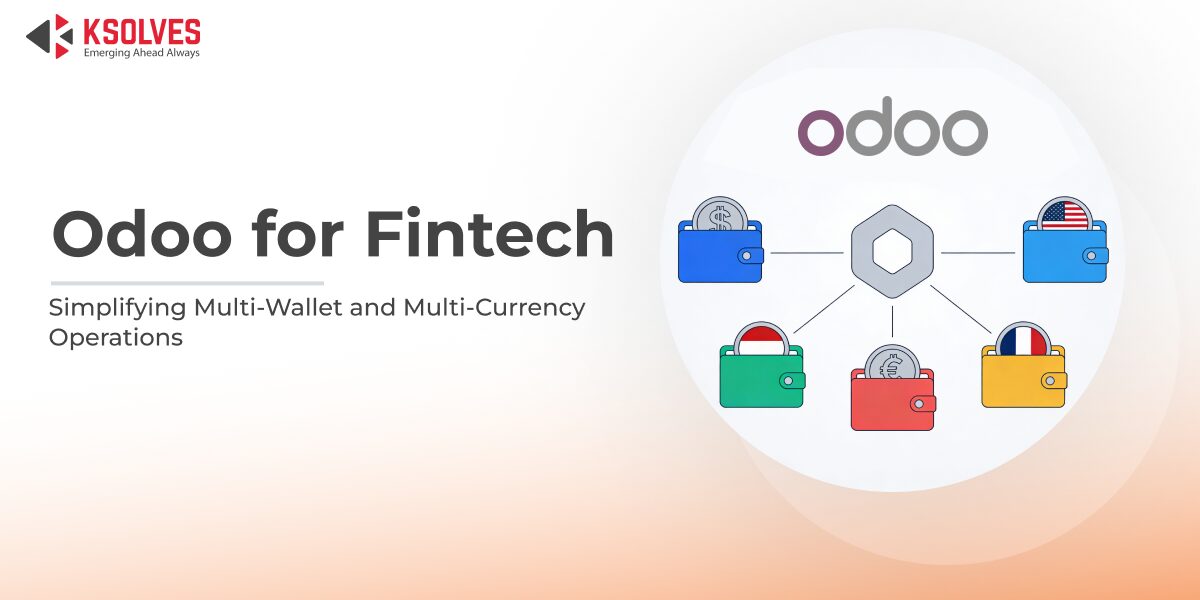
Managing money is no longer just about transactions; it’s about orchestrating thousands of wallet movements across currencies, regions, and regulations in real time. For fintech companies, every customer wallet, merchant settlement, and cross-border payment adds another layer of financial complexity. What starts as a fast, digital experience on the front end often turns into fragmented accounting, manual reconciliations, and limited financial visibility on the back end.
As fintech platforms scale globally, the challenge is no longer innovation, but it’s control, accuracy, and compliance at scale. This is where the Odoo ERP system becomes essential. Odoo does not replace payment engines or core banking platforms; instead, it provides the structured financial foundation needed to manage multi-wallet and multi-currency operations with confidence.
In this blog, we will explore how Odoo ERP for fintech companies simplifies multi-wallet and multi-currency management by centralizing financial data, automating currency handling, and bringing clarity to complex wallet-based operations.
Why Fintech Finance Becomes Complex at Scale
In the early stages, many fintech platforms operate with a patchwork of systems, such as one for wallets, another for accounting, separate tools for currency conversion, and manual processes for reconciliation.
This setup may work initially, but as transaction volumes increase and operations expand across regions, financial complexity grows exponentially.
Over time, this fragmented approach results in:
- Wallet balances that don’t align in real time.
- Manual and error-prone currency conversions.
- Slower financial closes and delayed reporting.
- Reconciliation gaps between wallets, banks, and payment gateways.
- Higher exposure to regulatory and compliance risks.
Without a centralized financial system, finance teams lose real-time visibility and are forced to spend more time validating numbers than analyzing them. Simple yet critical questions become difficult to answer:
- What is the actual wallet liability across all users right now?
- How much foreign exchange gain or loss has been realized this period?
- Are wallet balances fully backed and reconciled with bank accounts?
As fintech companies scale, this lack of financial clarity can slow growth, increase risk, and erode operational confidence.
Understanding Multi-Wallet and Multi-Currency Operations in Fintech
Modern fintech platforms operate on a complex financial foundation where multiple wallets and multiple currencies coexist simultaneously. These platforms typically manage:
- Customer wallets that hold user funds.
- Merchant wallets used for settlements and payouts.
- Escrow or holding wallets for regulated fund movement.
- Internal operational wallets for platform-level transactions.
Each wallet represents either a financial liability or an asset and must be accurately tracked, reported, and reconciled. Even minor inconsistencies can trigger operational inefficiencies, regulatory concerns, or loss of customer trust.
At the same time, fintech companies rarely operate in a single currency. Transactions may be initiated in one currency, settled in another, and reported in the company’s base currency. With exchange rates constantly fluctuating, foreign exchange differences directly affect revenue recognition and profitability.
When wallet and currency management are handled through disconnected or manual processes, financial data quickly becomes unreliable. Odoo does not replace wallet or payment systems. Instead, it provides a structured financial layer that brings multi-wallet and multi-currency operations into a unified accounting and reporting framework, designed specifically to support globally operating fintech businesses.
Common Pain Points Without a Unified System
When multi-wallet and multi-currency operations are managed across disconnected systems, fintech finance teams quickly feel the strain. Each wallet type and currency adds another layer of complexity, without a centralized framework to tie everything together.
As a result, teams often face:
- Fragmented wallet visibility, where customer, merchant, and internal wallet balances live in separate systems.
- Manual accounting for wallet movements and currency conversions, increasing the risk of inconsistencies.
- Lengthy and complex month-end reconciliations, especially when matching wallet balances with banks and payment gateways.
- Limited audit trails across wallets and currencies, making transaction-level traceability difficult.
- Heavy reliance on spreadsheets to bridge data gaps and validate numbers.
As transaction volumes and geographic reach grow, these challenges compound. Finance teams spend more time reconciling and validating wallet and currency data than generating insights, slowing financial closes and increasing operational and compliance risk.
How Odoo ERP for Fintech Companies Centralizes Financial Operations
As fintech platforms grow, managing wallets, currencies, accounting, and reconciliation across separate tools becomes inefficient and risky. Odoo addresses this by bringing all financial activities into one integrated system, creating a single source of truth for finance teams.
1. Centralized Wallet Representation
Odoo allows fintech companies to represent different wallet types within a structured accounting framework.
Wallets can be modeled using:
- Dedicated accounts for each wallet type (customer, merchant, escrow, internal).
- Separate journals to record wallet movements.
- Analytic accounting to track wallets by region, product, or business line.
This structure ensures:
- A unified view of all wallet balances.
- Clear separation between wallet types.
- Real-time visibility into wallet liabilities and assets.
2. Managing Multiple Wallets with Control
With wallets centrally managed in Odoo, finance teams can:
- Track wallet inflows and outflows in real time.
- Maintain separate ledgers for each wallet.
- Apply role-based access controls to restrict sensitive operations.
- Ensure every wallet movement is financially recorded.
Each transaction is captured through proper accounting entries, creating transparency and full traceability across wallet operations.
3. Built-In Multi-Currency Handling
Odoo’s multi-currency capabilities are part of its core accounting engine, making it suitable for fintech companies operating across regions.
3.1 Exchange Rate Management
- Supports multiple currencies simultaneously.
- Exchange rates can be updated automatically or manually.
- Transactions are recorded in both foreign currency and base currency.
3.2 Accurate FX Accounting
- Automatically calculates realized and unrealized FX differences.
- Post FX gains and losses to dedicated accounts.
- Keeps financial reports consistent and audit-ready.
4. Automated Accounting and Reconciliation
Odoo automates the financial impact of wallet transactions.
4.1 Real-Time Accounting
Every wallet transaction can automatically generate:
- Journal entries
- Ledger updates
- Currency conversions
This eliminates manual posting and reduces accounting errors.
4.2 Faster Reconciliation
Odoo supports:
- Bank reconciliation workflows.
- Matching wallet balances with bank and payment gateway data.
- Faster month-end and period closures.
This gives finance teams confidence that wallet balances are accurate, reconciled, and backed by actual funds.
What Fintech Companies Gain with Odoo
When Odoo acts as the financial backbone, fintech companies move from reactive financial management to controlled, insight-driven operations. Instead of chasing numbers across systems, finance teams gain clarity and confidence.
Key benefits include:
- Complete financial visibility across all wallets and currencies from a single platform, enabling faster and more informed decision-making.
- Accurate, real-time financial reporting, with wallet balances, FX impacts, and liabilities always up to date.
- Lower operational effort and costs by automating accounting, currency handling, and reconciliation processes.
- Stronger audit and compliance readiness, supported by clear transaction trails and standardized financial controls.
- Scalable financial operations that support new wallets, currencies, regions, and entities without reworking existing systems.
Together, these gains allow fintech companies to scale globally while maintaining financial accuracy, control, and regulatory confidence.
How Ksolves Helps Fintech Companies Master Multi-Currency and Multi-Wallet Operations in Odoo
Scaling fintech operations across wallets, currencies, and regions is complex, but it doesn’t have to be. At Ksolves, a trusted Odoo Gold Partner and Odoo Implementation Partner, we specialize in helping fintech companies leverage Odoo to simplify and automate these financial processes, turning complexity into clarity.
Here’s how we make it happen:
- Tailored Wallet Management: We design and configure Odoo to represent every wallet type, such as customer, merchant, escrow, and internal. So your finance team can track balances in real time with complete accuracy.
- Seamless Multi-Currency Handling: From automated exchange rate updates to FX gain/loss calculations, we set up Odoo to handle cross-border transactions effortlessly, ensuring your financial reports are always accurate and audit-ready.
- Automated Accounting & Reconciliation: Our Odoo developers implement workflows that automatically post wallet transactions, generate journals, and reconcile balances with banks and payment gateways. This reduces errors and frees your team to focus on strategic growth.
- Scalable & Compliant Solutions: Whether you’re expanding to new regions, adding new wallets, or introducing additional currencies, our solutions ensure your Odoo environment grows seamlessly while remaining fully compliant with local and international regulations.
With Ksolves, fintech companies don’t just manage wallets and currencies; they gain a strategic financial backbone that supports growth, improves visibility, and minimizes risk.
Spotlight on Ksolves’ Dynamic Financial Report for Odoo
Accurate financial reporting becomes even more critical when fintech companies manage multiple wallets and currencies. To address this, Ksolves’ Dynamic Financial Report extends Odoo’s financial capabilities by delivering clear, structured, and real-time financial insights without complexity.
Designed for finance teams that need clarity at scale, Dynamic Financial Report offers a comprehensive suite of reports that present a complete picture of business performance.
From tax reports and cash flow statements to balance sheets and profit & loss analysis, Dynamic Financial Report enables teams to quickly understand the financial impact of wallet movements and currency fluctuations.
What sets Dynamic Financial Report apart is its simplicity and visual clarity. Finance leaders can easily filter, drill down, and analyze data across entities, wallets, and currencies, making it easier to track liabilities, monitor FX impacts, and ensure accurate reporting.
Final Words
Managing multi-wallet and multi-currency operations is a critical challenge for growing fintech companies, and getting it right requires more than just technology. It demands deep domain understanding, a scalable ERP foundation, and the right implementation partner.
At Ksolves, we help fintech companies turn Odoo into a powerful financial backbone tailored to their unique wallet-based and cross-border operations. From designing structured multi-wallet accounting frameworks to enabling accurate multi-currency reporting and reconciliation, our Odoo experts ensure financial operations remain transparent, compliant, and scalable.
For fintech companies looking to scale with confidence, Ksolves is the partner that bridges innovation with financial control.
































AUTHOR
Odoo
Share with