CRM Software for Travel Industry
Summary
Explore how specialized Travel CRM transforms agencies and tour operators with better personalization, automation, and ROI. Compare top solutions, learn implementation best practices, and see how Ksolves delivers custom Salesforce CRM tailored for travel success.
Introduction
The travel industry is experiencing robust growth in 2025, fueled by post-pandemic recovery, rising disposable incomes, and a surge in demand for experiential journeys. According to the latest UN Tourism World Tourism Barometer, international tourist arrivals grew 5% in the first nine months of 2025 compared to 2024, surpassing 1.1 billion travelers and exceeding pre-pandemic levels in many regions.
Digital tools are transforming operations, enabling travel agencies and tour operators to deliver seamless, multi-channel experiences amid intense competition.
In this landscape, specialized travel CRM software has become indispensable for agencies and operators. Unlike generic systems, it offers tailored features like itinerary builders, booking integrations, and automated personalization to manage seasonal demands and build lasting customer relationships.
This guide explores how implementing the right travel agency CRM can help businesses maximize efficiency, enhance customer satisfaction, and drive superior ROI through data-driven insights and streamlined processes.
Challenges Faced by Travel Businesses Without a Dedicated CRM
Travel agencies and tour operators often struggle with fragmented operations when relying on emails, spreadsheets, and disconnected tools. Common pain points include:
- Scattered customer data across multiple platforms, leading to incomplete profiles and duplicated efforts
- Manual processes for quotations, bookings, and follow-ups that waste time and invite errors
- Missed leads due to a lack of tracking
- Slow follow-ups in a high-volume inquiry environment
These problems get worse with messy bookings, few options for personalizing trips, weak teamwork due to isolated information, and trouble handling busy and slow seasons.
In the end, these issues cause big problems: less revenue from missed sales, fewer repeat customers because of inconsistent service, and lower efficiency with higher costs and harder growth in a tough market.
What is Travel CRM Software?
Travel CRM software is a specialized customer relationship management system built for travel agencies, tour operators, and tourism businesses. It differs from generic CRM platforms by including industry-specific tools such as itinerary builders, booking integrations with Global Distribution Systems (GDS), quotation generators, and supplier management. These features help handle complex trips, seasonal demands, and inquiries from multiple channels.
At its core, travel agency CRM centralizes customer data to provide a complete view, automates workflows like follow-ups and payments, and connects with travel tools such as APIs for flights, hotels, and tours. It operates through essential processes:
- Capturing leads from websites, emails, or social media
- Creating and managing itineraries with custom quotes and bookings
- Tracking interactions for tailored recommendations
- Offering post-travel support with feedback and loyalty features
This setup streamlines operations and improves customer experiences from first contact to future trips.
Key Features of Effective Travel CRM Software
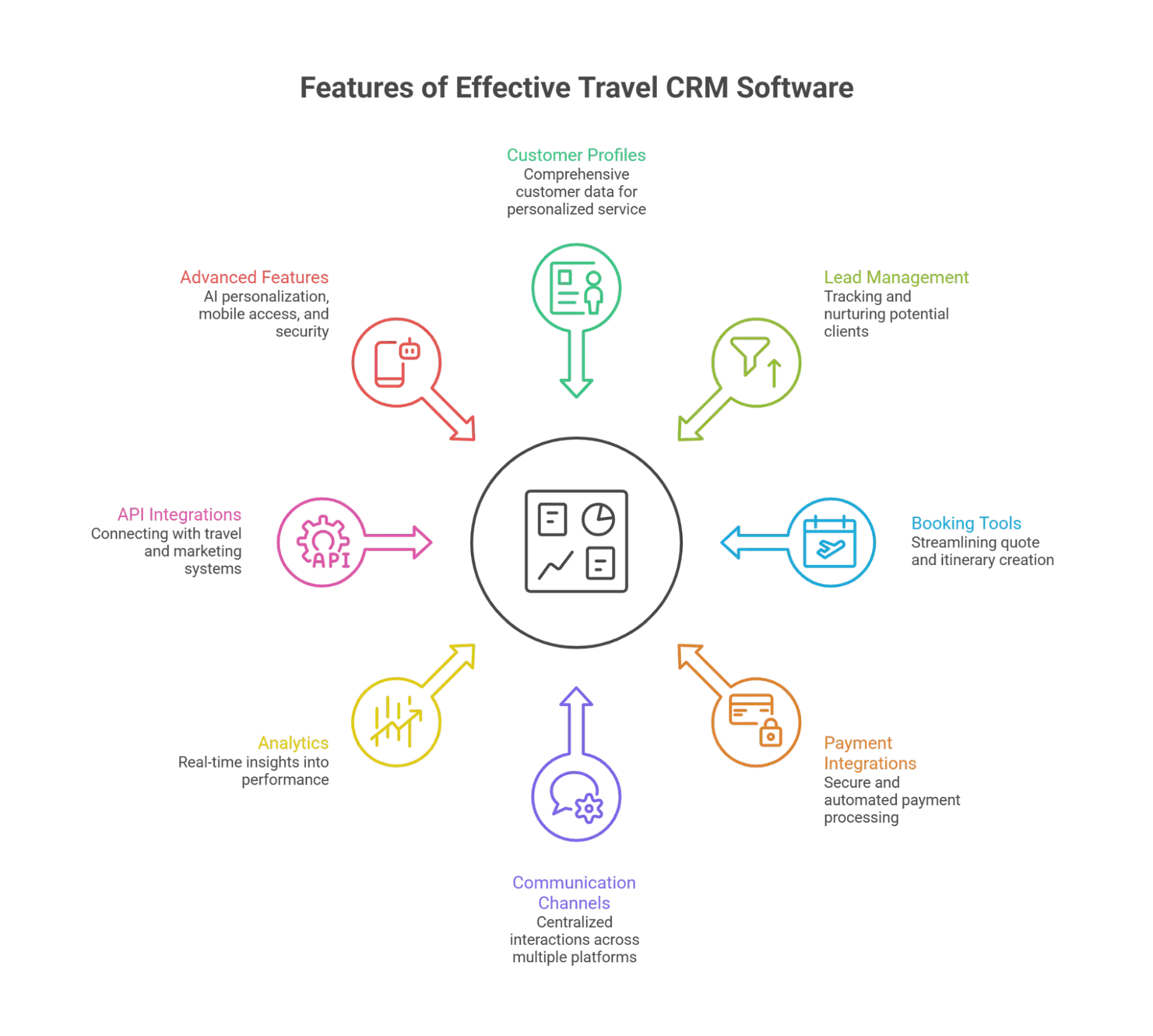
An effective travel CRM is equipped with essential modules tailored to the unique demands of travel agencies and tour operators. These features streamline customer management, accelerate sales, and enhance operational efficiency.
-
Customer Profiles, Segmentation, and 360-degree Views
This allows you to build comprehensive profiles capturing travel history, preferences, family details, budgets, and all past interactions. Segmentation by demographics, behavior, or travel type enables targeted campaigns, while a unified 360-degree view ensures every team member sees the full customer journey.
-
Lead Management and Automated Follow-ups
Capture leads from various sources, track them through customizable sales pipelines (e.g., inquiry → quote → booking → closed), assign tasks automatically, and set up drip campaigns or reminders to nurture prospects and prevent leads from going cold.
-
Booking, Quotation, and Itinerary Builders
Generate professional, branded quotes in minutes, build detailed, customizable itineraries with day-by-day plans, inclusions/exclusions, and visuals, then convert them directly into bookings with real-time availability checks.
-
Payment and Reservation Integrations
Securely link with popular payment gateways, like Stripe or PayPal, for partial/full payments, invoices, and refunds, while integrating reservations with suppliers to automate confirmations and reduce manual entry errors.
-
Multi-channel Communication
Centralize interactions across email, SMS, WhatsApp, social media, and phone from one platform, with templates for quick responses and conversation history tied to customer records for seamless handoffs.
-
Analytics, Reporting, and Feedback Tools
Access customizable dashboards for real-time insights into sales performance, conversion rates, revenue forecasts, and agent productivity, plus automated post-trip surveys to measure satisfaction and gather reviews.
-
Integrations with Travel APIs and Marketing Platforms
Connect effortlessly to systems like Amadeus, Sabre, or Galileo for live inventory, as well as booking engines, email marketing tools like Mailchimp, and accounting software for end-to-end automation.
-
Other Advanced Features
– AI-driven Personalization: Analyzes customer past data, preferences, and behavior to automatically suggest tailored travel packages, relevant add-ons, and upsell opportunities.
– Mobile Access: Offers full CRM functionality through dedicated mobile apps or responsive interfaces, allowing teams to manage leads, bookings, communications, and tasks from anywhere.
– Robust Security Compliance: Adheres to standards like GDPR and PCI-DSS, with features such as data encryption, role-based access controls, secure payment handling, and detailed audit logs to protect sensitive information.
Benefits of Implementing Travel CRM
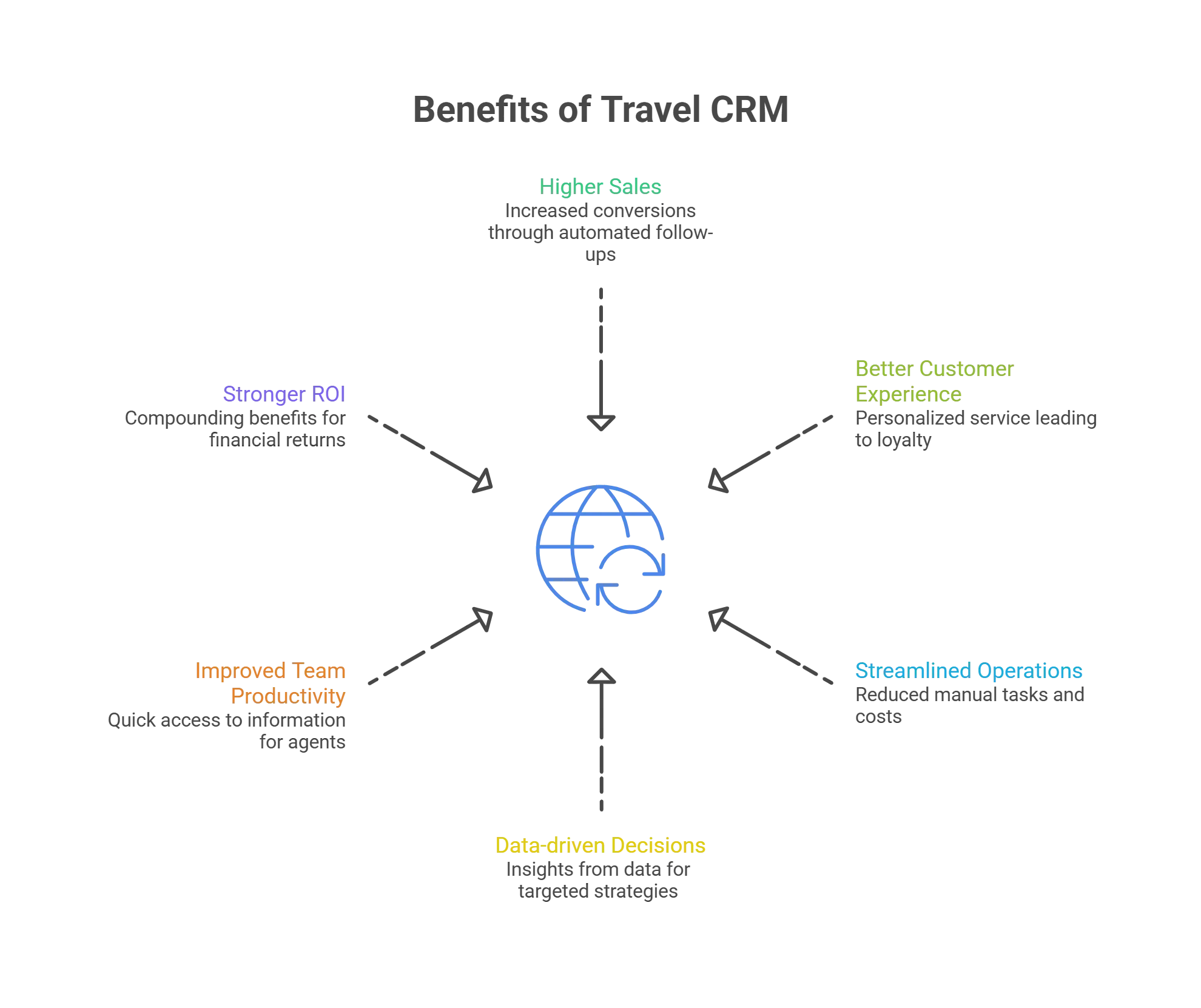
Implementing a dedicated Travel CRM delivers powerful advantages that directly address the challenges faced by travel agencies and tour operators. From increasing revenue to building stronger customer relationships, the benefits transform how businesses operate and grow in a competitive market.
-
Higher Sales and Conversions
A mid-sized agency using automated follow-ups might send personalized quotes within hours of an inquiry (instead of days), turning a casual website visitor interested in a hotel into a confirmed booking with add-ons like private tours and spa packages, resulting in 20-30% higher conversion rates.
-
Better Customer Experience and Loyalty
With a full history of past trips, the system can greet a returning family with suggestions like “Last year you loved beach resorts in Thailand. Here’s a similar option in Phuket with kids’ club upgrades,” leading to higher satisfaction, more repeat bookings, and customers who actively refer friends.
-
Streamlined Operations and Lower Costs
Instead of agents manually copying details across spreadsheets and emails to create itineraries, the CRM auto-generates branded quotes and itineraries in minutes. This reduces preparation time by half and lowers errors that previously led to costly re-bookings or refunds.
-
Data-driven Decisions
Dashboards might reveal that adventure tours to New Zealand spike in bookings from Australian clients aged 25-35 during winter. This allowed the agency to run targeted Facebook ads and negotiate better supplier rates in advance, maximizing margins on high-demand packages.
-
Improved Team Productivity
When a customer calls, any agent can instantly see the full conversation history, including WhatsApp chats from another colleague and notes from a recent quote, enabling quick, informed responses without frustrating “let me check with someone else” delays, even in multi-branch or remote teams.
-
Stronger ROI
Over time, these improvements compound. Higher conversions fill more seats, personalized experiences encourage customers to return year after year (substantially increasing lifetime value per client), and efficient operations keep overhead low, often delivering measurable returns within the first year of implementation.
Custom vs. Off-the-Shelf Travel CRM Solutions
Travel businesses must decide between off-the-shelf (ready-made) CRM solutions and custom-developed systems. The best choice depends on your agency’s size, workflows, budget, and growth goals. Below is a comparison to help evaluate both options.
| Aspect | Off-the-Shelf Solutions (e.g., Zoho CRM, Salesforce adaptations, HubSpot) | Custom Travel CRM Development |
| Implementation Time | Fast – weeks to get started | Longer – several months for full development |
| Initial Cost | Lower upfront (subscription-based) | Higher initial investment |
| Ongoing Costs | Recurring subscription fees + potential add-ons | Typically lower long-term (one-time development + maintenance) |
| Flexibility & Fit | Limited to available features; often requires workarounds for travel-specific needs | Fully tailored to your exact workflows, itineraries, and processes |
| Travel-Specific Features | Basic adaptations are possible, but complex tools (e.g., advanced itinerary builders, GDS integrations) may need extra plugins | Built-in support for quotations, multi-supplier bookings, custom portals, and niche requirements |
| Scalability | Good for small to mid-sized agencies; can hit limits as complexity grows | Excellent – grows seamlessly with your business volume and needs |
| Integrations | Relies on pre-built connectors; may not cover all travel APIs or legacy systems | Native, seamless integrations with any required tools (GDS, booking engines, accounting, etc.) |
| Updates & Support | Regular vendor updates and community support | You control updates; requires in-house or partner maintenance |
| Ownership & Control | Vendor-dependent; limited data/export control | Full ownership of code, data, and features |
| Best For | Small agencies or startups with standard needs and a limited budget | Mid to large agencies with unique processes, high volume, or plans for rapid growth |
Top Travel CRM Solutions in 2025
Below is a curated list of some of the most popular travel CRM options in 2025, based on user adoption, reviews, and industry recognition. This focuses on widely used general CRMs adapted for travel, along with a few dedicated tools known for strong travel workflows.
| CRM Solution | Best For | Key Travel Features | Pros | Cons |
| Salesforce | Large agencies needing scalability | AI personalization (Einstein), GDS integrations, advanced analytics, custom pipelines | Highly customizable, powerful AI, extensive integrations | Expensive, steep learning curve |
| HubSpot CRM | Small to mid-sized agencies, marketing-focused | Lead capture, email automation, pipeline tracking, and easy booking tool integrations | User-friendly, free starter plan, strong marketing tools | Needs add-ons for deep travel features |
| Zoho CRM | Budget-conscious agencies | Customizable pipelines, multi-channel communication, automation, and a mobile app | Affordable, versatile customizations | Can require setup for travel-specific flows |
| Pipedrive | Sales-driven agencies | Visual pipelines, automated follow-ups, deal tracking, and email integration | Intuitive for conversions, activity reminders | Limited native itinerary building |
| NetHunt CRM | Gmail-integrated agencies | Pipeline management, automation, multi-channel tracking, embedded in Gmail | Seamless Google Workspace integration | Less focused on complex bookings |
| monday CRM | Agencies needing flexible workflows | Custom boards for leads/bookings, AI automation, and team collaboration | Highly visual and customizable | More general-purpose than travel-specific |
| Creatio | Agencies wanting no-code customization | Workflow automation, AI insights, no-code platform for travel processes | No-code flexibility, strong automation | Higher cost for full features |
When evaluating these, consider your agency’s size, niche (e.g., luxury vs. adventure), and integration needs. Many offer free trials. Test how well they handle real travel scenarios like quotation speed and personalization.
For agencies with highly unique requirements, these can serve as a strong foundation before considering custom enhancements.
How to Implement the Right Travel CRM
Successful implementation requires careful planning to minimize disruption and maximize adoption.
-
Planning and Needs Assessment
Form a project team and map your current processes (lead capture → quotation → booking → post-travel). Identify pain points and define clear goals, like reducing quote time by 50% or increasing repeat bookings by 30%. Create a requirements checklist and timeline.
-
Data Migration and Setup
Clean and organize existing data, like contacts, bookings, and histories, before migration. Use built-in import tools or vendor-assisted services to transfer data accurately. Configure pipelines, custom fields, integrations (GDS, payment gateways, and marketing tools), and user roles during setup.
-
Team Training and Change Management
Provide hands-on training sessions tailored to different roles (e.g., agents vs. managers). Share quick-reference guides and video tutorials. Communicate benefits clearly to gain buy-in and address resistance by highlighting how the CRM reduces manual work.
-
Testing, Launch, and Optimization
Run a pilot with a small team or subset of data to identify issues. Test critical workflows end-to-end. Launch in phases if needed, such as starting with the sales team first and then moving to operations. After go-live, monitor usage, gather feedback, and optimize configurations based on real performance data.
How Ksolves Can Help with CRM Software Development & Implementation
As a leading Salesforce partner with deep expertise in CRM development and implementations, Ksolves specializes in tailoring solutions for the travel industry. We help agencies leverage platforms like Salesforce to build powerful, customized travel CRMs that go beyond off-the-shelf limitations.
Our services include:
- Custom CRM Development & Implementation: Building or enhancing Salesforce-based systems with travel-specific modules like advanced itinerary builders, GDS integrations, quotation automation, and supplier management.
- Migration & Integration: Seamless data migration from existing tools and integrations with booking engines, payment gateways, marketing platforms, and APIs.
- AI & Personalization: Implementing Salesforce Einstein for predictive recommendations, upsell opportunities, and hyper-personalized customer experiences.
- Training & Support: Comprehensive team training, ongoing optimization, and dedicated support to ensure maximum adoption and ROI.
- Scalable Solutions: From startups to enterprise-level operators, we design systems that grow with your business.
With years of experience delivering Salesforce solutions for travel clients, Ksolves ensures your CRM aligns perfectly with your workflows, driving higher conversions, loyalty, and efficiency. Contact us for a free consultation or demo to explore how we can transform your travel operations.
Conclusion
The travel industry demands personalization and seamless experiences more than ever. A dedicated travel CRM is essential for agencies and tour operators to remain competitive. It centralizes scattered data, automates repetitive tasks, enables hyper-personalized recommendations, and supports data-driven growth strategies. The right travel CRM empowers businesses to boost sales, enhance loyalty, streamline operations, and achieve sustainable profitability.
Whether you opt for an off-the-shelf solution for quick wins or custom development for a perfect fit, alignment with your unique needs and goals is key. Proper selection, thoughtful implementation, and ongoing optimization turn travel CRM into a powerful engine for long-term success.
Partnering with an experienced provider like Ksolves can accelerate this transformation. We deliver tailored Salesforce-based solutions that unlock maximum value. For more details, contact our experts at [email protected].
FAQs
1. What is the difference between a generic CRM and a travel CRM?
Generic CRMs focus on broad sales and contact management. Travel CRMs include specialized tools like itinerary builders, GDS integrations, quotation generators, supplier management, and travel-specific workflows.
2. How long does it take to implement a Travel CRM?
Off-the-shelf solutions can be live in weeks to 2-3 months. Custom travel CRMs typically take 4-9 months from planning to full launch, depending on complexity and integrations.
3. Can I integrate a travel CRM with my existing booking engines or GDS?
Yes. Most modern CRMs support integrations with payment gateways (Stripe, PayPal), marketing tools (Mailchimp), and accounting software. Custom solutions offer the deepest, most seamless connections.
4. Will my team resist adopting a new CRM?
Change resistance is common but manageable. Involve team members early, provide hands-on training, highlight time-saving benefits, and appoint internal champions to drive adoption.
5. How can Ksolves help with my travel CRM needs?
Ksolves is a trusted Salesforce partner specializing in custom CRM development, implementation, migration, AI integration, training, and ongoing support for the travel sector. Reach out to our sales team at [email protected] for a free consultation or personalized demo.