



From Idea to Prototype: Rapid GenAI Development Strategies from Ksolves
AI
5 MIN READ
December 5, 2025


The demand for Generative AI (GenAI) is soaring, redefining how enterprises innovate, automate, and scale operations. But while every organization wants to embrace AI, the journey from an initial concept to a tangible product can be lengthy and uncertain. This is where rapid GenAI prototyping emerges as a game-changer. It enables enterprises to turn AI ideas into working prototypes within days, test feasibility, measure ROI, and validate outcomes before full-scale deployment.
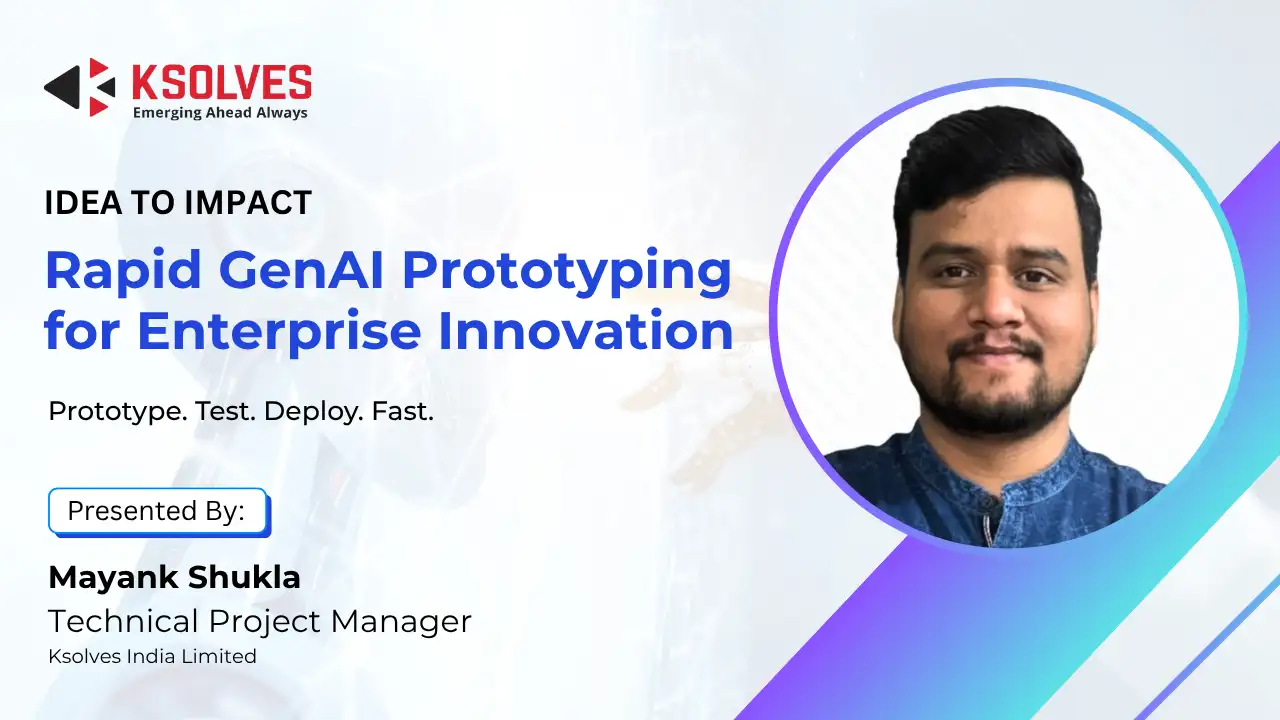
As Mayank, Technical Project Manager at Ksolves, described during a recent webinar, rapid prototyping isn’t about cutting corners; it’s about combining speed with strategic clarity. Drawing on his insights and Ksolves experience in delivering GenAI development services, this blog explores a playbook for quickly and effectively turning AI initiatives from whiteboard sketches into production-ready prototypes.
Why Speed Matters in GenAI Prototyping
In the rapidly evolving landscape of GenAI, speed is synonymous with competitive advantage. Enterprises that can experiment, iterate, and deploy faster than others can unlock innovation cycles in record time. According to a study as described in the webinar, by 2028, nearly one-third of all enterprise software will integrate agentic AI capabilities, a strong signal that GenAI adoption is accelerating across industries.
However, as Mayank emphasized, speed must always be guided by precision and purpose. The first step in any GenAI initiative is to define clear and measurable objectives. Instead of generic goals like “enhance efficiency,” set specific, ROI-focused targets such as:
- Reduce customer support response time by 30% within two weeks
- Automate 60% of internal reporting processes within one month
Rapid prototyping enables early stakeholder validation, ensuring alignment before making major investments. This agile approach minimizes risk, trims months of development cycles, and ensures every iteration moves closer to measurable business value.
Building Blocks of Rapid GenAI Development: The Gen Stack
As Mayank described, “While creating the prototype, it is not like reinventing the wheel again; it is most likely the Lego bricks; you just need to rearrange as per your need.” This analogy perfectly captures the modular and composable nature of Ksolves Gen Stack, a foundational framework that accelerates GenAI prototyping and scales seamlessly across projects.
Here are the five key building blocks:
- Orchestrators (LangChain, LangGraph): These frameworks manage the conversation flow and logic across AI agents, allowing developers to structure and control multi-step tasks with ease.
- LLM APIs (GPT-4, Claude 3, etc.): The foundation of any GenAI solution, large language models (LLMs) provide reasoning and generative capabilities. Ksolves advocates keeping them swappable to avoid vendor lock-in and ensure optimal model selection for accuracy, speed, or cost-efficiency.
- Vector Stores (e.g., Cassandra): These systems store and retrieve embeddings to support context-aware, data-driven responses. They bridge structured knowledge with generative models, improving response accuracy and relevance.
- Observability Tools: Monitoring system behavior is critical. Observability helps trace performance issues, debug model behavior, and estimate long-term LLM costs, which is vital for scaling sustainably.
- Guardrails: Responsible AI is non-negotiable. Guardrails filter outputs for profanity, bias, or unsafe content, ensuring professional, brand-consistent interactions every time.
This modular Gen Stack is the secret behind Ksolves ability to build working GenAI prototypes in days, not quarters, enabling clients to see immediate business impact.
Architectural Patterns for GenAI Prototyping
Every successful GenAI project begins with the right architectural pattern. According to Mayank, “There are two major patterns: Retrieval-Augmented Generation (RAG) and Agentic AI.” Both offer distinct pathways for solving complex business challenges.
1. Retrieval-Augmented Generation (RAG)
RAG combines LLM reasoning with real-time retrieval from knowledge sources, ensuring fact-based, contextually relevant outputs. This pattern is ideal for scenarios where accuracy and traceability are critical, such as HR chatbots, internal documentation assistants, or compliance advisors. For instance, an HR GenAI assistant can fetch company policies dynamically and respond with cited references, offering trustworthy answers to employee queries without retraining the entire model.
2. Agentic AI Workflows
In contrast, agentic workflows enable multiple autonomous agents to collaborate on tasks. Each agent specializes in a role, creating a network of intelligent “micro-workers.” For example, in a recruitment workflow, one agent might conduct initial candidate screening, while another schedules interviews for shortlisted candidates. Tools like LangGraph allow developers to design, pause, and resume such workflows with human oversight, ensuring agility and control.
These patterns help organizations choose the right approach for their GenAI goals while balancing structure with adaptability to enable faster decision-making.
Agile Deployment Models: Speed with Flexibility
Speedy prototyping demands equally agile deployment. As Mayank pointed out in his webinar, Ksolves relies on flexible deployment models tailored to enterprise requirements. Here are the three most effective strategies:
- Cloud APIs: Providers like Azure, AWS, and OpenAI offer API access to LLMs, eliminating the need for complex infrastructure. This is ideal for quick proofs-of-concept (POCs) and iterative MVP development.
- Open-Source Setup: When data privacy or on-premise control is essential, tools like Ollama or vLLM offer customizable, self-hosted alternatives. These setups balance speed with compliance and data sovereignty.
- Hybrid Deployment: The most versatile approach, hybrid setups combine cloud scalability with on-premise security. Teams can prototype in the cloud for speed, then transition to local infrastructure for production.
By using these deployment models strategically, Ksolves ensures each prototype evolves efficiently into a production-ready GenAI system with minimal friction.
Leveraging AI-Powered Development Tools
Ksolves integrates AI-assisted development environments to shorten build times and increase productivity. The two most impactful accelerators are:
- AI-Driven Coding Tools: By using AI-powered code assistants, developers can translate natural language prompts into executable code, drastically reducing manual development time. This accelerates both backend logic creation and API integration.
- Low-Code/No-Code Platforms: Frameworks like Streamlit and Gradio enable quick visualization of AI models without heavy front-end development. As Mayank highlighted, this approach empowers even non-developers to contribute, bridging the gap between technical and business teams.
These tools align perfectly with Ksolves agile philosophy OF building fast, validating early, and refining continuously.
Continuous Evaluation and Feedback Loops
Rapid prototyping without evaluation can lead to misdirection. That’s why Ksolves embeds continuous feedback mechanisms and measurable validation at every stage.
Key tools in this phase include:
- Ragas for accuracy and performance measurement.
- LangSmith for interpretability and debugging insights.
Weekly stakeholder demos and micro-feedback sessions ensure that every iteration incorporates actionable improvements. This “build-measure-learn” cycle keeps prototypes aligned with real-world expectations and evolving business priorities.
Moreover, each version is benchmarked against initial performance metrics, enabling teams to quantify ROI, a critical factor for enterprise adoption.
From Prototype to Production: Scaling Strategically
Transitioning from a prototype to a production-grade GenAI solution requires structure and governance, without slowing innovation. Ksolves facilitates this transformation through a Lean AI Center of Excellence (CoE) that maintains both quality and agility.
The CoE ensures:
- Standardized documentation and reusable templates for consistency.
- Governance frameworks to manage data security, compliance, and version control.
- Modular infrastructure to scale prototypes into full-fledged enterprise systems seamlessly.
By integrating best practices early, Ksolves minimizes rework and ensures that successful prototypes evolve into robust, maintainable GenAI applications ready for enterprise deployment.
The Ksolves Advantage: Turning Ideas into Impactful Prototypes
At Ksolves, rapid GenAI prototyping is built on a foundation of strategic clarity, technical precision, and agile execution. The company’s proven methodology, rooted in the practices described by Mayank, ensures that each prototype aligns with business goals and delivers measurable impact.
Key takeaways from Ksolves GenAI prototyping framework:
- Define ROI-driven goals at the outset.
- Build modular GenAI stacks for flexibility.
- Use RAG or agentic AI patterns for quick scaling.
- Choose a hybrid deployment for balanced agility.
- Implement observability, guardrails, and evaluation loops from day one.
This structured yet flexible framework allows enterprises to innovate at startup speed without compromising on security, quality, or compliance.
Conclusion
Rapid GenAI prototyping is revolutionizing how businesses approach innovation. It replaces long development cycles with short, agile iterations that deliver proof of value quickly. With the right strategy, modular architecture, and feedback-driven approach, organizations can unlock transformative results within weeks.
As showcased by Mayank and his team at Ksolves, the future of GenAI development lies in combining speed with precision, creativity with control, and prototypes with production-readiness.
If you’re ready to fast-track your AI initiatives, Ksolves Gen AI Development Services can help you design, prototype, and deploy enterprise-grade GenAI solutions that deliver measurable outcomes. From AI strategy consulting to model orchestration, observability, and deployment, Ksolves brings end-to-end expertise to transform your ideas into reality.
Let’s build the future, rapidly, intelligently, and strategically with Ksolves.































AUTHOR
AI
Mayank Shukla, a seasoned Technical Project Manager at Ksolves with 8+ years of experience, specializes in AI/ML and Generative AI technologies. With a robust foundation in software development, he leads innovative projects that redefine technology solutions, blending expertise in AI to create scalable, user-focused products.
Share with