



How ML Consulting Is Transforming Manufacturing Operations
AI
5 MIN READ
February 11, 2026

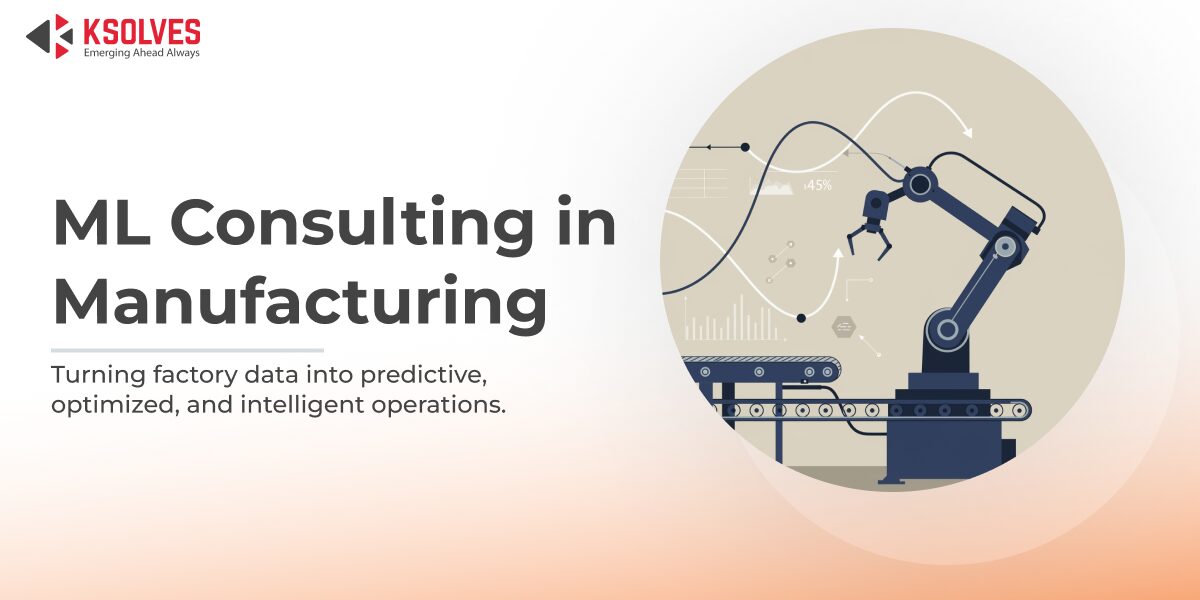
Manufacturing operations are no longer driven solely by automation and predefined rules. Today’s factories generate massive volumes of data from sensors, machines, quality systems, and enterprise platforms. Machine Learning (ML) enables manufacturers to convert this data into predictive and adaptive intelligence. Rather than reacting to failures or inefficiencies, manufacturers can now anticipate outcomes, optimize processes, and continuously improve performance.
Machine Learning consulting (ML consulting) plays a critical role in this shift by bridging the gap between raw industrial data and production-ready machine learning systems that operate reliably in real manufacturing environments. Hence, this blog will cover how ML consulting is transforming core manufacturing operations, the technical role of ML consultants in production environments, measurable business outcomes, and more.
Why Manufacturing Operations Are Turning to ML Consulting
Modern manufacturing environments are highly instrumented, yet most operational data remains underutilized. Time-series sensor data, machine logs, inspection images, and maintenance records are complex and difficult to analyze using traditional analytics. Manufacturing teams often lack the specialized expertise needed to design, train, deploy, and maintain ML models at scale.
ML consultants help manufacturers overcome these challenges by aligning machine learning solutions with operational constraints such as latency, explainability, and system integration. Their role extends beyond model development to include data engineering, deployment strategy, and lifecycle management.
Scholarly research supports this shift. A peer-reviewed study published on ScienceDirect reports that ML-driven predictive maintenance can increase equipment uptime by up to 20 percent while reducing maintenance costs by up to 25 percent in manufacturing environments.
Manufacturing Operations Transformed Through ML Consulting
-
Predictive Maintenance and Failure Forecasting
Predictive maintenance is one of the most mature and impactful ML applications in manufacturing. ML consultants design supervised learning models using historical failure data combined with real-time sensor inputs such as vibration, temperature, acoustic signals, and electrical current. These models detect early warning signs of component degradation, allowing maintenance teams to intervene before breakdowns occur. This approach minimizes unplanned downtime and extends asset life.
-
Intelligent Quality Control and Defect Detection
Quality inspection has shifted from manual sampling to ML-powered automation. Computer vision models trained on labeled defect images can detect surface flaws, dimensional deviations, and assembly errors in real time. Unsupervised learning techniques further identify anomalies in quality metrics that traditional thresholds fail to capture. ML consultants ensure these models integrate seamlessly with production lines and inspection hardware.
-
Demand Forecasting and Production Planning
Manufacturing demand is increasingly volatile due to market fluctuations and supply chain disruptions. ML consulting enables the use of advanced time-series forecasting models that account for seasonality, trend shifts, and external variables. These forecasts feed directly into production planning and inventory optimization systems, helping manufacturers balance capacity utilization with service levels.
-
Energy and Resource Optimization
Energy consumption is a significant cost driver in manufacturing. ML consultants apply regression models and reinforcement learning techniques to optimize energy usage across machines, shifts, and production batches. These models continuously learn optimal operating parameters, reducing waste while maintaining output quality.
Technical Responsibilities of ML Consultants in Manufacturing Environments
Deploying ML in manufacturing requires far more than training a model. ML consultants design robust data pipelines that collect and preprocess data from edge devices, SCADA systems, and enterprise platforms. Algorithm selection is guided by operational requirements such as inference speed, model interpretability, and compliance needs.
Deployment typically involves MLOps practices that support version control, automated retraining, and performance monitoring. Consultants also manage model drift caused by equipment aging, process changes, or new product variants. Security is another critical responsibility, especially when integrating ML systems across operational technology and IT environments.
Business Outcomes Enabled by ML Consulting
Manufacturers that adopt ML consulting achieve measurable operational improvements. Overall Equipment Effectiveness improves through reduced downtime and optimized throughput. Root cause analysis becomes faster and more accurate using ML-generated insights. Scrap rates and rework decline as quality deviations are detected earlier. At the enterprise level, leadership gains data-driven visibility into plant performance, enabling informed strategic decisions.
ML Consulting Expertise from Ksolves for Manufacturing Enterprises
Ksolves partners with manufacturing organizations to deliver production-grade ML solutions aligned with real operational goals. Our expertise spans predictive maintenance, quality intelligence, demand forecasting, process optimization, and more. We focus on building scalable and reliable ML systems that integrate with existing manufacturing infrastructure and deliver consistent business value.
Case Study: Turning Manufacturing Data into Predictive Operational Intelligence
Client Challenge: A manufacturing client faced frequent machine breakdowns and inconsistent product quality due to reactive maintenance practices and limited early fault visibility.
How Ksolves Helped: Ksolves developed predictive maintenance models using sensor telemetry and historical maintenance data. ML-based anomaly detection was implemented to identify early quality deviations. These models were integrated with existing manufacturing systems for real-time insights.
Impact:
- Reduced unplanned downtime
- Improved production stability
- Enabled proactive and data-driven maintenance planning
Read the full case here.
If you also have a manufacturing environment impacted by unplanned downtime, quality variability, limited operational visibility, or any other issue, connect with the ML experts at Ksolves to explore how machine learning can transform your operations.
Conclusion
Machine learning is no longer an experimental capability in manufacturing. When implemented correctly, it becomes a core operational system that drives predictive maintenance, quality consistency, and production efficiency.
ML consulting, on the other hand, ensures that models are not only accurate but also deployable, scalable, and aligned with real manufacturing constraints. By combining domain expertise with production-ready ML architectures, manufacturers can convert operational data into sustained performance improvements and long-term competitive advantage.
Connect with our experts at Ksolves today to explore how ML Consulting Services can optimize your manufacturing operations and deliver measurable business outcomes.

































AUTHOR
AI
Mayank Shukla, a seasoned Technical Project Manager at Ksolves with 8+ years of experience, specializes in AI/ML and Generative AI technologies. With a robust foundation in software development, he leads innovative projects that redefine technology solutions, blending expertise in AI to create scalable, user-focused products.
Share with