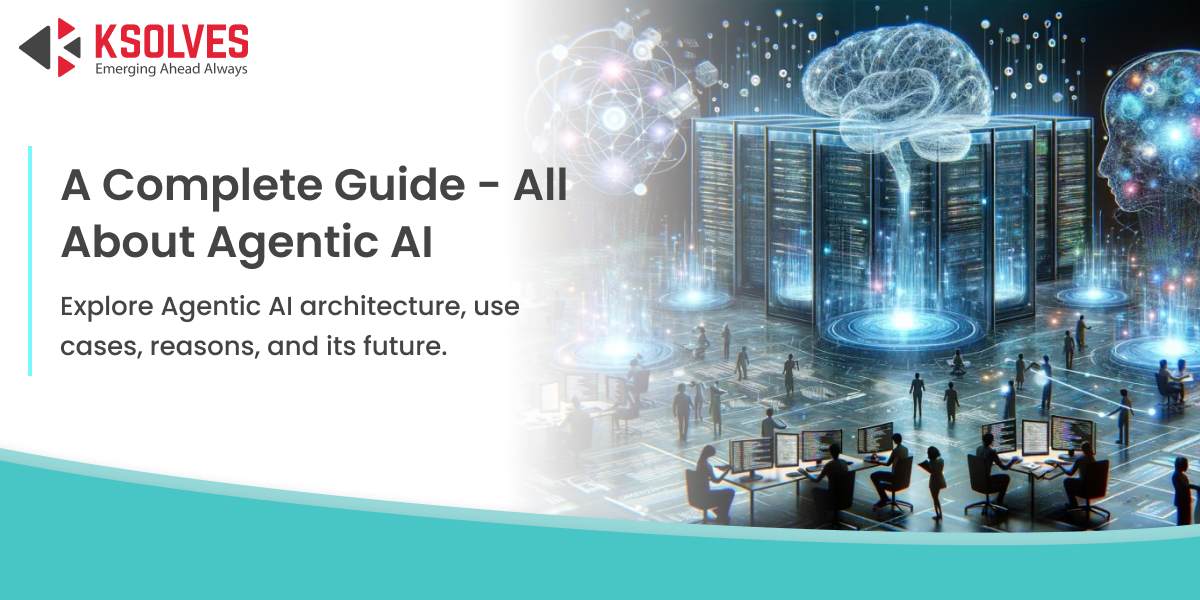
Agentic AI: Guide to Its Use Cases, Architecture, and Future
Read More


Agentic AI is the new frontier of enterprise automation. These systems do more than analyze data. They think with intent, decide with context, and act with autonomy.
Ksolves brings this intelligence to your business with Agentic AI Consulting Services using advanced agent frameworks built for real-world performance.
Agentic AI combines planning, memory, tool usage, multi-agent orchestration, and human oversight to deliver adaptive, goal-oriented execution across enterprise workflows.





 Contact Us
Contact Us
Contact Us
Contact Us
Contact Us
Contact Us
Contact Us
Contact Us
Contact Us
Contact Us
Contact Us
Contact Us
Contact Us
Contact Us
Contact Us
Contact Us
Contact Us


Agentic AI handles dynamic, multi-step reasoning, allowing enterprises to respond to changing conditions without manual intervention.

It also integrates across CRMs, ERPs, and external tools to execute tasks consistently and reliably at scale.

Agentic AI also reduces human dependency, speeds up processes, and improves task completion accuracy through autonomous action.

Unlike traditional rule-based automation, agentic AI continuously optimizes workflows, allowing enterprises to achieve goal-driven execution across departments.

Agentic AI ensures predictable, high-quality outcomes even in unpredictable data environments, helping organizations maintain operational continuity.

Unlike conventional AI, which only generates outputs or predictions, agentic AI plans, evaluates, and executes end-to-end workflows autonomously.
|
Agent Type
|
What It Does
|
Where it Fits Best
|
|---|---|---|
|
Reactive Agents
|
Detect conditions, match patterns, and trigger predefined actions with minimal latency.
|
Customer support routing, instant triage, alert handling.
|
|
Deliberative Agents
|
Maintain world models, simulate outcomes, evaluate constraints, and choose optimal strategies.
|
Supply chain decisioning, resource optimization, and strategic planning.
|
|
Collaborative Multi-Agent Intelligence
|
Multiple specialized agents negotiate, synchronize tasks, and collaborate using orchestrators like LangGraph and AutoGen.
|
Cross-department workflow coordination, sales–finance–logistics alignment.
|
|
Generative Agents
|
Break down goals, plan multi-step tasks, gather external data, and execute actions using LLMs and APIs.
|
Journey automation, itinerary planning, personalized recommendations.
|
|
Learning Agents
|
Improve autonomously using reinforcement learning by testing strategies and optimizing based on outcomes.
|
Dynamic pricing, retention tactics, risk scoring.
|
|
Hybrid Agents
|
Combine reactive speed, deliberative planning, generative creativity, and learning-based improvement in a unified architecture.
|
Complex multi-layer workflows need adaptability and precision.
|
|
Tool-Using / Action Agents
|
Execute tasks by calling APIs, updating CRMs/ERPs, triggering processes, querying databases, and interacting with enterprise systems.
|
Automated end-to-end workflow, CRM updates, data extraction, and multi-system actions.
|
|
Monitoring & Guardrail Agents
|
Observe agent behavior, enforce safety rules, detect off-policy actions, and maintain compliance across processes.
|
Regulated workflows, enterprise audit trails, AI safety and reliability systems.
|
|
Agentic AI Pattern
|
Core Concept
|
The Real-World Analogy
|
Best Business Impact
|
|---|---|---|---|
|
Reflection
|
Critique & Iterate: The agent reviews its own output for errors before delivery.
|
A writer proofreading and revising their own first draft.
|
99% Accuracy in automated reporting and legal document generation.
|
|
Tool Use
|
External Action: The agent uses APIs to interact with your existing software stack.
|
A human using a calculator or Google to find facts and solve math.
|
Seamless Integration with CRMs (Salesforce), ERPs, and Data Lakes.
|
|
Planning
|
Step-by-Step Breakdown: The agent maps out a complex goal into micro-steps.
|
A Project Manager creating a detailed Trello board or To-Do list.
|
Autonomous Execution of multi-week research or logistics projects.
|
|
Multi-Agent
|
Distributed Specialization: Multiple agents with distinct roles collaborate.
|
A cross-functional team (Dev, Design, and Product) is launching a feature.
|
Enterprise Scalability through our Multi-Agent Intelligence orchestration.
|
|
React
|
Think → Do → Observe: A loop of reasoning followed by action and observation.
|
A detective follows clues one by one to solve a complex case.
|
Dynamic Problem Solving for fraud detection and real-time troubleshooting.
|

GPT‑4o

Claude

Llama(Open Model)

LangChain

LangGraph

AutoGen

CrewAI

Semantic Kernel

Pinecone

Weaviate

Chroma / ChromaDB

Milvus

Redis

Docker

Kubernetes

Cloud / on-prem compute

Storage

Networking

Secrets Management

Prometheus

Grafana

OpenTelemetry

Weights & Biases (W&B)
LangChain Evaluator

Guardrails (OpenAI)

Human-in-the-loop (HITL) platforms

Revolutionizing patient care and operational efficiency through autonomous AI agents.

Enhancing security, compliance, and real-time decision-making in financial operations.

Driving personalized experiences and streamlined inventory management.

Optimizing production and minimizing downtime with predictive intelligence.

Enabling efficient routing and resilient supply chain oversight.

Advancing vehicle reliability and innovation through smart diagnostics.

Ensuring seamless network performance and rapid issue resolution.

Promoting sustainable and reliable energy distribution.

Personalizing learning journeys for better student outcomes.

Streamlining public services with secure and efficient automation.

Simplifying property evaluation and transaction workflows.

Accelerating content processing and metadata management.
Agentic AI is an autonomous AI system that can plan, decide, and take actions to achieve goals, adapting dynamically with minimal human intervention.
Agentic AI refers to an autonomous system capable of planning, reasoning, executing, and self-evaluating tasks. Whereas, AI agents are individual components of the system that perform specific roles such as planning, execution, or evaluation.
It uses LLMs, memory layers, tools, multi-agent orchestration, and action validators to complete tasks across enterprise systems autonomously.
Ksolves delivers production-grade agentic AI systems with autonomous reasoning, multi-step task execution, and enterprise tool integration. Our expertise in memory systems, skill orchestration, and safety guardrails positions us as one of the top agentic AI consulting services companies in 2025.
These are safety and policy controls that prevent agents from executing unsafe, unauthorized, or non-compliant actions.
Traditional automation follows predefined rules, whereas agentic AI dynamically adapts, thinks, reasons, evaluates, and autonomously executes actions.
Any domain that requires multi-step reasoning and automated decisions, such as finance, retail, healthcare, manufacturing, telecom, and logistics.
Yes, through API-based action layers, vector stores, and adaptive orchestration models.
Timelines depend on data availability, process complexity, and the required number of integration layers. Most projects begin with a rapid prototype, followed by skill integration, guardrail setup, and production deployment. Advanced setups involving Multi Agent Intelligence may take longer due to system-wide orchestration needs.