



Salesforce Trade Promotion Management Guide
Summary
Trade marketing promotions are essential for driving growth, but managing them effectively requires centralized data and real-time insights. Salesforce enables end-to-end Trade Promotion Management by unifying planning, execution, spend control, and performance analytics on a single platform. With AI-driven insights and scalable cloud capabilities, businesses can maximize promotion ROI and trade spend efficiency. Partnering with experts like Ksolves helps organizations implement and optimize Salesforce TPM for long-term success.
Introduction
Trade marketing promotions are incentives and activities that manufacturers offer to retailers, distributors, or wholesalers. These include discounts, displays, allowances, and cooperative funding to increase product visibility, drive sales volume, secure better shelf space, and build stronger channel loyalty.
In the consumer goods industry, managing trade promotions is essential for growth. Companies spend an estimated $500 billion globally each year on trade promotions. Yet, many struggle to achieve strong returns. Proper trade promotion management helps drive revenue, improve retailer partnerships, and optimize trade spend.
Without the right approach, common challenges arise. These include inefficient planning, poor in-store execution, inaccurate forecasting, and low ROI due to manual processes or fragmented data.
This is where modern trade promotion management software changes the game. Solutions like Salesforce trade promotion management in Consumer Goods Cloud provide unified planning, AI-driven insights, and automation. They transform outcomes by enabling better trade promotion optimization and retail promotion optimization.
This comprehensive guide covers the basics of trade marketing promotions, types with trade promotion examples, and the role of Salesforce in trade promotion management. Let’s dive right in!
Understanding Trade Marketing Promotions
Trade marketing promotions target the B2B side of the supply chain. Manufacturers and brands offer incentives to channel partners, such as retailers, distributors, and wholesalers, to encourage them to stock, display, and sell their products more aggressively. These promotions focus on pushing products through the distribution channel rather than pulling demand from end consumers.
In contrast, consumer promotions are B2C-focused. They include coupons, contests, samples, or buy-one-get-one offers aimed directly at shoppers to drive immediate purchases. While consumer promotions stimulate end-user demand, trade promotions build support from intermediaries to ensure products get prime placement and active selling effort.
Key Objectives of Trade Promotions
Effective trade marketing promotions serve multiple business goals:
- Increase sales velocity: Encourage retailers to order more and sell faster.
- Secure better shelf space: Gain prominent placement, end-caps, or featured displays.
- Clear inventory: Move excess or seasonal stock quickly.
- Build long-term retailer relationships: Foster loyalty and preferred partner status through consistent value.
Key Stakeholders Involved
The main players in managing trade promotions are:
- Manufacturers/Brands: Design, fund, and track promotions.
- Distributors/Wholesalers: Handle logistics and often pass incentives to retailers.
- Retailers: Execute in-store activities and report performance.
Successful trade promotion management requires alignment among these stakeholders. It helps by providing shared visibility and streamlined collaboration across the entire channel.
Common Types of Trade Promotions (with Examples)
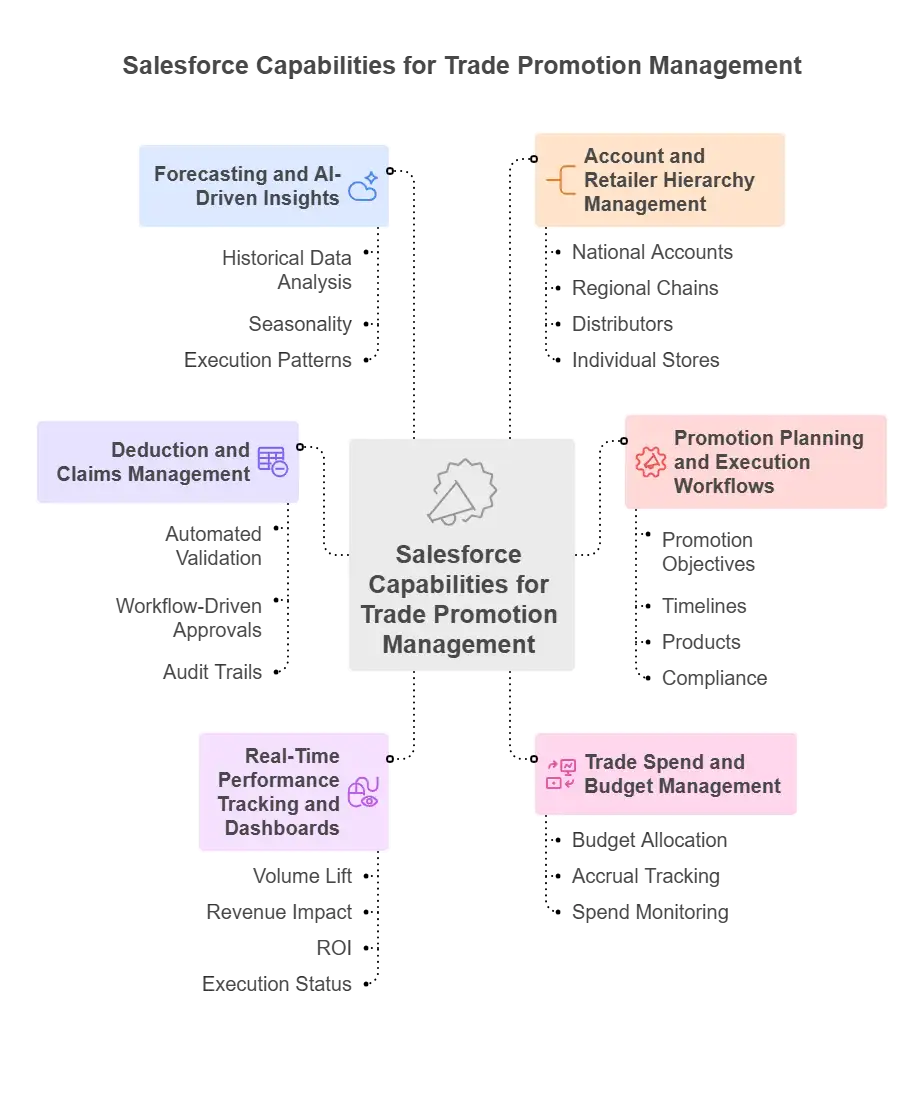
Salesforce equips organizations with end-to-end capabilities to plan, execute, monitor, and optimize trade promotions while maintaining financial control and transparency across stakeholders.
-
-
Account and Retailer Hierarchy Management
-
Salesforce enables structured management of complex account and retailer hierarchies, including national accounts, regional chains, distributors, and individual stores. This hierarchy-driven approach ensures promotions, pricing, budgets, and performance metrics are aligned at every level.
-
-
Promotion Planning and Execution Workflows
-
Salesforce supports standardized, automated workflows for promotion planning, approvals, and execution. Teams can define promotion objectives, timelines, products, and expected uplift while ensuring compliance with internal policies. Automated approvals and task assignments keep promotions on track and reduce delays, errors, and manual coordination.
-
-
Trade Spend and Budget Management
-
With Salesforce, organizations gain real-time visibility into trade spend across accounts, brands, and time periods. Budget allocation, accrual tracking, and spend monitoring help prevent overspending and improve financial accuracy. This enables tighter control over trade investments and ensures spending aligns with business priorities.
-
-
Real-Time Performance Tracking and Dashboards
-
Native analytics and dashboards provide instant insights into promotion performance, including volume lift, revenue impact, ROI, and execution status. Stakeholders can monitor progress in real time, quickly identify underperforming promotions, and take corrective action before issues impact results.
-
-
Deduction and Claims Management
-
Salesforce streamlines the management of trade deductions and claims by linking them directly to approved promotions. Automated validation, workflow-driven approvals, and clear audit trails reduce disputes, minimize revenue leakage, and accelerate settlement cycles.
-
-
Forecasting and AI-Driven Insights (Einstein AI)
-
Einstein AI enhances trade promotion management with predictive forecasting and intelligent insights. By analyzing historical data, seasonality, and execution patterns, Salesforce helps teams predict promotion outcomes, identify high-ROI tactics, and optimize future plans. These AI-driven insights enable smarter decision-making and continuous improvement in promotion effectiveness.
Challenges in Managing Trade Promotions
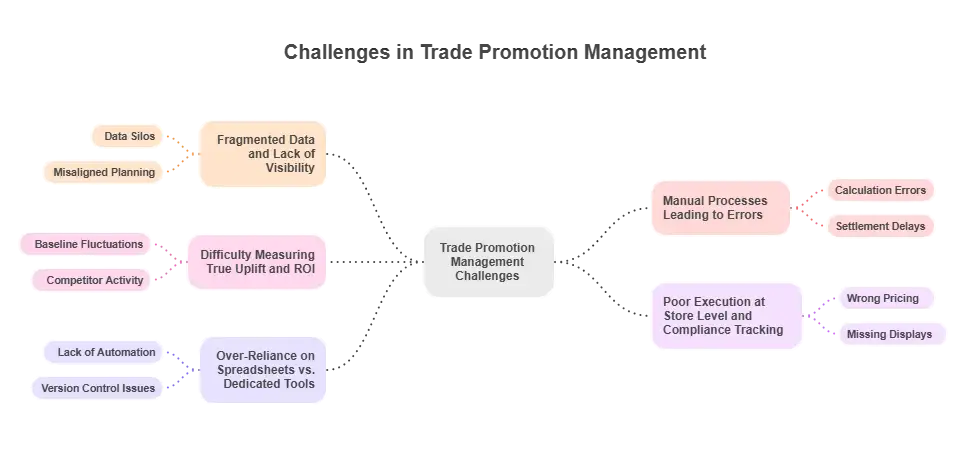
Managing trade promotions is complex and resource-intensive. Without the right processes and tools, companies face significant hurdles that reduce effectiveness and waste budget. Here are the most common challenges in trade promotion management.
-
-
Fragmented Data and Lack of Visibility
-
Data often sits in silos across sales, finance, marketing, and field teams. Retailers and distributors use their own systems, making it hard to get a unified view.This lack of visibility leads to misaligned planning, duplicate efforts, and missed opportunities. Teams struggle to see real-time performance across accounts or regions.
-
-
Manual Processes Leading to Errors
-
Many organizations still rely on spreadsheets for budgeting, planning, and settlement. Manual entry increases the risk of calculation errors, missed claims, or overpayments. Settlement delays occur when invoices and proofs don’t match. These mistakes erode margins and strain retailer relationships.
-
-
Difficulty Measuring True Uplift and ROI
-
Calculating actual sales lift from promotions is tough. Baseline sales fluctuate, and external factors (like competitor activity) interfere. Without accurate attribution, trade spend optimization suffers. Brands overfund ineffective promotions or underinvest in high performers, leading to poor trade promotion optimization.
-
-
Poor Execution at Store Level and Compliance Tracking
-
Promotions planned at headquarters often fail in stores. Issues include wrong pricing, missing displays, or low stock.Tracking compliance manually is time-consuming and inaccurate. Low execution rates mean lost sales despite heavy spending.
-
-
Over-Reliance on Spreadsheets vs. Dedicated Tools
-
Spreadsheets are flexible but not scalable. They lack automation, version control, and real-time collaboration. As promotion volume grows, spreadsheets become error-prone and slow. Modern trade promotion management tools and trade promotion software solve this with centralized data, workflows, and analytics. Platforms like Salesforce address these challenges directly with their trade promotion management tools. They provide unified visibility, automated settlements, AI-driven insights, and mobile execution tracking for better results and higher ROI.
Role of Technology: Trade Promotion Management Tools and Software
Leading trade promotion management tools offer a comprehensive set of capabilities designed to address common pain points:
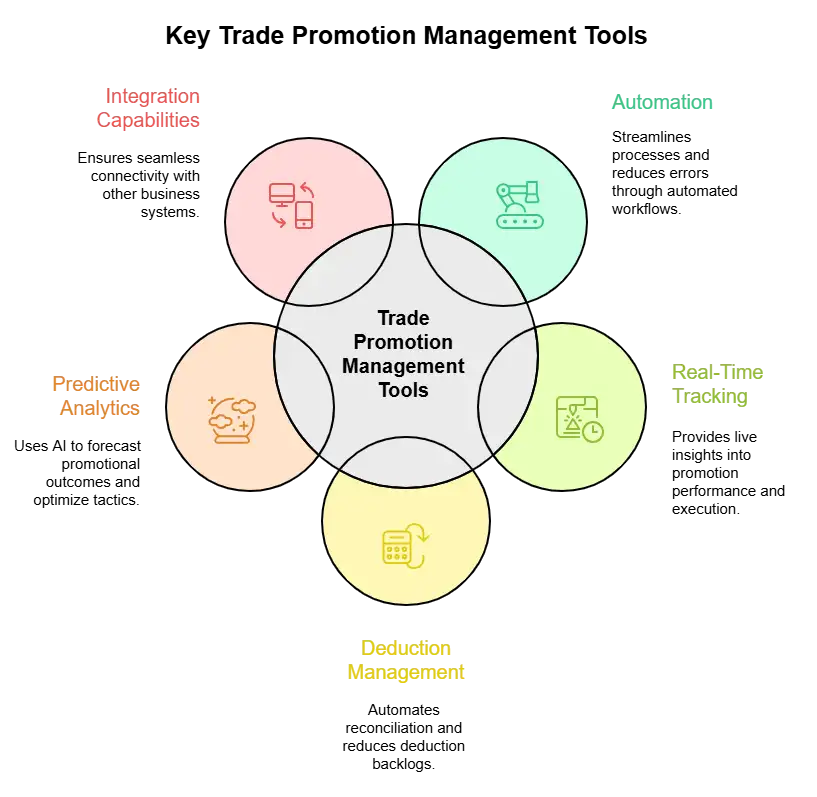
- Automation: Automated planning, budgeting, fund allocation, claims processing, and settlement reduces manual effort and human error. Workflows automatically route approvals, update forecasts, and trigger alerts for off-track promotions.
- Real-Time Tracking and Visibility: Centralized dashboards provide live insights into promotion performance, in-store execution, spend accrual, and uplift across retailers and channels. Field teams can upload compliance photos and execution data via mobile apps for immediate visibility.
- Deduction Management and Claims Reconciliation: Advanced tools automatically match retailer deductions and claims against planned promotions, flag discrepancies, and streamline dispute resolution, often reducing deduction backlog by 50-70%.
- Predictive Analytics and Scenario Modeling: AI-driven forecasting uses historical data, baselines, and external factors to predict promotional uplift and recommend optimal tactics.
- Integration Capabilities: Seamless connectivity with ERP, CRM, retail execution apps, and data warehouses ensures a single source of truth.
Why Salesforce for Trade Marketing Promotions Management
Salesforce provides a unified, intelligent platform designed to manage the complexity of trade marketing promotions while improving control, visibility, and ROI. By centralizing all trade promotion data, including accounts, retailers, budgets, promotions, claims, and performance metrics, Salesforce acts as a single source of truth across sales, finance, and marketing teams.
This eliminates data silos, reduces manual reconciliation, and ensures consistent, data-backed decision-making with real-time visibility into trade spend and promotion performance.
Built on the world’s leading CRM, Salesforce combines native analytics, automation, and scalability to support modern Trade Promotion Management. Real-time dashboards and insights help track ROI and execution, while automated workflows streamline approvals, execution, and claims management. Its cloud-native architecture, low-code flexibility, and extensive ecosystem of ERP, POS, and analytics integrations enable businesses to scale, adapt, and innovate without being constrained by rigid systems.
Core Salesforce Capabilities for Trade Promotion Management
Salesforce provides a unified, intelligent platform designed to manage the complexity of trade marketing promotions while improving control, visibility, and ROI. By centralizing all trade promotion data, including accounts, retailers, budgets, promotions, claims, and performance metrics, Salesforce acts as a single source of truth across sales, finance, and marketing teams.
This eliminates data silos, reduces manual reconciliation, and ensures consistent, data-backed decision-making with real-time visibility into trade spend and promotion performance.
Built on the world’s leading CRM, Salesforce combines native analytics, automation, and scalability to support modern Trade Promotion Management. Real-time dashboards and insights help track ROI and execution, while automated workflows streamline approvals, execution, and claims management. Its cloud-native architecture, low-code flexibility, and extensive ecosystem of ERP, POS, and analytics integrations enable businesses to scale, adapt, and innovate without being constrained by rigid systems.
Salesforce Products That Enable Trade Promotions
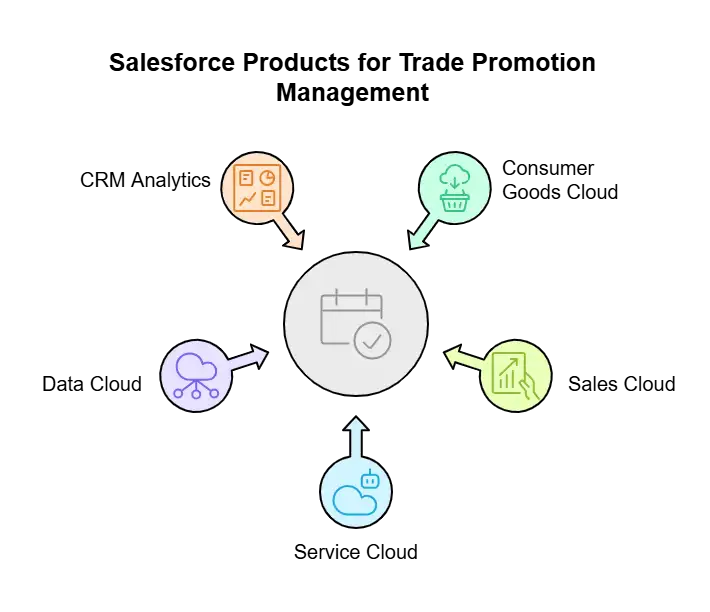
Salesforce offers a powerful combination of industry-specific clouds and platform capabilities that work together to support end-to-end trade promotion management. Each product plays a distinct role in planning, executing, and optimizing trade promotions.
-
-
Salesforce Consumer Goods Cloud for TPM
-
Salesforce Consumer Goods Cloud provides purpose-built capabilities for trade promotion management in consumer-facing industries. It supports promotion planning, trade spend management, retailer collaboration, and execution tracking. With a unified view of accounts, products, and promotions, teams can manage complex trade activities more efficiently while improving visibility into promotion performance and ROI.
-
-
Sales Cloud and Service Cloud Use Cases
-
Sales Cloud implementation enables account teams to plan and manage trade promotions as part of broader customer and retailer relationships. It helps align promotions with sales targets, pipeline activities, and joint business plans. Service Cloud implementation supports post-promotion processes such as claims, deductions, and dispute resolution through case management, automation, and SLA tracking, ensuring faster settlements and stronger retailer relationships.
-
-
Data Cloud for Unified Retailer and Shopper Data
-
Salesforce Data Cloud brings together data from multiple sources, including ERP systems, POS data, syndicated data providers, and digital channels. By unifying retailer, shopper, and promotion data into a single profile, organizations gain deeper insights into buying behavior, promotion effectiveness, and demand patterns. This unified data foundation enables more accurate forecasting and smarter promotion decisions.
-
-
Analytics and Reporting with CRM Analytics
-
CRM Analytics (Tableau CRM) delivers advanced reporting and visualization for trade promotion performance. Interactive dashboards provide real-time visibility into KPIs such as uplift, ROI, trade spend efficiency, and execution compliance. With self-service analytics and AI-powered insights, teams can quickly identify trends, diagnose issues, and continuously optimize trade promotion strategies.
Best Practices for Implementing Salesforce TPM
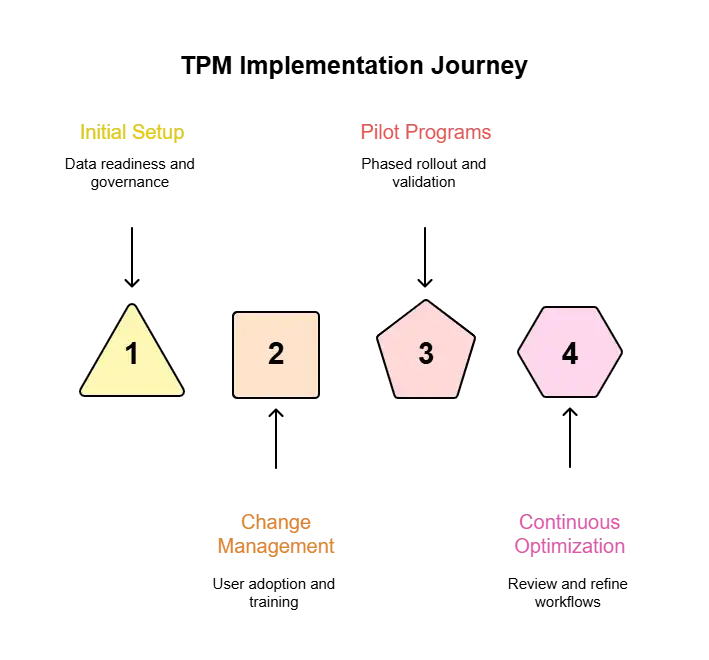
A successful Salesforce Trade Promotion Management (TPM) implementation depends on strong foundations, structured execution, and continuous improvement. Following proven best practices helps organizations maximize adoption, ROI, and long-term value.
-
-
Data Readiness and Governance
-
Start with clean, structured, and reliable data. Standardize account hierarchies, product master data, pricing, and historical promotion data before implementation. Clear data governance models ensure consistency, accuracy, and accountability across teams, enabling trusted reporting and better decision-making from day one.
-
-
Change Management and User Adoption
-
TPM impacts multiple teams, including sales, finance, marketing, and field operations. A structured change management approach with role-based training, clear communication, and executive sponsorship is critical. Designing intuitive workflows aligned with real-world processes helps drive faster adoption and reduces resistance to change.
-
-
Pilot Programs and Phased Rollout
-
Instead of a big-bang deployment, begin with pilot programs focused on specific regions, brands, or promotion types. This phased approach allows teams to validate processes, refine configurations, and address gaps early, ensuring smoother scaling across markets and business units.
-
-
Continuous Optimization
-
TPM is not a one-time initiative. Regularly review KPIs, user feedback, and promotion performance to optimize workflows, budgets, and strategies. Leveraging analytics and AI-driven insights enables continuous refinement and sustained improvement in trade promotion effectiveness.
Also Read: Salesforce Implementation Guide
Industry Use Cases and Real-World Scenarios
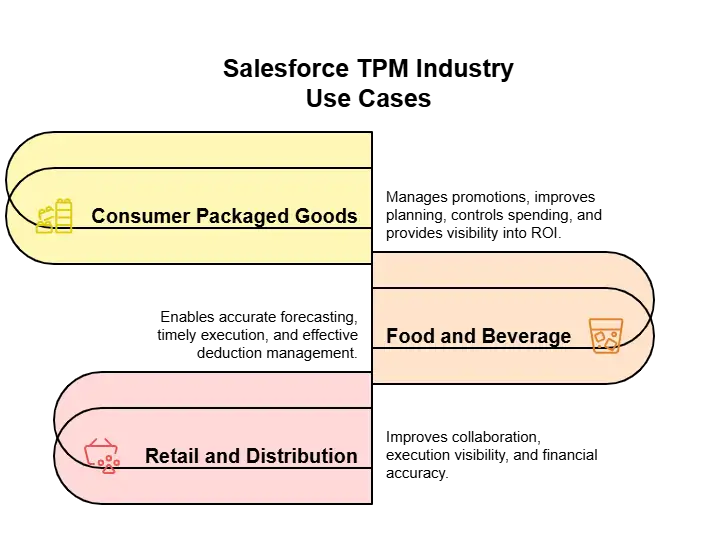
Salesforce TPM supports a wide range of industries where trade promotions play a critical role in driving revenue and retailer engagement.
-
-
Consumer Packaged Goods (CPG)
-
CPG companies use Salesforce TPM to manage high volumes of promotions across multiple retailers and regions. It helps improve promotion planning, trade spend control, and in-store execution while delivering clear visibility into ROI and category performance.
-
-
Food and Beverage
-
In the food and beverage industry, where seasonality, pricing sensitivity, and compliance are key challenges, Salesforce TPM enables accurate forecasting, timely execution, and effective deduction management. This ensures promotions drive volume without eroding margins or creating operational complexity.
-
-
Retail and Distribution-Driven Businesses
-
For businesses reliant on distributors and retail partners, Salesforce TPM improves collaboration, execution visibility, and financial accuracy. It helps align promotions with joint business plans, track retailer compliance, and optimize trade investments across complex distribution networks.
How Ksolves Helps You Maximize Salesforce Trade Promotion Management
Ksolves helps organizations unlock the full value of Salesforce Trade Promotion Management by combining deep Salesforce expertise with real-world trade marketing and consumer goods experience. As a trusted Salesforce Summit partner, Ksolves designs and implements TPM solutions tailored to your business model, promotion complexity, and growth goals.
From data readiness and platform configuration to integrations with ERP, POS, and distributor systems, Ksolves ensures a seamless and scalable TPM foundation. Our team customizes promotion workflows, approval processes, dashboards, and KPIs to align with your trade strategies while ensuring accuracy, compliance, and transparency across teams.
Ksolves also brings advanced analytics and AI-driven insights to help optimize trade spend and promotion performance. By leveraging Salesforce Data Cloud, CRM Analytics, and Einstein AI, we enable smarter forecasting, ROI-driven decision-making, and continuous optimization. Beyond implementation, Ksolves provides ongoing support, enhancements, and optimization to ensure your TPM strategy evolves with changing market and retailer dynamics.
Conclusion: Driving Profitable Trade Promotions with Salesforce
Trade promotions represent one of the largest investments for consumer-facing businesses, making effective management essential for sustainable growth. Salesforce provides a powerful, integrated platform to plan, execute, measure, and optimize trade promotions with greater visibility, control, and ROI.
With the right Salesforce implementation partner, organizations can move beyond reactive promotion management and build a data-driven, collaborative, and scalable trade marketing strategy. By combining Salesforce’s capabilities with Ksolves’ expertise, businesses can transform trade promotions into a long-term growth engine that strengthens retailer relationships, improves margins, and delivers measurable business impact. Contact us today at [email protected].
FAQs
- What is trade promotion management (TPM)?
Trade promotion management involves planning, executing, tracking, and optimizing incentives offered to retailers, distributors, and wholesalers. It helps businesses improve product visibility, drive sales volume, and maximize ROI from trade spend. - How does Salesforce support trade marketing promotions management?
Salesforce provides a unified platform that centralizes promotion planning, trade spend management, execution tracking, claims, and analytics. Using Consumer Goods Cloud, Data Cloud, CRM Analytics, and Einstein AI, it enables real-time visibility, automation, and data-driven optimization. - What are the key benefits of using Salesforce for trade promotion optimization?
Salesforce helps improve promotion ROI, optimize trade spend, enhance retailer collaboration, and ensure better in-store execution. AI-driven insights and real-time analytics enable continuous improvement and smarter decision-making. - Why choose Ksolves for Salesforce Trade Promotion Management implementation?
Ksolves combines deep Salesforce expertise with real-world trade promotion experience. As a Salesforce Summit Partner, Ksolves delivers tailored TPM implementations, seamless integrations, advanced analytics, and ongoing optimization to maximize long-term value.





























