



Salesforce Implementation Guide
Summary
Salesforce Implementation in 2026 requires a structured approach to maximize ROI and business growth. From planning and customization to data migration, integration, and user adoption, Ksolves provides a comprehensive roadmap and expert guidance. With certified professionals and industry-specific expertise, we help businesses implement Salesforce efficiently, overcome challenges, and achieve measurable results.
Introduction
Salesforce has emerged as a groundbreaking force in the CRM industry and has established itself as a global leader in customer relationship management. For over a decade, it has consistently grown its market share to over 23%, which reflects its strong demand and competitive edge.
With advanced analytics, AI-powered insights, and highly customizable features, Salesforce helps businesses improve operational efficiency, drive customer satisfaction, and achieve sustainable growth.
Enterprises across industries rely on Salesforce as a tailored solution that enables them to scale effectively and increase profitability. By adopting a cloud-first approach, businesses can centralize customer data, stay aligned with industry trends, and unlock new opportunities for digital transformation.
This guide provides a complete step-by-step roadmap for a successful Salesforce implementation and will help you maximize ROI while ensuring long-term success.
What is Salesforce Implementation?
Salesforce is a leading CRM platform that helps businesses manage and optimize every customer interaction. To fully leverage its potential, companies implement Salesforce by tailoring the platform to their unique processes and goals.
Salesforce implementation typically includes configuring features, migrating data, and integrating with existing systems to create a seamless business environment. When done right, it enables organizations to enhance sales efficiency, deliver superior customer service, and generate more accurate forecasts.
Now, let’s look at the major advantages of implementing Salesforce for your business.
Advantages of Implementing Salesforce
Implementing Salesforce empowers organizations to centralize customer data, streamline processes, and drive smarter decision-making through automation and analytics. Its scalability and customization ensure that businesses of all sizes can adapt the platform to meet evolving needs while maximizing ROI.
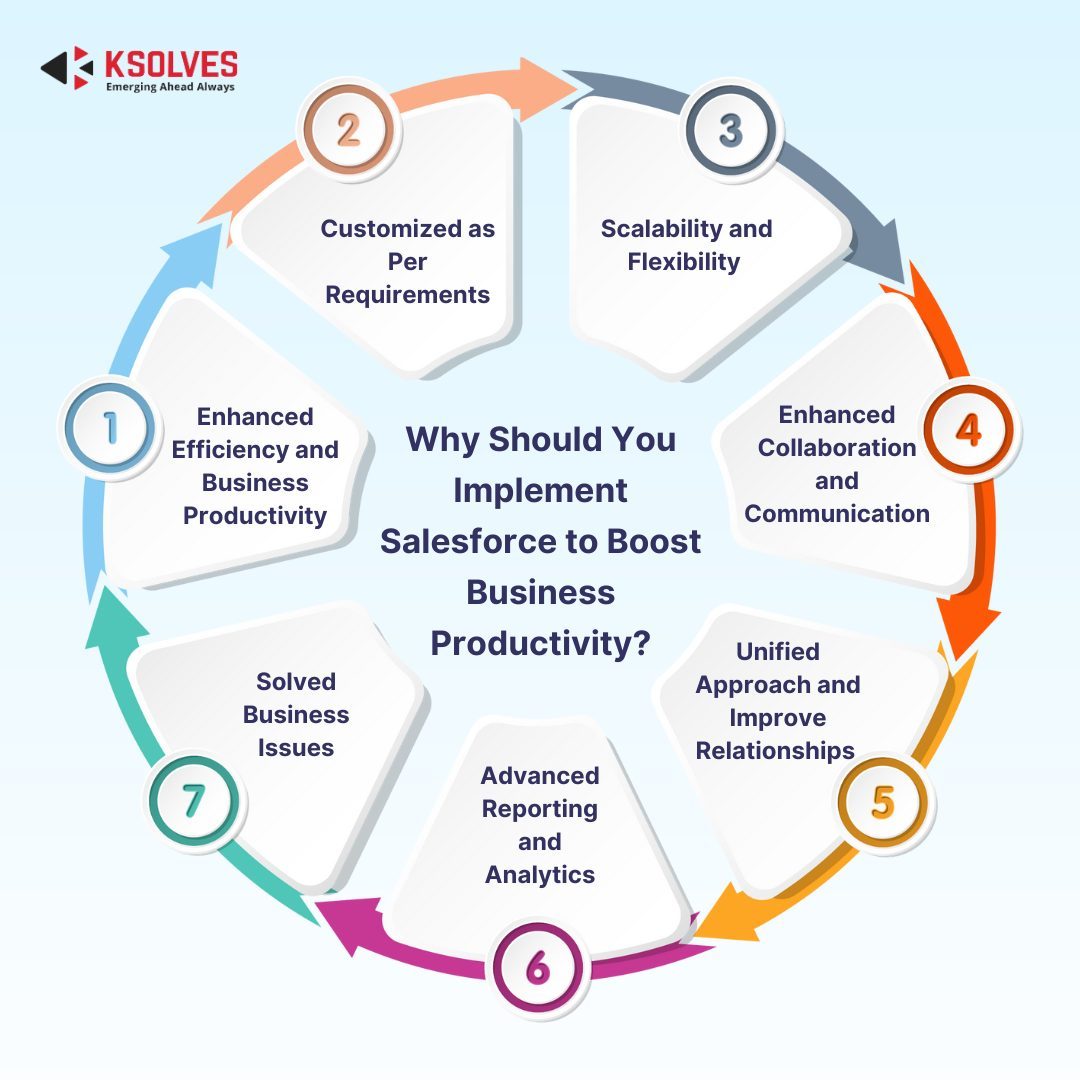
1. Enhanced Efficiency and Business Productivity
Salesforce streamlines business workflows by automating manual processes and reducing repetitive tasks. Its advanced and customizable features allow enterprises to design processes that align perfectly with business requirements. This reduces errors, speeds up task completion, and improves operational efficiency, ultimately boosting overall productivity.
2. Customized as Per Requirements
One of Salesforce’s biggest strengths is its adaptability. The platform can be tailored to match specific workflows, business rules, and operational needs. Through customized fields, objects, workflows, and user interfaces, organizations can create a Salesforce environment that fits their unique requirements, enabling a more efficient and effective operational framework.
3. Scalability and Flexibility
As businesses grow and expand globally, Salesforce scales with them. New functionalities, modules, and integrations can be added without disrupting ongoing operations. This makes Salesforce a go-to choice for organizations seeking a future-ready platform that can adapt to evolving market demands.
4. Enhanced Collaboration and Communication
Salesforce provides a centralized platform for teams to share information, track progress, and collaborate on projects in real time. This unified approach eliminates data silos, strengthens cross-team communication, and enhances overall efficiency.
5. Unified Approach to Strengthening Customer Relationships
Salesforce’s CRM capabilities enable businesses to consolidate customer data and interactions in one place. This allows for a deeper understanding of customer needs, enabling personalized engagement and targeted marketing campaigns. As a result, businesses can foster stronger, long-lasting relationships.
6. Advanced Reporting and Analytics
Salesforce offers powerful reporting tools and predictive analytics to track performance, identify trends, and optimize strategies. These insights support data-driven decision-making, giving businesses a competitive edge in improving efficiency and profitability.
7. Continuous Innovation and Support
Salesforce regularly rolls out updates, enhancements, and new features to keep businesses aligned with industry trends and emerging technologies. Combined with extensive resources, training, and customer support, this ensures organizations can continually optimize their Salesforce environment for long-term success.
Ksolves Salesforce Implementation Guide – A Step-By-Step Process
Discover how Ksolves helps businesses implement Salesforce effectively, from planning and customization to data migration and user adoption.
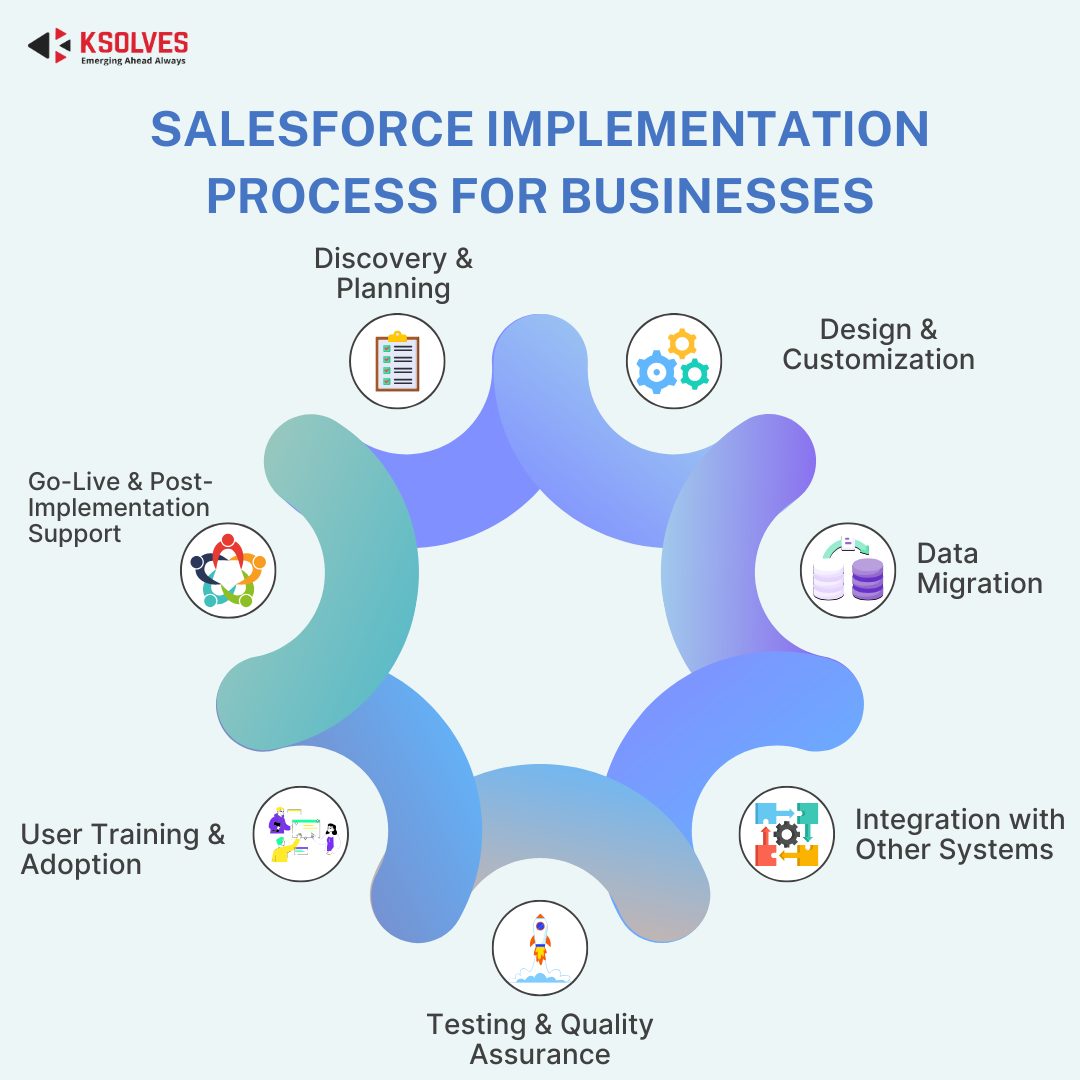
1. Discovery and Planning
At Ksolves, every Salesforce implementation begins with a thorough discovery phase to ensure alignment between the platform’s capabilities and your business objectives. We conduct in-depth requirement gathering sessions with all stakeholders, audit your existing systems, and perform a detailed gap analysis. This allows us to create a tailored project roadmap that outlines timelines, deliverables, and success metrics, ensuring the foundation is strong before moving into execution.
2. Design and Customization
Our certified Salesforce experts design a data model that perfectly fits your workflows and business structure. We configure workflow automations to eliminate repetitive tasks, set up role-based access controls to maintain security, and create intuitive page layouts for a seamless user experience. Ksolves specializes in UI customization that not only enhances usability but also boosts adoption rates across teams.
3. Data Migration
Migrating data into Salesforce is a critical step that requires precision. Ksolves ensures this process is error-free by first mapping all data fields, cleansing outdated or duplicate entries, and validating the integrity of imported data. Our team uses best practices and proven tools to guarantee that your transition to Salesforce is smooth, with zero loss of valuable information.
4. Integration with Other Systems
To help you maximize the value of Salesforce, Ksolves integrates it seamlessly with your existing business ecosystem. Whether it’s ERP systems, marketing automation tools, or customer support platforms, we leverage APIs and middleware solutions like MuleSoft and Zapier to create a connected environment where data flows effortlessly between platforms.
5. Testing & Quality Assurance
Before going live, our QA specialists perform rigorous testing, including unit testing and user acceptance testing (UAT), to identify and resolve any issues. We fine-tune performance, fix bugs, and ensure that every workflow functions exactly as intended. At Ksolves, quality is non-negotiable, so no solution is deployed until it meets our high-performance and reliability standards.
6. User Training and Adoption
Adoption is key to a successful Salesforce implementation. Ksolves conducts role-specific training sessions so that each team member can fully utilize Salesforce in their day-to-day tasks. We also create comprehensive knowledge bases and user guides to support ongoing learning. This ensures your team remains confident and productive long after deployment.
7. Go-Live and Post-Implementation Support
When your Salesforce solution goes live, our job doesn’t end there. Ksolves closely monitors adoption rates, collects feedback from users, and makes continuous optimizations to further align Salesforce with evolving business needs. Our post-implementation support ensures that you have a reliable partner to help you adapt, innovate, and grow with Salesforce over time.
Best Salesforce Implementation Practices
Below are the seven best Salesforce implementation practices in 2026 to ensure a smooth and effective process:
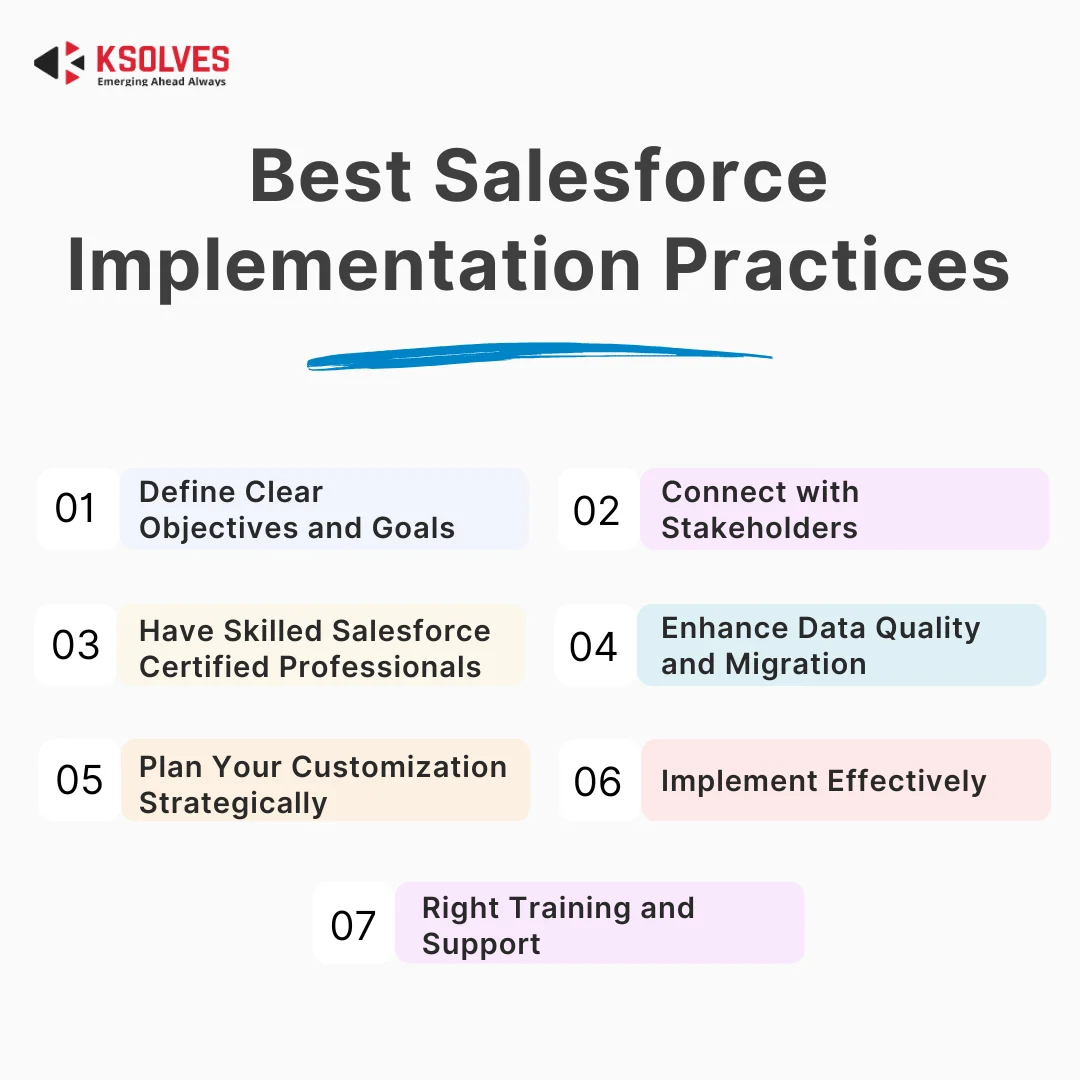
1. Define Clear Objectives and Goals
Before choosing the right Salesforce edition, it is a must for you to identify clear objectives and business goals. The plan should be specific, measurable, achievable, and match the timelines. You must define and know what you want to achieve with Salesforce to improve the sales process and enhance the customer experience with the right Salesforce implementation roadmap.
2. Connect with Stakeholders
A successful Salesforce implementation strategy needs a proper built-in form by connecting with all the business clients. The stakeholders include executives, department heads, and all users who interact with the system daily. By engaging with stakeholders in the initial phase, it is possible to address the needs and consequences that work on committing to the project’s success.
3. Have Skilled Salesforce Certified Professionals
A skilled certified Salesforce professional is important to the success of the Salesforce project. The entire team includes Salesforce administrators, developers, business analysts, and project managers with years of experience in Salesforce implementation. Having a team of Salesforce professionals ensures that all the project concerns are covered properly.
4. Enhance Data Quality and Migration
Data is considered as the backbone of any CRM system and ensuring the data quality is important. Conducting a thorough data audit before the migration process so that if there is any kind of data duplicacy then they are removed.
5. Plan Your Customization Strategically
You must create the right balance when customizing Salesforce to meet user needs. By tailoring the platform thoughtfully, you can enhance business processes without complications. A well-planned customization ensures smoother adoption and reduces the risk of errors or inefficiencies.
6. Implement Effectively
By focusing on an iterative Salesforce approach such as Agile methodology, you can enhance the Salesforce implementation process. By dividing the entire plan into small phases, you can be able to achieve milestones correctly. This allows other team members or admins to give continuous feedback, make rapid adjustments, and ensure that the project is meeting the client’s goals.
7. Right Training and Support
The entire process is not only about implementation, but it also needs proper training and support for team members. With comprehensive training, users will be able to maximize the system’s capabilities and adapt to new features or business updates.
Factors That Influence the Cost of Salesforce Implementation
The cost of implementing Salesforce varies depending on the project’s complexity, typically ranging from $10,000 for smaller projects to $100,000+ for large-scale implementations with extensive customization. Several critical factors influence the final investment:
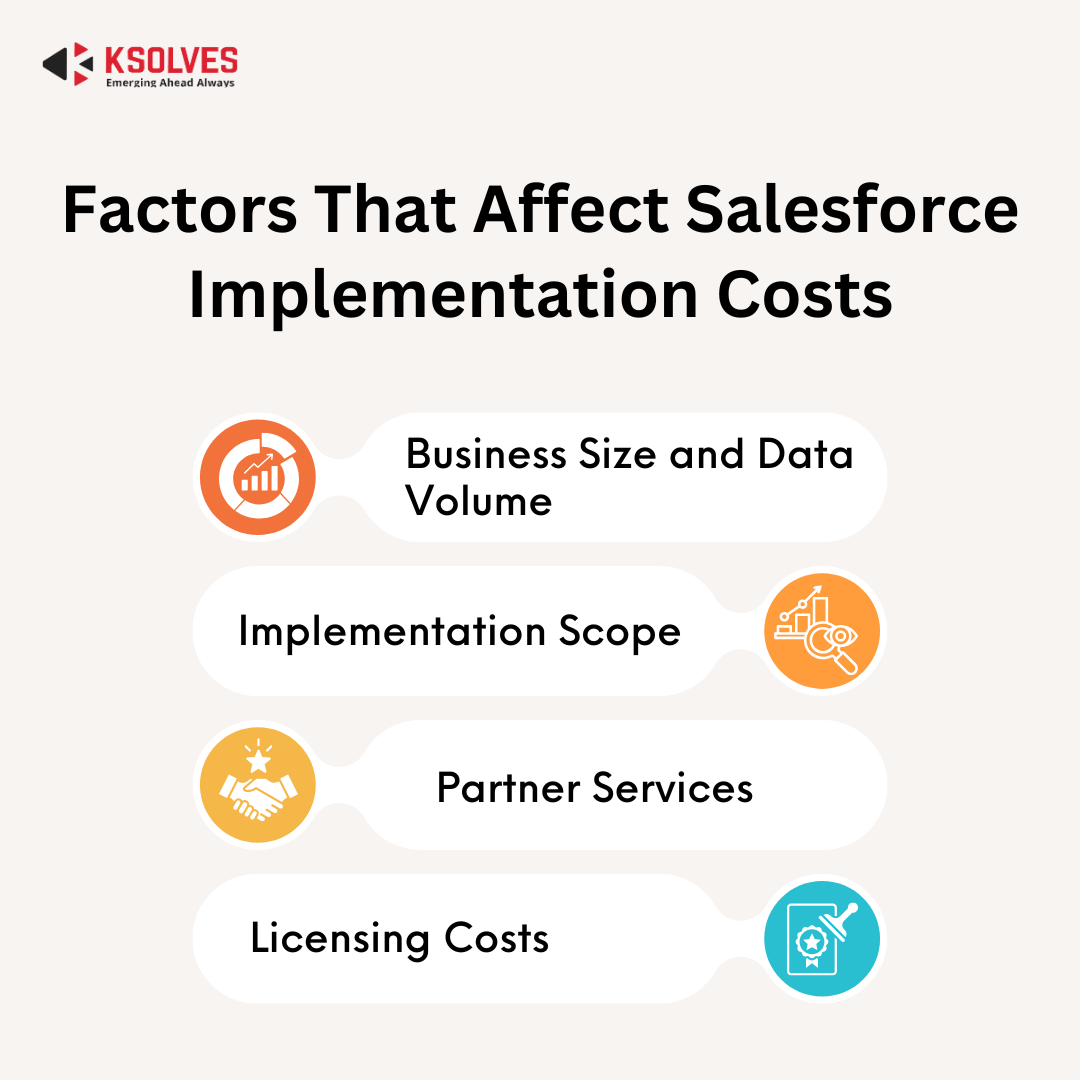
1. Business Size and Data Volume
The number of users and the volume of data in your organization significantly affect implementation costs. Larger teams or industries with complex systems, such as healthcare, often require specialized configurations and features, which can increase overall expenses.
2. Implementation Scope
The level of customization and configuration needed directly impacts cost. This includes creating custom objects, fields, and workflows tailored to your business processes. Integrating Salesforce with other systems and purchasing third-party apps for additional functionality can also add to the total investment.
3. Partner Services
Engaging a certified Salesforce partner may seem like an added expense, but it helps reduce risks, streamline the implementation process, and save time. Expert partners provide training, ongoing support, and maintenance, ensuring a smoother implementation and maximizing your return on investment.
4. Licensing Costs
Salesforce edition choices, such as Enterprise, Unlimited, Professional, or Lightning, determine license pricing. Additional features like Sales Cloud, Service Cloud, or Marketing Cloud also incur extra costs depending on the organization’s requirements.
Types of Salesforce Implementation Models
Salesforce offers several implementation models and deployment strategies, each with unique benefits and considerations. Understanding these options helps align Salesforce with your business processes, customization needs, and goals.
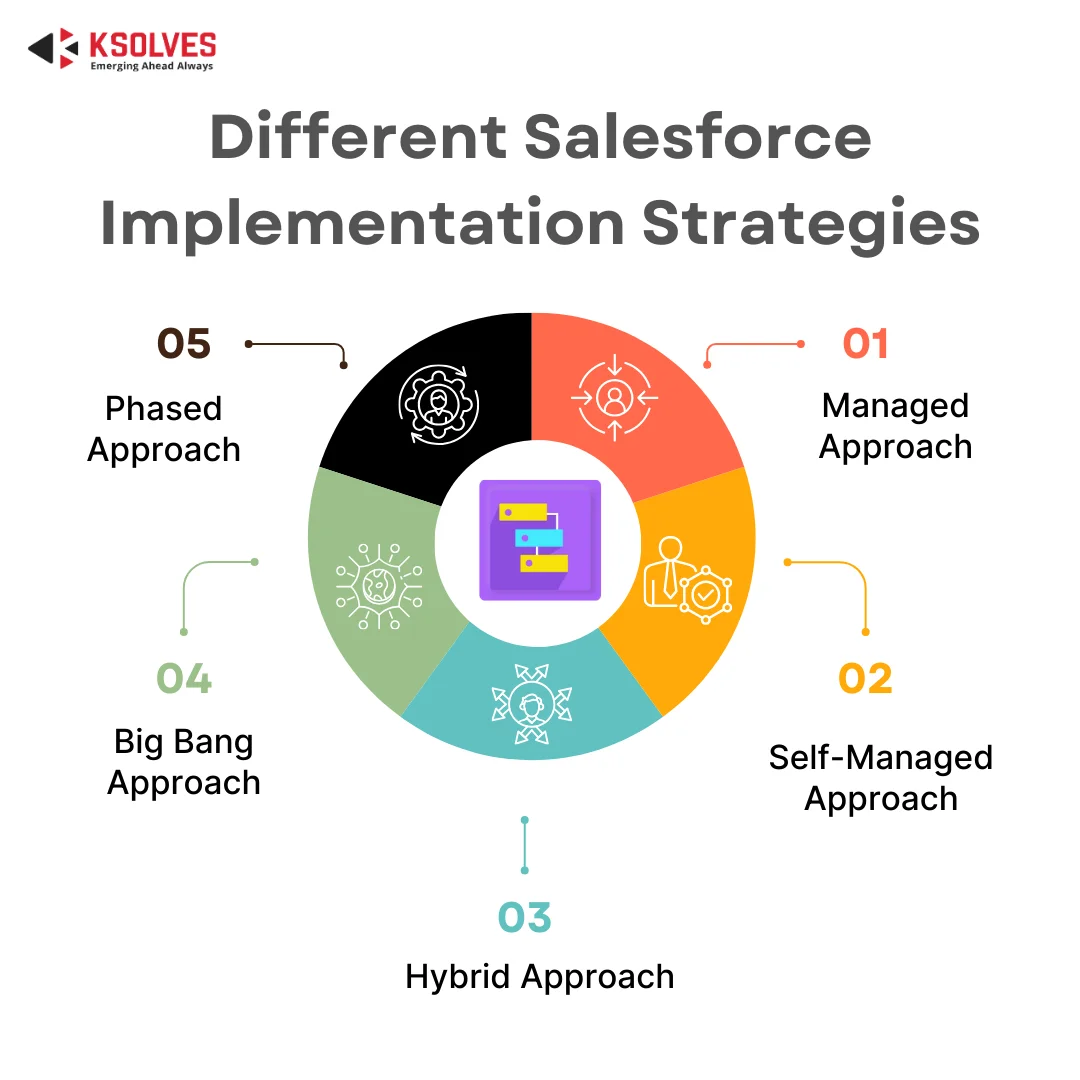
1. Managed Approach
In the managed model, the implementation partner handles the majority of the Salesforce deployment, including planning, customization, configuration, data migration, user training, and go-live support.
Benefits:
- Access to in-depth expertise and proven implementation practices
- Reduced risks and complexities
- Faster execution with a clear project roadmap
Drawbacks:
- Higher implementation costs
- Limited flexibility and control over certain decisions
2. Self-Managed Approach
Here, your organization takes primary responsibility for Salesforce implementation, with the consulting partner providing advisory guidance.
Benefits:
- Cost-effective compared to fully managed implementations
- Greater control and internal expertise
- Team learns how to optimize Salesforce for business processes
Drawbacks:
- Requires significant technical expertise and resources
- Longer project timelines and potential errors due to lack of experience
3. Hybrid Approach
The hybrid model divides responsibilities between your team and the implementation partner. For example, the partner may manage complex customizations, while your team handles configurations or user adoption.
Benefits:
- Balances cost and expertise
- Hands-on experience for internal teams
- Allows targeted training and knowledge transfer
Drawbacks:
- Requires effective collaboration and communication
- Misalignment can lead to delays or implementation challenges
4. Big Bang Approach
The Big Bang strategy implements Salesforce across all users and processes at once. Often used by startups, SMBs, or organizations ready for a full-scale rollout.
Benefits:
- Faster deployment and lower initial cost
- Immediate ROI as all resources focus on change management simultaneously
Drawbacks:
- Higher risk; overlooking small details can affect all users
- Rollback is difficult, making post-implementation support critical
5. Phased Approach
The Phased approach implements Salesforce in stages, gradually migrating users and processes over time. It is often preferred by larger enterprises.
Benefits:
- Reduced risk as each phase can be tested and validated
- Teams gain experience and knowledge incrementally, improving adoption
Drawbacks:
- Longer timeline and potentially higher long-term costs
- Requires careful coordination between phases
Salesforce Implementation Challenges
Implementing Salesforce can bring transformative benefits, but it also comes with challenges that organizations must navigate carefully. Understanding these obstacles upfront helps businesses plan effectively and ensure a smooth, successful deployment.
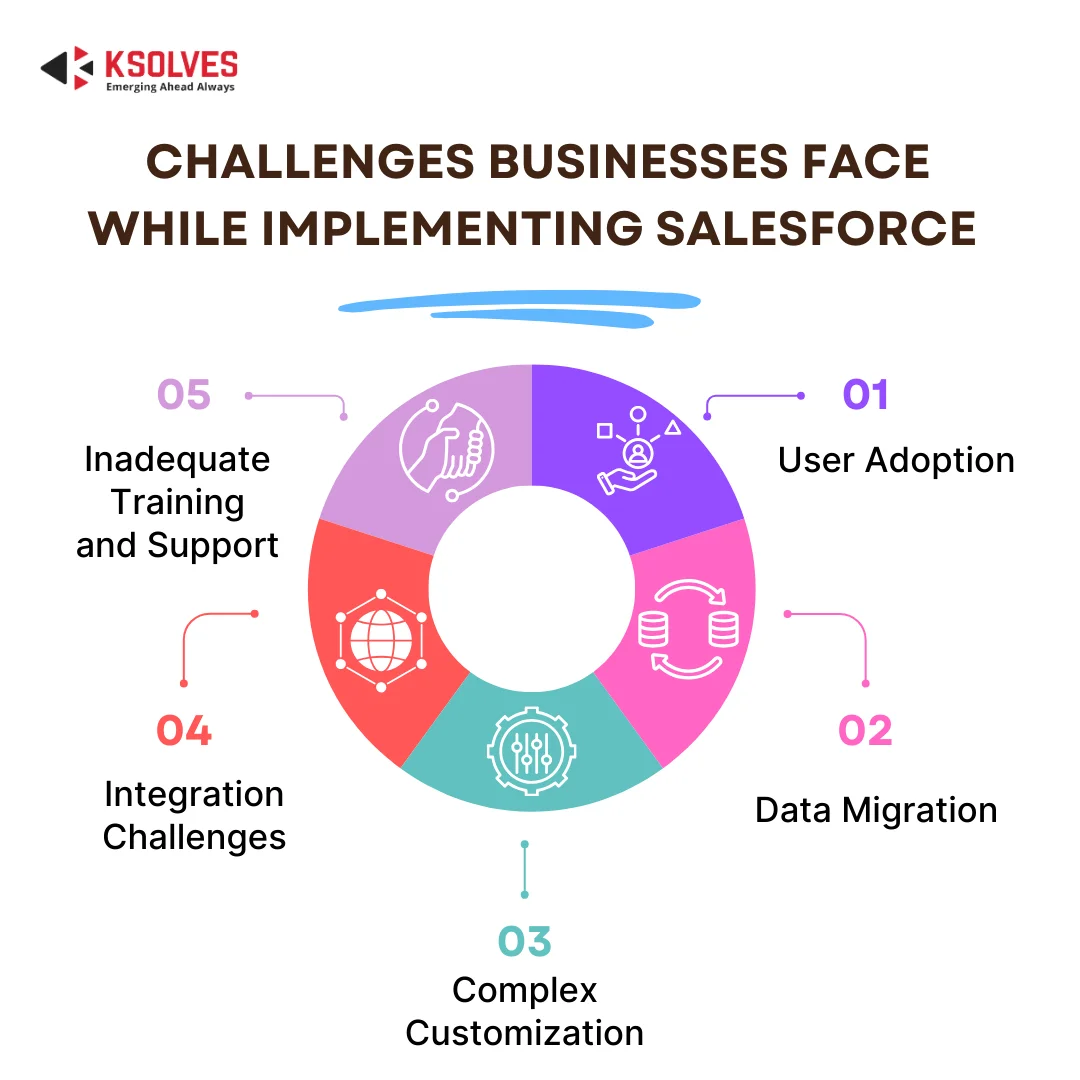
1. User Adoption
Employees often face challenges when switching to a new system, which can make them hesitant to adopt it. If employees avoid using Salesforce due to unfamiliarity or perceived extra work, the platform may be underutilized, reducing its potential benefits.
2. Data Migration
Migrating existing data to Salesforce can be a complex and time-consuming task. Issues such as inconsistent formats, poor data quality, or insufficient cleansing can lead to data integrity problems, affecting the accuracy and reliability of the information stored in Salesforce.
3. Complex Customization
Salesforce offers extensive customization options, but configuring the platform to match specific business workflows can be challenging. Improper customization can result in delays, errors, or inefficiencies, impacting overall project success.
4. Integration Challenges
Integrating Salesforce with other systems, applications, and databases is essential for seamless data flow. However, differences in data formats, structures, and integration processes can create discrepancies that hinder operational efficiency.
5. Inadequate Training and Support
Without proper training and support, users may not fully leverage Salesforce’s features. Limited training materials, guidance, or ongoing support can reduce efficiency and prevent teams from realizing the platform’s full potential.
After understanding these challenges, it is essential to implement proactive planning, robust change management strategies, and user-centric training to ensure a smooth and successful Salesforce implementation.
Why Should You Choose Ksolves as a Salesforce Implementation Partner 2026?
As a leading Salesforce implementation partner, Ksolves has achieved the pinnacle of the Salesforce Consulting Partner program. With our customer-centric approach, we deliver projects of varying complexities and successfully meet client requirements. The Ksolves team follows Agile methodology to ensure flexibility and quickly adapt to customer’s needs.
1. Expertise and Certifications
Ksolves comprises 100+ experienced professionals and holds 350+ Salesforce certifications, making us a certified Salesforce Summit partner. This ensures deep knowledge and proven skills to handle complex Salesforce implementations.
2. Customized Salesforce Solutions
Salesforce implementation is not a one-size-fits-all approach. Ksolves provides tailored solutions designed to meet the specific needs of each business, helping achieve strategic goals efficiently.
3. Training and Support
The Ksolves team offers comprehensive training to ensure user adoption and provides ongoing support to answer questions and address business challenges effectively.
4. Business Productivity
Choosing Salesforce implementation with Ksolves helps enhance sales, customer service, and marketing processes, ultimately driving measurable business growth.
Case Studies: How Ksolves Drives Salesforce Implementation Success
At Ksolves, we help businesses overcome CRM challenges with tailored Salesforce solutions, automation, and cloud-based strategies. These success stories showcase our expertise in streamlining operations, improving customer engagement, and driving measurable business outcomes.
Boosting Reporting Accuracy & Decision-Making by 20%
Client Challenge:
A mid-sized financial services firm faced fragmented data across spreadsheets and legacy systems, leading to inconsistent reporting and delayed decision-making.
Ksolves Solution:
Implemented Salesforce to centralize data, automate reporting, and provide real-time dashboards for executives.
Results:
- 22% improvement in reporting accuracy
- 30% faster decision-making
- 40% reduction in reporting preparation time
- Enhanced compliance and risk management
Reducing Manufacturing Production Delays by 25%
Client Challenge:
A global manufacturing company struggled with frequent production delays due to siloed systems and lack of real-time demand forecasting.
Ksolves Solution:
Implemented Salesforce to integrate sales, production, and service teams, enabling real-time demand forecasting and streamlined quoting processes.
Results:
- 25% reduction in production delays
- 30% improvement in on-time delivery
- 20% increase in order fulfillment efficiency
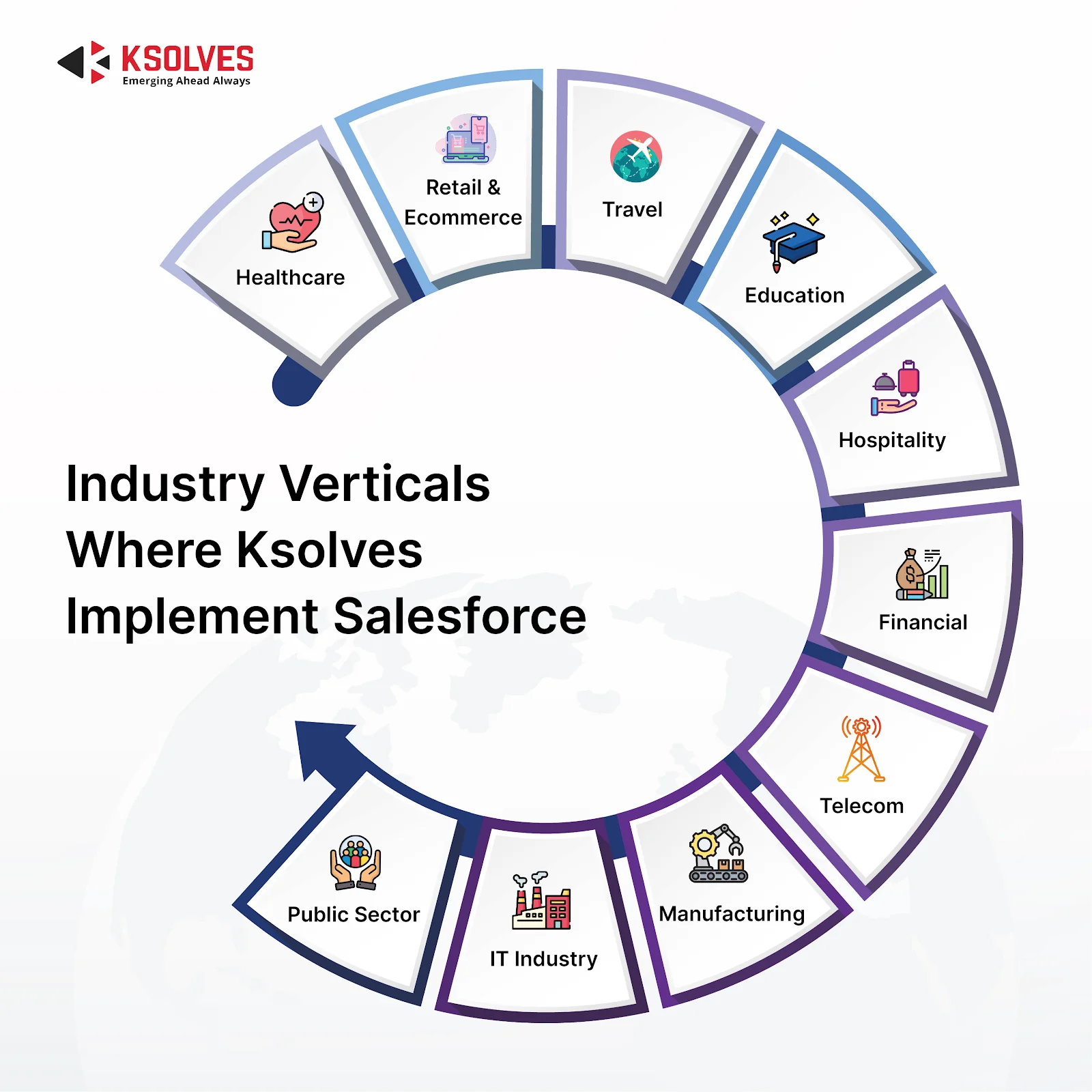
Industry Verticals Where Ksolves Implements Salesforce
Ksolves serves a wide range of industries, helping businesses overcome unique challenges with tailored Salesforce solutions.
Our certified Salesforce professionals work closely with companies across sectors such as Healthcare, Retail, Manufacturing, Real Estate, Finance, and Hospitality to streamline operations, improve customer engagement, and drive growth.
Top Salesforce Clouds That Ksolves Implements
Our professionals specialize in implementing various Salesforce clouds while addressing specific business challenges. The top clouds include:
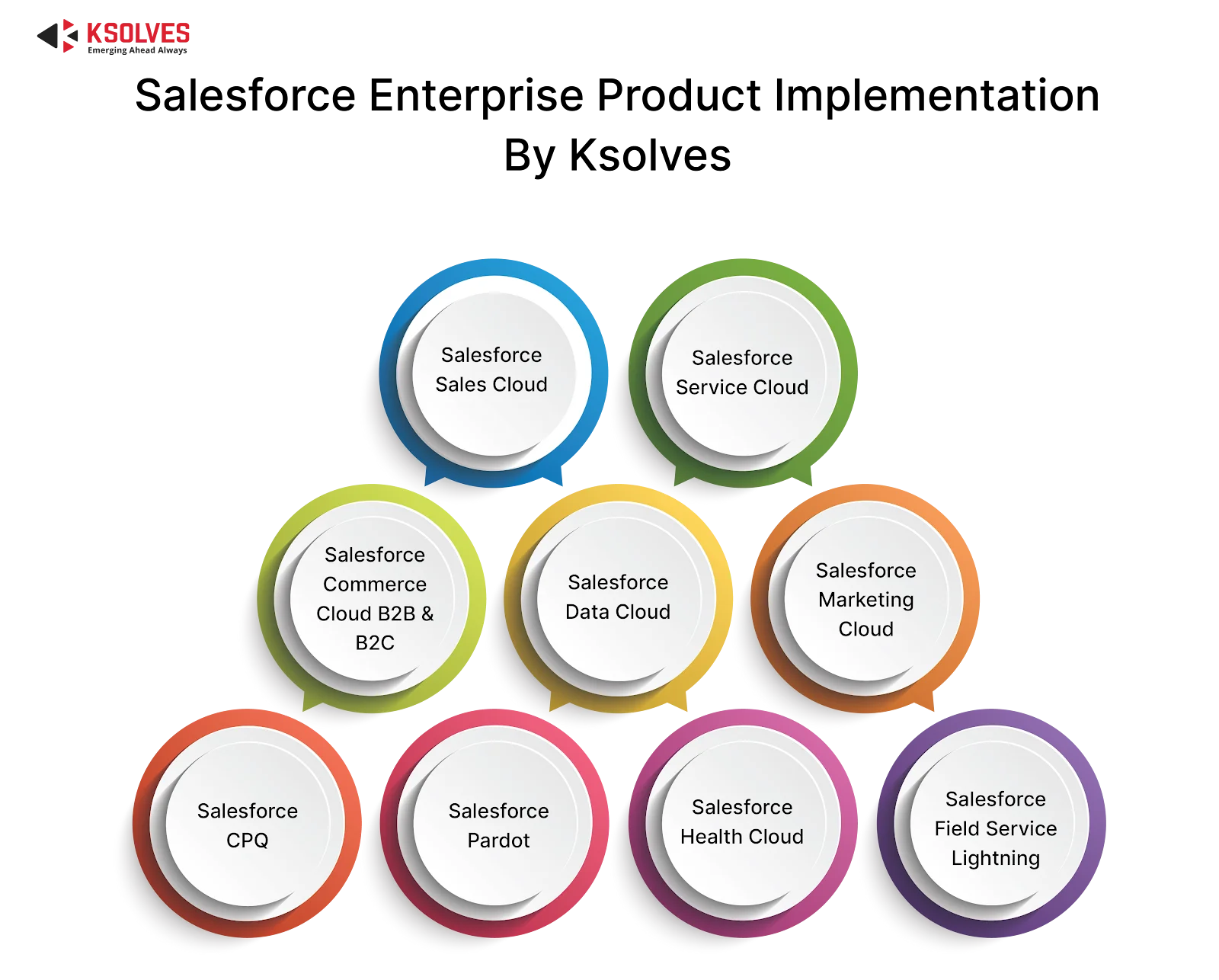
1. Sales Cloud
With Ksolves, you can manage customer relationships and interactions effectively by opting for the Salesforce Sales Cloud implementation approach.
2. Service Cloud
Ksolves team professionals focus on delivering the right customer service experience with Salesforce Service Cloud implementation.
3. Commerce Cloud B2B & B2C
By opting for Salesforce Commerce Cloud implementation, you can engage the B2B and B2C E-Commerce experiences to manage the business sales process.
4. Data Cloud
Ksolves Salesforce Data Cloud implementation will help businesses unify the customer data for a 360-degree view by providing a holistic understanding of consumers.
5. Marketing Cloud
Our certified professionals offer expertise in automating and personalizing marketing campaigns for businesses across the globe with Salesforce Marketing Cloud implementation.
6. Salesforce Revenue Cloud
Ksolves Salesforce Revenue Cloud Implementation service (formerly known as Salesforce CPQ) enables you to configure, price, and quote complex products and services efficiently.
7. Marketing Cloud Account Engagement
Ksolves implements the B2B Marketing Automation tools (formerly known as Pardot) that nurture the leads and drive sales growth.
8. Health Cloud
Ksolves Health Cloud implementation works on managing patient engagement and care coordination for healthcare organizations.
9. Field Service Lightning (FSL)
By implementing the Ksolves Field Service Lightning implementation, you can automate and optimize the field service operations and ensure efficient service delivery.
Is It the Right Time to Implement Salesforce CRM?
Deciding when to invest in Salesforce CRM depends on several business factors. In short, the answer is a resounding Yes! Salesforce remains a powerful tool for driving efficiency, growth, and customer satisfaction. Key reasons include:
1. Market Leadership
Salesforce continues to lead the CRM industry in 2026 and beyond, with a large, established user base. Its advanced features, extensive support resources, and proven track record make it a reliable choice for businesses of all sizes.
2. Strong Financial Impact
When companies face inefficiencies or financial setbacks due to fragmented operations, Salesforce helps optimize processes, improve revenue tracking, and enhance financial performance. Its proven ROI attracts businesses and investors alike.
3. Growth Potential
Salesforce CRM maintains a strong market position and is expected to grow continuously. Implementing it now allows your business to stay ahead of trends, leverage cutting-edge technology, and gain a competitive advantage.
Conclusion
Implementing Salesforce is a transformational step for businesses looking to enhance their CRM management and drive measurable business value. As a leader in the CRM industry, Salesforce offers a scalable and customizable platform that adapts to the unique needs of enterprises across the globe.
Choosing the right Salesforce implementation partner is crucial for a successful deployment. Ksolves certified professionals bring years of expertise and follow a customer-centric approach, guiding businesses through complex implementation processes.
Our step-by-step Salesforce Implementation Guide 2026 ensures that every aspect of the deployment, from consulting and customization to integration, is covered. Ksolves provides unmatched support to companies ready to begin their Salesforce journey, guaranteeing a smooth and successful implementation. To start leveraging Salesforce to transform your business, reach out to us today at [email protected].
FAQs
1. What is Salesforce implementation?
Salesforce implementation is the process of configuring, customizing, migrating data, and integrating Salesforce into your business processes to maximize operational efficiency, improve customer experience, and drive business growth.
2. How long does a Salesforce implementation take?
The duration depends on the project’s complexity, the number of users, customizations, and integrations. Small-scale implementations may take 2–3 months, while enterprise-level deployments can take 6–12 months or more.
3. How much does Salesforce implementation cost?
Costs vary based on business size, implementation scope, partner services, and licensing requirements. Small projects may start around $10,000, while large-scale deployments with extensive customization can exceed $100,000.
4. Why choose Ksolves as a Salesforce implementation partner?
Ksolves has 100+ certified professionals with 350+ Salesforce certifications, offering tailored solutions, comprehensive training, and ongoing support. We follow Agile methodology to deliver scalable, high-quality Salesforce solutions across industries.





























