



SAP HANA to Odoo Migration with AI: Why Businesses Are Making the Switch
Odoo
5 MIN READ
April 8, 2026

If you’re running SAP HANA and wondering whether the licensing cost, customization complexity, and upgrade cycles are worth it, you’re not alone. A growing number of mid-sized manufacturers, distributors, and service businesses are making the switch to Odoo. Not because SAP HANA is broken. Because of their scale of operations, Odoo delivers more value, faster, at a fraction of the cost
The global ERP market is projected to surpass $70 billion by the end of the decade, driven by increasing demand for cloud-based, flexible, and cost-efficient solutions. In fact, over 60% of organizations are now prioritizing cloud ERP adoption to improve scalability and reduce operational overhead.
This shift is prompting businesses to reassess traditional ERP systems like SAP HANA and explore modern alternatives such as Odoo, which is already trusted by over 7 million users worldwide.
While SAP HANA continues to serve large enterprises with complex requirements, its cost structure and implementation complexity are leading many organizations, especially mid-sized and growing businesses, to consider more agile and scalable ERP solutions.
In this blog, we explore why businesses are migrating from SAP HANA to Odoo, the benefits they achieve, and the key technical considerations involved in making the transition successfully.
Understanding SAP HANA and Odoo ERP
Before evaluating the shift, it’s important to understand how SAP HANA and Odoo differ in terms of architecture, capabilities, and business fit.
What is SAP HANA?
SAP HANA is a high-performance, in-memory database platform that powers enterprise-grade ERP systems. It is engineered to handle large volumes of transactional and analytical data simultaneously, enabling real-time processing and advanced business insights.
Enterprises typically adopt SAP HANA when they require deep data processing capabilities, complex integrations, and scalability across global operations. Its architecture is designed to support mission-critical workloads, making it a preferred choice for large organizations with sophisticated IT ecosystems.
Key characteristics include:
- In-memory computing that enables real-time analytics and reporting
- A highly structured and layered architecture supporting complex enterprise processes
- Broad functional coverage across finance, supply chain, procurement, and more
- A mature ecosystem of tools, integrations, and enterprise-grade support
While these capabilities make SAP HANA powerful, they also introduce a level of complexity that can increase implementation timelines, operational overhead, and overall cost of ownership, especially for organizations that do not fully utilize its extensive feature set.
What is Odoo?
Odoo ERP, on the other hand, takes a fundamentally different approach to ERP. It is a modular, open-source platform that brings together a wide range of business applications into a single, unified system.
Instead of deploying a large, monolithic ERP, businesses can start with only the modules they need, such as CRM, Sales, or Accounting, and expand gradually as their operations grow. This flexibility makes Odoo particularly appealing to organizations looking for agility without compromising on functionality.
Key characteristics include:
- A modular architecture that allows phased and flexible ERP adoption
- An open-source framework that supports extensive customization and integration
- A modern, web-based interface designed for ease of use and faster adoption
- Rapid deployment cycles compared to traditional ERP systems
Odoo is especially well-suited for growing and mid-sized businesses, as well as enterprises looking to simplify their ERP landscape. Its ability to unify multiple business functions into a single platform, without the burden of heavy infrastructure or complex customization, makes it a strong contender in today’s ERP ecosystem.
SAP HANA vs Odoo: Key Differences
|
Parameter |
SAP HANA |
Odoo |
|
Architecture |
In-memory, enterprise-grade, layered architecture |
Modular, lightweight, and unified architecture |
|
Deployment Approach |
Typically large-scale, full-suite implementation |
Start small and scale with modules as needed |
|
Customization |
Complex, requires specialized expertise |
Flexible and easier to customize with open-source framework |
|
Implementation Time |
Longer timelines (weeks to months) |
Faster deployment (days to weeks) |
|
Cost Structure |
High licensing, infrastructure, and maintenance costs |
Lower upfront and ongoing costs |
|
User Experience |
Functional but often complex for end users |
Modern, intuitive, and user-friendly interface |
|
Scalability |
Highly scalable for large, global enterprises |
Scalable, especially suited for growing and mid-sized businesses |
|
Integration |
Strong ecosystem but often requires additional configuration |
Easier integrations with built-in and third-party apps |
|
Upgrade & Maintenance |
More structured but resource-intensive |
Simpler upgrades with less dependency on specialized resource |
Why Businesses Are Moving Away from SAP HANA
SAP HANA continues to be a powerful ERP backbone for large-scale enterprises/ However, many organizations, especially mid-sized and growing businesses, are re-evaluating its long-term viability. The shift is not driven by a lack of capability, but by the need for greater agility, cost efficiency, and operational simplicity in today’s dynamic business environment.
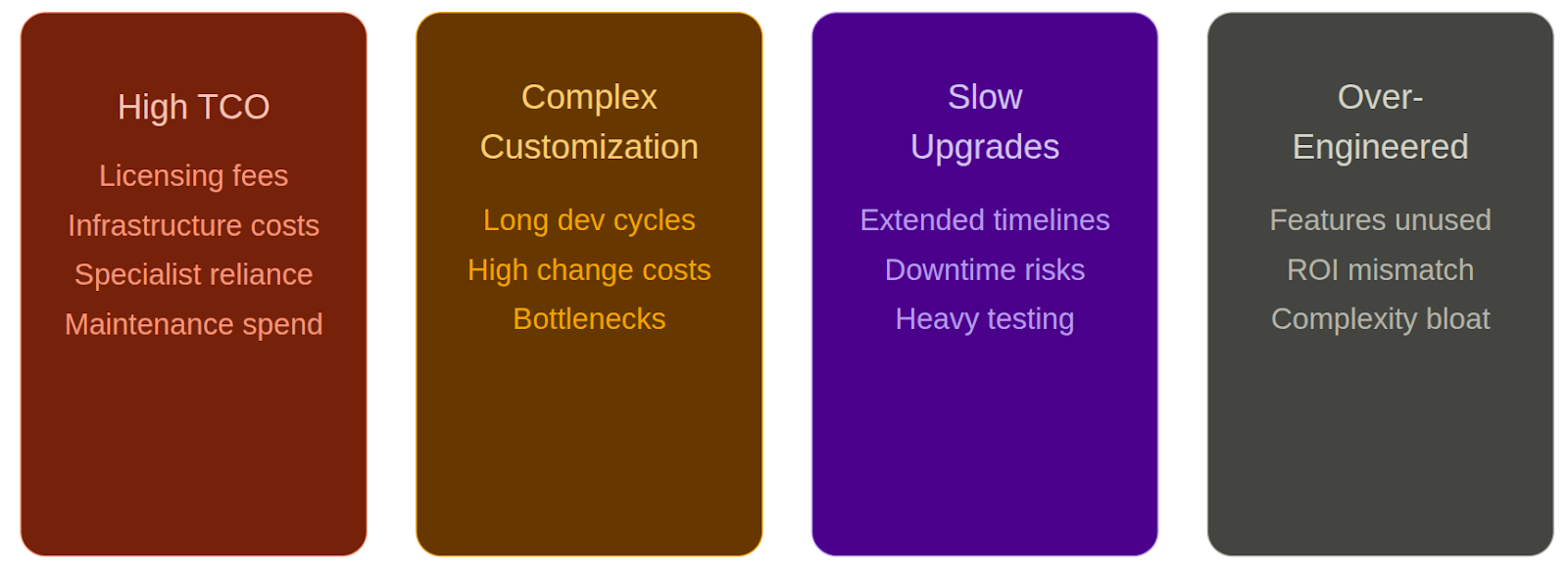
Let’s explore the key factors behind this transition.
1. High Total Cost of Ownership (TCO)
One of the most significant challenges with SAP HANA is its overall cost structure. Beyond the initial investment, businesses must account for ongoing expenses that can steadily increase over time.
Key cost drivers include:
- High licensing and subscription fees.
- Significant infrastructure investment, particularly for on-premise deployments.
- Continuous maintenance, upgrades, and support costs.
- Dependence on highly specialized (and often expensive) SAP consultants.
For many organizations, particularly in the mid-market segment, this results in a high total cost of ownership that doesn’t always align with actual usage or business value. As a result, companies begin exploring ERP solutions that offer a more balanced cost-to-value ratio.
2. Complex Customization and Limited Flexibility
Modern businesses require ERP systems that can evolve quickly alongside changing processes and market demands. However, customizing SAP HANA to meet these evolving needs can be challenging.
Common limitations include:
- Heavy reliance on specialized development expertise.
- Longer development and deployment cycles.
- High costs associated with even minor modifications.
This level of complexity often creates bottlenecks, making it difficult for organizations to innovate or adapt workflows in real time. Over time, this rigidity can hinder business responsiveness and slow down digital transformation initiatives.
3. Lengthy Implementation and Upgrade Cycles
Implementing or upgrading SAP HANA is typically a large-scale project that demands significant time, resources, and planning.
Organizations often face:
- Extended implementation timelines.
- Resource-intensive deployment processes.
- High risk during system transitions.
Upgrades, in particular, require extensive testing, validation, and sometimes system downtime. Without careful execution, these upgrades can disrupt business continuity, making agility a challenge in fast-moving markets.
4. Over-Engineering for Mid-Sized Enterprises
SAP HANA is designed to cater to highly complex enterprise environments. However, this level of sophistication can become a disadvantage for organizations with simpler operational needs.
Many businesses find that:
- Only a fraction of the available features are actively used.
- The system feels overly complex for day-to-day operations.
- The cost and effort required to maintain the system outweigh its benefits.
This mismatch often leads to underutilization of capabilities and inefficiencies in ROI, prompting businesses to consider more streamlined and adaptable ERP solutions.
Why Odoo is Becoming the Preferred ERP Alternative
As businesses move toward more agile and cost-efficient operations, Odoo is emerging as a strong alternative to traditional ERP systems. Its flexibility, scalability, and modern architecture align closely with the needs of organizations looking to simplify operations without compromising on functionality.
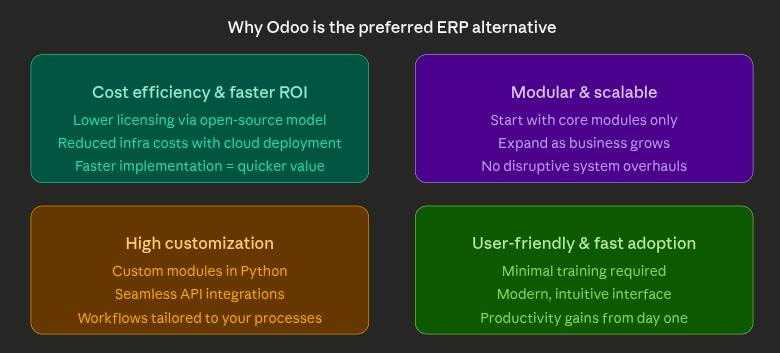
Here’s what makes Odoo a preferred choice for ERP transformation.
1. Cost Efficiency and Faster ROI
One of the most compelling advantages of Odoo is its ability to deliver enterprise-grade functionality without the heavy cost burden typically associated with traditional ERP systems.
Key financial benefits include:
- Significantly lower licensing costs due to its open-source model.
- Reduced infrastructure expenses, especially with cloud-based deployments.
- Faster implementation cycles, leading to quicker time-to-value.
- Less dependency on niche or highly specialized consultants.
Together, these factors enable businesses to achieve a faster and more predictable return on investment, making ERP adoption more accessible and sustainable.
2. Modular and Scalable Architecture
Odoo’s modular design allows businesses to adopt ERP at their own pace, rather than committing to a full-scale implementation from day one.
This approach enables organizations to:
- Start with core modules such as Sales, Accounting, or Inventory.
- Expand functionality incrementally as business needs evolve.
- Scale operations without undergoing disruptive system overhauls.
This flexibility supports a phased digital transformation strategy, reducing both risk and upfront investment.
3. High Customization and Flexibility
Unlike rigid ERP systems, Odoo is built to adapt. Its open architecture empowers businesses to tailor the platform to their unique workflows and industry requirements.
Key capabilities include:
- Easy customization of business processes and workflows.
- Development of custom modules using Python and the Odoo framework.
- Seamless integration with third-party applications via APIs.
This ensures that the ERP system evolves alongside the business, rather than becoming a constraint.
4. User-Friendly Interface and Faster Adoption
User adoption is often a major challenge in ERP implementations, but Odoo addresses this with a clean, intuitive interface designed for modern users.
As a result:
- Employees require minimal training to get started.
- Teams can quickly adapt to the system.
- Productivity improves across departments.
A user-friendly ERP significantly reduces resistance to change, which is critical for successful digital transformation.
5. Strong Community and Ecosystem
Odoo is backed by a large and active global ecosystem that continuously contributes to its growth and innovation.
This ecosystem provides:
- A vast network of developers, partners, and solution providers.
- Regular updates, enhancements, and new feature releases.
- A wide range of industry-specific modules and extensions.
This not only accelerates innovation but also reduces dependency on a single vendor, giving businesses greater control over their ERP strategy.
Key Business Benefits of SAP HANA to Odoo Migration
Migrating from SAP HANA to Odoo is not just a system replacement; it’s a strategic move that delivers measurable business value across cost, agility, and operational efficiency. Here’s how organizations benefit from this transition:
1. Reduced Operational Costs
One of the most immediate and tangible benefits of migration is cost optimization. By moving to Odoo, businesses can significantly lower both direct and indirect ERP expenses.
Key cost advantages include:
- Reduced licensing and subscription costs due to Odoo’s flexible pricing model.
- Lower maintenance and upgrade expenses compared to traditional ERP systems.
- Decreased IT overhead with simplified infrastructure and cloud-ready deployment.
This allows organizations to reallocate IT budgets toward innovation and growth initiatives rather than system upkeep.
2. Improved Business Agility
In today’s dynamic market environment, the ability to adapt quickly is critical. Odoo enables businesses to operate with greater responsiveness and flexibility.
This translates into:
- Faster response to changing customer demands and market conditions.
- Real-time visibility into operations, enabling quicker and more informed decision-making.
- The ability to modify workflows and processes without long development cycles.
As a result, organizations become more agile, resilient, and competitive.
3. Enhanced Process Automation
Automation is a key driver of efficiency, and Odoo provides built-in capabilities to streamline end-to-end business processes.
Automation benefits include:
- Streamlined workflows across finance, inventory, sales, and HR.
- Reduced manual intervention and dependency on repetitive tasks.
- Minimization of human errors, leading to improved data accuracy.
This leads to higher productivity, faster execution, and consistent process outcomes across departments.
4. Unified Business Operations
Many organizations operate with fragmented systems that create data silos and inefficiencies. Odoo addresses this by bringing all core business functions into a single, integrated platform.
Key outcomes include:
- Consolidation of multiple standalone systems into one unified ERP.
- Centralized data repository for accurate and consistent reporting.
- Improved cross-functional collaboration and transparency.
With a single source of truth, businesses can make data-driven decisions with greater confidence and clarity.
How Ksolves Ensures Seamless SAP HANA to Odoo Migration with an AI-Driven Execution
Migrating from SAP HANA to Odoo is a complex transformation that requires precision, speed, and minimal disruption to business operations. At Ksolves, this process is accelerated and de-risked through a structured, AI-driven migration framework designed to ensure accuracy, efficiency, and faster time-to-value.
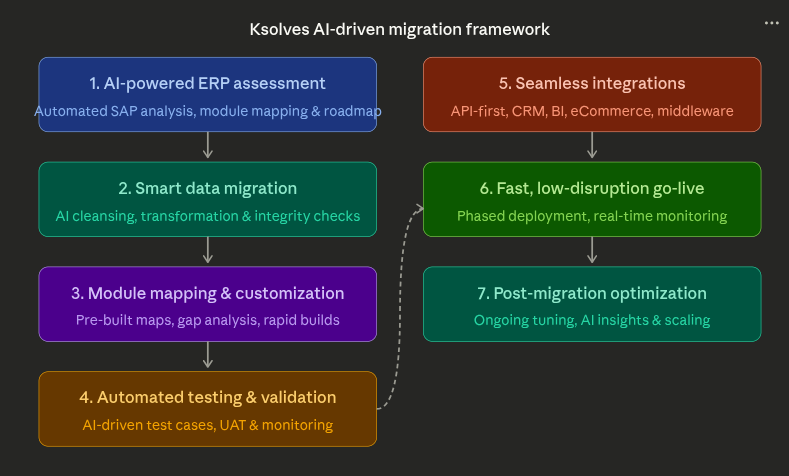
Here’s how Ksolves delivers a seamless migration experience:
1. AI-Powered ERP Assessment and Migration Planning
Ksolves begins with a comprehensive assessment of the existing SAP landscape using AI-assisted analysis tools.
This includes:
- Automated analysis of SAP data structures, tables, and dependencies.
- Identification of redundant, obsolete, or duplicate data.
- Intelligent mapping of SAP modules to Odoo equivalents.
- Data-driven recommendations for migration scope and prioritization.
- Mapped SAP tables to Odoo models using pre-built mapping frameworks covering 110+ SAP tables across FICO, SD, MM, PP, and PM, reducing assessment time from 2 weeks to 2 days.
This approach ensures a well-defined migration roadmap, reducing uncertainties and accelerating decision-making.
2. Smart Data Migration and Transformation
Data migration is one of the most critical aspects of ERP transformation. Ksolves leverages AI to enhance both speed and accuracy in this phase.
Key capabilities include:
- Automated data extraction and classification from SAP HANA.
- AI-generated transformation scripts handle SAP BSEG, KNA1, LFA1, and MARA table exports and map them to Odoo’s master models automatically, not manually.
- AI-assisted data cleansing to eliminate inconsistencies.
- Intelligent transformation and mapping to align with Odoo data models.
- Validation frameworks to ensure data integrity and completeness.
This minimizes manual effort while ensuring high-quality, error-free data migration.
3. Accelerated Module Mapping and Customization
Ksolves combines domain expertise with AI-driven insights to streamline module mapping and customization.
Approach includes:
- Pre-built mapping frameworks for common SAP modules (Finance, Sales, Inventory, Manufacturing).
- Gap analysis supported by AI recommendations.
- Rapid development of custom modules aligned with business workflows.
- Reusable components to reduce development time.
This enables faster configuration of Odoo while maintaining alignment with existing business processes.
4. Intelligent Automation of Testing and Validation
Testing is often time-consuming and resource-intensive in ERP migrations. Ksolves optimizes this phase through automation.
This involves:
- Automated test case generation with AI based on a client’s existing SAP transaction history.
- AI-driven validation of migrated data and system performance.
- Continuous monitoring for discrepancies and anomalies.
- Faster User Acceptance Testing (UAT) cycles.
The result is a highly reliable system with reduced risk at go-live.
5. Seamless Integration with Existing Systems
For businesses operating in hybrid IT environments, integration is critical. Ksolves ensures smooth connectivity between Odoo and other enterprise systems.
Integration capabilities include:
- API-first architecture for real-time data exchange.
- Integration with CRM, BI tools, eCommerce platforms, and third-party applications.
- Middleware support for complex ecosystems.
This ensures business continuity without disrupting existing workflows.
6. Faster Go-Live with Minimal Business Disruption
Ksolves follows a structured deployment strategy to ensure a smooth transition.
Execution approach:
- Phased or parallel deployment based on business needs.
- Real-time monitoring during go-live.
- Immediate issue resolution through AI-assisted diagnostics.
This enables organizations to go live faster and with confidence, minimizing downtime.
7. Post-Migration Optimization and Continuous Improvement
Migration is just the beginning. Ksolves continues to deliver value through ongoing optimization.
Post-go-live support includes:
- Performance monitoring and system tuning.
- Continuous enhancements based on user feedback.
- AI-driven insights for process optimization.
- Ongoing support and scalability planning.
This ensures that businesses maximize the long-term value of their Odoo investment.
Real-World Success: From SAP HANA to Odoo in Just One Week by Ksolves
A leading manufacturing enterprise operating across multiple plants in India partnered with Ksolves to transition from SAP HANA to Odoo, without disrupting its 24×7 operations.
Despite managing high-volume daily logistics (30–40 inbound and 20–30 outbound shipments) and supporting 60–70+ active ERP users, the company successfully went live on Odoo in just 1 week. This was made possible through Ksolves’ AI-driven execution approach, which accelerated data migration, module setup, and system configuration while ensuring business continuity.
Key highlights:
- 1-week go-live, compared to typical 3–4 week timelines.
- Zero operational downtime during migration.
- Seamless transition for 60+ users across four plants.
- Immediate deployment of Sales, Purchase, Inventory, and Invoicing processes.
- Reduced system overhead and improved flexibility post-migration.
This case demonstrates how a well-planned, AI-assisted migration strategy can deliver speed, stability, and long-term scalability, even in complex manufacturing environments.
Final Words
Migrating from SAP HANA to Odoo is a strategic step toward greater agility, scalability, and cost efficiency. Odoo, with its modular architecture, flexibility, and lower total cost of ownership, offers a practical path forward, enabling organizations to simplify operations while retaining full control over their processes.
However, the success of such a transformation depends heavily on execution. A well-planned migration, supported by the right expertise and intelligent automation, can significantly reduce risks, accelerate timelines, and ensure business continuity.
With Ksolves as an Odoo Implementation partner, this shift becomes faster, safer, and outcome-driven. By combining AI-powered execution with deep Odoo expertise, Ksolves ensures minimal disruption, rapid go-live, and a system that delivers measurable business impact from day one, helping organizations turn ERP migration into a long-term competitive advantage.
































AUTHOR
Odoo
Share with