Project Name
RabbitMQ v3 to v4 Production Cluster Upgrade
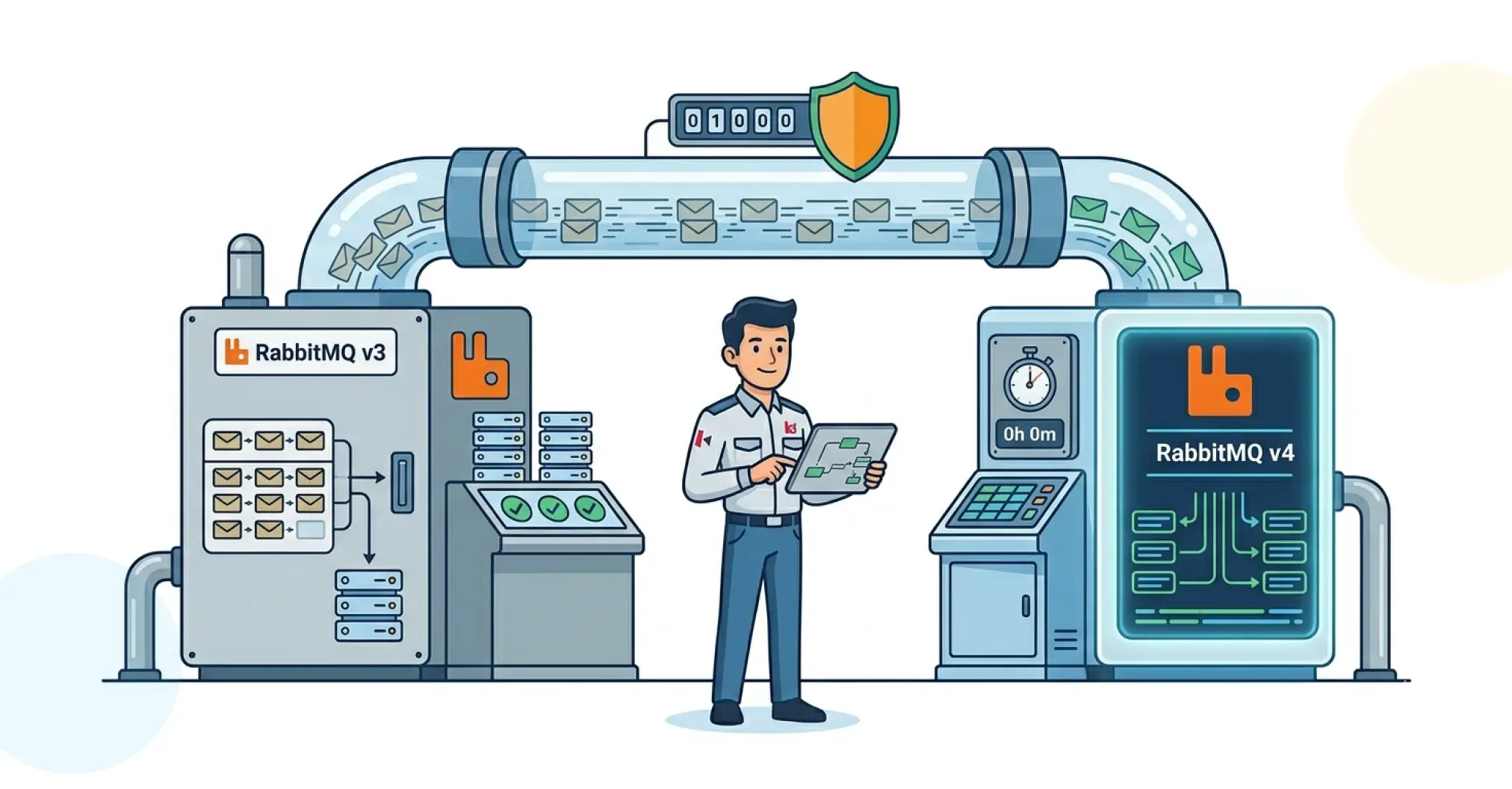

Upgrading a production RabbitMQ cluster is not routine maintenance, as it is a precision operation. A single misstep during version alignment, queue migration, or node promotion can mean lost messages, split-brain cluster failure, or hours of unplanned downtime across every application that depends on the broker.
A client running a production RabbitMQ v3. x cluster with Classic Mirrored Queues and Erlang 26x needed to move to v4. x, an upgrade that introduced Quorum Queues as the production-recommended queue type, deprecated Classic Mirrored Queues, and required a simultaneous Erlang runtime upgrade that could not be performed as a simple in-place swap on a live cluster.
The client engaged Ksolves to plan and execute the full upgrade, from pre-upgrade assessment through post-go-live tuning, with an explicit requirement for zero data loss and minimal service disruption across all dependent applications. We designed and delivered a five-step rolling upgrade methodology: Assessment, Staging, Rolling Upgrade, Validation, and Monitoring.
The challenges faced by the client are as follows:
- Erlang Runtime Version Alignment (26x to 27x): RabbitMQ v4. x required an Erlang runtime upgrade from 26x to 27x. Because the two versions are tightly coupled, an incompatible Erlang version on any single node during a rolling upgrade would prevent that node from rejoining the cluster, making precise sequencing across all nodes critical.
- Breaking Changes Between v3 and v4: RabbitMQ v4. x introduced deprecated Classic Mirrored Queue policies, changed default configurations, and removed legacy behaviors. Without a thorough compatibility assessment, deprecated configurations active in production would silently break or prevent node startup on v4.x.
- Migrating Classic Mirrored Queues to Quorum Queues: Classic Mirrored Queues are deprecated in v4.x in favor of Quorum Queues, which use the Raft consensus protocol. Migrating live queues with persistent message backlogs between these fundamentally different queue types required a carefully controlled cutover sequence to prevent message loss or delivery duplication.
- Persistent Message Backlog During Upgrade: The production cluster carried active message backlogs at upgrade time. Any node restart or queue migration that did not account for in-flight and persisted messages risked losing unprocessed messages, an unacceptable outcome for the client's dependent services.
- Zero Downtime Constraint: A full cluster restart, the simplest upgrade path, was not acceptable. The upgrade had to be performed as a rolling, node-by-node operation with no window during which all nodes were simultaneously unavailable, while dependent services continued to publish and consume messages throughout.
Ksolves designed a structured five-step upgrade methodology (Assessment, Staging, Rolling Upgrade, Validation, and Monitoring) purpose-built to eliminate the highest-risk failure modes in a major version upgrade in live production.
- Pre-Upgrade Assessment and Planning: A comprehensive analysis of the production cluster was conducted, including RabbitMQ and Erlang version inventory, active queue types and mirroring policies, consumer and publisher connectivity audit, identification of deprecated configurations, and persistent backlog sizing. A detailed upgrade plan with rollback checkpoints was signed off on before any production action was taken.
- Staging Environment Build and Validation: A staging environment was built to mirror the production cluster, with the same node count, queue topology, starting version, and equivalent message load. The complete upgrade sequence was rehearsed end-to-end on staging before the production upgrade was authorized to proceed.
- Rolling Node-by-Node Upgrade on Production: Each production node was gracefully removed from the cluster, upgraded to Erlang 27x, and RabbitMQ v4. x, and reintroduced before the next node was touched, maintaining cluster quorum and availability throughout. Node-level health checks, queue synchronisation confirmation, and message routing validation were performed at each step.
- Controlled Queue Migration and Policy Cleanup: Classic Mirrored Queues were migrated to Quorum Queues in a controlled sequence: new Quorum Queue definitions were created, consumers migrated, publisher routing updated, persistent backlogs drained to completion, and old queue instances removed. Deprecated mirroring policies were cleaned up to ensure a fully compatible cluster state.
- Post-Upgrade Performance Tuning and Observability: Following migration sign-off, Quorum Queue configuration was optimized for the client's throughput and latency profile, and memory and disk alarms were recalibrated for v4. x defaults, and an enhanced observability stack was deployed, covering cluster health metrics, queue depth monitoring, consumer lag alerting, and node-level performance dashboards.
Technology Stack
| Category | Technology | Role in This Engagement |
|---|---|---|
| Messaging | RabbitMQ v3.x to v4.x | Production message broker and core platform for the engagement, requiring version-compatible node sequencing, breaking-change mitigation, and Quorum Queue adoption. |
| Runtime | Erlang 26.x to 27.x | Upgraded in parallel with RabbitMQ, with strict version alignment maintained at each node transition during the rolling upgrade process. |
| Queue Architecture | Classic Mirrored Queues to Quorum Queues | Migrated to Raft consensus-based replication through a controlled publisher and consumer cutover process while preserving all persistent backlogs. |
| Methodology | Rolling Upgrade (Node-by-Node) | Ensured cluster quorum and application availability throughout the upgrade by gracefully removing, upgrading, and reintroducing each node sequentially. |
| Observability | Cluster Health and Queue Monitoring Stack | Implemented real-time monitoring for cluster health metrics, Quorum Queue depth, consumer lag alerts, and node performance dashboards post-upgrade. |
- Seamless Upgrade Delivered with Minimal Disruption: The complete upgrade to RabbitMQ v4. x and Erlang 27x were executed across all production nodes using a rolling strategy, with all dependent application services remaining operational throughout the maintenance window.
- Zero Data Loss Across All Queues and Backlogs: Zero messages were lost during the upgrade and queue migration. The controlled cutover sequence, covering new Quorum Queue creation, consumer migration, publisher rerouting, backlog drain, and legacy queue removal, preserved complete message delivery integrity across all affected queues.
- Classic Mirrored Queues Fully Replaced by Quorum Queues: All production queues now operate as Quorum Queues, delivering stronger consistency guarantees via Raft consensus, improved performance under load, and full forward compatibility with RabbitMQ v4.x, with all deprecated mirroring policies removed and cluster state cleaned.
- Improved Cluster Performance and Stability: Quorum Queues deliver measurably improved throughput and reduced replication overhead versus Classic Mirrored Queues under the client's production load profile. Post-upgrade performance tuning further optimized memory and disk alarm thresholds for v4. x defaults.
- Enhanced Security and Observability: RabbitMQ v4. x security enhancements are active across the cluster. The new observability stack, covering cluster health, queue depth, consumer lag alerting, and node performance dashboards, replaced reactive incident response with proactive, real-time monitoring.

“We expected the RabbitMQ upgrade to be our biggest infrastructure risk of the quarter. Ksolves made it a non-event. The rolling approach meant our applications never lost connectivity, every message was preserved, and the new Quorum Queue setup is noticeably more stable under load.”
-Head of Infrastructure (name withheld by request)
The client’s production cluster ran on a deprecated Erlang 26x runtime with Classic Mirrored Queues and no validated upgrade path that could meet zero data loss and minimum downtime requirements. As part of our RabbitMQ consulting services, we at Ksolves, an AI-First company, delivered a complete, production-validated upgrade to RabbitMQ v4.x and Erlang 27x using a five-step rolling methodology, with zero data loss, zero message duplication, and minimal service disruption throughout.
The phased approach, combining staging validation before any production action, node-by-node rolling upgrade to maintain quorum, and controlled queue migration with backlog drain, eliminated the three highest-risk failure modes: cluster split-brain, message loss, and extended downtime.
Classic Mirrored Queues are fully replaced by Quorum Queues across the production cluster, delivering stronger consistency, improved throughput, and full forward compatibility with RabbitMQ’s v4.x roadmap. The post-upgrade observability stack gives the operations team the visibility needed to manage the cluster proactively from day one.
Need a Zero-Downtime Rabbitmq Upgrade Without Risking Message Loss