



Enhance Drug Discovery and Clinical Trials with Agentic AI
AI
5 MIN READ
February 18, 2026

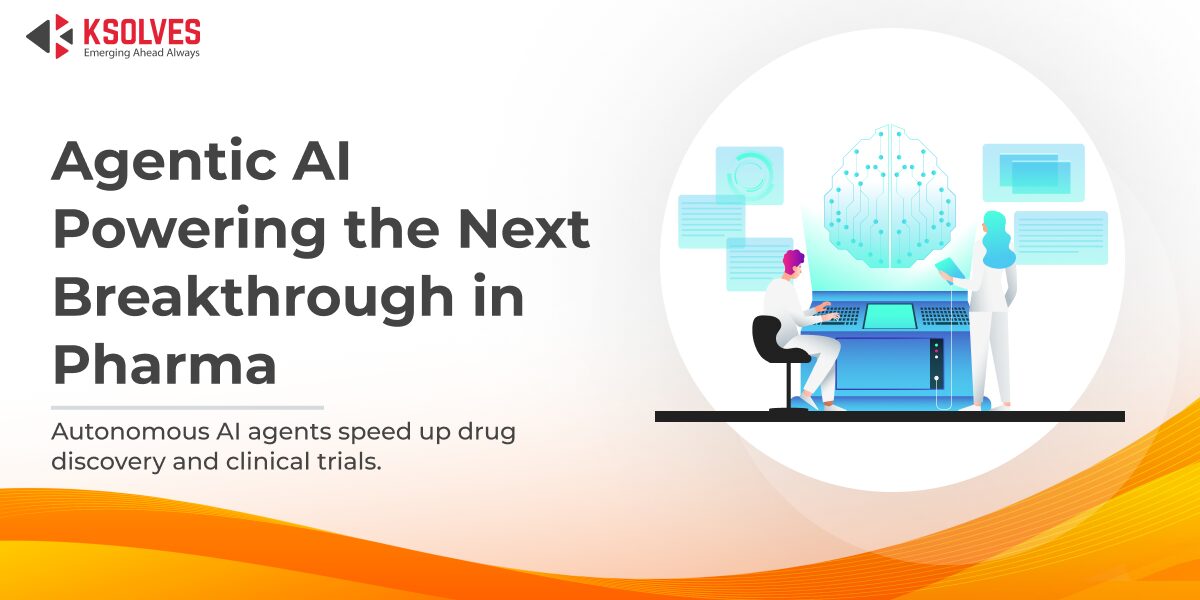
The pharmaceutical industry continues to face significant hurdles like development costs exceeding billions, timelines often exceeding a decade, and success rates that remain low. Agentic AI introduces a powerful new paradigm. These autonomous, goal-driven systems can reason, plan, use tools, and execute complex multi-step tasks with limited human intervention.
Built on large language models and integrated with specialized tools, agentic AI adapts dynamically to uncertainty and pursues objectives efficiently. In drug discovery and clinical trials, agentic AI is transforming processes from target identification and compound design to patient recruitment, adaptive trial design, and real-time data analysis.
This blog examines the technical applications, proven examples, and practical considerations of agentic AI in these domains.
The Urgent Need for Innovation in Pharma
Drug development remains one of the most expensive and risky scientific endeavors. A study estimates the mean cost of developing a new drug at $879.3 million (2018 dollars) when including both failures and capital costs. These high costs, combined with prolonged timelines and limited success rates, create a strong imperative for technologies that can accelerate discovery, minimize failures, and streamline clinical development. Agentic AI stands out as a critical enabler of such transformation.
Revolutionizing Drug Discovery with Agentic AI
Agentic AI agents manage intricate workflows in drug discovery by combining reinforcement learning, generative modeling, graph-based methods, and multi-agent collaboration.
- Target Identification: Agents query multi-omics databases and use graph neural networks (GNNs) to model disease pathways and protein interactions. Multi-objective optimization prioritizes targets based on druggability, novelty, and therapeutic relevance.
- Virtual Screening and Hit Identification: Agents screen billions of compounds using AI-accelerated molecular docking and reinforcement learning to explore chemical space efficiently. High-accuracy protein-ligand interaction predictions are informed by models such as AlphaFold 3.
- Lead Optimization: Generative models (diffusion models and GANs) create novel molecules. Dedicated agents evaluate stability, toxicity, and ADMET properties using molecular dynamics and predictive models. Multi-agent systems automate iterative design-test-refine cycles.
Real-world example: Insilico Medicine’s Pharma.AI platform, driven by agentic workflows, discovered a novel inhibitor for idiopathic pulmonary fibrosis in only 18 months, significantly faster than conventional approaches.
| AI Technique | Application | Key Benefit |
| Reinforcement Learning | Chemical space exploration | Reduces screening time from months to days |
| Graph Neural Networks | Protein-ligand interaction modeling | Improves prediction accuracy by 20-30% |
| Generative Models | De novo molecule design | Generates 1000+ viable candidates per run |
| Multi-Agent Systems | Workflow orchestration | Automates end-to-end discovery pipelines |
Accelerating Clinical Trials with Agentic AI
Clinical trials require sophisticated logistics, data integration, and real-time decision-making. Agentic AI agents optimize these processes across several key areas.
- Patient Recruitment and Enrollment: Natural language processing extracts eligibility criteria from protocols. Agents analyze electronic health records using federated learning to ensure privacy while identifying and matching suitable patients. This approach can reduce recruitment timelines by up to 40%.
- Data Integration and Analysis: Multi-agent systems harmonize heterogeneous data from wearables, labs, and imaging. They apply survival analysis, mixed-effects models, and automated CDISC-compliant reporting to deliver rapid insights.
Overcoming Implementation Challenges
Deploying agentic AI requires careful attention to several factors:
- Data Quality and Bias: Addressed through adversarial debiasing and diverse training datasets.
- Explainability: Methods such as SHAP and LIME provide transparency into agent decisions.
- Regulatory Compliance: FDA guidelines stress rigorous validation, robustness testing, and human-in-the-loop oversight.
- Scalability: Cloud-native frameworks such as LangChain and AutoGen support distributed agent deployment.
In the near future, swarm intelligence (coordination among thousands of agents) is expected to shorten discovery timelines further.
Effective implementation of agentic AI demands specialized expertise. Agentic AI Consulting Services from Ksolves provide end-to-end support, including custom multi-agent architecture design, integration with existing pharmaceutical systems, and regulatory compliance guidance. By leveraging frameworks like AutoGen and CrewAI, our experts enable companies to deploy scalable, high-impact agentic workflows tailored to their needs.
































Author
About the Author Editorial Team The Ksolves Editorial Team includes certified Salesforce experts, Big Data engineers, AI/ML specialists, Zoho consultants, and experienced technology writers focused on delivering clear, actionable insights for modern businesses. With hands-on experience across Salesforce, Big Data platforms, AI/ML solutions, application development, software testing, and Zoho ERP/CRM, the team publishes practical guides, real-world use cases, and industry updates that support smarter decisions and faster growth. Every article is created to solve business challenges, guide technology adoption, and keep organizations aligned with evolving digital ecosystems.
Share with