



Compare Snowflake and Talend Cloud Data Integration
Big Data
5 MIN READ
January 23, 2026

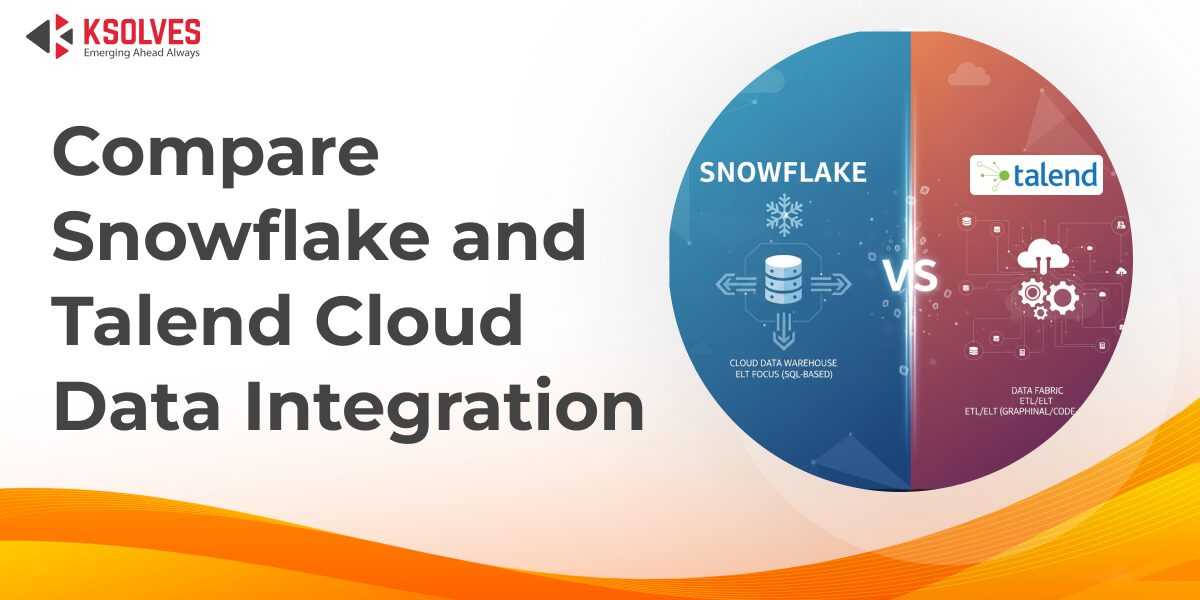
When it comes to managing and making sense of data, one size doesn’t fit all. Whether you’re a data engineer, a business analyst, or someone simply trying to get clean, reliable insights from your systems, choosing the right tools is critical.
Two popular names that frequently appear in conversations about cloud data platforms are Snowflake and Talend Cloud Data Integration. Both are powerful in their own ways, but they serve very different purposes. And if you’ve ever wondered how they truly compare in the real world, you’re not alone.
Let’s break it down in simple terms. No jargon. Just honest comparisons to help you make the right choice for your data stack.
What is Snowflake?
Snowflake is a cloud-native data warehouse designed to handle modern analytics workloads with speed and scalability. Unlike traditional warehouses, it separates storage from compute, allowing businesses to scale resources independently and pay only for what they use.
Key Features:
- Elastic Scalability: Instantly scale compute power up or down depending on workload demand.
- Cross-Cloud Support: Runs seamlessly on AWS, Azure, and Google Cloud.
- Data Sharing & Collaboration: Enables secure sharing of live data across organizations without duplication.
- Semi-structured Data Handling: Native support for JSON, Avro, and Parquet.
- Security First: End-to-end encryption, role-based access controls, and compliance with major standards (HIPAA, SOC2, GDPR).
What is Talend?
Talend is not a warehouse; it is a data integration and data quality platform that helps organizations connect disparate data sources, ensure governance, and maintain trust in data. With its Data Fabric suite, Talend covers ETL, API services, and real-time pipeline orchestration.
Key Features:
- End-to-End Integration: Connects cloud, on-premises, and hybrid systems.
- Data Quality & Governance: Includes Talend Trust Score™, lineage tracking, and compliance support.
- Real-Time Streaming: Capable of handling batch and streaming data.
- Embedded Data Prep Tools: Cleansing, transformation, and enrichment at scale.
- Native Snowflake Integration: Talend runs inside Snowflake using Snowpark and UDFs, optimizing performance while preserving governance.
Comparison Between Snowflake vs Talend
There are some other comparison factors that show the difference between Snowflake vs Talend.
- Query Language Capabilities: Snowflake Dominates
Snowflake clearly wins when it comes to query language flexibility. Reviewers praise its SQL support and advanced capabilities that allow data analysts to write complex queries with ease. Whether you are analyzing millions of rows or joining multiple tables across schemas, Snowflake delivers fast, accurate results.
On the other hand, Talend supports SQL as part of its ETL workflows; its core focus isn’t query execution; it’s integration and transformation. This makes Talend better suited for preparing data before it reaches a warehouse like Snowflake.
Bottom Line: If you need to run complex queries directly on your data warehouse, Snowflake is the clear leader.
- Data Lake Analytics: Snowflake Scales with Your Data
Snowflake’s architecture was designed for massive data scale, and it shows. Users highlight how well Snowflake handles data lake-style analytics, making it an ideal choice for organizations dealing with huge datasets, such as in finance, retail, or healthcare.
Talend, while a strong data pipeline and ETL tool, doesn’t specialize in long-term storage or querying of large volumes of unstructured data. It integrates well with data lakes, but is not a data lake platform itself.
Bottom Line: For enterprise-scale analytics and data lake workloads, Snowflake is better equipped.
- Real-Time Integration: Snowflake Stays Ahead
Snowflake’s real-time integration features, including Snowpipe and streaming support, make it possible to analyze fresh data as it flows in. This is critical for use cases like fraud detection, customer personalization, and IoT analytics.
Talend does support real-time data pipelines, especially when using its Spark or Kafka integrations, but reviewers say it doesn’t quite match Snowflake’s performance or ease in this area. Some users report occasional lag or setup complexity.
Bottom Line: For real-time processing at scale, Snowflake provides smoother performance and faster insights.
- Ease of Use: Designed for Broader Teams
One of Snowflake’s standout features is its user-friendly experience. Users across different skill levels, from data scientists to business analysts, say it’s easy to onboard and work within the platform.
Talend, while powerful, has a slightly steeper learning curve, particularly for users unfamiliar with ETL/ELT processes or its component-based design. Some teams report needing additional training or support to fully utilize their capabilities.
Bottom Line: If ease of onboarding and accessibility matter, Snowflake is more intuitive for cross-functional teams.
- Performance Analytics: Snowflake Provides Deeper Insights
Monitoring and optimizing data workflows is crucial, and Snowflake’s built-in performance tools, including query history, warehouse monitoring, and usage dashboards, help teams make data-driven infrastructure decisions.
Talend, while it does offer logging and monitoring for pipelines, doesn’t provide the same level of visibility into processing performance. Some users feel less informed when trying to troubleshoot or optimize workloads.
Bottom Line: For workflow transparency and system optimization, Snowflake provides richer performance tools.
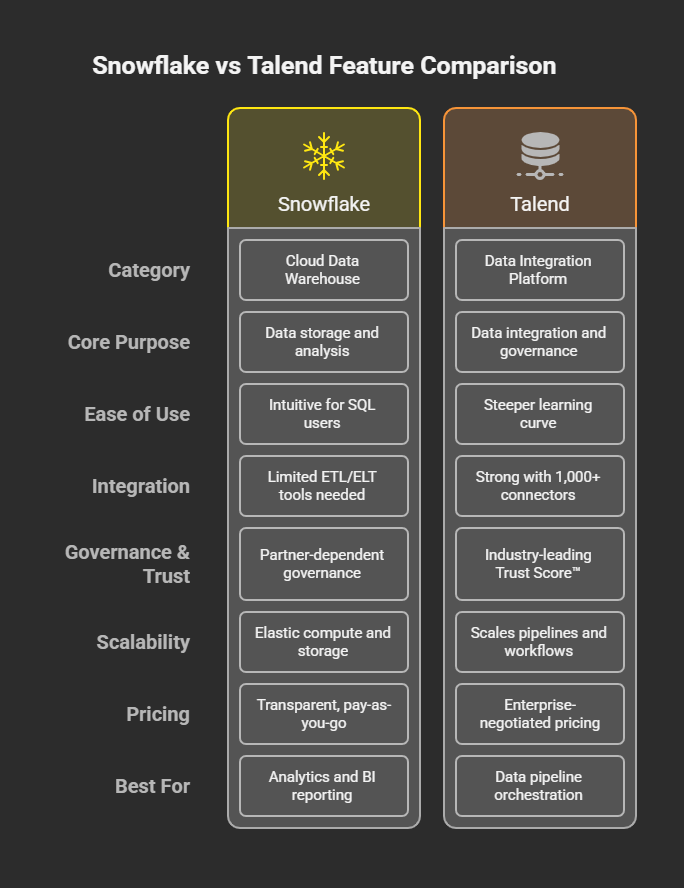
When to Choose Snowflake, Talend, or Both
- Choose Snowflake if: Your business relies heavily on analytics, BI reporting, and scalable data warehousing.
- Choose Talend if: You need strong integration pipelines, compliance-driven governance, and trusted data management across complex ecosystems.
- Choose Both if: You want a powerful combination—Talend for integration and governance, Snowflake for analytics and storage. Many enterprises adopt both for end-to-end data modernization.
Conclusion
Snowflake and Talend are not direct competitors as much as they are complementary pillars of a modern data stack. Snowflake shines as a cloud-native data warehouse built for speed, scale, and analytics. Talend, in contrast, stands out as a data integration and governance powerhouse, ensuring that the data entering analytics platforms is accurate, trusted, and compliant. The choice between them depends on your business priorities.
At Ksolves, we simplify this journey by offering end-to-end Snowflake consulting services and ongoing support, helping enterprises modernize their data architecture with confidence and efficiency.
































AUTHOR
Big Data
Anil Kushwaha, Technology Head at Ksolves, is an expert in Big Data. With over 11 years at Ksolves, he has been pivotal in driving innovative, high-volume data solutions with technologies like Nifi, Cassandra, Spark, Hadoop, etc. Passionate about advancing tech, he ensures smooth data warehousing for client success through tailored, cutting-edge strategies.
Share with