



When to Move from Internal Kafka Monitoring to External Kafka Support Service
Big Data
5 MIN READ
December 24, 2025

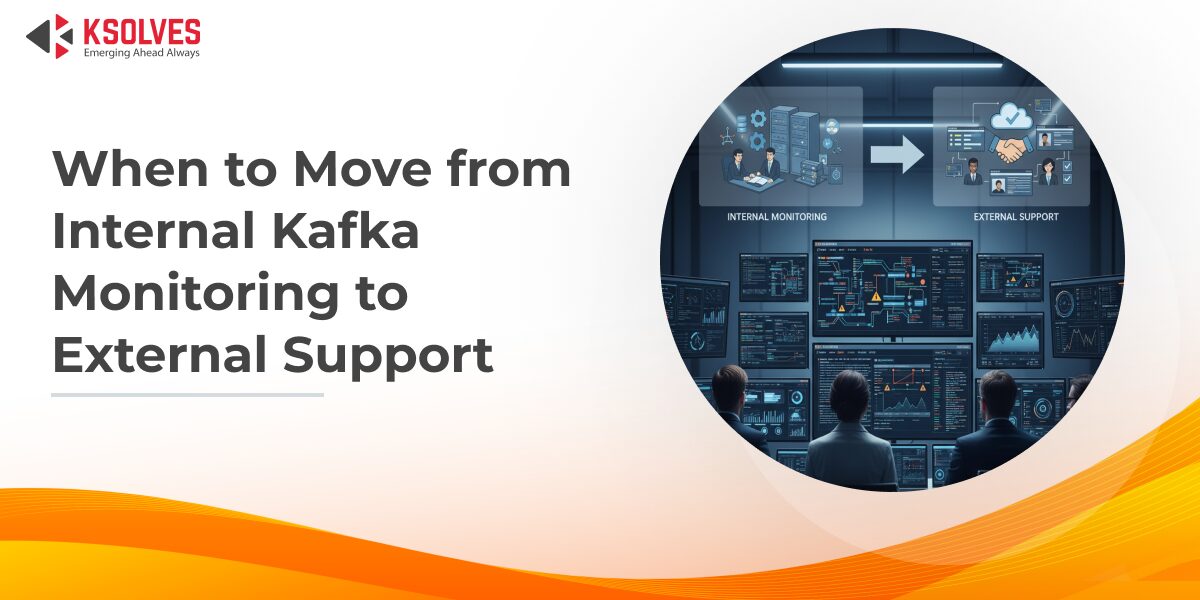
Apache Kafka has become the backbone of real-time data streaming for modern enterprises. Whether you’re building event-driven architectures, microservices, or large-scale data pipelines, Kafka ensures reliable, scalable, and fault-tolerant message streaming. However, managing Kafka internally can be complex and resource-heavy. At some point, organizations need to ask: Is it time to move from internal Kafka monitoring to an external Kafka support service?
In this blog, we’ll explore the signs that indicate the need for external help, the benefits of leveraging expert Kafka support services, and why a trusted partner like Ksolves can help you optimize performance and scale seamlessly.
Understanding Internal Kafka Monitoring
Many organizations begin their Kafka journey by handling monitoring internally. This usually involves:
- Using open-source monitoring tools such as Prometheus, Grafana, and Kafka Manager.
- Assigning internal DevOps teams to set up alerts and dashboards for broker health, consumer lag, and throughput.
- Tracking key performance metrics like partition distribution, topic replication, and disk usage.
- Handling incident response in case of downtime or bottlenecks.
While internal monitoring gives teams more control, it comes with hidden challenges, including a lack of expertise, 24×7 monitoring requirements, and difficulty scaling Kafka clusters during peak loads.
Challenges of Relying Solely on Internal Monitoring
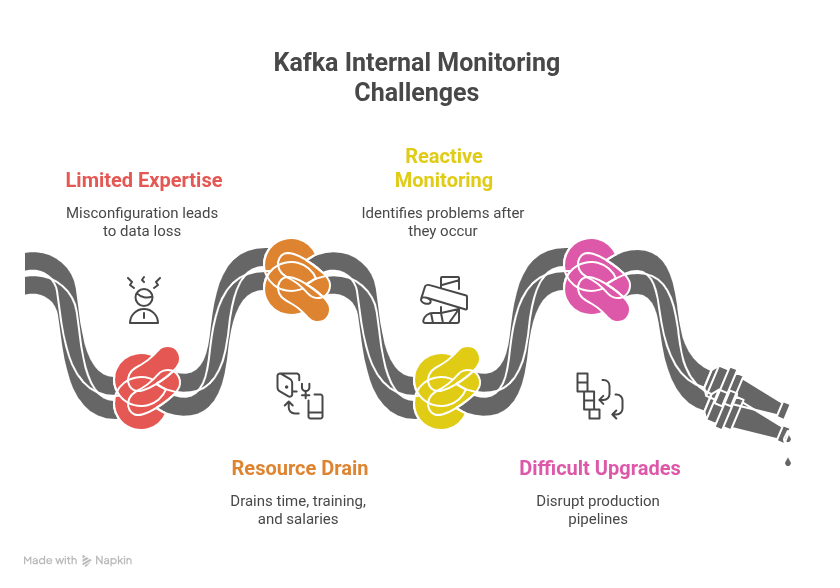
1. Limited Expertise
Kafka is not a simple message queue but a distributed streaming platform with intricacies around brokers, zookeepers (or KRaft in newer versions), partitions, and replication. Without deep expertise, it’s easy to misconfigure settings, which can lead to performance degradation or data loss.
2. Resource Drain
Maintaining an in-house Kafka monitoring team requires significant investment in time, training, and salaries. Smaller IT teams often struggle to balance Kafka monitoring with other critical tasks.
3. Reactive, Not Proactive
Internal monitoring often identifies problems only after they’ve occurred, such as consumer lag spikes or unbalanced partitions. Proactive prevention of issues, however, requires specialized skills and predictive analytics.
4. Difficulty in Kafka Upgrades
Every Kafka upgrade service involves compatibility checks, downtime planning, and risk of cluster instability. Without proper expertise, upgrades can disrupt production pipelines.
Signs You Need an External Kafka Support Service
So, how do you know it’s time to move from internal monitoring to an external Kafka support service? Watch out for these signs:
1. Frequent Downtime or Latency Issues
If your team spends hours troubleshooting frequent downtime, lag, or unresponsive brokers, it’s time to consider external help. Continuous uptime is critical for real-time business operations.
2. Difficulty Scaling Kafka Clusters
As your data volumes grow, scaling Kafka horizontally (adding brokers, partitions, or topics) becomes more complex. Improper scaling can lead to uneven partition distribution and consumer lag.
3. Lack of 24×7 Monitoring
Modern enterprises operate across time zones. If your internal team can’t provide round-the-clock monitoring, external Kafka experts can fill the gap with 24×7 incident management.
4. Complex Kafka Upgrade Requirements
If your organization plans a Kafka upgrade service but fears disruption, external experts ensure smooth version transitions, zero data loss, and compliance with best practices.
5. Compliance and Security Concerns
Industries such as finance, healthcare, and e-commerce require strict data compliance and secure streaming pipelines. External support ensures adherence to compliance frameworks.
Benefits of External Kafka Support Service
1. Proactive Monitoring and Alerts
External Kafka support providers use advanced monitoring tools and AI-driven alerts that proactively prevent issues before they impact production.
2. Faster Incident Response
Instead of spending hours troubleshooting, external experts provide a rapid response, minimizing downtime and keeping business operations seamless.
3. Expert Guidance on Kafka Upgrades
A Kafka upgrade service managed by external professionals like Ksolves ensures your cluster remains up-to-date, secure, and optimized without disrupting production workloads.
4. Cost Efficiency
Rather than hiring a full-time team of Kafka experts, businesses can leverage an external Kafka support service at a fraction of the cost.
5. End-to-End Kafka Management
From deployment and configuration to upgrades, scaling, and monitoring, external partners handle the entire Kafka ecosystem, freeing up your internal IT teams.
How Ksolves Can Help with Kafka Support and Upgrades
When you choose Ksolves for your Kafka needs, you get more than just monitoring but also a dedicated Kafka support service that ensures reliability, performance, and scalability.
Here’s what Ksolves brings to the table:
- 24×7 Kafka Monitoring & Support: Continuous monitoring and real-time alerts.
- Kafka Upgrade Service: Safe and reliable upgrades to the latest Kafka versions.
- Performance Optimization: Fine-tuning configurations for high throughput and low latency.
- Disaster Recovery & Backup Plans: Ensuring business continuity during failures.
- Compliance-Ready Security: Secure Kafka clusters aligned with industry standards.
With a proven track record of handling complex Kafka ecosystems across industries, Ksolves ensures you never have to worry about performance bottlenecks or downtime again.
Choosing the Right Time to Transition
Still unsure when to make the move? Here’s a quick checklist to evaluate:
- Do you face recurring Kafka downtime or long resolution times?
- Is your team struggling with Kafka upgrades and version compatibility?
- Are you planning to scale Kafka clusters due to business growth?
- Do you need 24×7 monitoring and compliance assurance?
If you answered “yes” to any of these, it’s the right time to explore an external Kafka support service.
Conclusion
Kafka is a powerful platform, but managing it internally comes with its share of risks and limitations. As businesses scale and data pipelines become mission-critical, relying solely on internal monitoring can hold back innovation.
By transitioning to an external Kafka support service, you can ensure proactive monitoring, faster incident response, cost efficiency, and expert guidance for Kafka upgrade services.
At Ksolves, we specialize in delivering enterprise-grade Kafka support and upgrade solutions that empower businesses to maximize the potential of real-time data streaming. Don’t let Kafka bottlenecks slow you down and partner with Ksolves for seamless performance, scalability, and reliability.
Frequently Asked Questions
When should I move from internal Kafka monitoring to an external support service?
If you’re facing frequent downtime, difficulty scaling clusters, a lack of 24/7 monitoring, or challenges with Kafka upgrades, it’s time to consider an external Kafka support service to improve reliability and performance.
What are the benefits of using an external Kafka support service?
External Kafka support services offer proactive monitoring, faster incident resolution, seamless Kafka upgrade services, expert guidance, cost efficiency, and compliance-ready security.
Can external Kafka experts help with Kafka upgrades?
Yes. External Kafka professionals provide dedicated Kafka upgrade services to ensure smooth version transitions, zero data loss, and optimized performance.
Is outsourcing Kafka support cost-effective?
Absolutely. Outsourcing Kafka support eliminates the cost of continuous training and full-time staffing while delivering enterprise-grade expertise and 24×7 support.
Why choose Ksolves for Kafka support?
Ksolves delivers end-to-end Kafka support services, including monitoring, upgrades, scaling, security, and disaster recovery—ensuring maximum uptime and business continuity.
For more information, contact us at [email protected].































Author
About the Author Editorial Team The Ksolves Editorial Team includes certified Salesforce experts, Big Data engineers, AI/ML specialists, Zoho consultants, and experienced technology writers focused on delivering clear, actionable insights for modern businesses. With hands-on experience across Salesforce, Big Data platforms, AI/ML solutions, application development, software testing, and Zoho ERP/CRM, the team publishes practical guides, real-world use cases, and industry updates that support smarter decisions and faster growth. Every article is created to solve business challenges, guide technology adoption, and keep organizations aligned with evolving digital ecosystems.
Share with