



ERPNext for Wholesale Businesses: Managing Orders, Stock, and Credit
ERPNext
5 MIN READ
February 9, 2026

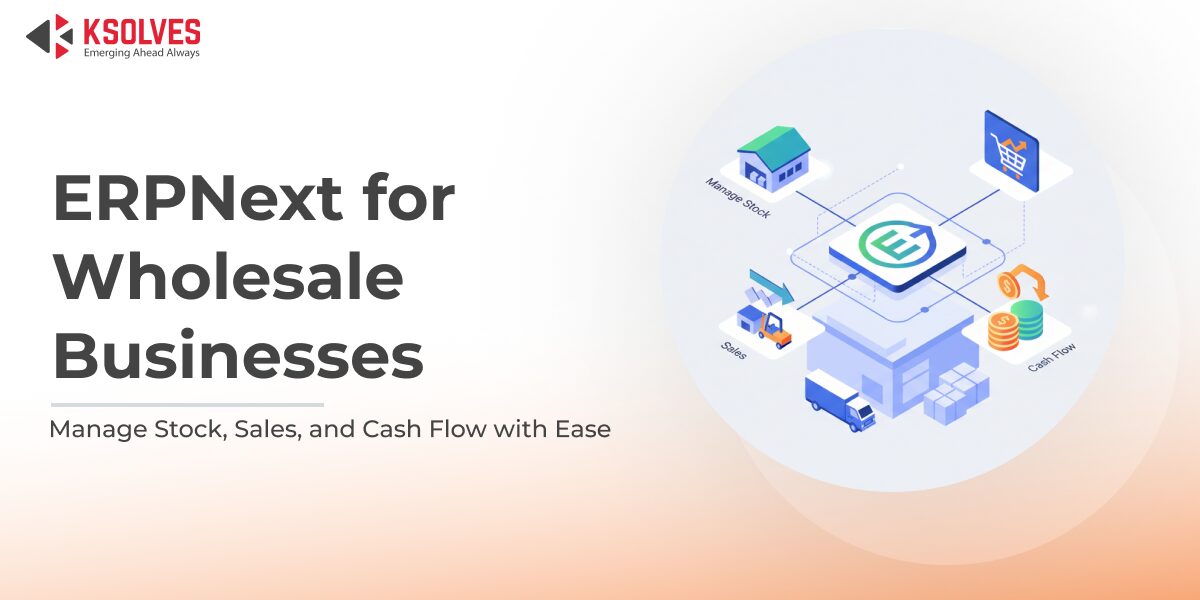
Wholesale businesses operate in a very specific middle ground. They are not retail, where transactions are instant and standardized. They are not manufacturing, either, where planning happens well in advance.
Wholesale sits in between, dealing with large order values, negotiated pricing, credit cycles, and fast-moving inventory, all at the same time. As the business grows, this complexity grows quietly in the background. What worked with a few customers, a single warehouse, and basic accounting tools starts to feel stretched, decisions take longer, and visibility reduces.
The business keeps moving, but control starts to slip. This is usually the point where wholesale companies begin to look at an ERP, not to grow faster, but to run cleaner and with more clarity.
What is ERPNext?
ERPNext is an open-source enterprise resource planning system designed to run the core operations of a business in one place. Instead of using separate tools for accounting, inventory, sales, purchasing, and reporting, ERPNext connects all of these functions into a single system with shared data.
At a basic level, ERPNext helps businesses track what they buy, what they sell, what they store, and what they get paid for, in real time. Every transaction, whether it is a sales order, a delivery, a purchase, or a payment, updates inventory and financial records automatically. This removes the need for manual reconciliation between systems.
Unlike retail-focused software that prioritizes billing speed, ERPNext is built for operational depth. It supports multi-warehouse inventory, customer-specific pricing, credit management, purchase planning, and integrated accounting. Because it is open-source, businesses can configure and extend it to match how they actually operate, without being locked into rigid workflows.
For wholesale businesses, ERPNext acts as a single source of truth. Sales teams, warehouse teams, and accounts all work on the same data, which improves accuracy, control, and decision-making as the business grows.
Challenges in running a wholesale business
Running a wholesale business comes with a unique set of operational challenges. These challenges usually do not appear on day one. They show up gradually as order volumes increase, product ranges expand, and customer relationships become more complex.
1. Limited visibility across inventory
Wholesale businesses handle large quantities across multiple products and locations. Without real-time visibility, it becomes difficult to know what is actually available, what is reserved, and what is slow-moving. This often leads to overstocking some items and running out of others.
2. Managing credit and outstanding payments
Unlike retail, wholesale operates heavily on credit. Tracking customer limits, overdue invoices, and payment follow-ups manually becomes risky as the customer base grows. Poor visibility into receivables directly impacts cash flow.
3. Customer-specific pricing and margins
Wholesale pricing is rarely standard. Prices vary by customer, order size, and negotiated terms. Managing this manually makes it hard to understand true margins and easy for pricing errors to slip in.
4. High dependency on manual processes
Many wholesale businesses rely on spreadsheets, disconnected software, or individual knowledge for daily operations. As transaction volume increases, manual processes slow teams down and increase the chance of errors.
5. Coordination between sales, warehouse, and accounts
Orders, dispatches, and invoicing involve multiple teams. When systems are not connected, miscommunication leads to delays, incorrect deliveries, and billing mismatches.
6. Difficulty scaling operations
What works for one warehouse or a small customer base often breaks when the business expands. Adding new locations, sales teams, or product lines without proper systems reduces control instead of improving growth.
7. Lack of reliable data for decision-making
Owners and managers need clear answers on stock health, customer profitability, and cash position. When data is spread across tools or updated late, decisions are based on estimates rather than facts.
Benefits of ERPNext for wholesale businesses
ERPNext helps wholesale businesses bring structure and clarity to daily operations. Instead of managing sales, inventory, and accounts separately, everything works together in one system. This makes it easier to scale without losing control.
1. Better visibility across inventory
ERPNext shows real-time stock across warehouses, batches, and locations. Sales teams know what can be sold, warehouse teams know what to dispatch, and management gets a clear view of slow-moving and fast-moving items.
2. Improved cash flow control
By linking sales, invoices, and payments, ERPNext gives a clear picture of outstanding receivables. Credit limits, overdue invoices, and customer payment behavior are visible at all times, helping businesses reduce payment delays.
3. Accurate pricing and margin clarity
Customer-specific pricing rules and discount structures are managed within the system. This reduces manual errors and helps businesses understand actual margins by product and customer.
4. Faster and more reliable order processing
Sales orders, deliveries, and invoices flow smoothly without repeated data entry. This reduces billing mistakes, speeds up dispatch, and improves customer trust.
5. Stronger coordination between teams
Sales, warehouse, and accounts work on the same data. This removes confusion caused by emails, spreadsheets, and verbal updates, and improves accountability across teams.
6. Scalable multi-warehouse and branch management
ERPNext supports multiple warehouses and business locations with centralized reporting. As the business grows, visibility and control remain intact.
7. Integrated accounting and compliance
Accounting is built into ERPNext and updated automatically with every transaction. This simplifies GST compliance, audits, and month-end closing.
8. Flexibility without vendor lock-in
Because ERPNext is open-source, businesses can configure workflows to match how they operate. This provides long-term flexibility without heavy licensing costs.
Also Read: How ERPNext POS Transforms Retail Operations for Speed and Accuracy
Real-world use cases of ERPNext in wholesale businesses
ERPNext is not about theory. It is used daily by wholesale businesses to solve very specific operational problems.
Use case 1: Managing inventory across multiple warehouses
A wholesale distributor operating from multiple locations uses ERPNext to track stock in real time across all warehouses. Sales teams can check availability instantly, warehouse teams get clear picking lists, and management can see which locations are overstocked or understocked. Inter-warehouse transfers are tracked properly, reducing confusion and stock mismatch.
Use case 2: Credit control and faster collections
A B2B wholesaler selling on credit uses ERPNext to set customer credit limits and payment terms. Sales orders are blocked automatically for overdue customers, reducing risk. Accounts teams track outstanding invoices clearly, and management gets a real-time view of receivables instead of chasing data at month-end.
Use case 3: Customer-specific pricing and margin tracking
A wholesale business with negotiated pricing uses ERPNext pricing rules to manage different rates for different customers and order volumes. This removes dependency on manual price lists and helps the business understand actual margins by customer and product.
How to select the right ERPNext service provider?
ERPNext is powerful, but the outcome depends heavily on the implementation partner. Here are practical factors to look for.
- Understanding of wholesale workflows—Your service provider should understand how wholesale businesses actually operate, including credit sales, pricing complexity, inventory risks, and warehouse processes.
- Focus on configuration, not over-customization- A good partner will first use standard ERPNext features and configuration. Heavy customization should only be done when truly required, as it affects long-term stability.
- Clear implementation approach—Look for a provider that offers a clear plan covering requirement analysis, data migration, user training, and post-go-live support.
- Strong support and maintenance model—ERP implementation does not end at go-live. Ongoing support, upgrades, and issue resolution matter just as much.
- Proven ERPNext experience—Case studies, certified consultants, and real implementation experience are more important than generic ERP claims.
Read More – How ERPNext Helps E-Commerce Stores Manage Inventory & Fulfillment
Why is Ksolves the right ERPNext service provider for your business?
Ksolves brings both technical expertise and real business understanding to ERPNext implementations.
Ksolves has hands-on experience implementing ERPNext for wholesale and distribution businesses, focusing on inventory control, credit management, pricing workflows, and integrated accounting. The approach is practical, not over-engineered, and aligned with how businesses actually work.
The team follows a structured implementation methodology, starting with business process understanding, followed by configuration, controlled customization, and user training. This reduces risk and improves adoption across teams.
As an experienced ERPNext service provider, Ksolves offers end-to-end support, from implementation and data migration to ongoing maintenance and optimization. Businesses benefit from flexibility, transparency, and a long-term partnership rather than a one-time deployment.
For wholesale businesses looking to improve control, visibility, and scalability, Ksolves helps turn ERPNext into a system that supports real operations, not just software usage.
































AUTHOR
ERPNext
Share with