



Why Salesforce Health Cloud Fails at Patient Coordination And How to Fix It
Salesforce
5 MIN READ
December 22, 2025

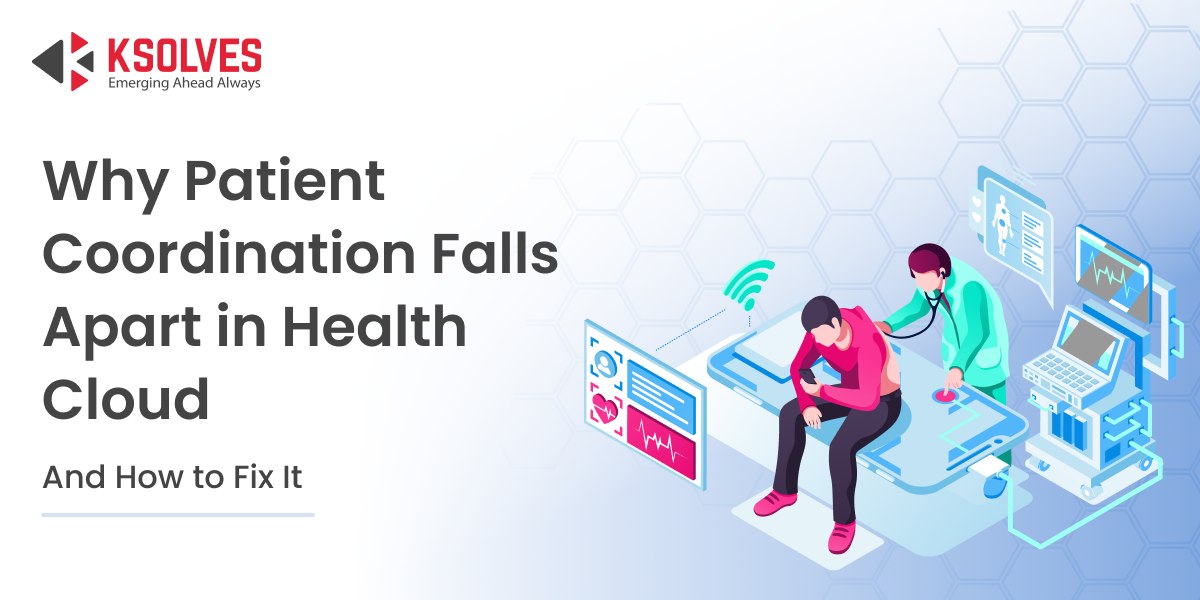
Salesforce Health Cloud is often positioned as a game-changer in patient management. It promises better care coordination, deeper patient insights, and improved outcomes through a connected, data-driven platform. For healthcare providers, the ability to unify clinical and non-clinical workflows under one roof has become a necessity.
Effective patient coordination plays a vital role in reducing care gaps, avoiding redundant procedures, and improving overall patient satisfaction. Whether it’s managing chronic conditions or transitioning patients from hospital to home, the ability to deliver timely, coordinated care can directly impact health outcomes and operational efficiency.
Yet, despite Health Cloud’s robust feature set, many organizations struggle to see real improvements in coordination. Why? Because the tool alone isn’t the solution. The #1 reason Health Cloud fails to deliver on its promise is a fundamental misalignment between the platform and the real-world workflows it’s meant to support.
In this blog, we’ll explore what’s going wrong and, more importantly, how to fix it.
Why Patient Coordination Remains a Challenge with Salesforce Health Cloud
Despite implementing Salesforce Health Cloud, many healthcare organizations continue to struggle with fragmented communication between care teams. A typical scenario: a discharged patient misses a follow-up because the primary care physician was never alerted, the care coordinator lacked access to the latest discharge notes, and no automated reminder was triggered.
This isn’t just an isolated case. According to the Joint Commission, miscommunication between caregivers causes up to 80% of serious medical errors. Additionally, researcher Annegret Hannawa reports that in Germany, 80% of treatment errors trace back to unsafe communication. These communication breakdowns lead to missed appointments, duplicated tests, delayed treatments, and avoidable hospital readmissions.
When stakeholders invest in Salesforce for healthcare organizations, they usually expect:
- A centralized view of the patient across care settings
- Real-time alerts and updates on critical changes
- Automated task assignments for follow-ups and care plan execution
- Streamlined collaboration between physicians, nurses, care managers, and administrative staff
But without the right workflows, training, or governance in place, these expectations remain unmet, and the platform becomes just another system rather than a catalyst for better coordination.
The #1 Reason It Fails: Misalignment with Real-World Workflows
Despite its robust features, Salesforce Health Cloud often falls short when it’s not customized to mirror the actual workflows of healthcare teams. The number one reason for failure? Misalignment between what the system is configured to do and how clinicians, care coordinators, and administrative staff operate in the real world.
Many implementations take a top-down approach—deploying out-of-the-box modules and assuming they’ll fit across departments. But healthcare isn’t a one-size-fits-all environment. Care coordination involves complex, dynamic workflows that vary not only by organization but also by specialty, care setting, and even individual team roles.
When Health Cloud configurations don’t account for specific handoffs (like between inpatient discharge teams and primary care providers) or miss logic required for referrals, follow-ups, or triage alerts, patient coordination breaks down. Tasks fall through the cracks. Alerts are sent too late or not at all. And worst of all, the very people responsible for managing care journeys, nurses, case managers, and social workers, struggle to trust or adopt the platform.
Take, for instance, a care coordinator who’s responsible for monitoring follow-ups post-hospital discharge. If the care plan wasn’t properly configured to trigger alerts based on discharge status, or if those alerts aren’t routed to the right person at the right time, the patient might miss a critical follow-up appointment. That’s not a technology failure; it’s a workflow failure.
This misalignment often stems from not involving frontline staff during the planning and design stages. Without their input, workflows are built in isolation from clinical realities. The result is a Health Cloud instance that looks good on paper but fails to deliver impact on the ground.
At Ksolves, we’ve seen this pattern time and again, and it’s why our approach to Health Cloud implementation prioritizes stakeholder collaboration. We work closely with both clinical and administrative users to understand their specific pain points, processes, and patient touchpoints before any configuration begins. The goal is not just to launch the platform, but to make it genuinely usable, scalable, and aligned with real-world care coordination.
Supporting Reasons That Compound the Problem
Beyond workflow misalignment, several other factors commonly worsen the challenges of poor patient coordination during Health Cloud implementation:
- Incomplete Data Migration or Disconnected Systems: Patient data often resides across multiple platforms, like EHRs, lab systems, imaging software, pharmacy records, etc. If these aren’t integrated properly with Health Cloud, the care team lacks a 360-degree view. Critical information, such as lab results, discharge summaries, or prescription changes, may be missing, causing delays or errors in care delivery. Without seamless interoperability, even the best coordination workflows break down.
- Over-Customization Without Usability Testing: While customizing Health Cloud can help tailor it to unique clinical needs, overdoing it, especially without involving end-users, leads to cluttered interfaces and confusing processes. For example, adding too many fields or automations can overwhelm users or slow them down. If custom modules aren’t tested with real-world users, adoption rates plummet, and staff revert to manual tracking outside the system.
- Misunderstanding of Health Cloud’s Out-of-the-Box Capabilities: Many teams underutilize powerful built-in features like care plan templates, task automation, and patient timelines because they either don’t know they exist or assume custom development is always required. This not only leads to unnecessary complexity and cost but also fails to maximize the value of the platform. Educating stakeholders on native functionality is critical during implementation.
- Inexperienced Implementation Partners Lacking Healthcare Expertise: A Salesforce partner without domain knowledge in healthcare may implement Health Cloud like a generic CRM, ignoring the clinical nuances of care coordination. This results in poor design decisions, irrelevant workflows, and compliance oversights. Healthcare implementations require partners who understand regulations (like HIPAA), terminology, patient lifecycle stages, and clinical operations, not just Salesforce architecture.
What Patient Coordination Should Look Like in Health Cloud
When implemented effectively, Salesforce Health Cloud can significantly enhance how care teams coordinate around a patient. At its core, strong patient coordination means ensuring the right people have the right information at the right time, without manual chasing or fragmented systems. Here’s what that looks like in practice:
- Automated Task Assignments and Follow-Ups: Health Cloud should automatically assign tasks to the right team members based on treatment plans or diagnosis codes. For example, after a cardiology consult, a care coordinator could be auto-assigned to schedule a stress test or follow-up visit, reducing delays and improving continuity.
- Unified Patient Journey View: All care providers, from physicians to administrative staff, should have a 360-degree view of the patient’s history. This includes appointments, lab results, past and upcoming referrals, care plans, medications, and case notes. No more switching between EHRs, paper notes, and email threads.
- Real-Time Alerts for Proactive Intervention: Critical changes, such as missed appointments, new diagnoses, test results, or hospital discharges, should trigger real-time alerts. These alerts help care managers and clinicians take timely action, reducing the chances of readmissions or care gaps.
- Built-In Compliance and Role-Based Access: Health Cloud should ensure that only authorized users can access sensitive health information, with strict adherence to HIPAA, GDPR, and other regional data protection laws. Role-based permissions and audit trails add a layer of security and accountability.
Making Health Cloud Work: Practical Recommendations for Success
Getting the most out of Salesforce Health Cloud requires more than just technical setup—it demands strategic alignment with real-world clinical operations. Here’s how healthcare organizations can ensure successful implementation and truly enhance patient experience and coordination:
- Engage End Users Early: Involve frontline staff—nurses, care coordinators, and administrative teams—right from the planning phase. Their input ensures the system mirrors daily operations and addresses real pain points, improving both usability and adoption.
- Map Actual Workflows, Not Just Ideal Ones: Conduct detailed workflow mapping to capture how tasks and communication truly happen across departments. This helps uncover hidden bottlenecks and ensures the Health Cloud configuration aligns with real-time care delivery, not just textbook processes.
- Customize with Purpose, Not Just Possibility: While Health Cloud offers powerful out-of-the-box features, default settings rarely match every organization’s needs. Instead of over-customizing blindly, tailor workflows, alerts, and dashboards based on specific outcomes you want to drive, like faster discharge follow-ups or reduced missed appointments.
- Choose the Right Implementation Partner: The partner you choose should have deep Salesforce expertise and a solid understanding of healthcare workflows. The right implementation partner brings both technical proficiency and domain insight, helping healthcare organizations avoid common pitfalls and maximize ROI.
How Ksolves Helps Healthcare Organizations Succeed
At Ksolves, we understand that successful Health Cloud implementation hinges on real-world applicability and long-term support, not just technical deployment. Here’s how we ensure our healthcare clients get measurable outcomes from Salesforce Health Cloud:
- Tailored Implementations Aligned with Actual Workflows: We don’t believe in one-size-fits-all setups. Our consultants work closely with clinical and administrative teams to map current workflows and design Health Cloud configurations that reflect how care is actually delivered. This leads to better adoption and smoother coordination.
- Experience Across Healthcare Specialties: Whether you’re running a telehealth platform, diagnostic lab, hospital network, or home care service, Ksolves brings relevant experience. Our domain expertise ensures Health Cloud features are leveraged to fit the nuances of your specialty, from remote patient monitoring to referral management.
- Seamless Integrations with EHRs and Third-Party Systems: A disconnected system is a lost opportunity. We help integrate Health Cloud with EHR platforms, pharmacy databases, lab systems, and communication tools to deliver a unified view of the patient. Our implementations are built with HIPAA, GDPR, and local compliance in mind.
- Post Go-Live Support and Optimization: Our engagement doesn’t end at launch. Ksolves provides structured post-go-live support, including user training, workflow tweaks, and performance monitoring. We also help organizations evolve their Health Cloud as new needs emerge or regulations change.
Final Words!
Salesforce Health Cloud has the potential to revolutionize patient coordination, but only when it’s built around actual clinical operations. Misaligned workflows, poor user adoption, and disconnected data systems often lead to underwhelming results. To fix this, healthcare providers must prioritize user input, purpose-driven customization, and smart integration. At Ksolves, we bring both technical depth and healthcare expertise to help you get it right, turning your Health Cloud investment into real, trackable improvements in care delivery. Contact us today at [email protected].
































Author
About the Author Editorial Team The Ksolves Editorial Team includes certified Salesforce experts, Big Data engineers, AI/ML specialists, Zoho consultants, and experienced technology writers focused on delivering clear, actionable insights for modern businesses. With hands-on experience across Salesforce, Big Data platforms, AI/ML solutions, application development, software testing, and Zoho ERP/CRM, the team publishes practical guides, real-world use cases, and industry updates that support smarter decisions and faster growth. Every article is created to solve business challenges, guide technology adoption, and keep organizations aligned with evolving digital ecosystems.
Share with