Project Name
AI-Powered Multi-Service Dispatch System
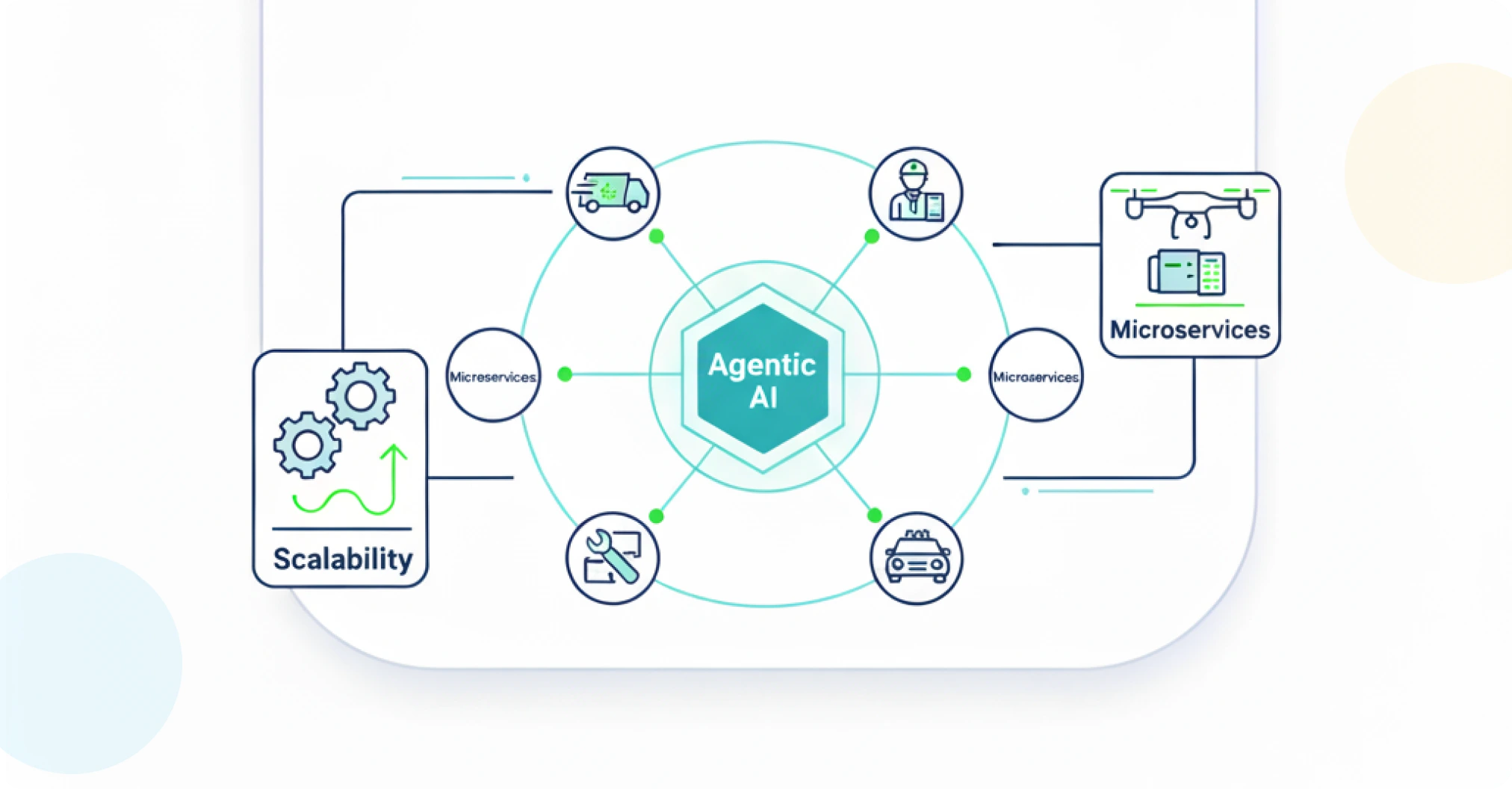

As an AI-first company, Ksolves focuses on addressing operational complexity with intelligent, scalable systems rather than on incremental automation.
A client operating across 14 cities in Southeast Asia approached Ksolves with a growing challenge. Managing a fleet of over 9,000 active drivers and processing upwards of 180,000 dispatch events daily across three service verticals, their existing platform relied heavily on static rules and manual coordination, making it inefficient in dynamic, real-time scenarios.
The client needed a system that could intelligently assign tasks, adapt to real-time conditions, and scale seamlessly across multiple services without increasing operational overhead. Each vertical carried its own SLA requirements, driver pool, and routing logic, and managing these through a shared rule engine meant any change to one vertical risked breaking the others.
Traditional dispatch systems were not designed for this level of complexity. Ksolves addressed this by combining Agentic AI with a microservices-based architecture to create a system capable of autonomous decision-making and real-time optimization.
The challenges faced by the client are as follows:
- Fragmented Multi-Service Operations: The client managed multiple service lines, each with different dispatch logic, dependencies, and operational constraints. A single, unified system was difficult to achieve using conventional approaches.
- Inefficient Manual and Rule-Based Dispatching: Static rules could not adapt to real-time variables such as traffic conditions, service priority, or resource availability. This resulted in delays, suboptimal allocations, and increased operational costs.
- Scalability Limitations: As demand increased, the existing system struggled to handle higher volumes without degrading performance or experiencing bottlenecks.
- Lack of Real-Time Decision Intelligence: The system lacked the ability to continuously analyze incoming data and make dynamic decisions, limiting responsiveness in time-sensitive scenarios.
- Complex Data Handling and Geospatial Requirements: Managing location-based data, routing, and proximity-based assignments required advanced geospatial processing that the legacy system could not efficiently support.
- Absence of Observability and Incident Tracing: The legacy platform had no centralized logging or tracing layer. When an assignment failed or a request timed out, engineers had no structured audit trail to diagnose the cause. This made every incident a manual investigation and considerably slowed post-mortem analysis.
- No Graceful Degradation Under Load: During traffic spikes, the system offered no fallback mechanism. A surge in requests caused the entire dispatch queue to stall rather than shedding non-critical load gracefully. This all-or-nothing failure mode amplified the customer impact of any capacity shortfall.
- Driver State Synchronisation Lag: Driver availability and location data were refreshed on a polling interval, introducing latency between the actual field state and the dispatcher's view. This stale-state problem led to double assignments and ghost drivers appearing available long after they had accepted a task.
Ksolves engineered a next-generation dispatch platform by combining Agentic AI with a modular microservices architecture, enabling real-time, intelligent decision-making at scale.
- Agentic AI for Autonomous Dispatch Decisions: Ksolves designed AI agents built on a structured decision loop that ingests live inputs, including location, service priority, and resource availability, evaluates them against configurable constraints, and produces optimized dispatch assignments without manual intervention. The agent layer was implemented in Python and communicates with downstream microservices via well-defined internal APIs.
- Real-Time Data Processing and Event Handling: The platform processed live data streams via an event-driven pipeline, with service requests, driver location updates, and cancellations published as discrete messages consumed by relevant microservices in near real time. This significantly reduced end-to-end dispatch latency compared to the client's previous polling-based approach.
- Geospatial Optimization with PostGIS: PostgreSQL with PostGIS powered proximity detection and nearest-driver matching using spatial queries optimized with GiST indexes, keeping geospatial query performance consistent even as the dataset scales.
- High-Performance Backend with Go and Redis: Go handled high-throughput dispatch coordination services, while Redis served as both a low-latency state cache and a priority queue for dispatch job ordering, ensuring stable performance during request volume spikes.
- Scalable and Fault-Tolerant System Design: Services were containerized and scaled independently based on load. Circuit breakers at inter-service boundaries and stateless service design ensured fast recovery from individual node failures without platform-wide disruption.
- Real-Time Driver State Synchronisation via Push Events: To eliminate the stale-state problem caused by polling, Ksolves replaced the legacy interval-based driver sync with a push-based event model. Driver location updates and availability changes were published as events the moment they occurred, consumed by the driver state microservice, and immediately reflected in Redis. The AI dispatch agent always reasoned over a current, consistent view of field resources with no lag-induced ghost assignments.
- Configurable Per-Vertical Dispatch Rules Engine: Each service vertical was given its own configurable constraint profile managed through a rules configuration layer. The AI agent loaded the relevant constraint set before evaluating each assignment, meaning dispatch logic for one vertical could be updated or tuned independently without touching the core agent or disrupting other service lines. This replaced the shared global rule engine that had been a source of cross-vertical instability.
- Structured Observability and Distributed Tracing: A structured logging layer and distributed tracing spans were instrumented across every microservice boundary. Each dispatch decision emitted a traceable event that recorded the inputs evaluated, the applied constraint set, and the final assignment outcome. This gave the operations team a complete, searchable audit trail for every transaction, reducing mean time to diagnose from hours of manual log correlation to minutes of targeted trace lookup.
- Priority-Based Load Shedding for Graceful Degradation: Redis priority queues were configured to enforce service-level tiers under capacity pressure. When inbound request volume exceeded processing thresholds, low-priority tasks were held in queue rather than rejected, while high-priority service requests continued to be dispatched without interruption. This ensured that a volume spike degraded experience gracefully by tier, rather than causing a platform-wide stall as the legacy system had.
Technology Stack
| Layer | Technology | Role in the System |
|---|---|---|
| AI / Decision Layer | Python (Agentic AI Agents) | Autonomous dispatch decision loop with configurable per-vertical constraint evaluation |
| High-Throughput Services | Golang | Dispatch coordination, event routing, and inter-service orchestration at scale |
| Geospatial Database | PostgreSQL + PostGIS | Proximity queries, nearest-driver matching, GiST-indexed spatial lookups |
| State Cache & Queue | Redis | Low-latency driver state cache, priority dispatch queue, load shedding tier management |
| Messaging / Event Broker | Event-Driven Pipeline | Asynchronous inter-service communication decouples producers from consumers |
| Container Orchestration | Kubernetes | Independent per-service horizontal scaling and automated recovery |
| Observability | Distributed Tracing + Structured Logging | End-to-end audit trail for every dispatch decision across all microservice boundaries |
- Significant Improvement in Dispatch Efficiency: Automated, AI-driven decision-making reduced manual intervention and improved the speed and accuracy of service allocation.
- Real-Time Optimization Across Services: The system dynamically adapted to changing conditions, ensuring optimal routing and resource utilization across multiple service lines.
- Scalable Operations Without Performance Bottlenecks: The microservices architecture allowed the client to scale operations seamlessly as demand grew.
- Reduced Operational Costs: Optimized dispatching and better resource utilization led to measurable cost savings in daily operations. Fewer idle driver assignments and reduced manual coordination overhead were the primary contributors to this reduction.
- Enhanced Customer Experience: Faster response times and improved service reliability resulted in higher customer satisfaction.
“Our dispatch operations had reached a point where scaling the business meant scaling the operations team at the same rate, but we could not keep adding coordinators every time we opened a new geography. Ksolves fundamentally changed that equation. The AI-driven system they built handles thousands of assignments every day without manual oversight, and when conditions change in the field, it adapts without us having to intervene. The visibility we now have into every dispatch decision has also transformed how we handle incidents. What used to take hours of investigation now takes minutes.”
— Head of Operations, Multi-Service Logistics Platform (name withheld by request)
This engagement highlights what it means to be an AI-first company. Ksolves did not just build a dispatch system but redefined it by embedding Agentic AI at its core.
By building AI agents with a well-defined decision loop, grounding geospatial logic in optimized PostGIS queries, and separating concerns cleanly across independent microservices, the platform moved beyond static rule engines to a system that could reason, adapt, and recover autonomously. Combined with a scalable microservices architecture and a high-performance Go and Redis backend, this gave the client a unified system built for speed, flexibility, and growth.
As a trusted provider of AI and ML Consulting Services, Ksolves continues to deliver systems that are not only scalable but capable of thinking, optimizing, and evolving with business needs.
Solve Your Most Complex Dispatch and Scaling Challenges with AI