Project Name
How Ksolves Helped a Government Tech Provider Achieve Zero Data Loss with Apache Cassandra DC-DR

For a software provider managing critical national government projects, a database failure is not just an IT incident. It is a service disruption affecting citizens, agencies, and regulatory obligations. With no secondary site and no automated failover, a single infrastructure failure means total service loss until engineers can manually intervene.
The client is a B2G (Business-to-Government) software development company based in India, building and maintaining digital infrastructure for national and state government agencies. Their platform supports multiple active government projects, all running on an Apache Cassandra cluster. Government SLAs and strict data sovereignty requirements meant their infrastructure needed to meet a very high bar for reliability and recoverability.
With new project onboardings requiring formal disaster recovery capabilities, the absence of a DC-DR (Datacenter – Disaster Recovery) architecture had become a contractual risk they could no longer put off. They partnered with Ksolves, an AI-first company, leveraging AI-assisted delivery workflows to implement a multi-datacenter Cassandra DC-DR setup capable of surviving a primary site failure with zero data loss and no disruption to live operations.
The client came to Ksolves with infrastructure risks that standard single-site Cassandra deployments are fundamentally unable to address:
- No Disaster Recovery Capability for Critical Government Workloads: The client's Apache Cassandra cluster operated from a single data center with no secondary site and no automated failover. Any infrastructure failure, whether hardware fault, network outage, or physical site event, would result in complete service loss across all government projects. With citizen-facing services dependent on the platform, operating without a recovery plan was a contractual and reputational risk the client could no longer accept.
- No Established Data Synchronization Path to a Secondary Site: The client needed to maintain a passive DR site at a physically separate location, but had no existing mechanism for real-time data replication from the primary data center (DC) to the disaster recovery site (DR). Building this path required Cassandra's multi-datacenter replication capabilities to be configured correctly across their existing keyspace structures, a non-trivial undertaking.
- Read and Write Isolation Requirements: The architecture required that all application read and write operations remain exclusively on the primary DC under normal operating conditions. The passive DR site must not serve requests and must only become active during a declared disaster event. Achieving this with Cassandra's distributed architecture required precise consistency level and replication strategy configuration.
- Zero-Disruption Transition to Multi-Datacenter Topology: The migration to a two-datacenter cluster had to be executed without interrupting live government services. Any downtime during the transition would directly impact the government agencies and citizens relying on the platform, making a zero-downtime bootstrapping approach a hard requirement rather than a preference.
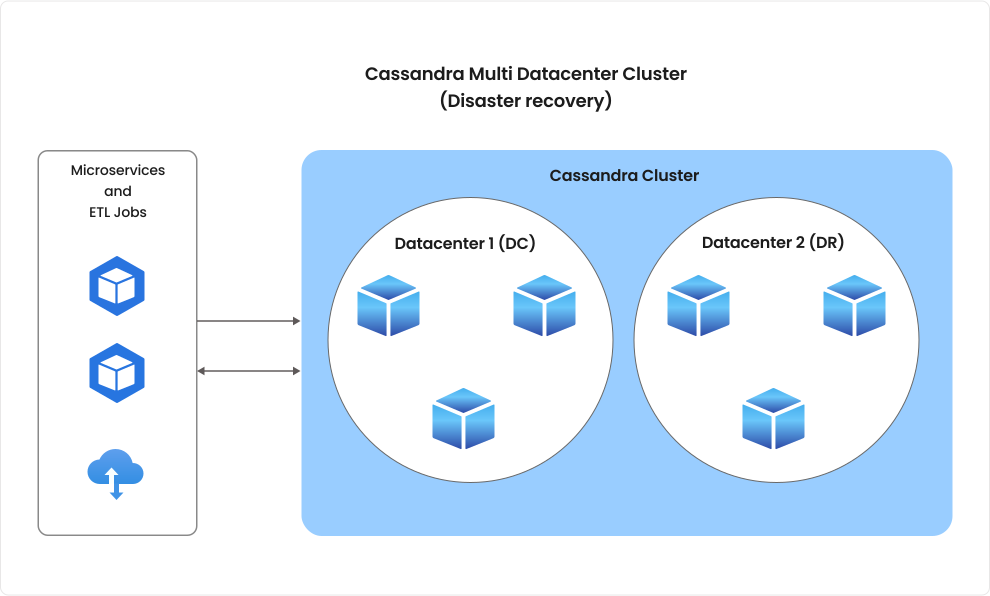
Ksolves designed and implemented a multi-datacenter Apache Cassandra architecture using Cassandra's native NetworkTopologyStrategy replication model, establishing a geographically separate passive DR site that maintains real-time synchronization with the primary data center without participating in live application traffic.
- AI-Assisted Configuration Validation: Ksolves used AI-powered tooling to validate the DC-DR configuration against best practices, identifying potential replication inconsistencies and topology misconfigurations before go-live, reducing the risk of post-deployment issues.
- Multi-Datacenter Cassandra Topology Design: The cluster was configured as a two-datacenter topology, with "DC" as the active primary site and "DR" as the passive disaster recovery site, using Cassandra's NetworkTopologyStrategy to define independent replication policies per datacenter. Each datacenter was assigned a dedicated replication factor, ensuring full data parity between the primary and disaster recovery sites at all times.
- Replication and Consistency Level Configuration: Write operations were directed exclusively to the primary DC using LOCAL_QUORUM consistency. This ensures the application only waits for acknowledgment from nodes within the active datacenter. Cassandra's built-in asynchronous replication then propagated all writes to the DR site, maintaining continuous synchronization without adding latency to production operations.
- Snitch and Rack Awareness Configuration: The GossipingPropertyFileSnitch was configured on all nodes to correctly identify datacenter and rack topology. This ensured Cassandra's internal routing logic respected the DC/DR separation and that the disaster recovery site was never used for read traffic under normal operating conditions.
- Read and Write Isolation via Application-Level Consistency Controls: The client's application layer was configured to direct all queries to the primary DC using LOCAL_QUORUM consistency, with the DR site receiving replicated data passively. Failover procedures were fully documented and tested. In the event of a primary DC failure, the application connection string could be updated to redirect traffic to the DR site with minimal manual steps and no data loss.
- Zero-Downtime DR Site Bootstrapping: The disaster recovery datacenter was bootstrapped and added to the existing Cassandra cluster using a rolling node addition process. Cassandra's nodetool utilities were used throughout to manage token assignment, monitor stream progress, and verify replication completion, all without interrupting the live government applications running on the primary datacenter.
- Architecture and Configuration Documentation: Ksolves delivered complete architecture documentation covering the two-datacenter topology, keyspace replication settings, consistency level strategy, failover runbook, and ongoing operational guidance, equipping the client's internal team to manage and extend the DR setup independently.
Technology Stack
| Component | Details |
|---|---|
| Core Database | Apache Cassandra |
| Replication Strategy | NetworkTopologyStrategy |
| Consistency Level | LOCAL_QUORUM (writes to primary DC) |
| Snitch | GossipingPropertyFileSnitch |
| Topology | 2-datacenter cluster: DC (active) + DR (passive) |
| Containerization | Docker |
| Orchestration | OpenShift |
| Migration Tools | Apache Cassandra nodetool |
The DC-DR architecture Ksolves delivered produced measurable outcomes across resilience, data integrity, and compliance readiness:
- Near-Zero RPO Achieved: Cassandra's asynchronous replication propagates all writes to the DR site within seconds, eliminating the previously unrecoverable single-site failure scenario and replacing it with a fully synchronized passive site ready to assume traffic at any point.
- RTO Reduced to Under 30 Minutes: Prior to this engagement, a primary DC failure had no defined recovery path. With the DR site synchronized and a tested failover runbook in place, the client can now redirect application traffic to the DR site in under 30 minutes.
- Zero Downtime During Migration: The DR site was bootstrapped and integrated into the live Cassandra cluster with no interruption to government application traffic, satisfying contractual uptime requirements throughout the transition.
- 100% Data Synchronization Maintained: Continuous real-time replication between DC and DR has maintained full data consistency since implementation, with no replication lag incidents reported in post-deployment monitoring.
- Government SLA Compliance Achieved: The multi-datacenter architecture gave the client the formal DR capability required to satisfy government SLA obligations and unblock new project onboardings that had been pending DR certification.
- Scalable Foundation for Future Expansion: The NetworkTopologyStrategy-based architecture supports additional datacenters or regions without keyspace redesign, growing with the client's government project portfolio.
“Our government project obligations meant we could not afford to operate without a disaster recovery setup any longer. Ksolves understood exactly what we needed and implemented the entire DC-DR architecture without any impact to our running applications. The DR site has been synchronizing continuously since day one, and we now have the disaster recovery certification our government clients require.”
— Head of Infrastructure, Government Software Provider, India
Ksolves, with its AI-first delivery approach, transformed the client’s single-site cluster into a geographically resilient, continuously synchronized disaster recovery system. What was once an unrecoverable failure scenario is now a managed, documented recovery process with zero data loss and no disruption to live government services.
As the client onboards new government agency projects, the Cassandra foundation Ksolves built is ready to meet each new DR certification requirement without any re-engineering. For enterprises managing critical workloads on Apache Cassandra, this is what production-grade disaster recovery looks like.
If you are looking to build a similar solution, connect with a Ksolves Apache Cassandra expert and explore what is possible for your infrastructure.
Looking to Implement a Strong Data Recovery Solution for Your Cassandra Cluster?