Project Name
MinIO Server-Side Encryption with HashiCorp Vault - GDPR & HIPAA Compliant Object Storage for Enterprises

Our client is a multinational telecom operator known for its rapid network expansion and innovative adoption of digital technologies. Operating across several regions, they needed to handle large volumes of highly sensitive data – including Call Detail Records (CDRs), customer identity documents, transaction histories, and proprietary business reports – stored in a MinIO-based object storage environment. With strict adherence to data privacy regulations such as GDPR, PCI-DSS, and HIPAA, the client required a robust, scalable, and compliant MinIO server-side encryption mechanism for its object storage infrastructure.
Despite having an efficient MinIO-based object storage system, the client encountered several pressing challenges:
- Data Security Compliance: Meeting stringent GDPR, HIPAA, and PCI-DSS standards while ensuring all stored data remains protected through encrypted object storage.
- Lack of Centralized Key Management: Encryption keys were managed locally rather than through a centralized key management system like HashiCorp Vault, creating security vulnerabilities and operational risks due to potential key loss or compromise.
- Performance Overhead:The team needed an encryption mechanism that would not slow down data access or degrade overall system performance.
- Scalability: With rapidly growing data volumes, the solution had to be future-proof and capable of scaling without significant architectural changes.
To address these challenges, we implemented a MinIO server-side encryption solution using MinIO, Key Encryption Service (KES), and HashiCorp Vault as part of a modernized, GDPR and HIPAA compliant security architecture. This MinIO SSE-KMS architecture effectively secures data at rest, ensuring compliance with GDPR, HIPAA, and PCI-DSS regulatory requirements while maintaining performance efficiency.
1. The Redesigned Architecture
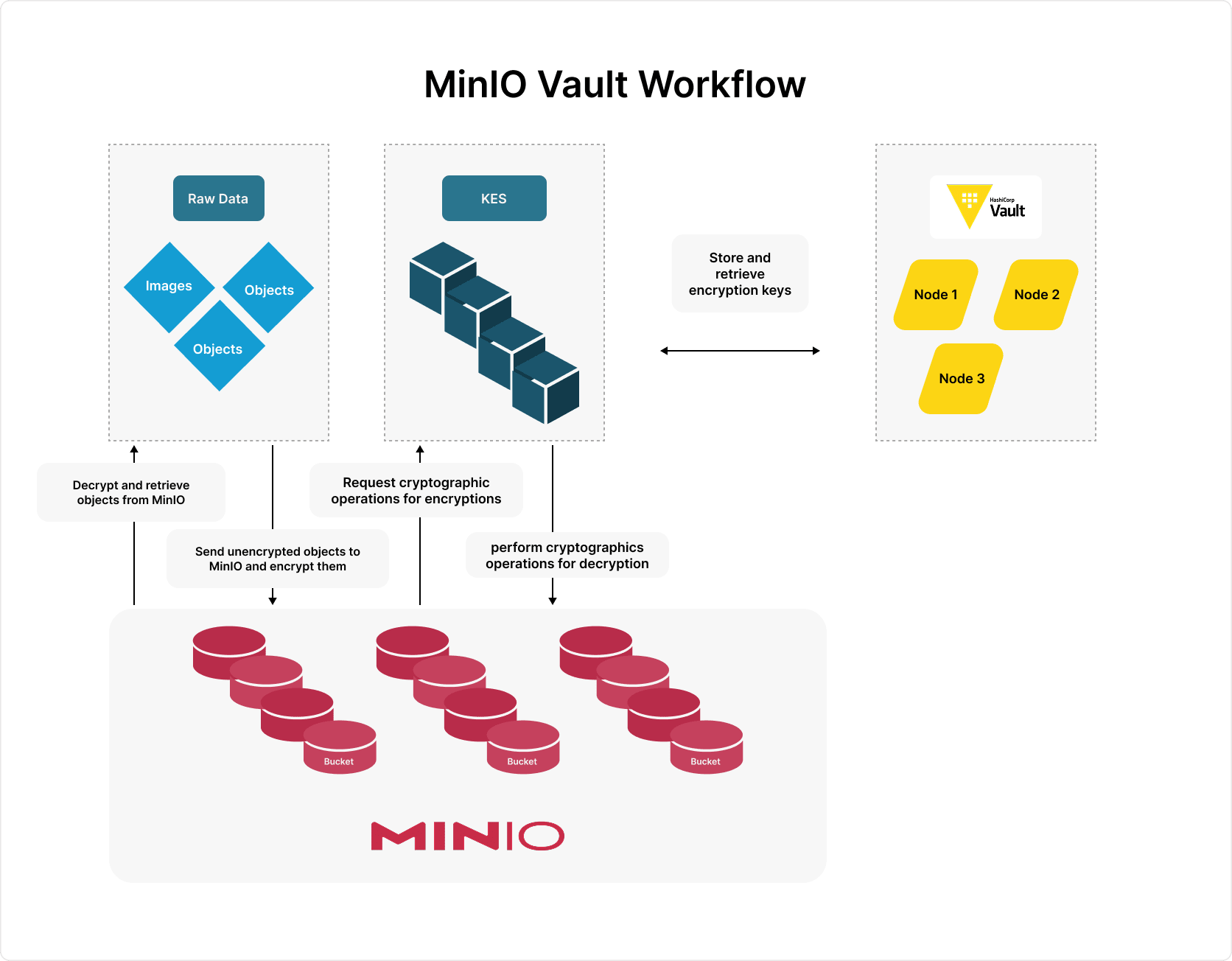
- Raw Data Ingestion: Images, videos, and other unstructured data objects are ingested and sent directly to MinIO for storage.
- MinIO Storage & Encryption: MinIO Storage & Server-Side Encryption: MinIO receives the unencrypted data and delegates all cryptographic operations to the Key Encryption Service (KES) for secure object storage.
- Key Encryption Service (KES): KES acts as the encryption engine, handling all cryptographic operations on behalf of MinIO.
- Centralized Key Management with HashiCorp Vault: KES securely retrieves and manages encryption keys from HashiCorp Vault, ensuring centralized key governance and reducing risks of unauthorized access or key compromise.
- Secure Decryption Process: Upon user request, MinIO coordinates with KES and Vault to decrypt objects on the fly, ensuring data is accessed securely and efficiently.
2. Implementation Steps
Infrastructure Setup: Deploying MinIO and HashiCorp Vault:
- Deployed MinIO on high-performance storage nodes.
- Installed and configured HashiCorp Vault on a three-node cluster for high availability.
- Set up KES as the intermediary encryption service.
Key Management Configuration: Integrating HashiCorp Vault with KES:
- Integrated HashiCorp Vault with KES to manage encryption keys securely.
- Configured MinIO to request cryptographic operations from KES.
Encryption Policy Enforcement: MinIO Bucket-Level SSE Configuration:
- Enabled automatic server-side encryption on MinIO buckets.
- Applied encryption policies to enforce secure data storage.
Testing and Validation:
- Conducted encryption and decryption tests to validate data security.
- Measured system performance to ensure minimal latency impact.
Deployment and Monitoring:
- Rolled out the new architecture in production.
- Implemented monitoring tools to track encryption processes and key usage.
The newly implemented architecture delivered immediate and measurable benefits:
- Enhanced Data Security: All stored objects are now protected by MinIO server-side encryption by default, significantly reducing the risk of data exposure.
- Regulatory Compliance: The setup aligns with GDPR, PCI-DSS, and HIPAA mandates for compliant encrypted object storage in financial services environments.
- Centralized Key Management: Encryption keys are securely stored and managed in HashiCorp Vault's centralized key management system, minimizing the risk of exposure, unauthorized access, or loss.
- Minimal Performance Overhead: The encryption workflow is optimized for efficiency, ensuring secure data access with negligible impact on latency or performance.
- Scalability for Growth: The modular architecture ensures easy scalability to support future data growth without re-engineering.
By implementing MinIO server-side encryption using MinIO, KES, and HashiCorp Vault, the client successfully transformed its GDPR and HIPAA-compliant object storage infrastructure while maintaining performance and scalability. The solution reinforced data compliance, centralized key governance, and future readiness – all critical for a modern telecom enterprise. Further, the client plans to enhance its encryption framework with advanced audit logging and real-time monitoring to ensure continuous compliance and security intelligence across its data infrastructure.
Strengthen Your Data Protection Strategy with Ksolves Expertise!