Project Name
How Ksolves Delivered NiFi Registry, RBAC and Flow Optimisation with AI First Approach


A leading Libyan telecom provider was running an Apache NiFi-powered Notification Mediation system that processed up to 850,000 customer notification transactions per day across mobile voice, data, and digital services. The company serves over 4 million subscribers and is one of Libya’s primary telecoms operators. The system was business-critical — any degradation directly impacted revenue. But the environment had no flow versioning, no centralised authentication, and configurations that had grown complex and largely undocumented over time. The client needed a partner with deep Apache NiFi Development Solutions expertise and the ability to assess, fix, and secure the environment quickly. Ksolves brought its AI-first delivery model to the engagement, applying AI-assisted analysis across every phase to reduce assessment time and deliver sharper recommendations within a tight project window.
- End-to-End Flow Visibility: The client lacked full visibility into their NiFi data flows. Manual review of the existing pipeline was time-consuming and error-prone, making it difficult to identify inefficiencies or catch misconfigurations before they caused issues downstream.
- Personalised Notification Management: Notifications needed to be routed intelligently based on user behaviour and preferences. The existing architecture made this difficult to govern, test, or modify without risk of disruption.
- Revenue-Critical Reliability: The Notification Mediation system sat directly in the path of customer engagement and billing operations. Downtime or degraded performance had an immediate financial cost.
- High Throughput at Scale: The system had to handle between 700,000 and 850,000 transactions per day reliably, with room to grow further as the subscriber base expanded. Building for that throughput required rapid stress analysis and flow simulation -- work that is slow and inconsistent when done manually.
- Security and Governance Gaps: There was no flow versioning, no structured access control, and no audit trail. The environment had expanded without the governance controls needed to manage it safely across development, staging, and production.
Ksolves conducted a structured assessment and optimisation of the client's Apache NiFi environment, with AI-assisted tooling applied at each phase to compress delivery time and improve output quality.
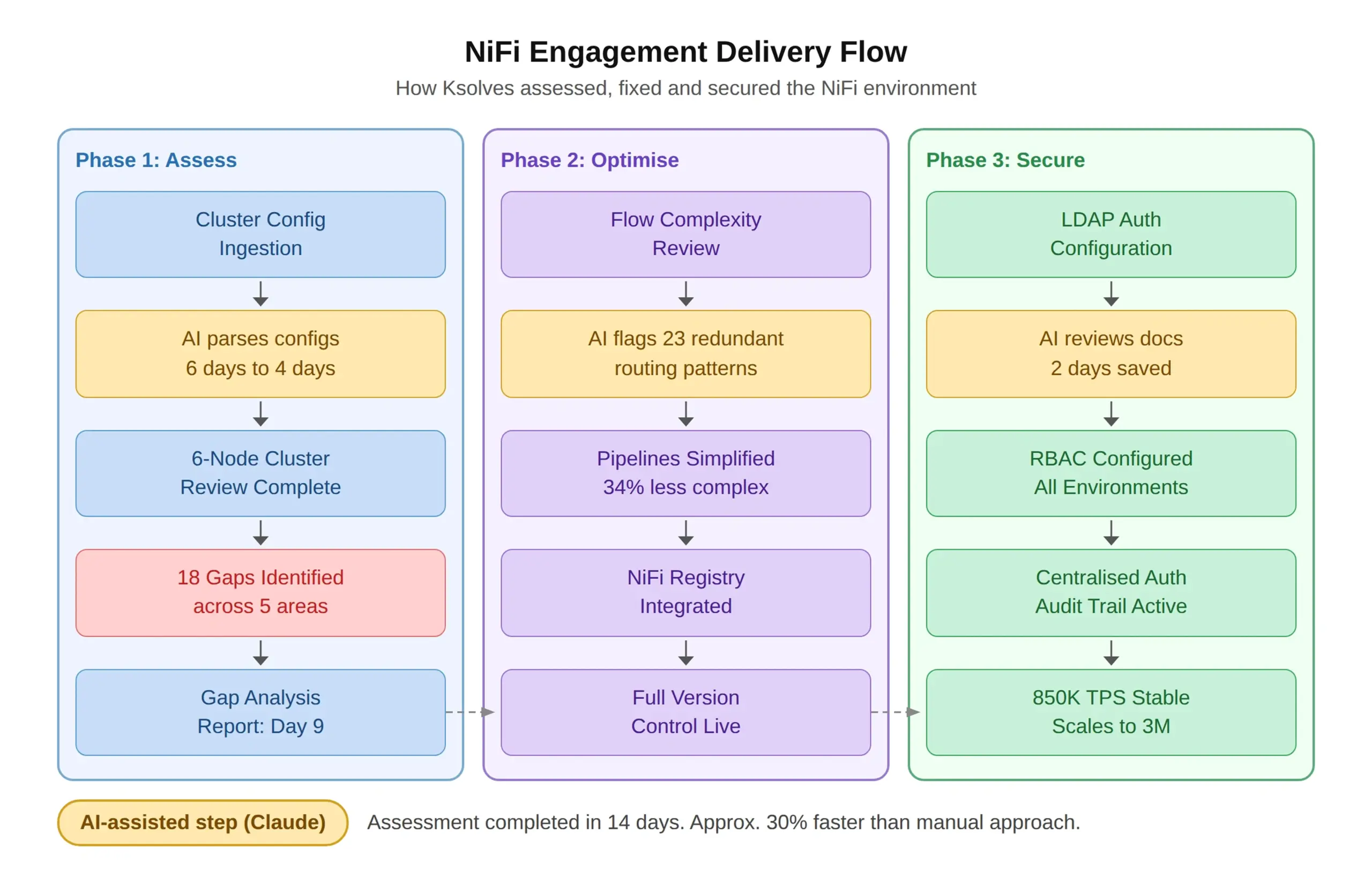
- Cluster Review and Optimisation: The team assessed the full NiFi cluster configuration across 6 nodes, including processor configurations, back-pressure thresholds, and connection queuing. AI-assisted parsing of configuration files cut the initial assessment from an estimated 6 days of manual review down to 4 days, allowing engineers to move into architectural recommendations earlier in the engagement.
- Flow Simplification and NiFi Registry Integration: Ksolves reviewed all active NiFi flows, identified 23 redundant routing patterns, and simplified the pipeline architecture to reduce complexity and maintenance overhead. The team also implemented Apache NiFi Registry, introducing version control and enabling structured promotion across environments. AI-assisted flow analysis surfaced routing inefficiencies that would have taken an additional 1 to 2 days to identify manually.
- Gap Analysis and Reporting: Ksolves delivered a structured Gap Analysis Report covering 5 risk areas across cluster configuration, flow design, security, and governance, with 18 prioritised recommendations. AI-assisted synthesis of findings reduced report compilation from an estimated 4 days to under 3 days, with the completed report delivered on day 11 of the engagement.
- LDAP Authentication and RBAC Implementation: The team configured centralised LDAP authentication and Role-Based Access Control across the cluster, replacing the previous ungoverned access model. AI-assisted documentation review accelerated alignment with security standards and reduced the configuration and validation phase from an estimated 7 days to just under 5 days.
Tech Stack
| Component | Detail |
|---|---|
| Core Platform | Apache NiFi (6-node cluster) |
| Versioning and Registry | Apache NiFi Registry |
| Authentication | LDAP, Role-Based Access Control (RBAC) |
| AI-Assisted Tooling | Claude (Anthropic) -- applied to configuration analysis, flow review, and gap analysis compilation |
| Throughput Capacity | 700,000 to 850,000 transactions per day |
| Deployment | On-premise |
The optimised NiFi cluster now reliably handles 850,000 notification transactions per day, with the architecture confirmed to support growth to 2 to 3 million daily transactions without a full re-architecture. The client's engineering team has a clear, prioritised roadmap from the Gap Analysis Report, a governed deployment process through NiFi Registry, and a secured environment with LDAP and RBAC in place. AI-accelerated NiFi cluster assessment, combined with hands-on Apache NiFi Development Solutions expertise, delivered a faster engagement, a cleaner architecture, and a system the client can operate and scale with confidence.
- Pipeline Complexity Reduced by 34%: Removing 23 redundant routing patterns cut pipeline complexity by 34%, making the system easier to maintain, extend, and debug without re-reviewing the full flow.
- Assessment Phase Completed 30% Faster: AI-assisted configuration parsing and flow analysis reduced the combined assessment and review phases from an estimated 14 days to 10 days, freeing the team for higher-value architectural work.
- Gap Analysis Report Delivered on Day 11: A structured report covering 5 risk categories and 18 prioritised recommendations was ready on day 11 of a 14-day engagement. Manual synthesis alone would have pushed delivery to day 13 or beyond.
- Security Formalised Across All Environments: RBAC and centralised LDAP authentication replaced an ungoverned access model, giving the client controlled, auditable access across their full NiFi environment for the first time.
- Full Version Control Established via NiFi Registry: All flows are now versioned, enabling rollback, change tracking, and structured deployment across dev, staging, and production. The client moved from zero version control to a fully governed pipeline within a single engagement.
“The Ksolves team had a complete picture of our environment within the first few days, and the Gap Analysis Report was more thorough than we expected. The speed of the engagement was notable — solid architectural recommendations, security improvements, and versioning all set up within two weeks. The AI-assisted approach clearly made a difference in how quickly they were able to work through our configuration.”
— Head of IT Infrastructure, Leading Libyan Telecom Provider
(name withheld by request)
This engagement delivered a production-ready, scalable Apache NiFi environment for a telecom provider processing up to 850,000 transactions per day. Ksolves’ AI-first delivery model compressed a 14-day assessment workload to 10 days, enabling deeper recommendations, a structured Gap Analysis Report, and full RBAC and NiFi Registry implementation within the project window. For organisations running complex NiFi environments, the combination of AI-accelerated analysis and experienced Apache NiFi Development Solutions expertise is the most direct path from a fragile, undocumented pipeline to a governed, scalable architecture.
Ready to optimize your NiFi workflows with Ksolves AI-first Big Data expertise?