



Apache Storm vs Apache Spark: A Feature-by-Feature Breakdown
Apache Kafka
5 MIN READ
April 6, 2026

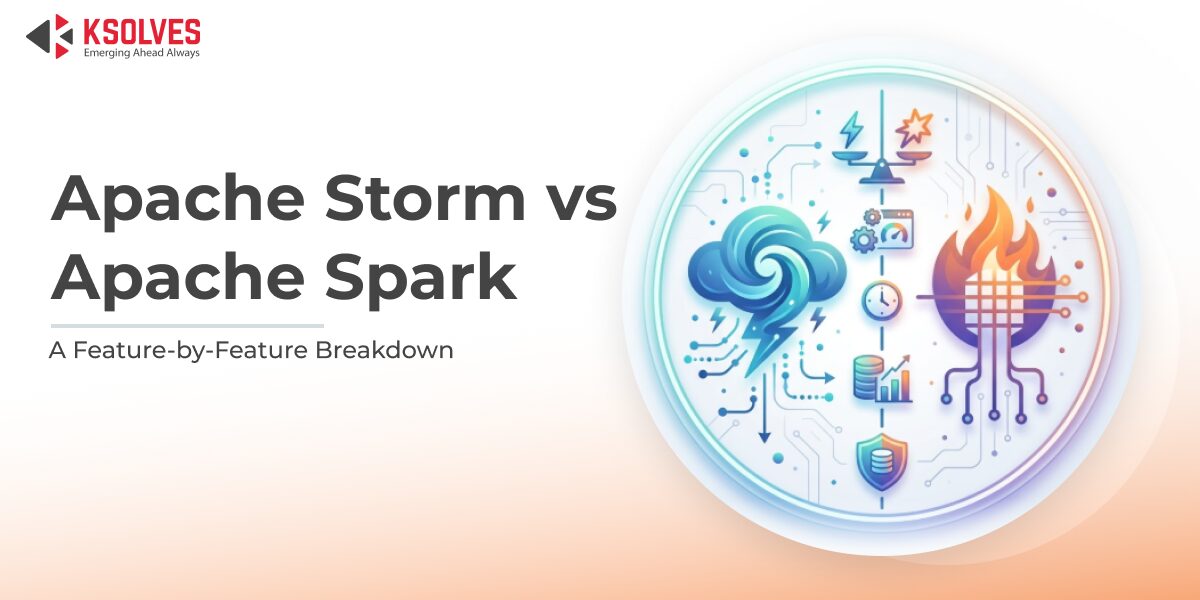
As the reliance on real-time data continues to grow across industries, the demand for robust real-time streaming solutions is rising sharply. Organizations are increasingly turning to advanced streaming technologies to process massive volumes of data as it arrives. The two prominent frameworks that facilitate real-time data processing are Apache Storm and Apache Spark. While both are designed to handle large-scale data streams, they differ significantly in architecture, processing models, performance, and use cases.
With numerous options in the stream processing ecosystem, navigating the differences between Apache Spark vs Storm can be challenging. This blog offers a comprehensive, feature-by-feature comparison to help you understand their core strengths, use cases, and architectural approaches, enabling you to choose the right fit for your data strategy.
Understanding Apache Storm and Apache Spark
Here is the key difference between Apache Spark vs Apache Storm:-
Apache Storm is an open-source, distributed real-time computation system designed for processing unbounded streams of data. It excels in scenarios requiring low-latency processing and is known for its ability to handle high-velocity data streams with sub-second latency.
Apache Spark, on the other hand, is a unified analytics engine for large-scale data processing. It provides high-level APIs in Java, Scala, Python, and R, and supports general batch processing, streaming analytics, machine learning, and graph processing. Apache Spark includes a module called Spark Streaming, designed for handling real-time data streams in a scalable and fault-tolerant way.
Apache Storm vs Apache Spark: Feature-by-Feature Comparison
Let’s break down the comparison of Storm and Spark across several key parameters to understand their core differences and performance characteristics.
| Comparison Between Apache Storm vs. Apache Spark | ||
| Feature | Apache Storm | Apache Spark |
| Processing Model | Pure stream processing (true real-time) | Micro-batch processing |
| Stream Abstractions | Tuples, Spouts, Bolts | DStreams, Structured Streaming |
| State Management | Requires manual implementation | Built-in support via updateStateByKey |
| Auto Scaling | Dynamic rebalancing is supported without a restart | Limited dynamic scaling; topology is static |
| Programming Language Support | Java, Scala, Clojure | Java, Scala, Python, R |
| Fault Tolerance | Achieved through Zookeeper and internal mechanisms | Achieved via cluster manager and data checkpointing |
| YARN Integration | Via Apache Slider | Natively supported |
| Latency | Very low (near real-time) | Higher compared to Storm |
| Ease of Development | DAG-based with simple APIs | Slightly complex but well-documented APIs |
| Ease of Operation | Relies on Zookeeper, complex deployment | Easier with native support on YARN |
| Development Cost | Higher due to stream-only support | Lower due to unified processing capabilities |
| Provisioning Tools | Apache Ambari, manual setup | Basic monitoring via Ganglia, Spark UI |
| Code Reusability | Stream and batch processing are handled separately | Unified codebase for batch and streaming |
Explanation of Key Differences
1. Processing Models
The fundamental difference between Storm vs Spark lies in their processing models:
- Storm supports native stream processing, handling data as it arrives. It’s ideal for use cases that demand immediate insights.
- Spark, on the other hand, uses micro-batching — data is grouped into short time intervals before processing. While not as real-time as Storm, it’s more suitable for complex computations over short intervals.
2. Performance and Latency
- Apache Storm is optimized for low-latency processing, often achieving sub-second processing times. This makes it ideal for applications like real-time analytics, monitoring, and alerting systems.
- Apache Spark Streaming introduces slight latency due to its micro-batch processing model. However, it offers high throughput and is well-suited for applications where processing timeframes are in the order of seconds.
3. Fault Tolerance
Both Storm and Spark offer mechanisms for fault tolerance:
- Apache Storm ensures reliability through its acknowledgment mechanism. Each tuple processed can be tracked, and if processing fails, the tuple can be replayed. Storm supports at-least-once, at-most-once, and exactly-once processing semantics, providing flexibility based on application needs.
- Apache Spark 6 achieves fault tolerance through data replication and lineage information. If a node crashes, Spark is able to regenerate the missing data using its built-in lineage tracking. Spark Streaming guarantees exactly-once semantics under certain conditions, which is beneficial for applications requiring high reliability.
4. Integration Ecosystem
- Storm integrates well with real-time systems like Apache Kafka and HBase, but lacks comprehensive built-in tools.
- Spark has a rich ecosystem: it integrates natively with Hadoop, Hive, Kafka, Cassandra, and MLlib, enabling complete end-to-end data workflows.
5. Language Support
- Storm was initially built for Java and Clojure, which may restrict developer productivity for teams more familiar with Python or R.
- Spark offers broad multi-language support, especially for Python and Scala users, making it popular in data science and AI-driven use cases.
6. Ease of Development and Operation
- Apache Storm requires developers to define topologies explicitly, which can be complex for intricate processing workflows. It primarily supports Java and Clojure, which might limit accessibility for developers familiar with other languages.
- Apache Spark offers high-level APIs in multiple languages, including Java, Scala, Python, and R. Its rich set of libraries for SQL, machine learning, and graph processing simplifies the development of complex data processing applications.
7. Scalability
Both frameworks are designed to scale horizontally:
- Apache Storm allows for scaling by adding more worker nodes to the cluster. Its architecture supports parallel processing, enabling it to handle increased data volumes effectively.
- Apache Spark also supports horizontal scaling. Its in-memory processing capabilities and efficient task scheduling make it capable of handling large-scale data processing tasks across clusters
8. Use Case Flexibility
While Storm focuses solely on streaming, Spark unifies batch and stream processing under one platform, making it ideal for businesses needing both capabilities.
When to Use Apache Storm
- Applications demanding real-time streaming with low latency
- Use cases with complex routing or event-based architectures
- Environments needing multiple delivery guarantees
When to Use Apache Spark
- Workloads involving both batch and stream processing
- Systems needing high throughput over low latency
- Use cases requiring advanced analytics, ML models, and SQL support
Final Thoughts: Choosing Between Apache Storm and Spark
Both Apache Storm and Apache Spark offer strong capabilities in processing real-time data, but they serve different purposes. When real-time performance is critical and latency must be kept minimal, Apache Storm is a better option. On the other side, choose Apache Spark for a more general-purpose engine that handles batch, streaming, machine learning, and iterative processing under a unified platform.
Ultimately, in the race of Apache Spark vs Storm, choosing the right one depends on your organization’s specific data architecture, latency requirements, and operational constraints.
At Ksolves, we specialize in delivering end-to-end Apache Spark support services tailored to your business needs. Whether you’re building a Spark-based data pipeline from scratch or need ongoing optimization and troubleshooting, our certified big data experts ensure your Spark environment is stable, scalable, and performance-driven.
Frequently Asked Questions
What is the core difference between Apache Storm and Apache Spark?
When should I choose Apache Storm over Apache Spark?
Does Apache Spark support true real-time stream processing?
Which framework handles fault tolerance better – Storm or Spark?
Can Apache Storm and Apache Spark work together in the same pipeline?
Which framework is better for machine learning and advanced analytics?
Who provides professional Apache Spark support and implementation services?
Have more questions? Contact our team for a free Big Data consultation.
































AUTHOR
Apache Kafka
Atul Khanduri, a seasoned Associate Technical Head at Ksolves India Ltd., has 12+ years of expertise in Big Data, Data Engineering, and DevOps. Skilled in Java, Python, Kubernetes, and cloud platforms (AWS, Azure, GCP), he specializes in scalable data solutions and enterprise architectures.
Share with