



Leveraging AI/ML Workloads on OpenShift: Building the Intelligent Enterprise
OpenShift
5 MIN READ
April 27, 2026

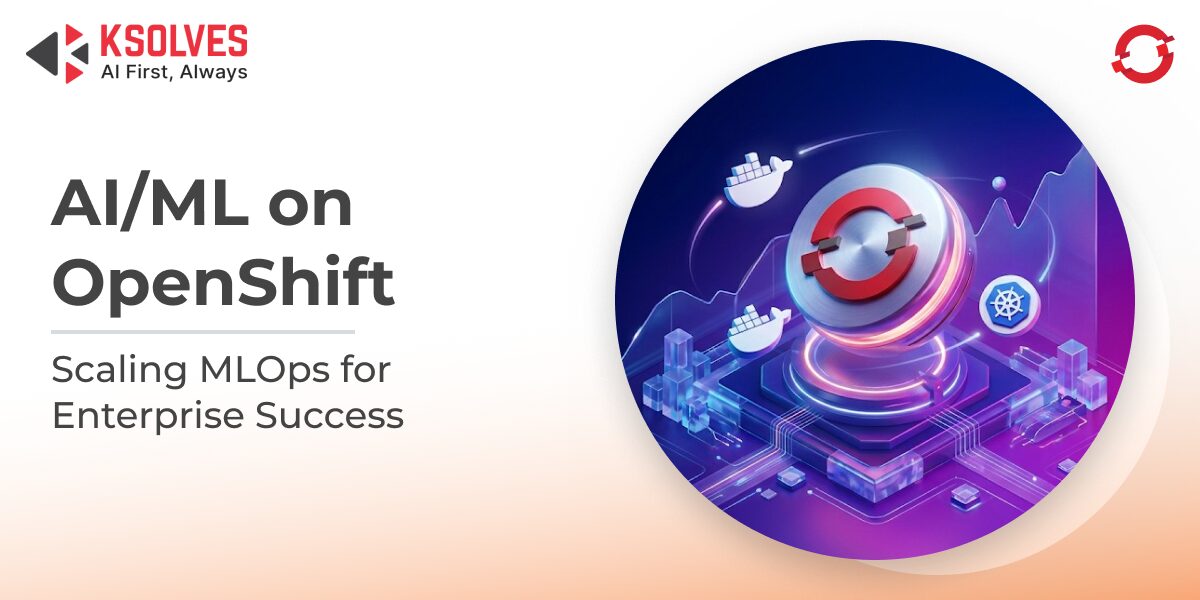
Artificial intelligence and machine learning are no longer experimental ambitions. They are production imperatives. From real-time fraud detection in financial services to predictive diagnostics in healthcare, enterprises are racing to bring AI-powered applications from the lab into live environments at scale. Yet the gap between a data scientist’s notebook and a production-grade inference service remains wide and treacherous.
Red Hat OpenShift bridges that gap. As the industry’s leading enterprise Kubernetes platform, OpenShift provides a consistent, secure, and hybrid-cloud-ready foundation for the entire AI/ML lifecycle, from data preparation and model training to serving, monitoring, and retraining. Paired with the right delivery partner, organizations can operationalize AI faster, with fewer surprises and greater confidence.
This blog explores the technical architecture, core capabilities, and best practices for running AI/ML workloads on OpenShift, and how Ksolves’ AI-driven delivery approach helps enterprises unlock the full potential of this platform.
Why OpenShift for AI/ML?
Modern AI/ML workloads are fundamentally distributed systems problems. They require:
- Reproducibility experiments and pipelines must run identically across environments.
- Scalability training jobs must burst across dozens of GPU nodes; inference services must auto-scale with traffic.
- Portability models trained on-premises must be deployable to the cloud, and vice versa.
- Governance data lineage, model versioning, bias detection, and auditability are non-negotiable in regulated industries.
Kubernetes already addresses many of these concerns, and OpenShift builds on Kubernetes with enterprise-grade security, integrated DevOps tooling, and a rich ecosystem of AI-accelerating components.
OpenShift’s hybrid cloud architecture ensures that data scientists and ML engineers work with consistent tooling, whether the cluster lives in an on-premises data center, AWS, Google Cloud, IBM Cloud, or at the edge.
Also Read: 10 Common Challenges in OpenShift Adoption and How to Overcome Them
The OpenShift AI Platform Architecture
1. Red Hat OpenShift AI (RHOAI)
Red Hat OpenShift AI (formerly Open Data Hub) is the dedicated MLOps platform layer built on top of OpenShift. It is available as an OpenShift Operator and assembles a portfolio of open-source tools, primarily from the Kubeflow and Project Jupyter ecosystems, into a governed, enterprise-ready experience.
At a high level, RHOAI addresses five stages of the AI/ML lifecycle:
| Stage | Key Components |
| Data Preparation | MinIO (S3-compatible storage), Feast (feature store), Apache Spark |
| Model Development | Jupyter Notebooks, Elyra, Python workbenches with PyTorch/TensorFlow |
| Pipeline Automation | Kubeflow Pipelines, Elyra Notebook Pipelines |
| Model Serving | KServe, ModelMesh, vLLM, NVIDIA Triton, OpenVINO |
| Monitoring & Governance | Prometheus, TrustyAI (fairness/explainability), drift detection |
2. Workbench Environments
Data scientists start in a workbench, a containerized environment pre-configured with Python, Jupyter notebooks, and the full AI/ML library stack (PyTorch, TensorFlow, Pandas, scikit-learn, and more).
These workbenches run as pods on OpenShift, eliminating environment inconsistency and ensuring experiments are reproducible from the first commit.
3. Data Science Pipelines (Kubeflow Pipelines)
Once experiments stabilize, workflows are promoted into automated pipelines. OpenShift AI uses Kubeflow Pipelines (KFP) as its pipeline engine. Engineers define pipelines as Python code or YAML; each step runs as an isolated container, enabling clean dependency management and partial re-execution.
The Elyra JupyterLab extension allows data scientists to graphically compose pipelines directly from notebook cells, lowering the barrier to pipeline adoption.
Pipeline artifacts, datasets, trained model files, and metrics are stored in S3-compatible object storage (MinIO or Amazon S3), ensuring durability and traceability across runs.
4. Distributed Training with CodeFlare and Ray
Large-scale training jobs, fine-tuning LLMs, and training computer vision models on terabyte datasets cannot run on a single node. OpenShift AI integrates CodeFlare and Ray for distributed workloads. CodeFlare simplifies orchestration by managing job scheduling, resource scaling, and GPU integration.
Ray provides the distributed compute substrate, enabling parallel execution across multiple cluster nodes. Teams submit RayCluster custom resources to the OpenShift API; the operator provisions worker pods dynamically, runs the training job, and tears down the cluster when complete, optimizing GPU utilization and cost.
5. GPU and Hardware Accelerator Support
OpenShift AI supports GPU acceleration from NVIDIA, AMD, and Intel out of the box. The provisioning chain is as follows:
- Node Feature Discovery (NFD) Operator: Automatically detects and labels nodes with hardware capabilities (GPU presence, CPU microarchitecture, memory topology).
- NVIDIA GPU Operator: Deploys the full NVIDIA software stack (drivers, CUDA toolkit, device plugin, DCGM exporter) as a DaemonSet, making GPU devices schedulable Kubernetes resources.
- GPU-as-a-Service: RHOAI can partition and schedule GPU resources centrally, providing detailed observability and enabling self-service GPU access for data scientists without manual node management.
For cost optimization on AWS, the AWS Neuron Operator (developed jointly by AWS and Red Hat) brings support for AWS Inferentia and Trainium chips to OpenShift, delivering up to 70% lower cost per inference compared to GPU-based instance types in many scenarios.
6. Model Serving: KServe and ModelMesh
Serving is where AI creates business value, and OpenShift AI provides a mature, production-grade serving layer.
KServe (formerly KFServing) deploys models as scalable Kubernetes services. It supports multiple serving runtimes out of the box:
- NVIDIA Triton Inference Server (kserve-tritonserver): Optimized for high-throughput, multi-framework inference with native ONNX support.
- OpenVINO Model Server: Intel-optimized runtime for CPU inference.
- vLLM: High-efficiency runtime for large language models, leveraging PagedAttention for memory efficiency and continuous batching for throughput.
ModelMesh enables multi-model serving, where many smaller models share a single serving infrastructure. This is ideal for organizations running dozens of specialized models. ModelMesh dynamically loads and unloads models based on request traffic, dramatically reducing infrastructure cost compared to one-deployment-per-model patterns.
OpenShift AI also includes llm-d, an open-source framework for distributed LLM inference at scale, enabling models to be split and served across a fleet of GPU nodes with fine-grained control and observability.
7. Monitoring, Fairness, and Governance
Production AI is not “deploy and forget.” OpenShift AI provides:
- Prometheus + Grafana: Tracks serving latency, throughput, error rates, and GPU utilization.
- TrustyAI: Measures model fairness and explainability, flagging decisions that may reflect biased training data.
- Drift Detection: Monitors input data distributions at inference time; alerts when live data diverges significantly from the training distribution, indicating the model may need retraining.
- AI Guardrails: A customizable safety control framework ensuring that deployed models, especially LLMs, remain transparent, fair, and compliant with organizational policies.
Also Read: Why Businesses Are Choosing OpenShift for Container Orchestration
Key Architectural Patterns for AI/ML on OpenShift
1. GitOps-Driven MLOps
By applying GitOps principles (via OpenShift GitOps, built on Argo CD) to ML pipelines, teams treat model training configurations, serving manifests, and infrastructure definitions as code in Git.
Every pipeline run, every model deployment, and every configuration change is version-controlled, peer-reviewed, and auditable, essential for regulated industries like finance and healthcare.
2. Model-as-a-Service (MaaS)
OpenShift AI supports a Model-as-a-Service pattern where LLMs and foundation models are deployed as shared, centrally managed API endpoints accessible to all teams. This avoids duplicated infrastructure, reduces GPU sprawl, and enforces consistent governance.
The AI Hub (Developer Preview) provides a dashboard experience for platform engineers to manage model catalogs, registries, and deployments, including MCP server integration for agentic AI use cases.
Gen AI Studio (Developer Preview) gives AI engineers a playground to experiment with and compare deployed models before promoting them to production.
3. Feature Store Integration
For real-time inference use cases (fraud detection, personalization, anomaly detection), freshness of input features is critical. OpenShift AI pipelines integrate with Feast as an online feature store.
At inference time, KServe custom predictors fetch the latest features for each request from Feast, ensuring predictions are always based on current data, not stale batch features.
4. Hybrid and Multi-Cloud Deployment
OpenShift AI runs consistently across:
- On-premises data centers for compliance, data sovereignty, and latency-sensitive workloads.
- Public clouds (AWS ROSA, Google Cloud, IBM Cloud) for elastic compute and managed services.
- Edge for inference at the point of data generation (manufacturing, retail, autonomous systems).
Teams use the same pipelines, the same serving manifests, and the same monitoring stack regardless of where the cluster runs. This portability eliminates the cost and risk of platform-specific rework.
Also Read – How AI-Driven OpenShift Consulting Improves ROI and Reduces Burn
Real-World Impact
Across industries, OpenShift-based AI/ML deployments are delivering measurable outcomes:
- Financial Services: NLP-based document verification systems have cut processing time from days to minutes, with 90% accuracy and 40% reduction in application downtime.
- Healthcare: Computer vision pipelines for medical imaging run reproducibly across on-premises and cloud clusters, accelerating diagnostic workflows.
- Telecommunications: Predictive maintenance models trained on network telemetry data detect faults before they cause outages.
- Automotive: Real-time anomaly detection models deployed at edge nodes identify production-line defects with sub-second latency.
Ksolves’ AI-Driven Delivery Approach on OpenShift
Deploying AI/ML workloads on OpenShift demands more than platform knowledge; it requires a delivery methodology that bridges data science, DevOps, and business outcomes.
As a certified Red Hat OpenShift Consulting Partner with over a decade of enterprise delivery experience, Ksolves brings a structured, AI-first approach to every engagement.
Phase 1: AI Readiness Assessment and Use Case Discovery
Ksolves begins every engagement with deep-dive discovery workshops to assess data maturity, infrastructure readiness, and team capability. Our consultants identify high-ROI AI use cases, define a phased adoption roadmap, and align technical architecture to business objectives, ensuring every investment has a clear path to value.
Phase 2: OpenShift Platform Engineering
Before a single model is trained, the platform must be right. Ksolves’ certified OpenShift engineers architect and deploy production-grade clusters tailored to AI/ML requirements:
- GPU node pools with NFD and NVIDIA GPU Operator configuration.
- Persistent storage with OpenShift Data Foundation (ODF) for model artifacts and datasets.
- Network policies, RBAC, and namespace isolation for multi-tenant data science environments.
- CI/CD pipelines using OpenShift Pipelines (Tekton), GitLab CI, or Jenkins.
- GitOps workflows via OpenShift GitOps (Argo CD) for pipeline and serving manifest management.
Phase 3: MLOps Pipeline Development
Ksolves ML engineers co-build end-to-end data science pipelines on Kubeflow Pipelines and Elyra. Pipelines are designed for automation, reproducibility, and scale, covering data ingestion, feature engineering, model training, hyperparameter tuning, evaluation, and artifact versioning.
\Distributed training configurations using CodeFlare and Ray are implemented for models requiring multi-node GPU compute.
Phase 4: Model Serving and Integration
Ksolves deploys trained models using KServe and ModelMesh, selecting the appropriate runtime (Triton, vLLM, OpenVINO) based on model type, latency requirements, and hardware availability.
Models are exposed as secure, governed REST or gRPC API endpoints. Integration with upstream applications, such as CRMs, ERPs, data lakes, and IoT platforms, is handled via REST APIs (FastAPI/Flask), event-driven architectures (Apache Kafka), and service mesh (Istio/Red Hat Service Mesh) for zero-trust inter-service communication.
Phase 5: Monitoring, Governance, and Continuous Improvement
Post-deployment, Ksolves implements full observability: Prometheus metrics, Grafana dashboards, TrustyAI fairness checks, and drift detection alerts. Our engineers configure model retraining triggers based on performance degradation signals, closing the MLOps loop.
We also support responsible AI compliance, helping organizations align deployments with SOC 2, ISO 27001, GDPR, HIPAA, and internal data governance standards.
Also Read – OpenShift Resource Management: Pods, Nodes, and Clusters
Ksolves’ Key Differentiators
| Capability | Ksolves Advantage |
| OpenShift Expertise | Certified Red Hat Partner with deep Kubernetes and OpenShift engineering bench |
| AI/ML Breadth | Full-stack coverage: data engineering, ML modeling, LLMOps, Agentic AI |
| Delivery Speed | Agile, sprint-based delivery with 90%+ client retention and 84%+ repeat business |
| Security-First | Security embedded from Day 1: RBAC, network policies, secrets management, compliance |
| Responsible AI | TrustyAI integration, bias detection, explainability, and guardrails for LLMs |
| Agentic AI Readiness | Multi-agent system design, RAG pipelines, MCP server integration on OpenShift AI |
Looking Ahead: Generative AI and Agentic Workloads on OpenShift
The frontier of AI on OpenShift is rapidly evolving toward Generative AI and Agentic AI workloads. OpenShift AI’s Gen AI Studio and AI Hub components (currently in Developer Preview) represent the platform’s commitment to making LLM and agentic workflows first-class citizens of the enterprise Kubernetes ecosystem.
Ksolves is already delivering production agentic AI systems: autonomous, multi-step workflow engines that integrate with CRMs, ERPs, IoT devices, and enterprise APIs. Our expertise in LangChain, RAG pipelines, vector memory design, and multi-agent orchestration, combined with OpenShift’s robust serving and governance infrastructure, positions enterprises to move from LLM experimentation to agentic production confidently and responsibly.
Conclusion
OpenShift is not simply a container platform that happens to support AI, but it is a purpose-built, enterprise-grade MLOps foundation. From GPU-accelerated distributed training and production-grade model serving to fairness monitoring and GitOps-driven governance, OpenShift provides every layer organizations need to operationalize AI at scale, across any environment.
Ksolves amplifies this platform with a delivery approach built around real-world AI outcomes: structured discovery, certified platform engineering, end-to-end pipeline development, and responsible AI governance. Whether you are taking your first steps into ML or scaling Generative AI across the enterprise, Ksolves and OpenShift together provide the shortest, most reliable path from data to value.































AUTHOR
OpenShift
Share with