



ERPNext vs Tally: Complete Comparison for Growing Businesses
ERPNext
5 MIN READ
April 28, 2026

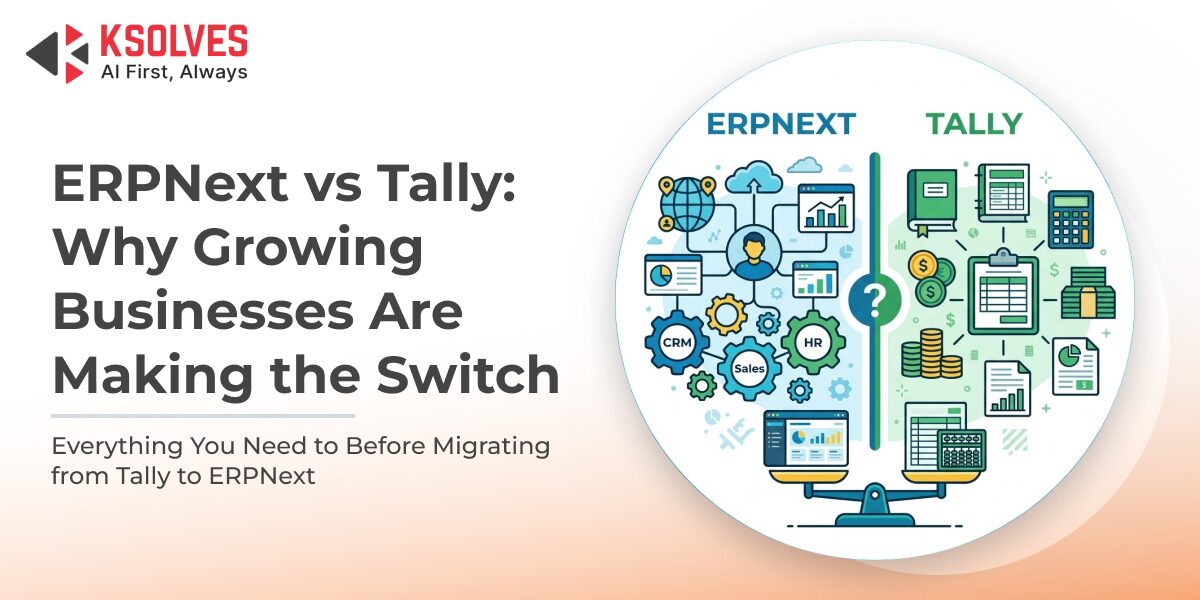
Most businesses start with Tally for a good reason. When finance means bookkeeping, compliance, and closing the books on time, it does the job well.
Growth changes what finance means. It becomes the backbone of planning, operations, and real-time decisions, and that is where accounting-only tools start falling short.
Tally tells you what happened. Fast-growing businesses need a platform that shows what is happening right now and what it means for tomorrow. That shift from record-keeping to operational intelligence is why businesses are moving from Tally to ERPNext.
Why are businesses Choosing to Migrate from Tally?
Tally was built for a version of business that no longer exists for most growing companies.
In 2000, running finance meant managing ledgers, filing returns, and keeping books clean. That was enough.
Business today runs differently. Supply chains, customer relationships, warehouse operations, HR, and sales pipelines all generate data that needs to connect. An accounting tool cannot do that, and the workaround, exporting Tally data into spreadsheets, reconciling it manually, and feeding it into other tools, becomes a full-time job on its own.
The bigger shift is AI. Businesses operating in an AI-first environment expect their software to surface insights, flag anomalies, and reduce manual decisions. And a tool that only records transactions is not built for that expectation. That gap between what Tally offers and what modern operations demand is the core reason companies are migrating from Tally to ERPNext.
If you are also one of them, keep reading.
Why ERPNext is the Right Tally Alternative
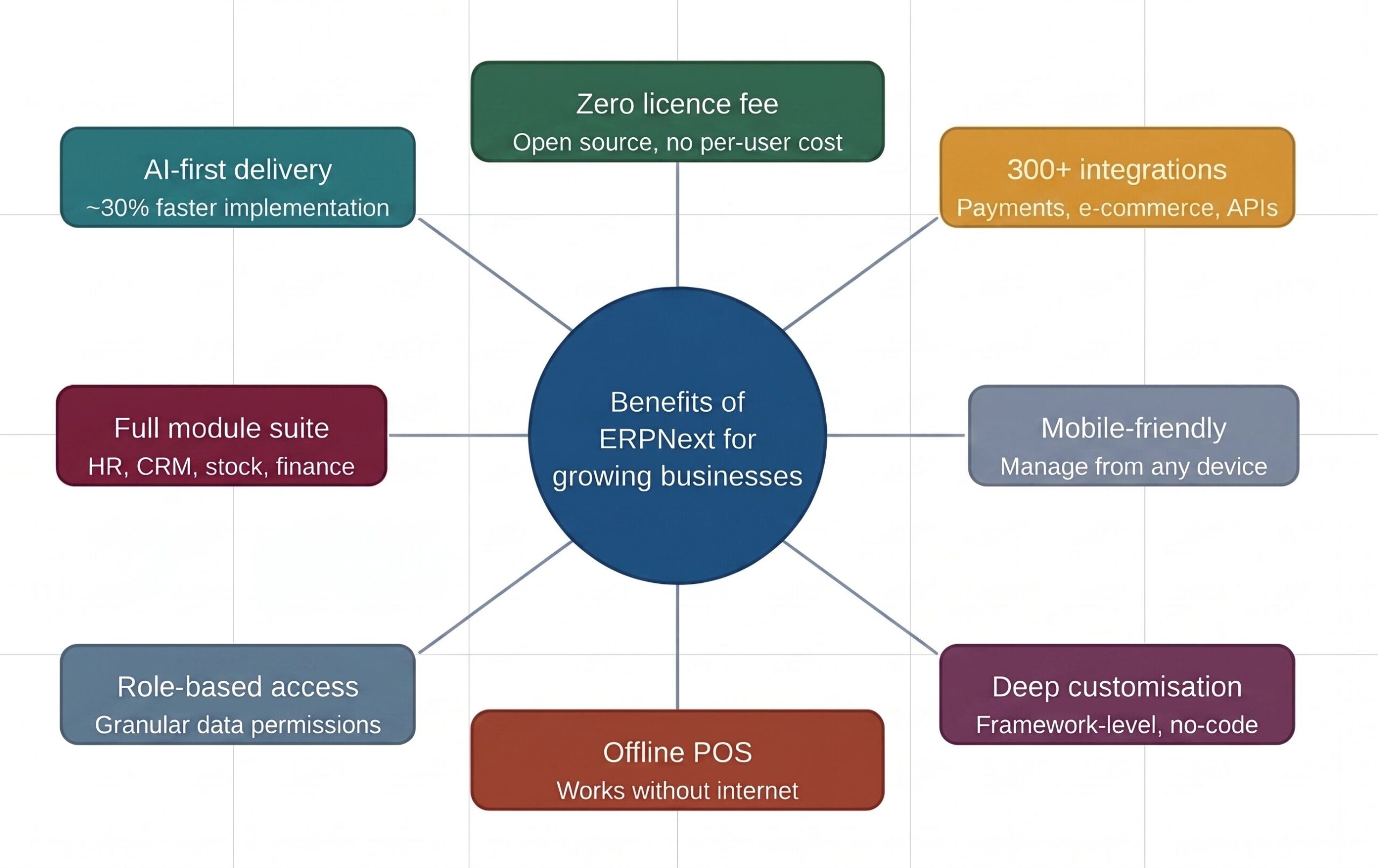
ERPNext is not just an accounting tool with more features. It is a complete business management platform; one system covering accounting, inventory, HR, CRM, sales, purchasing, project management, and more.
The difference matters because data in ERPNext is connected by design. A sales order updates inventory. A purchase updates payables. HR and payroll run inside the same system as finance. There is no exporting, no manual reconciliation between tools, no version of the truth that depends on which spreadsheet you are looking at.
It is also open source with zero software licence fees. The software licence is free; you pay only for hosting and support, not per-user seat licences or module unlocks. For businesses evaluating ERPNext services, this is one of the most immediate financial advantages over Tally’s subscription and licence model.
Must read – Top 10 Benefits of ERPNext for Small and Medium Businesses: And How an AI First Approach Enhances it Further
ERPNext vs Tally: At a Glance
|
Feature |
TallyPrime |
ERPNext |
|
Accounting |
Yes |
Yes |
|
Inventory and stock |
Basic |
Full |
|
HR and payroll |
No |
Yes |
|
CRM |
No |
Yes |
|
Sales management |
No |
Yes |
|
Project management |
No |
Yes |
|
Asset management |
No |
Yes |
|
Supply chain |
No |
Yes |
|
Warehouse management |
No |
Yes |
|
Dashboard and reporting |
Basic |
Advanced |
|
Mobile access |
No |
Yes |
|
REST API |
Limited (proprietary XML/JSON, not RESTful) |
Yes (open REST API) |
|
Framework-level customisation |
No |
Yes |
|
Deployment |
Windows (client-server or hosted via partners) |
Cloud, Linux, self-hosted |
|
Pricing model |
Subscription + licence fee |
Open source, zero licence fee |
ERPNext vs Tally: Features Compared
Tally’s feature set is deliberately narrow. It handles accounting well and covers basic inventory, and for a business that only needs that, it is enough. But when operations grow past the ledger; when the same business is also managing a sales pipeline, a warehouse, a team, and an e-commerce channel; Tally stops being a system and starts being one piece of a much larger, more expensive puzzle.
ERPNext covers that entire surface. Every module connects to the same database, which means a sales order updates inventory in real time, a purchase updates payables, and payroll runs inside the same system as your balance sheet. Bain and Company notes that expert-led ERP transformations deliver on average 20% more value at 20% lower cost compared to standard technical implementations; a gap that widens when businesses choose the wrong platform to begin with.
These are the five feature areas where the difference is most visible for a growing business.
Accounting and financial management
Both ERPNext and Tally handle double-entry accounting, GST compliance, and financial reporting. Tally’s strength in Indian statutory compliance: GST, TDS, e-invoicing, and audit trail – is well-established. ERPNext covers the same requirements natively, including e-invoicing integration, GST returns, and TDS deductions, within the same module that handles the rest of your operations.
The deeper difference is what sits around the accounting layer. In Tally, accounting is the whole product. In ERPNext, accounting is one module inside a connected system, so purchase invoices, sales transactions, payroll entries, and asset depreciation all update the books automatically, without manual journal entries.
ERPNext also supports multi-currency, multi-company, and multi-branch accounting natively, which Tally handles through add-ons or workarounds.
Inventory and warehouse management
Tally covers basic stock tracking. ERPNext covers the full inventory lifecycle; purchase orders, goods receipt, stock transfers between warehouses, batch and serial number tracking, reorder points, and landed cost calculation. For businesses running multiple storage locations or dealing with high SKU volumes, this is where Tally’s limitations become a daily operational problem, not just a feature gap.
CRM and sales management
Tally has no CRM. ERPNext includes a complete CRM module covering lead capture, opportunity tracking, quotations, sales orders, and customer communication history, all linked to the same financial data. A salesperson can raise a quotation in ERPNext and it flows through to delivery and invoicing without leaving the system. That kind of end-to-end visibility does not exist in Tally.
HR, payroll, and compliance
Tally does not manage HR. ERPNext handles the full employee lifecycle; onboarding, attendance, leave, payroll, expense claims, and statutory compliance. For businesses scaling their team, running HR and payroll inside the same system as finance means payroll entries post directly to the books and compliance reporting pulls from accurate, live data.
Integrations and API access
ERPNext is API-first and ships with native integrations for Shopify, WooCommerce, Amazon, Razorpay, Stripe, PayPal, Plaid, Google Workspace, Dropbox, Amazon S3, Exotel, Twilio, and more. Every integration connects into the same data layer, so a Shopify order creates an ERPNext sales order, updates inventory, and triggers fulfillment without a third-party connector or manual sync. ERPNext is built on the Frappe framework, meaning customisations are code-level, version-controlled, and portable not locked into proprietary configuration tools. TallyPrime’s API is constrained and proprietary; for businesses that rely on ERPNext services to extend their tech stack, this is the difference that compounds the most over time.
Most Common ERPNext Industry Use Cases
ERPNext is built to handle the operational complexity that varies by industry. These are five industries where the switch from Tally to ERPNext produces the clearest results.
- Manufacturing: Production planning, bill of materials, work orders, and quality control all connect with accounting in real time. Tally records the financial outcome; ERPNext manages the process that produces it.
Read how Ksolves implemented ERPNext for a manufacturing business: How Ksolves Improved Quality Control and End-to-End Traceability for a Mid-Size Manufacturer with ERPNext
- Trading and distribution: Multi-warehouse inventory, purchase orders, supplier management, and delivery tracking run inside a single system. Reconciling these across separate tools in Tally is where distribution businesses lose hours every week.
- Retail and e-commerce: ERPNext integrates natively with Shopify, WooCommerce, and Amazon. Inventory, orders, and financials stay in sync without manual exports. It also supports offline POS that syncs when connectivity returns.
- Professional services: Project management, timesheet tracking, billing, and client management sit alongside accounting. Service businesses running these functions in separate tools find ERPNext consolidates the entire client delivery workflow.
Read how Ksolves delivered ERPNext for an IT company: How Ksolves Enhanced Project Delivery and Billing Efficiency for a Technology Services Firm with ERPNext
- Healthcare and education: Compliance, HR, fee management, and procurement all carry operational weight in these sectors. ERPNext handles each function and keeps the financial picture accurate without running separate systems.
Read how Ksolves supported a multi-specialty hospital with ERPNext: How Ksolves Unified Operations for a Multi-Specialty Hospital with End-to-End ERPNext Implementation
AI-first ERPNext implementation delivers better results
How ERPNext gets implemented matters as much as what it offers. McKinsey analysis finds that nearly 70% of ERP transformation programs fall short of their full potential, and the failures relate to how the implementation is approached, not the software itself.
Businesses that go through an AI-first ERPNext implementation process see faster go-lives, fewer post-launch issues, and lower total cost of deployment. AI-augmented ERPNext Implementation services ensure every stage of the project; requirement mapping, configuration, testing, documentation, and data migration; runs with AI tools embedded in the workflow. Configuration conflicts get caught before UAT. Documentation is generated alongside development. Testing cycles are shorter because edge cases are identified earlier.
With AI handling repetitive tasks across configuration and testing, ERPNext services delivered through an AI-first methodology complete roughly 50% faster than standard project timelines based on Ksolves project delivery data. For a business migrating from Tally, that means a shorter disruption window and a faster path to the operational visibility ERPNext is built to provide.
ERPNext Implementation Partner: What Expert-led Implementation Brings
ERPNext is open source, which means the software is accessible to anyone. What an implementation partner brings is the difference between a system that is installed and a system that actually works for your business.
Bain and Company’s research on ERP transformations is direct on this point: 90% of ERP transformations fall short of their goals, and the reason is almost always how the implementation is run, not the platform itself. Expert-led ERPNext implementation services handle the decisions that are easy to get wrong; module configuration, data migration from Tally, workflow design, role-based permissions, and post-go-live support.
Ksolves approaches every ERPNext service with AI embedded across the full delivery workflow. This is not a separate AI layer on top of standard implementation; it is how the team works. Requirement analysis, configuration review, testing, and documentation all run with AI tools as part of the daily process. The result for your project is a shorter timeline, a lower total cost, and fewer issues after go-live.
Ksolves has delivered ERPNext implementations for manufacturing, healthcare, and technology businesses across India. If you are evaluating a Migrate from Tally to ERPNext, the right ERPNext implementation services partner is the decision that determines whether the transition creates value or creates a longer, more expensive problem to solve.
Talk to Ksolves and claim your no cost discovery session.
Frequently Asked Questions
- Can ERPNext fully replace Tally for an Indian business?
Yes. ERPNext supports GST compliance, TDS management, e-invoicing under GSTN, audit trail requirements, and all standard Indian statutory reporting natively, within the same system that handles inventory, HR, CRM, and sales.
- Is ERPNext really free?
The software licence is free and open source. You pay for hosting (cloud or self-hosted infrastructure) and implementation support, not per-user seat fees or module unlocks. This makes total cost of ownership significantly lower than Tally’s subscription and licence model at scale.
- How long does migration from Tally to ERPNext take?
Timeline depends on data volume, number of entities, and customisation requirements. A Ksolves AI-first implementation typically runs roughly 30% faster than a standard ERPNext migration. Contact Ksolves for a scoped migration assessment based on your specific setup.
- Does ERPNext work for businesses with multiple GST registrations or branches?
Yes. ERPNext supports multi-company, multi-branch, and multi-GSTIN setups natively. Each entity maintains separate books while consolidated reporting is available across the group.
- What happens to historical Tally data during migration?
Tally data can be migrated to ERPNext via structured export and import workflows. Opening balances, ledger masters, and transaction history are mapped to the ERPNext chart of accounts. A structured data migration plan is part of every Ksolves ERPNext implementation.
- Can ERPNext be customized for industry-specific workflows?
Yes. ERPNext is built on the Frappe framework, which means customisations are written as code, version-controlled, and upgradeable, not dependent on vendor-locked configuration tools. Ksolves has delivered industry-specific implementations for manufacturing, healthcare, retail, and professional services.


































AUTHOR
ERPNext
Share with