



How Global Banks Are Combating AI-Powered Cyber Fraud in 2026
Cybersecurity
5 MIN READ
May 1, 2026

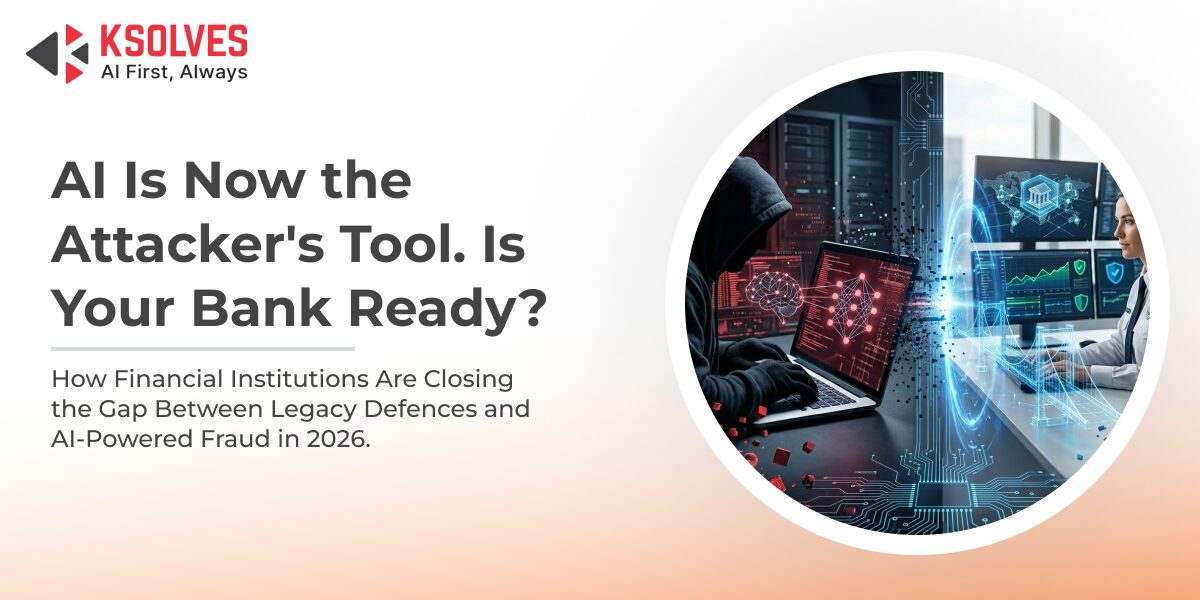
As technology advances, the threats built on top of it advance with it. Capabilities that once required state-level resources are now accessible to organised criminal groups and individual attackers. Security practices considered solid just five years ago carry blind spots that today’s attacks exploit directly.
The financial services sector sits at the centre of this shift, holding the distinction of being the most breached industry globally, with attack methods evolving faster than most internal security functions can match.
AI has widened that gap further.
The cybersecurity services that financial institutions deploy for fraud detection are now being mirrored by the attackers targeting them, applied in reverse to make attacks faster, more convincing, and harder to surface at scale.
This blog covers what AI-powered cyber fraud looks like operationally in 2026, what attack vectors banks are dealing with, and how cybersecurity services can protect financial institutions against threats that legacy systems were never designed to handle.
What Is AI-Powered Cyber Fraud in Banking?
AI-powered cyber fraud in banking refers to attacks that use artificial intelligence to automate, personalise, or scale fraudulent activity targeting financial systems, employees, or customers. This includes AI-generated phishing content, deepfake voice and video used to bypass authentication, automated credential stuffing, and machine learning tools that probe vulnerabilities at speeds no manual security process can match.
What separates AI-powered fraud from earlier attack methods is adaptability. Where older fraud detection systems flag activity based on fixed rules and known patterns, AI-generated attacks are built to operate below and around those thresholds, making each iteration harder to catch than the last.
AI Cyber Fraud Attack Vectors Targeting Banks in 2026
AI-Generated Phishing Attacks on Banks
Phishing in banking used to carry visible tells: generic greetings, awkward phrasing, requests that did not quite fit the context. Generative AI has removed those markers entirely. Attackers now produce highly personalised phishing content at scale, referencing real colleagues, live projects, and accurate organisational detail gathered from public sources and previous breach data.
Social engineering has moved well beyond email. Attackers impersonate internal IT support over calls, fabricate regulatory communications, and run multi-stage campaigns that build apparent credibility across weeks before acting.
Organisations that have not reviewed their cybersecurity services across communication and access layers are carrying exposure here that gets wider every time a new data breach adds to the available credential pool.
Deepfake Fraud and Voice Clone Attacks
Deepfake voice clone incidents have surged 243% over the past year, according to Accenture’s Banking Technology Trends 2026 report. Attackers now use audio clones of senior executives to authorise wire transfers by phone, bypassing verification built around voice recognition entirely.
Real-world example: In 2024, a finance employee at a multinational firm transferred HK$200 million, approximately USD 25 million, after a video call in which every participant, including the CFO, was a deepfake constructed from publicly available footage. The incident, reported by CNN in February 2024, remains one of the largest documented cases of deepfake-enabled financial fraud.
Synthetic Identity Fraud in Financial Services
Synthetic identity fraud combines genuine and fabricated personal data to create identities that clear standard KYC checks. AI accelerates both the construction of these identities and the iterative refinement needed to make them plausible across multiple verification systems. A synthetic identity assembled with a real address, a real employer, and a gradually built fabricated credit history passes the controls designed to reject obviously false applications.
Real-world example: The US Federal Reserve has identified synthetic identity fraud as the fastest-growing financial crime in the United States, with annual losses to lenders estimated above USD 6 billion, as documented in its research paper on synthetic identity fraud in the US payment system.
Automated Credential Stuffing and Account Takeover
Credential stuffing uses username and password combinations harvested from non-banking data breaches, relying on password reuse across services. AI-driven tooling tests large credential sets within hours, distributed across residential proxy networks at rates that mimic normal login behaviour and avoid threshold-based blocking.
Once an attacker controls a legitimate account, transactions from that account carry the trust profile of an established customer. Catching this requires behavioural analysis specific to how that account normally operates, comparing current activity against historical patterns rather than known fraud signatures.
Ransomware and Double Extortion in Banking
Ransomware encrypts systems and halts operations until payment is received. The double extortion variant adds a second lever: customer data is exfiltrated before encryption, and publication is threatened regardless of payment. For banks, this creates two simultaneous problems. The first is operational: systems are down. The second is regulatory: data exfiltration triggers mandatory incident reporting under CERT-In guidelines in India (six-hour reporting window), and under DORA for EU-regulated financial entities and their ICT service providers.
Restoring systems after paying a ransom does not close the compliance exposure. Notification obligations apply from the point of exfiltration, not from the point of resolution.
Sound alarming? It has happened.
In January 2024, LoanDepot filed an SEC Form 8-K disclosing a ransomware attack that compromised the personal data of approximately 16.9 million customers and forced multiple systems offline for several weeks.
Supply Chain and Third-Party API Attacks
According to the ITRC 2025 Annual Data Breach Report, 30% of breaches now involve a third party. Banks operate within integration-heavy ecosystems: payment processors, core banking vendors, identity providers, data aggregators, and regulatory reporting platforms. Every third-party connection is an attack surface that sits partially outside the bank’s direct control.
Supply chain attacks work by compromising a vendor with a weaker security posture to gain entry into the bank’s environment through a trusted channel. Alerts configured for external intrusion do not fire because the traffic originates from an authorised source.
Understanding how blockchain-based integrity frameworks are being applied to verify third-party connections is worth exploring separately. Read: Blockchain Security: Key Features, Types, and Use Cases
Reviewing your cybersecurity services for third-party and integration layer coverage is the logical next step after understanding how these attacks operate.
How Cybersecurity Services Can Protect Banks Against AI-Powered Cyber Threats
Full-Stack Coverage Across Every Layer
Perimeter security controls the entry point. It does not govern what happens once a trusted identity, a compromised vendor connection, or an authorised integration is already inside the environment. Full-stack cybersecurity services apply controls at the API layer, the data layer, the integration layer, and the access layer simultaneously. Coverage is consistent across the entire architecture, not concentrated at the edge.
Real-Time Transaction Monitoring and Screening
Screening transactions after they clear core systems means the risk has already passed through the most critical control point. Leading banks apply sanctions list verification, behavioural anomaly detection, and SWIFT protocol compliance checks at the point of entry. Every transaction is validated before it proceeds. Those that do not clear are blocked with a full audit trail retained, meeting the documentation requirements of correspondent banking frameworks and regulatory mandates including RBI guidelines.
24/7 Managed SOC and Behavioural Threat Detection
Static, rule-based detection flags what it already knows about. Behavioural analytics takes a different approach: it establishes baselines for individual accounts, users, and transaction patterns, then surfaces deviations from those baselines rather than matches against known signatures. This is how credential stuffing distributed at human-plausible rates gets caught. This is how account takeover on a legitimate account gets flagged despite the transaction amounts appearing normal.
Managed cybersecurity services keep this function operational around the clock. The IBM Cost of a Data Breach Report 2024 found that the average threat actor dwells time inside enterprise environments before detection runs to weeks. Closing that window requires detection and response to operate continuously, with human analysts triaging signals in real time.
Continuous Vulnerability Assessment and Penetration Testing
AI-powered automated scanning tools have shortened the window between a vulnerability appearing and an attacker finding it. Quarterly or annual vulnerability assessments leave extended periods of unexamined exposure in between. Continuous vulnerability assessment covers web applications, APIs, network infrastructure, and cloud configurations on a rolling basis. Findings are risk-rated and assigned to remediation cycles based on exploitability, not scheduling convenience.
Penetration testing complements this by simulating real attack conditions: not just finding vulnerabilities but testing whether existing controls actually prevent their exploitation under pressure. The combination gives financial institutions a working picture of their actual exposure rather than a snapshot from the last scheduled review.
Zero Trust Architecture at the Access Layer
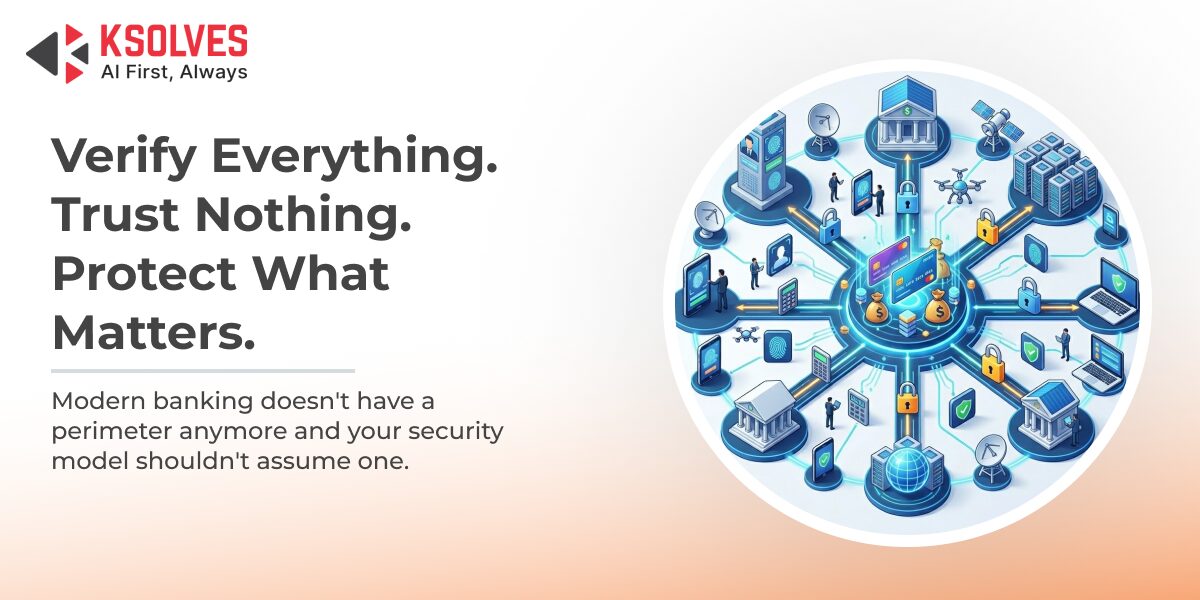
Zero Trust security removes the assumption that traffic already inside the network perimeter carries inherent trust. Every access request, from any identity, any device, or any integration, is verified against defined policy at the point of request. Sessions are validated continuously, not just at login. This architecture directly limits the damage from compromised credentials, insider threats, and supply chain intrusions, because the attacker’s access is bounded by policy at every step, not by where they managed to enter.
Cybersecurity Compliance Services as a Standing Function
RBI guidelines, CERT-In obligations, the DPDP Act 2023, and DORA for EU-regulated entities all specify security controls, incident reporting windows, and documentation requirements that apply continuously. Audit trails, compliance records, and incident reports generated as part of daily managed security operations mean regulatory readiness is a permanent condition. When a review happens or an incident requires reporting, the documentation already exists.
Cybersecurity compliance services structured as an ongoing function, rather than a pre-audit exercise, are what separate organisations that pass reviews from those that scramble through them.
What Mid-Tier Banks and Financial Institutions Must Do Now
Large global banks have the resources to staff internal SOC teams, run enterprise SIEM programmes, and maintain continuous assessment cycles. Mid-tier and regional financial institutions face the same threat landscape with a different resource profile.
Size does not reduce exposure. Research published by American Banker found 90% of community banks expect increasingly severe cyber attacks. Smaller institutions are considered softer targets. Attack tools built on AI do not filter by asset size or geographic market.
Prevention: API and Integration Layer Security
Every third-party connection and customer-facing API is a potential entry point. Effective prevention maps the full integration surface, enforces authentication at every connection point, and applies ongoing vendor security assessments. With supply chain attacks accounting for nearly a third of all breaches, integration layer security is now a primary control, not a secondary one.
Detection: Managed Cybersecurity Services and SOC Operations
Managed cybersecurity services operating 24/7 with SIEM and behavioural analytics tooling produce continuous signal across the full environment. Incident identification measured in minutes against threats operating at machine speed is what the managed SOC function delivers. Internal teams monitoring on business hours schedules cannot close that response gap.
Governance: Cybersecurity Compliance Services Built Into Operations
Security policies and compliance documentation assembled before a review are assembled too late. Cybersecurity compliance services embedded in the managed security engagement generate audit trails automatically, run access reviews on schedule, and produce regulatory reports within the timeframes frameworks require. Governance runs as a daily function, not a periodic project.
Managed cybersecurity services give mid-tier banks access to all three: 24/7 SOC monitoring, continuous vulnerability assessment, real-time transaction screening, and cybersecurity compliance operations, delivered as an ongoing engagement rather than built from scratch internally.
A cybersecurity risk assessment is the practical starting point. It documents current exposure across every layer and produces a prioritised remediation roadmap with defined timelines. The alternative is learning about the gaps from an incident report.
Cybersecurity Services Aligned to the 2026 Threat Landscape
Prevention: API and Integration Layer Security
Every third-party connection and customer-facing API is a potential entry point. Effective prevention maps the full integration surface, enforces authentication at every connection point, and applies ongoing vendor security assessments. With supply chain attacks accounting for nearly a third of all breaches, integration layer security has moved from a supporting concern to a primary one.
Detection: Managed Cybersecurity Services and SOC Operations
Managed cybersecurity services operating 24/7 with SIEM and behavioural analytics tooling produce continuous signals across the full environment. Incident identification measured in minutes against threats operating at machine speed is what the managed SOC function delivers. Internal teams monitoring on business hours schedules cannot match that response window.
Governance: Cybersecurity Compliance Services Built Into Operations
Security policies and compliance documentation assembled before a review are assembled too late. Cybersecurity compliance services embedded in the managed security engagement generate audit trails automatically, run access reviews on schedule, and produce regulatory reports within the timeframes frameworks require. Governance runs as a daily function, not a periodic project.
Build the Security Posture the Threat Requires
AI-powered cyber fraud protection has changed the operating environment for every financial institution, large and small. The gap between where most organisations’ security posture sits and where the actual threat operates is not theoretical. It shows up in dwell times, in breach disclosures, and in compliance failures that had documented technical causes.
Closing that gap starts with a clear picture of current exposure. A cybersecurity risk assessment from Ksolves documents exactly where your organisation stands across every layer and produces a remediation roadmap with priorities and timelines attached.
Schedule a Consultation with our cybersecurity team to start with an accurate view of where your security posture stands today.
Frequently Asked Questions About Cybersecurity Services for Banks
What is AI-powered cyber fraud in banking?
AI-powered cyber fraud in banking refers to attacks that use artificial intelligence to automate, scale, or personalise fraudulent activity against financial institutions, their employees, or their customers. Common forms include AI-generated phishing, deepfake voice and video fraud, automated credential stuffing, and machine learning tools used to identify vulnerabilities faster than manual security teams can track.
What do managed cybersecurity services for banks include?
Managed cybersecurity services for banks provide continuous outsourced security operations: 24/7 SOC monitoring, real-time threat detection, incident response within defined SLA timelines, vulnerability assessment, and compliance reporting. The function operates across the full technology stack, covering cloud, on-premises, and integration environments, without requiring an internal team to staff and run it.
What is a SOC in cybersecurity?
A Security Operations Centre (SOC) is a dedicated function responsible for continuous monitoring, threat identification, and incident response across an organisation’s security environment. In banking, a SOC covers transaction systems, APIs, user access layers, and third-party integration channels around the clock, with incidents triaged and responded to within regulatory and contractual SLA requirements.
What is the difference between vulnerability assessment and penetration testing?
A vulnerability assessment systematically identifies and catalogues security weaknesses across an environment on a rolling basis. A penetration test simulates a real attack to determine whether those vulnerabilities can be exploited under realistic conditions. Both serve different purposes in a mature security programme. Vulnerability assessment finds what is exposed. Penetration testing confirms whether existing controls actually prevent exploitation.































AUTHOR
Cybersecurity
Share with