Project Name
Enterprise Analytics and BI Platform on Microsoft Fabric for Leading Indian Manufacturer

The client is one of India’s most recognised consumer goods and furniture manufacturers, operating a diversified portfolio spanning furniture, material handling, consumer goods, plastics, and lifestyle products. They distribute through retail, wholesale, and direct channels across India and internationally.
Their enterprise technology stack was substantial: SAP S/4HANA as the primary ERP covering financials, procurement, manufacturing, and supply chain; Microsoft Dynamics CRM for operational and customer management; and Salesforce CRM for sales pipeline and customer engagement. Despite this investment, the organisation had no unified analytics layer. Every cross-functional report required manual data extraction from multiple systems, reconciliation in Excel, and distribution via email. Real-time decision-making was structurally impossible.
The leadership team engaged Ksolves to design and deliver a modern Business Intelligence platform that would consolidate all three source systems into a single governed data foundation and surface actionable insights across every major business function through interactive Power BI dashboards.
Ksolves’ Big Data consulting team used AI-assisted pipeline design and automated data quality checks during the build phase, cutting dashboard development cycles and reducing post-delivery rework to near zero across all 8 functional clusters.
- Three Disconnected Systems with No Cross-Functional View: SAP S/4HANA, Microsoft Dynamics CRM, and Salesforce CRM each held authoritative data for different parts of the business, but no integration layer connected them. Leadership had no single view of revenue, margin, collections, inventory, and supply chain in one place. Cross-functional planning and executive reporting depended on manual, time-consuming data assembly.
- 50+ Reports Running on Manual Excel Extraction: Business-critical reports including P&L summaries, collections ageing, inventory levels, manufacturing downtime, and sales pipeline were produced by extracting data from source systems, reconciling differences in Excel, and distributing via email. This introduced inconsistencies, consumed significant analyst time, and meant data was always stale by the time it reached decision-makers.
- No Geographic or Drill-Down Analytics for India Sales: With sales operations spanning hundreds of distributors and dealers across every Indian state, the organisation had no map-based or state-level drill-down analytics. Regional performance, territory-level pipeline, and geographic sales concentration were invisible. Sales leadership could not identify regional opportunities or underperformance proactively.
- No Row-Level Security Across Business Units: Without a governed BI layer, sensitive financial and operational data was distributed as flat files without role-based restrictions. Implementing proper row-level security required manual management at the database query level, making it operationally infeasible without a centralised platform.
- No Real-Time Visibility Across Manufacturing and Supply Chain: Production output, machine downtime, quality metrics, demand forecasting, and logistics performance were all tracked in separate system reports with no unified operational dashboard. Decisions on production scheduling, replenishment, and dispatch were made on lag-heavy, manually compiled data rather than live operational signals.
- Scalability Risk: Legacy SAP CCP Mid-Migration to S/4HANA: The organisation was actively migrating from its legacy SAP CCP system to SAP S/4HANA. The BI platform had to handle this transition without disruption, ingesting CCP data via Excel uploads during the migration window and then switching to SAP S/4HANA OData without requiring any dashboard rebuild or data model rework.
- Microsoft Fabric F64 Platform on OneLake: The platform was deployed on Microsoft Fabric F64 capacity, selected over F16 to ensure sufficient compute, storage (64 TB OneLake), and concurrency for the 250-widget production workload. F64 includes Copilot capability, Power BI capacity for all consumers, and required only 3 developer licences, delivering approximately 41% cost savings versus Pay-As-You-Go on reserved annual capacity.
- Big Data Medallion Architecture ETL with Apache Spark: Full Spark-based ETL pipelines were built for all three source systems: SAP S/4HANA via OData and SAP Extractor, Microsoft Dynamics via native Fabric connector, and Salesforce via Fabric pipeline connector. Apache Spark on Microsoft Fabric is a distributed Big Data processing engine designed to handle large-scale ETL workloads across complex, multi-source environments. The Bronze layer captured raw data with full audit trails. The Silver layer applied cleansing, validation, and cross-system conformity rules. The Gold layer produced aggregated, business-ready datasets powering all dashboard clusters. Pipelines were reused and extended across all 8 functional areas to ensure consistency. Ksolves used AI-assisted pipeline scaffolding to accelerate the ETL build across all three source connectors, reducing configuration time on repetitive pipeline tasks by a significant margin.
- SAP Migration Bridge: Excel Interim Ingestion to S/4HANA: To handle the live SAP CCP to S/4HANA migration, the platform was architected with a configuration-only source switchover. During the migration window, CCP data was ingested via Excel file uploads to OneLake. Post-migration, the data source was switched to SAP S/4HANA OData with no dashboard rebuild, no data model rework, and zero business disruption across the ERP transition. This is a direct outcome of the Big Data integration approach Ksolves applied: decoupling the semantic model from the ingestion source at the architecture stage rather than patching it later.
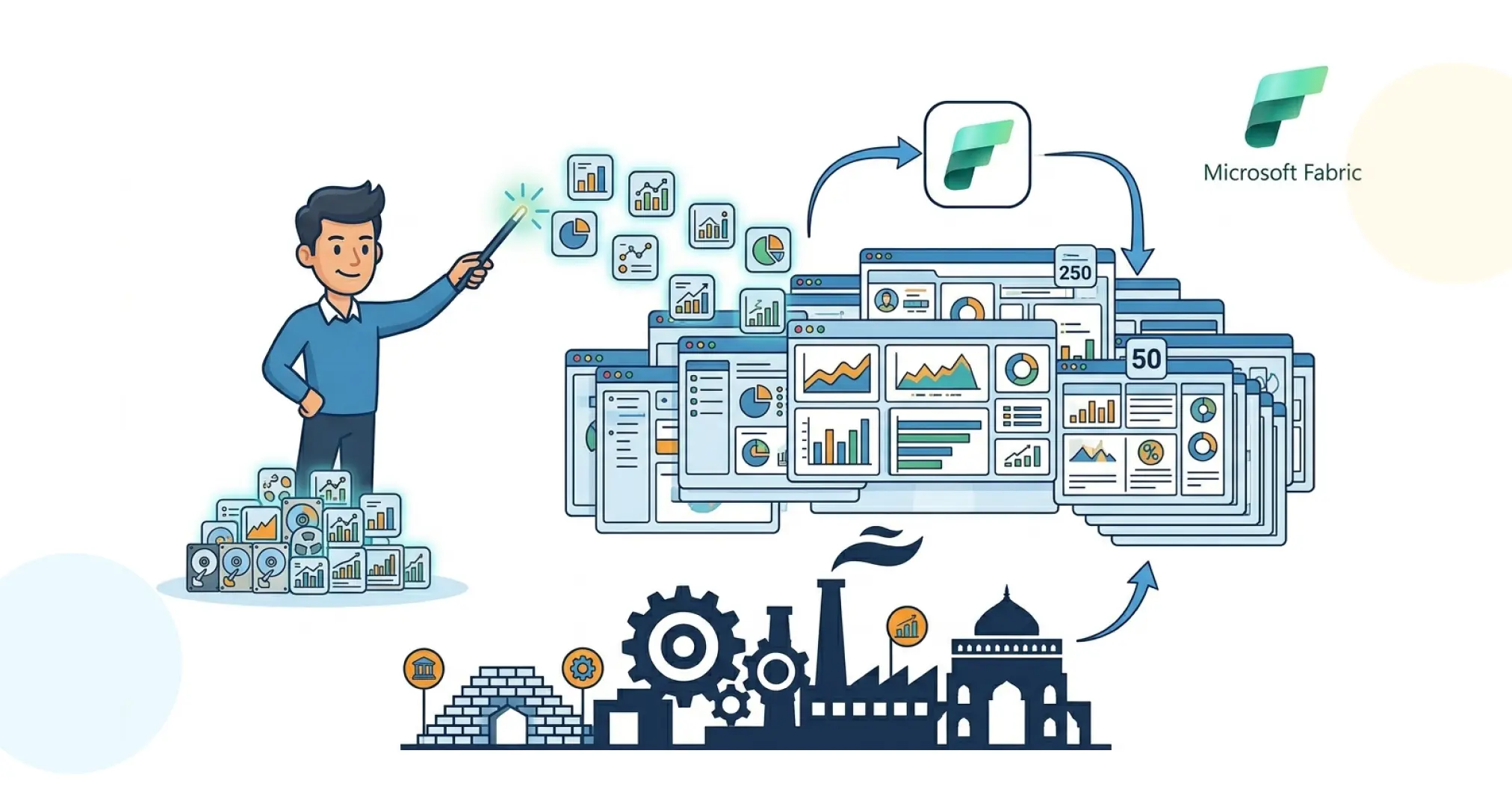
- 250 Widgets Across 50+ Dashboards Covering 8 Business Functions: Interactive Power BI dashboards were delivered across eight complete business functions: Sales (regional breakdown, product-level analysis, India state map with drill-down, sales funnel and pipeline); Collections (outstanding receivables, ageing analysis, cash flow tracking); Procurement and Stores (PO tracking, vendor performance, inventory movement); Manufacturing (production output, downtime, quality metrics); Supply Chain Planning (demand forecasting, replenishment); Logistics and Warehousing (dispatch tracking, delivery performance); Manpower (headcount, productivity, attendance); and Finance and Accounts (P&L, revenue vs target, budget variance).
- Native India Map with State-Level Drill-Down: Power BI's native India geographic analytics were deployed across the Sales dashboards, enabling sales leadership to visualise territory performance, click through from national to state-level views, and drill into district and dealer-level data. This replaced the complete absence of geographic analytics that had previously prevented regional performance management.
- Row-Level Security via Power BI Service: Native Power BI Row-Level Security was configured centrally in Power BI Service, ensuring every user sees only the data their role permits across all 50+ reports and all 8 functional clusters. This replaced the previous absence of access controls on distributed Excel reports, establishing a governed, role-aware analytics layer for the first time.
Technology Stack
| Category | Technology | Role |
|---|---|---|
| Platform | Microsoft Fabric F64 | Unified SaaS platform for Big Data engineering, Spark processing, OneLake storage, and Power BI in one governed environment |
| Architecture | Medallion Architecture on OneLake | Bronze to Silver to Gold Big Data pipeline across all three source systems, full lineage at every layer |
| Processing | Apache Spark (Fabric) | Distributed Big Data ETL across SAP, Dynamics, and Salesforce, pipelines reused across all 8 functional clusters |
| Frontend | Power BI (DirectLake) | 250 widgets across 50+ dashboards, India map drill-down, cross-filtering, and conversational AI analytics |
| Security | Power BI RLS + Azure AD | Row-Level Security across all 50+ reports, Azure AD for workspace-level identity and access governance |
| Integration | SAP OData + Fabric Connectors | SAP S/4HANA via OData and SAP Extractor, Dynamics and Salesforce via native Fabric connectors, Excel for interim CCP ingestion |
- Single Cross-Functional Analytics Layer Across 3 Enterprise Systems: Before, SAP, Microsoft Dynamics, and Salesforce held separate, incompatible datasets. Every cross-functional report required manual extraction, reconciliation, and distribution, taking days and arriving stale. After, all three source systems flow through a governed Medallion Architecture on OneLake into 250 widgets across 50+ Power BI dashboards, giving every business function access to a single, consistent, real-time source of truth.
- 250 Widgets and 50+ Dashboards Live Across 8 Business Functions: Before, critical business metrics across Sales, Collections, Procurement, Manufacturing, Supply Chain, Logistics, Manpower, and Finance were tracked in separate system reports or manually compiled Excel files with no interactive drill-down. After, 250 interactive Power BI widgets spanning 50+ dashboards and all 8 functional clusters are live in production, with drill-down, chart-level cross-filtering, geographic analytics, and role-level access controls active from day one.
- India State-Level Sales Geography Unlocked for the First Time: Before, sales leadership had no geographic analytics layer. Territory performance, regional pipeline, and state-level sales concentration were invisible, preventing proactive regional management across India's distributor and dealer network. After, the native Power BI India map with state-level drill-down enables leadership to move from national performance to state, district, and dealer-level analysis in a single interaction.
- Manual Excel Reporting Eliminated Across All Business Functions: Before, 50+ reports were produced by manually extracting data from source systems, reconciling in Excel, and distributing via email. This consumed significant analyst time and produced data that was stale the moment it was shared. After, all 50+ reports are automated, self-serve, and real-time via Power BI DirectLake, with scheduled data refresh, role-based access, and drill-through available to every authorised user without analyst involvement.
- Zero-Disruption SAP CCP to S/4HANA Migration: Before, the organisation was mid-migration from SAP CCP to S/4HANA with no clear mechanism to maintain BI continuity. Any interruption to source data would have broken dashboards and delayed the analytics programme. After, the platform ingested CCP data via Excel during the migration window and switched to SAP S/4HANA OData post-migration with a configuration-only change. No dashboard rebuild, no data model rework, and zero business disruption.

Before this engagement, a large Indian manufacturer ran SAP S/4HANA, Microsoft Dynamics, and Salesforce in complete analytical isolation. Over 50 business-critical reports were produced manually in Excel, geographic sales analytics did not exist, and cross-functional decision-making was delayed by days of data assembly.
Ksolves’ Big Data implementation team delivered a complete BI platform on Microsoft Fabric: 250 interactive Power BI widgets across 50+ dashboards and 8 functional clusters, all powered by a governed Medallion Architecture on OneLake unifying all three source systems into a single, real-time analytics layer.
The platform eliminated 50+ manual Excel reports, established India state-level geographic sales analytics for the first time, and deployed native Power BI Row-Level Security across all dashboards. The Microsoft Fabric F64 architecture with Apache Spark ETL, OneLake storage, and DirectLake Power BI was designed for zero-rebuild ERP transitions: the SAP CCP to S/4HANA migration completed without disrupting a single dashboard.
With the governed Medallion Architecture in place, the organisation’s analytics roadmap is fully open for the next phase: AI-powered forecasting, Copilot-enabled natural language queries, advanced supply chain optimisation, and automated financial planning, all built on the same Gold layer already powering 250 live widgets.
Still reconciling SAP, CRM, and operational data in Excel before every leadership meeting? Talk to Ksolves about delivering a governed Microsoft Fabric BI platform, from Medallion Architecture pipelines to 50+ interactive Power BI dashboards, that gives your leadership team a live, cross-functional view of every business function.
Stop Reconciling Excel Files – Get Your Sap, CRM, and Operational Data Live on One Dashboard.