



Why ServiceNow Implementations Fail And How to Avoid It
ServiceNow
5 MIN READ
May 21, 2026

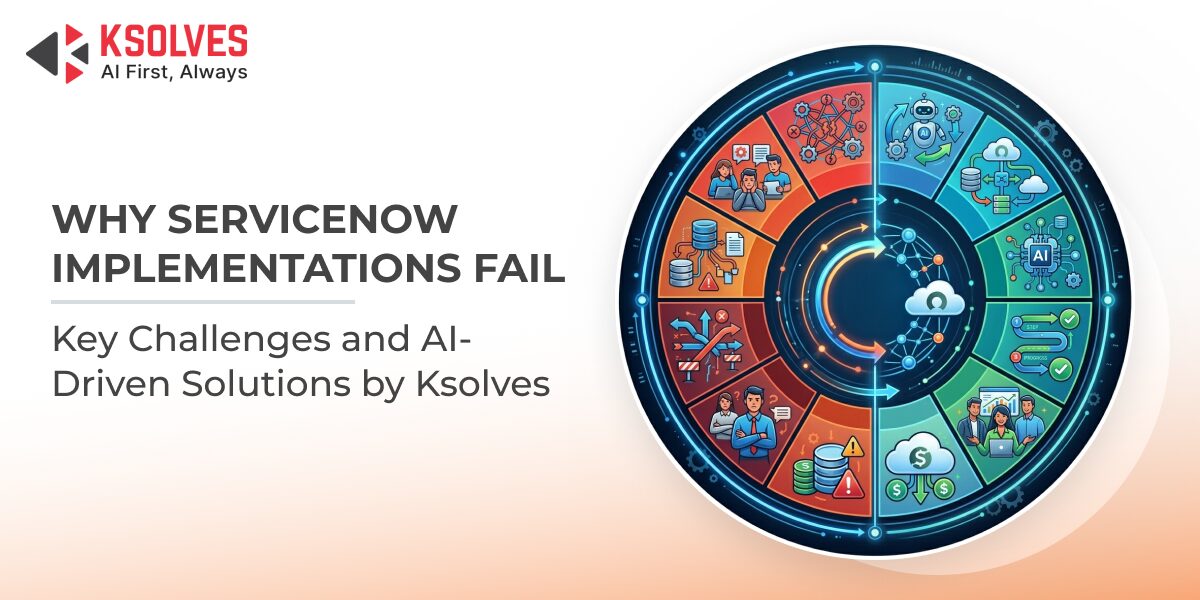
ServiceNow is one of the most powerful enterprise workflow automation platforms available today. Organizations invest in it to streamline operations, automate service delivery, improve employee experiences, and accelerate digital transformation across IT, HR, customer service, security, and business operations.
Yet despite its capabilities, many ServiceNow implementations fail to deliver the expected results.
Some projects suffer from delayed go-lives, budget overruns, low user adoption, and workflow inefficiencies. Others become over-customized, difficult to scale, and expensive to maintain. In many cases, employees continue relying on emails, spreadsheets, and manual processes even after implementation.
The issue is rarely the platform itself.
Most failed ServiceNow implementations happen because organizations focus only on deployment while overlooking process alignment, governance, change management, scalability, and user adoption.
In this blog, we’ll explore the most common reasons ServiceNow implementations fail, the warning signs enterprises often miss, and the best practices organizations can follow to build a scalable, adoption-driven, and successful ServiceNow transformation strategy.
The Real Cost of a Failed ServiceNow Implementation
A failed ServiceNow deployment creates far more than temporary project delays. The operational, financial, and strategic consequences often affect the organization for years.
1. Operational Consequences
When implementation issues arise, enterprises typically experience:
- Fragmented workflows across departments.
- Delayed incident resolution.
- Inconsistent service request handling.
- Duplicate approvals and manual escalations.
- Poor SLA compliance.
- Low workflow visibility.
- Employee frustration with inefficient processes.
Instead of simplifying operations, the platform introduces new layers of complexity.
In many organizations, employees eventually bypass the platform entirely and return to email chains, spreadsheets, and shadow workflows, eliminating the very automation benefits ServiceNow was meant to deliver.
2. Financial Consequences
Poorly managed ServiceNow projects often create:
- Escalating consulting costs.
- Expensive post-go-live fixes.
- Long-term technical debt.
- Wasted licensing investments.
- Increased maintenance expenses.
- Higher support overhead.
Over-customized environments become especially expensive because client scripts, UI policies, and Business Rules written outside upgrade-safe scoped applications break on every family release, forcing regression testing across every modified table and workflow.
3. Strategic Consequences
Perhaps the most damaging impact is organizational trust erosion.
Failed enterprise software implementations can:
- Reduce executive confidence in digital transformation initiatives.
- Slow future automation projects.
- Create resistance to enterprise-wide workflow modernization.
- Damage employee confidence in operational leadership.
When ServiceNow adoption declines internally, enterprises lose the opportunity to build a truly connected workflow ecosystem.
The Biggest Reasons ServiceNow Implementations Fail
A ServiceNow implementation can completely transform how an enterprise manages workflows, service delivery, automation, and employee experiences. But despite investing heavily in the platform, many organizations still struggle to achieve the operational efficiency and ROI they initially expected.
The reason is simple – Most ServiceNow implementation failures are not caused by the platform itself. They happen because organizations underestimate the complexity of enterprise transformation.
From poor workflow planning and excessive customization to weak governance and low user adoption, several factors can derail even the most promising ServiceNow deployment.
If your organization is planning a ServiceNow implementation, understanding these common challenges can help you avoid costly mistakes and build a scalable, future-ready digital workflow ecosystem.
1. Treating ServiceNow as Just an ITSM Tool Instead of an Enterprise Workflow Platform
One of the most common ServiceNow implementation mistakes is limiting the platform to the IT department.
Although ServiceNow started as an IT Service Management (ITSM) solution, modern enterprises now use it for:
- HR service delivery
- Customer service management
- Security operations
- Finance workflows
- Procurement management
- Legal operations
- Facilities management
- Enterprise-wide workflow automation
However, many organizations still approach ServiceNow implementation as a technical IT deployment rather than a business transformation initiative.
This creates a major disconnect because implementations are scoped only around the ITSM application Incident, Problem, Change, while modules like CSM (Customer Service Management), HRSD, and GRC are treated as afterthoughts with no shared workflow logic, common catalog structure, or unified service portal layer.
Over time, automation remains siloed within IT while enterprise-wide collaboration and workflow visibility never fully develop.
Successful ServiceNow implementation services focus on cross-functional transformation from the beginning. They involve stakeholders from multiple departments, align workflows with business goals, and establish governance models that support long-term operational scalability.
ServiceNow delivers the best results when organizations treat it as an enterprise workflow automation platform, not simply as a ticketing system.
2. Automating Inefficient Processes Instead of Optimizing Them First
Another major reason ServiceNow implementations fail is that organizations attempt to automate broken workflows without improving them first.
Many enterprises rush into automation because they want faster operations, improved SLA performance, and reduced manual work. But if the underlying processes are already inefficient, ServiceNow simply automates those inefficiencies.
This often happens when organizations lack:
- Clearly documented workflows.
- Standardized approval processes.
- Defined escalation paths.
- Service ownership structures.
- SLA alignment across teams.
As a result, automated workflows become unnecessarily complicated. Tickets route incorrectly, approvals stall between departments, and employees encounter workflow bottlenecks that slow down service delivery rather than improving it.
The most successful ServiceNow consulting strategies begin with process discovery and workflow optimization before implementation starts.
Organizations should:
- Audit existing workflows.
- Identify operational bottlenecks.
- Remove redundant approvals.
- Standardize service processes.
- Simplify workflow structures.
Because ultimately automating a bad process only creates a faster bad process.
3. Over-Customization Creates Long-Term Technical Debt
Over-customization is one of the biggest long-term risks in any ServiceNow implementation project.
Many enterprises try to replicate every legacy workflow exactly as it existed before modernization, writing complex Script Includes and Business Rules outside scoped applications, overriding base system tables like task and sc_request directly, and using GlideRecord queries in client-side scripts that bypass security rules and degrade portal performance.
This usually leads to:
- Complex scripting.
- Unsupported modifications.
- Difficult upgrades.
- Fragile integrations.
- Higher maintenance costs.
- Reduced platform scalability.
At first, heavy customization may seem beneficial because workflows appear familiar to users. But over time, these modifications create serious technical debt.
Every new platform upgrade becomes more difficult. Internal teams become dependent on external consultants for even minor changes. Maintenance costs increase, and scalability becomes limited.
This is why experienced ServiceNow implementation partners follow a “configuration-first” approach.
Instead of excessive customization, they:
- Use native ServiceNow capabilities whenever possible.
- Build upgrade-safe architecture.
- Standardize workflows across departments.
- Reduce unnecessary scripting.
- Prioritize long-term maintainability.
Customization should only happen when it creates measurable business value.
Otherwise, organizations risk turning ServiceNow into an expensive and difficult-to-manage platform.
4. Weak Executive Sponsorship and Poor Governance
A ServiceNow implementation is not just a technology project, but it is an enterprise-wide operational transformation initiative.
Without strong executive sponsorship, implementations often lose strategic direction after the initial deployment phase.
Many organizations make the mistake of delegating the entire implementation to technical teams while leadership remains disconnected from:
- Workflow decisions.
- CMDB ownership model.
- Governance discussions.
- Change management planning.
- Organizational communication.
- Transformation KPIs.
When leadership involvement weakens, governance problems quickly emerge. Scope creep increases, priorities become unclear, and stakeholder alignment begins to break down.
Employees also start viewing the implementation as “another IT project” instead of a meaningful business transformation effort.
Successful ServiceNow implementation strategies require active executive participation throughout the project lifecycle.
Organizations that achieve long-term success usually establish:
- Executive steering committees.
- Governance frameworks.
- Transformation roadmaps.
- Cross-functional review processes.
- Enterprise-wide communication strategies.
Strong leadership alignment is essential for successful enterprise workflow transformation.
5. Ignoring Change Management and User Adoption
Even technically successful ServiceNow deployments can fail if employees do not actually use the platform effectively.
In fact, low user adoption is one of the most common reasons organizations fail to achieve ROI from ServiceNow implementation projects.
Employees typically resist new workflows when:
- Training is insufficient.
- Interfaces feel overly complex.
- Communication is unclear.
- Workflows disrupt familiar processes.
- Teams do not understand the business benefits.
When adoption challenges are ignored, employees often return to spreadsheets, emails, manual approvals, and shadow workflows. This reduces workflow consistency and weakens automation outcomes.
The reality is simple – Go-live is not the finish line. User adoption is.
Successful ServiceNow implementation services prioritize change management from day one.
This includes:
- Role-based user training.
- Internal champions and advocates.
- Phased rollout strategies.
- Continuous employee feedback.
- Simplified user experiences.
- Ongoing support and optimization.
Organizations that focus on long-term adoption consistently achieve stronger workflow automation outcomes and better platform ROI.
6. Choosing the Wrong ServiceNow Implementation Partner
The success of a ServiceNow deployment heavily depends on the implementation partner involved.
Unfortunately, many organizations choose partners based only on technical certifications or pricing instead of evaluating strategic expertise.
Some ServiceNow consulting companies focus mainly on platform configuration while overlooking:
- Business process alignment.
- Industry-specific workflows.
- Scalability planning.
- Governance frameworks.
- Integration complexity.
- Long-term optimization.
This creates major operational challenges after go-live.
Generic workflows, poor integration strategies, inconsistent governance, and weak support models often limit the platform’s long-term value.
This becomes even more critical in industries such as:
- Healthcare
- Banking and financial services
- Manufacturing
- Telecom
- Retail
- Logistics
Where workflows involve compliance, security, and complex operational dependencies.
The best ServiceNow implementation partners focus on long-term business outcomes rather than short-term deployment completion.
Organizations should evaluate:
- Industry expertise.
- Workflow transformation experience.
- Integration capabilities.
- Governance methodology.
- AI and automation expertise.
- Post-go-live support models.
Choosing the right ServiceNow consulting partner can significantly reduce implementation risk and improve long-term scalability.
7. Trying to Implement Everything at Once
Many enterprises fail because they attempt to deploy ServiceNow across every department simultaneously.
While enterprise-wide transformation may sound attractive, large-scale implementations without phased planning often create:
- Scope creep
- Delayed testing cycles
- Resource overload
- Governance breakdowns
- Poor adoption
- Operational confusion
Trying to automate ITSM, HR workflows, customer service operations, security workflows, and enterprise service delivery all at once can overwhelm both technical and operational teams.
Successful ServiceNow transformation strategies usually follow a phased implementation roadmap.
Organizations typically begin with:
- IT Service Management (ITSM)
- HR Service Delivery
- Customer Service Management
- Security Operations
- Enterprise automation expansion
This phased approach allows organizations to:
- Deliver quick wins.
- Improve adoption gradually.
- Refine governance models.
- Reduce implementation risk.
- Optimize workflows continuously.
Incremental transformation almost always produces better long-term results than rushed enterprise-wide deployments.
8. Underestimating Data Quality and Integration Complexity
ServiceNow implementations rarely succeed in isolation.
Most enterprises integrate the platform with:
- SAP (via JDBC or REST-based IntegrationHub spokes).
- Salesforce CRM (using the native Salesforce Spoke in Flow Designer).
- HRMS solutions, like Workday HRMS (via SCIM or HR Import Sets).
- Monitoring tools like Dynatrace or Splunk (via MID Server event ingestion into Event Management).
- Identity management systems.
- Legacy enterprise applications.
- Active Directory (via LDAP scheduled imports into the User [sys_user] table).
This makes data quality and integration architecture extremely important.
Unfortunately, many organizations underestimate the complexity involved in integrating multiple enterprise systems.
Poor data governance often creates:
- Duplicate records.
- Broken integrations.
- Reporting inaccuracies.
- Asset management inconsistencies.
- Workflow synchronization issues.
Even the best-designed workflows become unreliable if the underlying data is inaccurate.
Successful ServiceNow implementation projects prioritize:
- Enterprise data audits.
- Integration planning.
- API governance.
- Master data management.
- Data standardization.
Because enterprise workflow automation is only as effective as the data powering it.
9. Lack of Governance After Go-Live
One of the biggest misconceptions about ServiceNow implementation is the belief that the project ends after deployment.
In reality, go-live is only the beginning.
Without long-term governance, organizations gradually experience:
- Workflow sprawl.
- Duplicate services.
- Uncontrolled customizations.
- Platform performance issues.
- Security inconsistencies.
- Operational inefficiencies.
Over time, the platform becomes increasingly difficult to manage and scale.
This is why mature enterprises establish a ServiceNow Center of Excellence (CoE) or governance team after implementation.
These governance structures help organizations manage:
- Workflow standards.
- Platform architecture.
- Upgrade planning.
- Security policies.
- Automation strategies.
- Change management processes.
Long-term ServiceNow success depends on continuous optimization, governance, and scalability planning, not just successful deployment.
Because the real value of ServiceNow comes from how effectively organizations evolve the platform over time.
Warning Signs Your ServiceNow Implementation Is Heading Toward Failure
Most failed ServiceNow implementations do not collapse overnight. The warning signs usually appear much earlier, often during workflow adoption, governance reviews, or day-to-day operational usage. Unfortunately, many organizations ignore these indicators until the platform becomes difficult to scale, optimize, or recover.
Recognizing these early signs can help enterprises take corrective action before operational inefficiencies, low adoption, and technical debt begin affecting long-term business outcomes.
Below are some of the most common indicators that a ServiceNow implementation may be heading toward failure.
1. Users Continue Relying on Spreadsheets, Emails, and Manual Approvals
One of the clearest signs of poor ServiceNow adoption is when employees continue using spreadsheets, email chains, or offline approvals instead of the platform itself.
This usually indicates that:
- Workflows are too complex.
- Processes do not align with operational needs.
- Employees lack proper training.
- User experiences are unintuitive.
- Teams do not trust the platform.
When shadow processes begin replacing platform workflows, automation consistency breaks down quickly. Over time, this creates fragmented operations, inaccurate reporting, and reduced workflow visibility across departments.
A successful ServiceNow implementation should simplify operations — not force employees to bypass the system to get work done.
2. SLA Metrics and Service Performance Decline After Deployment
Many organizations expect immediate improvements in service delivery after implementing ServiceNow. However, if SLA compliance, ticket resolution times, or operational responsiveness begin worsening after deployment, it often signals deeper workflow or governance issues.
This typically happens when:
- Workflows are poorly designed.
- Approval chains are overly complicated.
- Automation rules are misaligned.
- Escalation paths are unclear.
- Teams are struggling with adoption.
Instead of improving efficiency, the platform starts introducing operational friction.
Monitoring post-implementation service metrics is critical because declining performance often reveals process issues long before they become enterprise-wide operational problems.
3. Employees and Teams Constantly Complain About Workflow Complexity
A well-implemented ServiceNow environment should simplify service delivery and operational workflows. If employees regularly complain that workflows are confusing, time-consuming, or difficult to navigate, the implementation may already be creating adoption risks.
This often happens due to:
- Over-customization.
- Poor workflow design.
- Excessive approval layers.
- Unnecessary form fields.
- Lack of user-centric design.
When workflows become too complicated, employees naturally look for shortcuts outside the platform.
Over time, frustration reduces engagement, weakens adoption, and limits the effectiveness of enterprise workflow automation initiatives.
4. Manual Escalations Still Dominate Daily Operations
One of the primary goals of ServiceNow implementation is to reduce manual dependency through workflow automation and standardized service processes.
If employees still rely heavily on manual escalations, follow-up emails, or direct intervention from managers, it usually indicates that workflow automation is not functioning effectively.
This may point to:
- Broken workflow logic.
- Poor escalation mapping.
- Weak integration planning.
- Incomplete automation strategy.
- Inconsistent process governance.
A mature ServiceNow implementation should create predictable, automated service flows that reduce operational dependency on manual coordination.
5. Reporting Accuracy and Data Reliability Become Questionable
Data visibility is one of the biggest advantages of implementing ServiceNow. However, when leadership teams begin questioning dashboard accuracy, SLA reports, asset visibility, or operational analytics, it often signals major data governance issues.
This usually happens because of:
- Poor data migration.
- Duplicate records.
- Inconsistent integrations.
- Weak master data governance.
- Inaccurate workflow inputs.
Without reliable data, enterprises lose confidence in the platform’s reporting capabilities. This weakens decision-making and limits the value of workflow automation initiatives.
Successful ServiceNow implementation projects prioritize clean data architecture and integration governance from the beginning.
6. Platform Upgrades Create Fear Instead of Confidence
A healthy ServiceNow environment should support continuous innovation and scalable upgrades. But in heavily customized environments, even routine platform upgrades can become risky and expensive.
If internal teams fear upgrades because they expect:
- Workflow failures.
- Integration breakdowns.
- Customization conflicts.
- Operational downtime.
- Extensive retesting.
It usually means the platform has accumulated excessive technical debt.
This is one of the strongest indicators of a poor long-term implementation strategy.
Organizations that follow upgrade-safe architecture and configuration-first approaches are far more capable of scaling ServiceNow efficiently over time.
7. Business Teams Gradually Disengage From Transformation Discussions
Another major warning sign appears when business departments stop actively participating in ServiceNow roadmap discussions, workflow reviews, or transformation planning meetings.
This often indicates that teams:
- No longer see value in the platform
- Feel disconnected from implementation decisions
- Lack confidence in workflow outcomes
- Believe the platform only serves IT priorities
When business engagement declines, enterprise workflow transformation loses momentum quickly.
Successful ServiceNow implementation strategies require continuous collaboration between IT, operations, leadership teams, and business stakeholders. Long-term adoption depends heavily on maintaining cross-functional ownership and organizational alignment.
Why Choose Ksolves as Your ServiceNow Implementation Partner?
Most ServiceNow implementation partners can deploy workflows.
Very few can help enterprises build an intelligent operational ecosystem that continuously evolves, scales, and improves business performance.
That difference matters.
Because modern enterprises are no longer looking for just another ITSM deployment. They are looking for faster service delivery, connected enterprise operations, intelligent automation, better employee experiences, and workflows that can adapt to constant business change.
At Ksolves, an AI-first ServiceNow implementation partner, we approach ServiceNow implementation, as a long-term business transformation initiative, driven by operational intelligence, and designed for enterprise scalability.
We Don’t Just Implement ServiceNow. We Engineer Smarter Enterprise Operations.
Many ServiceNow projects fail because organizations focus only on technical configuration while ignoring workflow complexity, user adoption, governance, and operational scalability.
Ksolves takes a fundamentally different approach.
Before building workflows, the focus is on understanding:
- How your enterprise actually operates.
- Where service bottlenecks exist.
- Which workflows slow teams down.
- Where automation can create measurable impact.
- How departments interact across the organization.
- What prevents operational visibility and agility.
This business-first mindset helps enterprises avoid one of the biggest implementation mistakes – automating inefficient operations without optimizing them first.
The result is a ServiceNow ecosystem built around operational clarity, not unnecessary complexity.
AI-Driven ServiceNow Delivery That Goes Beyond Traditional Automation
Most enterprise workflows today still depend heavily on manual coordination, reactive service delivery, and disconnected operational systems.
Ksolves helps organizations move beyond traditional automation by bringing an AI-driven approach to ServiceNow implementation.
Instead of simply digitizing workflows, Ksolves helps enterprises build intelligent operational environments capable of:
- Smarter incident management.
- Predictive service operations.
- Faster ticket resolution.
- Intelligent workflow routing.
- Automated decision-making.
- Real-time operational visibility.
- Reduced manual intervention.
This creates a more proactive, responsive, and scalable enterprise workflow environment.
Because the future of ServiceNow isn’t just automation. It’s intelligent enterprise operations powered by AI-driven workflows.
Built for Scale. Designed for Long-Term Success.
One of the biggest reasons ServiceNow environments become difficult to manage is over-customization.
Organizations often try to recreate legacy systems inside a modern platform, creating technical debt that slows innovation, increases upgrade complexity, and limits scalability.
Ksolves helps enterprises avoid that trap.
The implementation approach prioritizes:
- Upgrade-safe architecture.
- Scalable workflow design.
- Configuration-first development.
- Clean integrations.
- Enterprise governance.
- Long-term maintainability.
This ensures your ServiceNow platform remains agile, scalable, and future-ready as business needs evolve.
Because enterprise transformation should accelerate growth, not create operational rigidity.
Faster Time-to-Value Without Sacrificing Governance
Large-scale ServiceNow implementations often become slow, expensive, and operationally overwhelming.
Ksolves focuses on delivering transformation in measurable phases instead of attempting massive, high-risk deployments all at once.
This agile delivery approach helps enterprises:
- Achieve faster operational wins.
- Reduce implementation risk.
- Improve user adoption.
- Refine workflows continuously.
- Scale automation strategically.
Instead of waiting months or years to realize value, organizations begin seeing measurable workflow improvements much earlier in the transformation journey.
A Technology Partner That Understands Enterprise Complexity
Modern enterprises operate across interconnected systems, departments, workflows, and compliance environments. Implementing ServiceNow successfully requires more than platform knowledge, but it requires deep understanding of enterprise operations.
Ksolves brings expertise across:
- Enterprise workflow automation.
- AI-driven digital transformation.
- Cloud and infrastructure modernization.
- Enterprise integrations.
- Data-driven operations.
- Process optimization.
- Scalable governance frameworks.
This allows organizations to build connected digital operations instead of isolated workflow systems.
Final Words
A successful ServiceNow implementation is not just about deployment – it’s about building scalable, intelligent, and efficient enterprise operations that continue delivering value over time.
Most ServiceNow implementation failures happen because organizations overlook workflow optimization, governance, user adoption, and long-term scalability. Enterprises that take a strategic, AI-driven approach are far more likely to achieve stronger automation, better operational visibility, and higher ROI.
With its business-first mindset and AI-driven delivery approach, Ksolves helps organizations transform ServiceNow into a future-ready platform for smarter workflows, connected operations, and long-term digital transformation success.
Transform fragmented processes into streamlined, AI-powered workflows with ServiceNow implementation expertise from Ksolves.































AUTHOR
ServiceNow
Share with