



How Agentic AI Systems Drive Hyper-Personalization and Boost Retail Revenue
AI
5 MIN READ
January 9, 2026

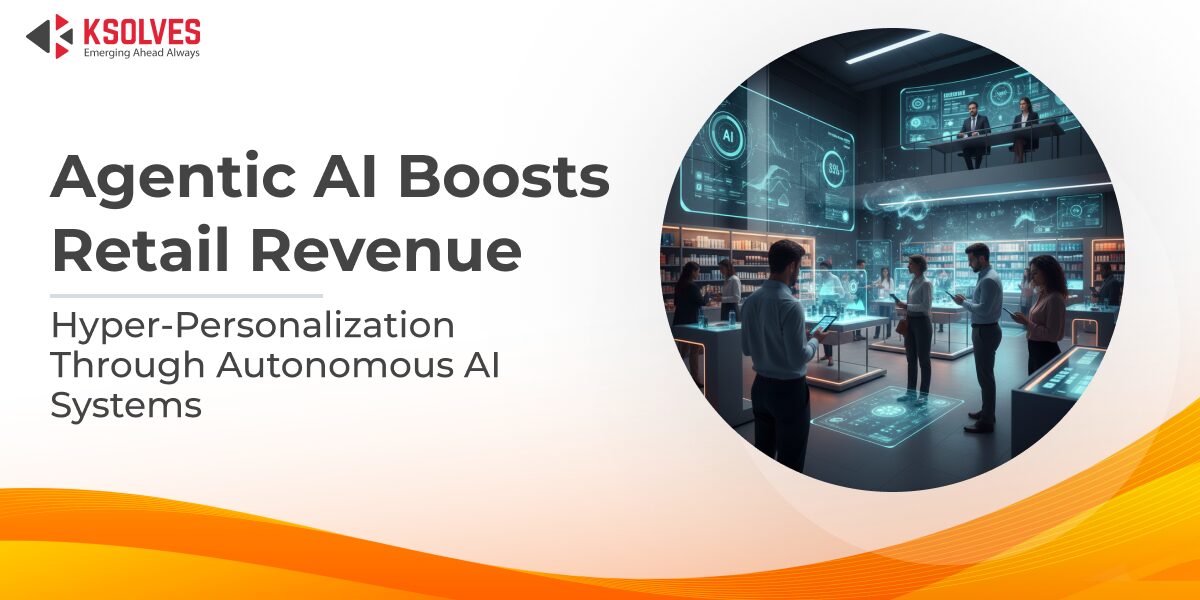
The retail landscape has transitioned from mass marketing to segmented personalization and now to the era of Agentic AI. Unlike traditional predictive models that merely suggest products based on historical data, agentic systems can reason, plan, and execute autonomous actions across disparate retail ecosystems.
In this blog, we will explore how the shift from passive algorithms to autonomous agents enables a self-optimizing retail environment that maximizes Customer Lifetime Value through real-time reasoning and cross-functional task execution. By moving beyond static “if-then” logic, these systems are driving a paradigm shift in hyper-personalization that directly correlates with exponential revenue growth.
The Technical Architecture of Agentic Personalization
At its core, an agentic AI system is not a single model but a sophisticated orchestration of multiple functional layers. Traditional recommendation engines are often reactive, waiting for a user query or a page refresh to trigger a pre-computed response. In contrast, Agentic AI operates on a Perceive-Reason-Act-Learn loop.

- Perception Layer: This involves real-time ingestion of high-velocity data streams, including clickstream telemetry, in-store biometric sentiment, and external environmental variables such as localized weather patterns and geopolitical shifts.
- Reasoning Engine: Utilizing Large Language Models (LLMs) as the cognitive backbone, the agent performs Chain-of-Thought (CoT) reasoning. It does not just see a “cart abandonment”; it reasons that the user is price-sensitive based on their history of purchasing only during “flash sales” and determines that a specific discount threshold is required to convert.
- Action Layer: Through Tool Use (Function Calling), the agent interacts with APIs. It can autonomously modify a UI, trigger a personalized email via a CRM, or adjust a product’s dynamic price in the ERP system without human intervention.
- Learning (Memory): Agentic systems utilize Vector Databases and Retrieval-Augmented Generation (RAG) to maintain both short-term session context and long-term user “personas,” ensuring that every interaction refines the global strategy.
From Static Segmentation to Dynamic Multi-Agent Systems
The real power of agentic AI in retail lies in Multi-Agent Systems (MAS). In this architecture, specialized agents collaborate to solve complex business objectives. For instance, a “Styling Agent” might analyze a user’s aesthetic preferences while a “Stock Check Agent” verifies real-time SKU availability across the supply chain.
When these agents negotiate in the background, the result is a level of hyper-personalization that feels anticipatory. If a customer is browsing for hiking gear, the agentic system can:
- The customer has a trip planned based on recent flight confirmation emails via an authorized integration.
- Coordinate with the Inventory Agent to find the nearest store with the items in stock.
- Directly negotiate a “bundle discount” with the Revenue Optimization Agent to ensure the customer closes the transaction immediately.
This level of cohesion eliminates the friction points that typically lead to a 70% average cart abandonment rate in traditional e-commerce.
Boosting Revenue Through Autonomous Optimization
Hyper-personalization is not just about “nicer” emails but also about maximizing Customer Lifetime Value (CLV) and Average Order Value (AOV) through precise, high-frequency micro-decisions.

1. Dynamic Pricing and Elasticity
Agentic AI systems monitor competitor pricing, current demand, and individual user price elasticity simultaneously. Instead of broad markdowns that erode margins, agents can apply individualized promotions. This ensures that the retailer captures the maximum possible margin from “brand-loyal” shoppers while providing the necessary incentive to “deal-seekers.”
2. Proactive Churn Mitigation
Traditional churn models are often “too little, too late.” Agentic systems detect “micro-signals” of disengagement, such as a decrease in session frequency or a shift in sentiment within support tickets. The agent can autonomously initiate a “Save-the-Customer” workflow, such as offering an exclusive early-access invite to a new collection, effectively turning a potential loss into a revenue opportunity.
3. Inventory-Aware Marketing
Revenue is often lost when marketing spends the budget on products that are low in stock. Agentic AI aligns marketing spend with inventory levels in real-time. If the Inventory Agent signals an overstock of a specific category, the Marketing Agent can instantly pivot ad spend and personalize recommendations for that category to high-intent users, optimizing both turnover and ad ROI.
Strategic Implementation and Integration
Transitioning to an agentic framework requires more than just deploying an LLM. It requires a robust data foundation and an orchestration layer that manages asynchronous agent communications while maintaining state consistency. Organizations must address challenges such as hallucination management, latency optimization, and security guardrails to ensure autonomous agents operate within business-defined parameters.
To navigate these technical complexities, many retailers are turning to specialized agentic AI consulting services. Partnering with an expert firm like Ksolves allows businesses to build scalable, secure, and goal-oriented AI workforces. By leveraging Ksolves’ expertise in Big Data and AI/ML orchestration, retailers can integrate agentic frameworks into their existing legacy ERP and CRM systems, ensuring that AI-driven decisions are grounded in proprietary business logic and real-world constraints.
Conclusion
The shift toward agentic AI represents a transition from passive recommendation to active revenue generation. By integrating autonomous reasoning with real-time execution, retailers can move beyond static personalization to create a fluid, high-conversion shopping environment. These systems do more than just predict behavior; they actively facilitate the path to purchase by resolving friction points and optimizing margins. Embracing this technical evolution is essential for retailers aiming to secure a competitive advantage in a data-driven, autonomous marketplace.
Frequently Asked Questions
Why is Ksolves considered a leader in agentic AI consulting services?
Ksolves excels in agentic AI consulting services by building autonomous Multi-Agent Systems that integrate with retail ERPs to drive hyper-personalization, optimize inventory, and maximize revenue through goal-oriented execution.
How does Agentic AI differ from traditional AI in retail?
Traditional AI is reactive, requiring prompts to generate suggestions; however, Agentic AI is proactive and autonomous, setting goals, reasoning through multi-step plans, and using tools to execute business actions independently.
Can Agentic AI truly reduce the 70% cart abandonment rate?
Yes. By using real-time reasoning to detect friction, agents can autonomously trigger personalized interventions, such as instant price adjustments or live support, to convert high-intent shoppers before they exit.
What are the main technical challenges in implementing retail agents?
Key hurdles include integrating with legacy systems, managing data silos, and ensuring low-latency communication between specialized agents while maintaining strict security guardrails and human-in-the-loop oversight for high-stakes decisions.
If you need guidance on architecture and rollout, reach us at [email protected].
What is the future of agentic commerce for consumers?
The future lies in “Personal Shopping Agents” that act as concierges. These agents will autonomously negotiate deals, manage returns, and anticipate needs by syncing with user calendars and behavioral data.
































Author
About the Author Editorial Team The Ksolves Editorial Team includes certified Salesforce experts, Big Data engineers, AI/ML specialists, Zoho consultants, and experienced technology writers focused on delivering clear, actionable insights for modern businesses. With hands-on experience across Salesforce, Big Data platforms, AI/ML solutions, application development, software testing, and Zoho ERP/CRM, the team publishes practical guides, real-world use cases, and industry updates that support smarter decisions and faster growth. Every article is created to solve business challenges, guide technology adoption, and keep organizations aligned with evolving digital ecosystems.
Share with