



The Power of Multi-Agent AI Teams in Driving Enterprise-Grade Outcomes
AI
5 MIN READ
December 19, 2025

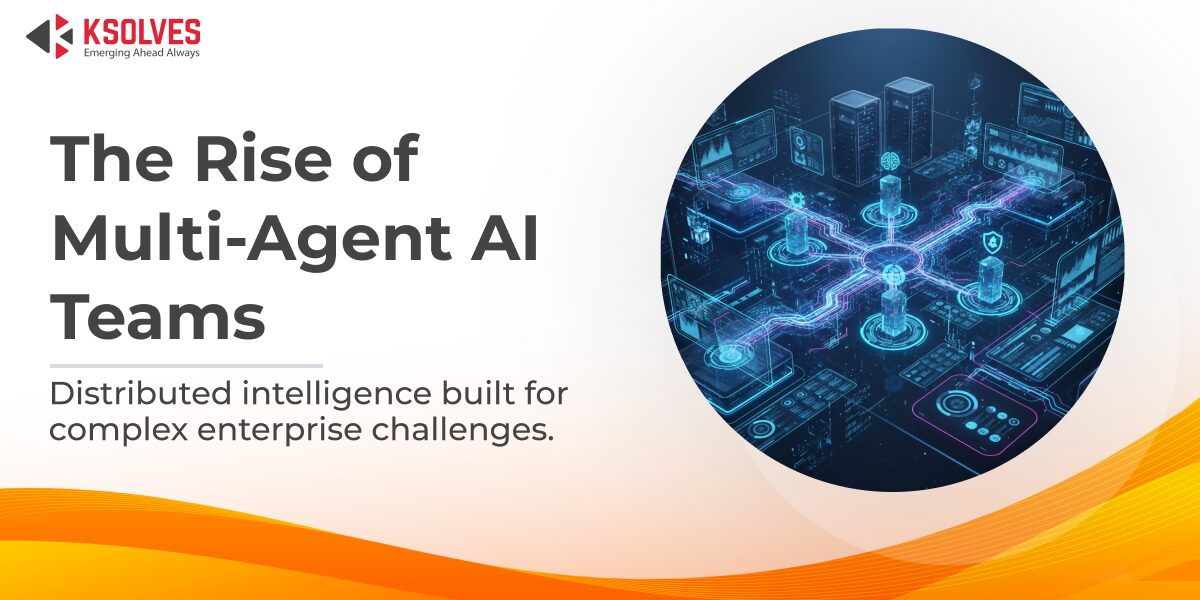
The demand for faster, more accurate, and context-aware decision-making is higher than ever. Enterprises are rapidly moving beyond traditional automation or standalone AI models. Instead, they now require intelligent systems that can collaborate, coordinate, and consistently deliver high-quality outputs. This is where multi-agent AI teams become essential.
Unlike single-agent systems, multi-agent AI teams can distribute tasks, share insights, adapt to changing environments, and self-optimize. This results in significantly better efficiency, accuracy, and enterprise-ready performance.
Understanding Multi-Agent AI Teams
A Multi-Agent AI Team is a coordinated collection of autonomous AI agents that work together to achieve a shared objective. Each agent has its own capabilities, knowledge base, and decision-making logic, and collaborates with other agents to enhance overall system performance.
This cooperative structure enables Multi-Agent AI Teams to combine specialized strengths, compensate for weaknesses, and maintain reliable output even in complex, fast-changing environments.
Key Characteristics of Multi-Agent AI Teams
- Specialization: Individual agents from multi-agent AI teams can be specialized for specific tasks. For example, in a customer support scenario, one agent can handle query classification, another can retrieve knowledge-base answers, and a third can generate natural-language responses. This division of labor ensures higher accuracy and reduces errors.
- Collaboration: Multi-agents continuously share their observations and results with the team. In predictive maintenance for manufacturing equipment, one agent may detect anomalies in vibration data, another may analyze historical failure patterns, and together, they can predict potential breakdowns with higher confidence than any single agent.
- Dynamic Task Allocation: Multi-agent AI teams can dynamically allocate tasks based on workload, expertise, and context. For instance, in an e-commerce recommendation system, agents can adjust recommendations in real-time based on browsing patterns, inventory changes, and ongoing promotions.
- Redundancy and Error Checking: When multiple agents work on overlapping tasks, the team can cross-verify results. This redundancy reduces the risk of errors and ensures higher output reliability.
Technical Advantages of Multi-Agent AI Teams
1. Improved Accuracy Through Collective Intelligence
Multi-Agent AI teams harness collective intelligence by integrating the insights of multiple agents. Consider a financial risk assessment system: one agent analyzes market trends, another evaluates historical client behavior, and a third assesses regulatory compliance risks. By combining these perspectives, the system produces a more accurate and comprehensive risk score than any single agent could achieve.
2. Real-Time Adaptability
In fast-changing environments, single-agent systems often struggle to adapt. Multi-agent AI teams, however, excel in real-time adaptation. For example, in autonomous logistics management, agents can monitor fleet locations, traffic conditions, and delivery schedules. If a delivery delay occurs, the team can reassign tasks, reroute vehicles, and adjust priorities instantly, ensuring smooth operations and high service quality.
3. Continuous Learning and Improvement
Many agent teams are designed with reinforcement learning and memory-sharing mechanisms. When an agent encounters a new scenario, it can learn from its experiences and share the update with the team. Over time, the system self-optimizes, minimizing errors and hence improving decision-making. A practical example is in healthcare diagnostics, where agents analyzing medical imaging can share their findings and collaboratively refine diagnostic algorithms, reducing false positives and improving patient outcomes.
4. Scalable Complexity Management
Complex business processes often involve multiple interdependent steps. Multi-agent AI teams manage this complexity efficiently by distributing tasks and monitoring dependencies. In supply chain management, different agents can handle procurement, production scheduling, quality inspection, and logistics. Their coordinated actions ensure that bottlenecks are identified early, resources are optimally used, and overall output quality is maximized.
Implementation Examples
- Automated Legal Document Review: Multi-agent AI teams can divide labor by clause, legal topic, or risk category. One agent identifies compliance issues, another cross-references legal precedents, and a third generates a summarized report for human lawyers. This improves accuracy, reduces review time, and ensures no critical clause is missed.
- Content Generation: In marketing, agent teams can manage end-to-end content creation. A research agent gathers data on trending topics, a writing agent drafts copy, an editing agent refines language, and a compliance agent ensures brand guidelines and legal requirements are met. The final output is faster, more accurate, and higher-quality than content generated by a single AI.
- Fraud Detection in Banking: Agents specializing in transaction monitoring, behavioral analytics, and anomaly detection collaborate to detect suspicious activities. By pooling insights, they reduce false positives and ensure high detection accuracy, protecting both the bank and its customers.
Why Multi-Agent AI Teams Outperform Single-Agent Systems
The strength of agent teams lies in distributed intelligence. Their architecture and knowledge base limit single-agent AI models. When a task requires multi-dimensional analysis, cross-checking, or continuous adaptation, single-agent outputs can be error-prone or slow. Agent teams, through collaboration, redundancy, and dynamic problem-solving, consistently deliver higher-quality outputs.
Furthermore, agent teams offer enhanced transparency and traceability. Each agent’s decision-making process can be logged and analyzed, which is critical for compliance-intensive industries such as finance, healthcare, and legal services.
Enhancing Enterprise Operations with Agentic AI
Businesses looking to leverage agent teams can benefit immensely from Agentic AI Consulting Services. At Ksolves, our experts design, implement, and maintain multi-agent systems tailored to your enterprise needs. From defining agent roles and communication protocols to integrating with existing workflows, we ensure that your AI systems not only act autonomously but also deliver consistently high-quality outcomes.
Engaging with Ksolves gives your enterprise access to cutting-edge agentic AI strategies, real-time performance optimization, and robust governance frameworks, all designed to improve operational efficiency and output quality.
Conclusion
Multi-agent AI teams represent a significant evolution in enterprise AI, moving beyond the limitations of single agents to deliver higher-quality output. By combining specialization, collaboration, dynamic task allocation, and continuous learning, these systems ensure higher accuracy, faster adaptability, and greater operational efficiency.
For businesses aiming to maximize the impact of AI while maintaining compliance, transparency, and scalability, leveraging Agentic AI Consulting Services from Ksolves ensures expert guidance in designing, implementing, and optimizing agent teams tailored to organizational needs.
Connect with our Agentic AI team today!
Frequently Asked Questions
How do Multi-agent AI teams improve output quality compared to single-agent systems?
Multi-agent AI teams leverage specialization, collaboration, and redundancy.
By dividing tasks among agents, cross-verifying results, and continuously learning
from each other, they deliver more accurate, reliable, and context-aware outputs
compared to single-agent systems.
What industries benefit most from multi-agent AI teams?
Industries with complex, dynamic, or compliance-heavy operations benefit the most.
These include finance, healthcare, legal, manufacturing, and logistics, where
multi-agent systems efficiently manage multidimensional tasks and significantly
reduce errors.
Why choose Ksolves for Agentic AI Consulting Services?
Ksolves combines deep AI expertise, enterprise-grade frameworks, and hands-on
experience in designing multi-agent systems. Our consulting services ensure
scalable, compliant, and high-performing solutions that enhance output quality
and operational efficiency across industries.































Author
About the Author Editorial Team The Ksolves Editorial Team includes certified Salesforce experts, Big Data engineers, AI/ML specialists, Zoho consultants, and experienced technology writers focused on delivering clear, actionable insights for modern businesses. With hands-on experience across Salesforce, Big Data platforms, AI/ML solutions, application development, software testing, and Zoho ERP/CRM, the team publishes practical guides, real-world use cases, and industry updates that support smarter decisions and faster growth. Every article is created to solve business challenges, guide technology adoption, and keep organizations aligned with evolving digital ecosystems.
Share with