



Java Security Best Practices: Building Secure Applications in 2026
Java
5 MIN READ
January 1, 2026

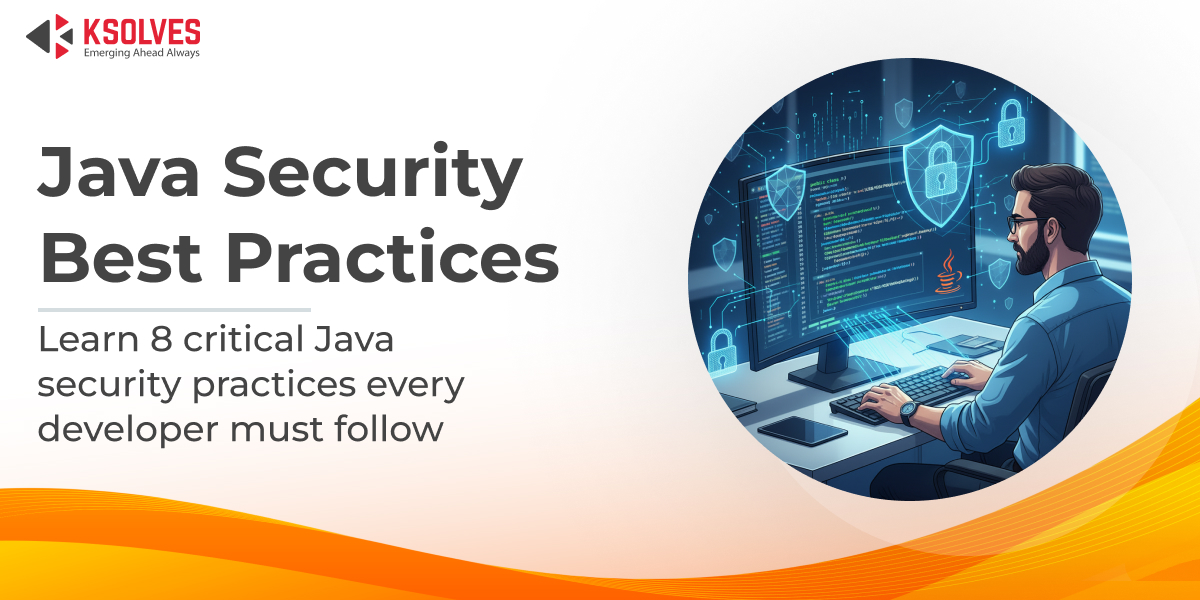
In an era where cyber threats evolve faster than ever, securing Java applications is no longer optional; it’s a business imperative. With over 9 million developers worldwide relying on Java for mission-critical systems, vulnerabilities in Java-based applications can lead to devastating data breaches, financial losses, and reputational damage. Whether you’re building enterprise systems, web platforms, or mobile apps, implementing robust security practices ensures your applications remain resilient against sophisticated attacks.
As a leading Java development company, we at Ksolves have helped Fortune 500 companies fortify their Java ecosystems using proven security strategies. This comprehensive guide explores essential Java security best practices that every developer and organization should implement in 2026.
1. Input Validation and Sanitization: Your First Line of Defense
Never trust user input. This fundamental principle prevents injection attacks, one of the most common vulnerabilities in Java applications.
java
// Bad practice – Direct SQL concatenation
String query = “SELECT * FROM users WHERE id = “ + userId;
// Best practice – Use PreparedStatement
String query = “SELECT * FROM users WHERE id = ?”;
try (PreparedStatement stmt = connection.prepareStatement(query)) {
stmt.setString(1, userId);
// Execute query
}
Key practices:
- Validate all input against expected formats (regex, whitelists)
- Use OWASP Java Encoder for HTML/XML/JSON escaping
- Implement centralized validation using Bean Validation (JSR 380)
- Sanitize inputs at both client and server sides
2. Secure Authentication and Authorization
Weak authentication mechanisms are a hacker’s dream. Modern Java applications require multi-layered security.
java
// Spring Security configuration example
@Bean
public SecurityFilterChain filterChain(HttpSecurity http) throws Exception {
http
.authorizeHttpRequests(authz -> authz
.requestMatchers(“/admin/**”).hasRole(“ADMIN”)
.requestMatchers(“/api/**”).authenticated()
.anyRequest().permitAll()
)
.oauth2ResourceServer(oauth2 -> oauth2.jwt());
return http.build();
}
Implementation checklist:
- Use strong password policies with bcrypt hashing
- Implement multi-factor authentication (MFA)
- Session management with short timeouts and secure cookies
- Role-based access control (RBAC) with principle of least privilege
- JWT tokens with proper expiration and refresh mechanisms
3. Secure Data Storage and Transmission
Data protection extends beyond code to storage and transmission layers.
java
// Secure password hashing
PasswordEncoder encoder = PasswordEncoderFactories.createDelegatingPasswordEncoder();
String hashedPassword = encoder.encode(“userPassword”);
// HTTPS configuration in Spring Boot
server.ssl.key-store=classpath:keystore.p12
server.ssl.key-store-password=secret
server.ssl.key-alias= tomcat
Essential measures:
- Encrypt sensitive data at rest using AES-256
- Always use HTTPS with TLS 1.3
- Implement proper key management with rotation policies
- Use secure random number generation for tokens
- Database encryption for PII data
4. Dependency Management and Vulnerability Scanning
Third-party libraries introduce significant risks if not properly managed.
xml
<!– Maven dependency with vulnerability checking –>
<dependency>
<groupId>org.springframework</groupId>
<artifactId>spring-web</artifactId>
<version>6.1.0</version>
</dependency>
Best practices:
- Regular dependency updates using tools like Dependabot
- Vulnerability scanning with OWASP Dependency-Check
- Software Bill of Materials (SBOM) generation
- Pinning versions in production environments
- Regular security audits of third-party components
5. Secure Coding Practices
Clean, secure code is the foundation of application security.
java
// Secure random number generation
SecureRandom random = new SecureRandom();
byte[] token = new byte[32];
random.nextBytes(token);
// Proper exception handling
try {
// Sensitive operation
} catch (SpecificException e) {
logger.error(“Operation failed”, e);
throw new CustomSecurityException(“Access denied”);
}
Coding standards:
- Avoid hardcoded credentials and secrets
- Proper exception handling without information leakage
- Memory management to prevent information disclosure
- Secure logging without sensitive data
- Code reviews with security checklists
6. Container and Cloud Security
Modern Java applications often run in containers and cloud environments.
yaml
# Docker security best practices
FROM openjdk:21-jre-slim
USER 10001:10001
COPY app.jar /app.jar
ENTRYPOINT [“java”, “-jar”, “/app.jar”]
Container security:
- Run containers as non-root users
- Minimal base images with regular updates
- Resource limits and isolation
- Secrets management with environment variables or secret managers
- Network policies and segmentation
7. Runtime Application Self-Protection (RASP)
Implement security controls that operate within the application itself.
java
// Runtime protection example
public class SecurityManager {
public static void validateInput(String input) {
if (containsMaliciousPattern(input)) {
Runtime.getRuntime().halt(1); // Immediate shutdown
}
}
}
RASP capabilities:
- Real-time attack detection and prevention
- Virtual patching for known vulnerabilities
- Behavioral analysis of application execution
- Automated response to detected threats
8. Regular Security Testing and Monitoring
Security is an ongoing process, not a one-time event.
java
// Security testing with JUnit and REST Assured
@Test
public void testXSSProtection() {
given()
.param(“input”, “<script>alert(‘xss’)</script>”)
.when()
.get(“/search”)
.then()
.body(containsString(“<script>”));
}
Testing strategy:
- Static Application Security Testing (SAST)
- Dynamic Application Security Testing (DAST)
- Penetration testing with OWASP ZAP
- Continuous security monitoring
- Incident response planning
The Cost of Insecurity
Recent studies show that the average cost of a data breach in 2026 exceeds $4.5 million. Java applications, being widely used in financial services, healthcare, and e-commerce, are prime targets. A single vulnerability can compromise millions of records and destroy customer trust.
Future-Proofing Your Java Security
As quantum computing advances, traditional encryption methods face new challenges. Stay ahead by:
- Implementing post-quantum cryptography algorithms
- Adopting zero-trust architecture principles
- Using AI-powered threat detection
- Regular security training for development teams
- Staying updated with Java security advisories
Secure Your Java Applications with Expert Partners
Implementing these security best practices requires deep expertise and continuous vigilance. At Ksolves, we don’t just build Java applications; we engineer fortress-like security into every line of code.
As a premier Java software development services provider with over 12 years of experience, our 150+ certified Java developers have successfully delivered 200+ secure, enterprise-grade applications. Our Java web development services and Java application development services incorporate security-by-design principles from day one.
Whether you need custom Java development services, Java Web Application Development, Java Mobile Application Development, or Java Enterprise Application Development, our security-first approach ensures:
- OWASP Top 10 compliance
- Regular penetration testing
- Automated security scanning in CI/CD pipelines
- 24/7 monitoring and incident response
- Compliance with GDPR, HIPAA, PCI-DSS, and ISO 27001
Don’t leave your Java applications vulnerable. Partner with Ksolves to transform security from a checkbox to a competitive advantage.































AUTHOR
Java
Share with