



Odoo 20: Expected Features, Release Date, and What Businesses Can Anticipate in 2026
Odoo
5 MIN READ
May 22, 2026

In the fast-paced world of enterprise resource planning (ERP), Odoo stands out as a flexible, cost-effective, and rapidly innovating platform. With millions of users worldwide and a commitment to annual major releases, Odoo continues to challenge traditional ERP giants by delivering comprehensive tools for CRM, accounting, inventory, manufacturing, eCommerce, HR, and more; all in one integrated suite.
As we look ahead to late 2025, excitement is building around Odoo 20, the upcoming major version expected to push boundaries further in AI, automation, and user-centric design. While official details remain under wraps (as is typical until closer to launch), industry trends, partner insights, and Odoo’s recent trajectory provide a clear picture of what businesses can anticipate. This in-depth guide covers the expected release date, speculated features, potential impacts, and why Odoo 20 could be a game-changer for organizations of all sizes.

Odoo Version 20: Confirmed Release Timeline
Odoo has adhered to an annual major release schedule since its early days, with each integer version (e.g., 18.0, 19.0) introducing significant enhancements. Recent history confirms this pattern:
- Odoo 18: Launched October 2024
- Odoo 19: Launched September 2025
Following suit, Odoo 20 is planned for September 2026. It is set to launch during Odoo Experience 2026, from September 24-26, 2026, at Brussels Expo in Belgium. This timing aligns with Odoo’s growth strategy, including ambitious targets like reaching 10,000 employees and €1 billion in revenue by 2027. The release will mark another milestone in making advanced ERP accessible without prohibitive costs.
| Version | Release Period | Launch Event Details |
| Odoo 18 | October 2024 | Odoo Experience 2024, Brussels Expo |
| Odoo 19 | September 2025 | Odoo Experience 2025 (September 18-20), Brussels Expo |
| Odoo 20 | September 2026 | Odoo Experience 2026 (September 24-26), Brussels Expo |
This predictable cadence ensures continuous evolution while providing long-term support for recent versions.
Expected Features in Odoo 20: Insights from Trends and Patterns
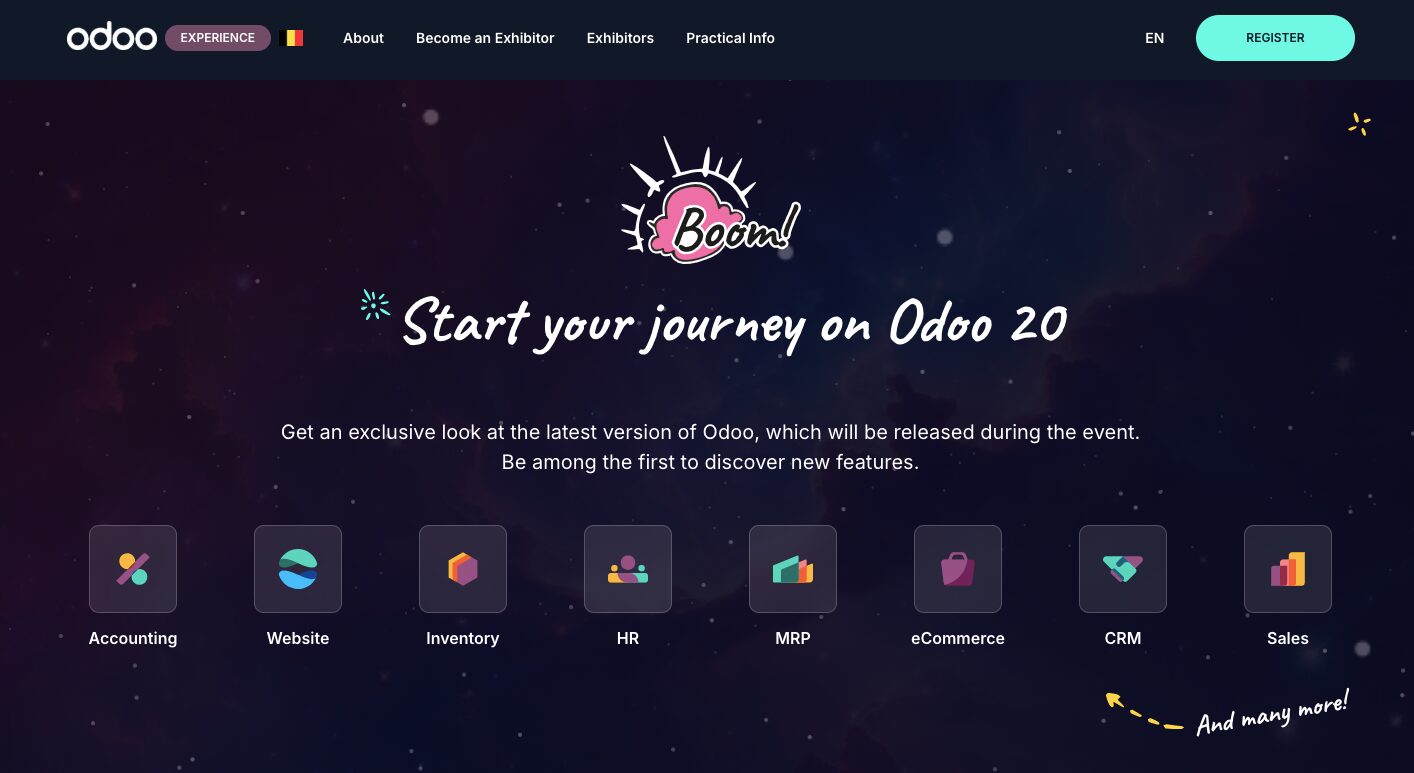
Odoo has not yet officially released the complete feature list for Odoo 20. However, based on roadmap discussions, partner insights, and community wish lists emerging as Odoo 19 gains adoption, several strong predictions have surfaced particularly from enterprise and advanced-use perspectives.
Below is a structured overview of the most anticipated Odoo 20 features, reflecting what businesses and consultants are closely watching.
Stronger Financial & Accounting Tools
Odoo 20 is expected to further strengthen its financial and accounting capabilities, especially for mid-sized and enterprise organizations.
Key expectations include:
- Native financial forecasting to project future performance using budgets and actuals, moving beyond static financial planning.
- Improved reconciliation views designed to scale effectively for both small teams and large finance departments.
- Direct government reporting interfaces for regulatory compliance, such as localized tax and statutory export formats in select regions.
These enhancements are expected to build upon recent improvements introduced in budgeting, financial closing, and reporting modules.
Enterprise-Level Scalability & Performance
Odoo’s architecture continues to evolve toward enterprise-grade scalability, and Odoo 20 is expected to push this further.
Potential enhancements include:
- A more refined offline mode, enabling uninterrupted operations in environments with unstable or low-bandwidth internet connections.
- Read-replica database support to distribute read workloads and improve system performance for organizations with high user concurrency (10,000+ users).
These improvements aim to make Odoo more suitable for large enterprises and high-traffic deployments.
Advanced AI & Agentic Automation
Odoo’s AI capabilities are expected to evolve beyond simple assistance features in Odoo 20.
Anticipated developments include:
- Agentic AI, where the system proactively executes workflows and actions instead of only responding to prompts.
- Deeper automation embedded within business processes, reducing manual intervention across departments.
These advancements would build on the initial AI features introduced in Odoo 19, such as AI chat, prompts, and server-side automation actions.
Smarter Sales & Subscription Logic
Sales and subscription-based businesses may see notable functional improvements in Odoo 20.
Expected enhancements include:
- Automated pricing visibility rules for bundles, upsells, and complex quotations, including custom pricing scenarios.
- Native frame agreements and subscription merging, allowing multiple subscriptions to be managed under a single contract structure.
These features would be especially valuable for recurring revenue models and long-term customer contracts.
Inventory & Supply Chain Intelligence
Odoo 20 is expected to introduce deeper intelligence and automation within inventory and supply chain workflows.
Key areas of focus may include:
- Proactive replenishment and forecasting-driven actions, going beyond basic reorder rules.
- Advanced packaging support, such as mixed pallets and multi-product packaging with complex unit-of-measure configurations.
These enhancements target real-world warehouse and logistics operations with higher operational complexity.
Multilingual & Website Improvements
Global businesses using Odoo’s website and eCommerce modules are expecting improved multilingual support.
A key anticipated enhancement is:
- Independent translations for multilingual websites, ensuring changes made in one language do not unintentionally affect other language versions.
This improvement would significantly enhance usability for international eCommerce operations.
User Experience & Collaboration Enhancements
While specific UI changes for Odoo 20 remain undisclosed, recent version trends indicate continued focus on usability and collaboration.
Likely improvements include:
- More refined dashboards, reports, and mobile responsiveness
- Enhanced collaboration tools and internal knowledge management
These updates are expected to deliver incremental yet meaningful productivity gains.
Business Benefits of Odoo 20
Upgrading to Odoo 20 could deliver:
- Streamlined Operations: Deeper automation across departments, minimizing manual tasks and reducing errors, which frees up teams to focus on strategic work while improving overall workflow efficiency and speed.
- Data-Driven Growth: Enhanced predictive tools for better forecasting and strategy, enabling proactive decision-making, accurate demand planning, and insightful analytics that support scalable expansion in competitive markets.
- Cost Efficiency: Open-source flexibility with modular additions as needed, avoiding expensive licensing fees of proprietary ERPs, lowering total ownership costs, and allowing businesses to invest savings in growth initiatives.
- Future-Readiness: Features addressing emerging needs like sustainability tracking, remote work support, and advanced integrations (e.g., IoT and cloud services), ensuring compliance with evolving regulations and adaptability to new technologies.
For sectors such as manufacturing, retail, and services, this means tighter inventory controls, more accurate financial reporting, happier and more productive teams, and stronger overall competitiveness in a digital-first landscape.
Conclusion: Preparing for the Next Evolution of Odoo
Odoo 20 is shaping up to be more than just another annual release; it marks the next phase in Odoo’s evolution toward a smarter, more adaptive, and future-ready ERP platform. While the official feature set will be unveiled closer to Odoo Experience 2026, the direction is already clear. Advancements in AI-driven automation, low-code customization, mobile-first user experience, deeper integrations, and industry-focused solutions are expected to redefine how businesses operate on Odoo.
For organizations planning their ERP strategy for 2026 and beyond, Odoo 20 presents a strong opportunity to streamline operations, improve decision-making, and stay compliant in an increasingly digital and regulated business environment. With enhanced cloud scalability, sustainability reporting, and intelligent automation, businesses can prepare themselves not just for today’s challenges but for what lies ahead.
As the Odoo ecosystem continues to grow, industry events play a crucial role in shaping innovation and collaboration. Ksolves will also be attending Odoo Experience 2026 in Brussels, where Odoo 20 is expected to take center stage. If you’re planning to be there, let’s connect, exchange insights, and explore how upcoming Odoo innovations can be leveraged to drive real business value. We look forward to meeting you at the event and discussing what the future of Odoo holds.
Note: These are currently community expectations / informed predictions, not official release notes — official details typically appear closer to release

































AUTHOR
Odoo
Neha Negi, Presales and Business Associate Head at Ksolves is a results-driven ERP consultant with over 8 years of expertise in designing and implementing tailored ERP solutions. She has a proven track record of leading successful projects from concept to completion, driving organizational efficiency and success.
Share with