



How Odoo Helps Prevent Delays in Solar EPC Projects
Odoo
5 MIN READ
February 27, 2026

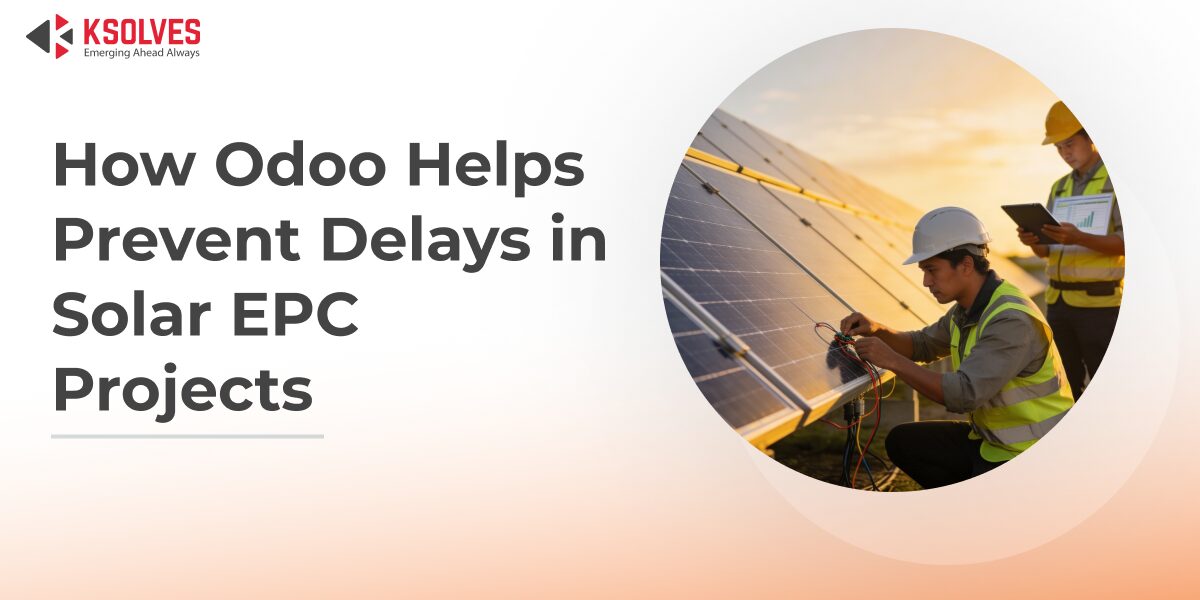
Solar EPC (Engineering, Procurement, and Construction) projects operate on tight timelines, thin margins, and strict contractual commitments. Whether it’s a rooftop installation or a multi-megawatt utility-scale solar plant, even minor delays in procurement, approvals, or site coordination can cascade into cost overruns and penalty clauses.
In an industry where coordination between engineering teams, procurement departments, site supervisors, vendors, and finance is critical, disconnected systems and manual tracking often become the root cause of delays.
This is where an integrated ERP like Odoo plays a transformative role by synchronizing operations, improving visibility, and enabling proactive control across the entire EPC lifecycle.
In this blog, we explore the most common causes of delays in solar EPC projects and how Odoo systematically eliminates them to enable predictable, on-time project completion.
Why Solar EPC Projects Get Delayed
Before understanding the solution, it’s important to examine the operational bottlenecks.
1. Inaccurate Project Planning & Resource Forecasting
Solar EPC projects involve multiple phases:
- Site survey and feasibility study.
- Engineering design and approvals.
- Procurement of modules, inverters, mounting structures, and cables.
- Civil and electrical installation.
- Testing and commissioning.
Without structured project planning tools, dependencies between tasks are poorly managed. For example, mounting structure installation cannot begin until civil foundations are completed. If one task slips, downstream activities are affected.
Lack of real-time visibility into manpower and equipment allocation further worsens the issue.
2. Procurement & Material Shortages
Solar projects are highly dependent on the timely availability of:
- PV modules
- Inverters
- Transformers
- DC/AC cables
- Mounting structures
- SCADA systems
Common problems include:
- Incorrect material forecasting.
- Vendor lead-time miscalculations.
- Delayed purchase approvals.
- No real-time inventory visibility.
A missing inverter delivery can stall an entire project phase.
3. Poor Site Coordination
Solar EPC execution involves:
- Head office planning teams
- Site engineers
- Subcontractors
- Quality inspectors
Manual reporting via emails or spreadsheets creates:
- Delayed issue escalation.
- Miscommunication between teams.
- Inaccurate progress updates.
Without centralized tracking, management often learns about delays too late.
4. Budget & Cash Flow Constraints
Solar projects are milestone-based. Payments are often linked to:
- Material delivery
- Installation completion
- Commissioning milestones
If invoicing is delayed or cost tracking is inaccurate:
- Cash flow gaps arise.
- Vendor payments get delayed.
- Procurement slows down.
Financial misalignment directly impacts project timelines.
5. Compliance & Documentation Delays
Solar EPC projects require:
- Grid interconnection approvals.
- Electrical inspector certifications.
- Net metering documentation.
- Safety compliance records.
Scattered documentation across emails and shared drives leads to approval delays.
How Odoo Prevents Solar EPC Project Delays
Preventing delays in solar EPC projects requires more than tracking tasks; it requires synchronizing planning, procurement, inventory, finance, field operations, and compliance on a single platform.
This is exactly what Odoo enables.
By integrating Project Management, Purchase, Inventory, Accounting, Field Service, and Document Management into one unified system, Odoo eliminates the disconnects that typically slow down execution.
Here’s how.
1. Centralized Project Planning with Gantt Charts & Task Dependencies
Odoo Project Management allows EPC companies to structure projects phase by phase, from design and procurement to installation and commissioning.
Project managers can:
- Define stages such as Engineering, Procurement, Civil Works, Installation, and Testing.
- Create tasks with logical dependencies.
- Visualize timelines through interactive Gantt charts.
- Assign manpower based on workload capacity.
- Monitor real-time completion percentages.
If civil work is delayed, dependent activities like structure installation automatically reflect the impact on timelines. This immediate visibility allows managers to reallocate resources or adjust schedules before delays escalate.
Spotlight: Ksolves’ Odoo Gantt View
Want even sharper control over your project timelines?
Ksolves’ Odoo Gantt View takes Odoo’s planning capabilities to the next level with a powerful, easy-to-use visual timeline. It gives you a clear, interactive view of your entire project so you can plan, schedule, allocate resources, and adjust tasks in just a few clicks.
With its intuitive drag-and-drop interface, you can instantly reschedule activities, rebalance workloads, and see the impact of changes in real time. No complex spreadsheets. No confusion. Just complete visibility and control over deadlines.
For solar EPC companies managing multiple phases and tight milestones, this enhanced Gantt experience makes project planning faster, smarter, and far more predictable.
Take Charge of Every Project Deadline with Odoo Gantt View!
2. Smart Procurement & Automated Replenishment
Procurement is one of the most delay-sensitive areas in solar EPC. Odoo connects project demands directly with purchasing workflows.
With Odoo Purchase and Inventory:
- Material requirements can be generated from project BoQs.
- Purchase requests can be automated based on demand.
- Vendor lead times are recorded and monitored.
- RFQs can be compared and approved within the system.
- Incoming shipments are tracked in real time.
Minimum stock rules can be configured for critical components like inverters or mounting structures. If stock falls below defined thresholds, the system can automatically trigger replenishment requests.
Material allocation can also be managed project-wise, ensuring that one project does not consume stock allocated for another. This prevents cross-project shortages, a common cause of execution delays.
3. Real-Time Inventory & Multi-Site Material Tracking
Solar EPC companies often manage multiple sites simultaneously. Without centralized visibility, material tracking becomes chaotic.
Odoo supports:
- Multi-warehouse management.
- Site-specific stock locations.
- Internal transfers between warehouses and project sites.
- Batch and lot tracking for traceability of modules and inverters.
- Delivery validation workflows.
Project managers can instantly view:
- What materials are available at each site?
- What stock is in transit?
- What items are pending procurement?
This level of transparency eliminates guesswork and significantly reduces material-related downtime at project locations.
4. Mobile-Based Site Reporting & Issue Escalation
Field-level visibility is critical in preventing delays. With Odoo Field Service and mobile accessibility, site engineers can:
- Update task progress in real time.
- Upload site images as proof of work.
- Log issues, defects, or blockers.
- Record installation quantities.
- Generate inspection or service reports.
Instead of relying on weekly status calls or manual reports, leadership gains real-time insight into actual site conditions.
If a blocker is reported, such as delayed equipment delivery or technical constraints, escalation workflows ensure the issue reaches the right stakeholders immediately. This shortens resolution time and minimizes schedule impact.
5. Budget Control & Real-Time Cost Monitoring
Financial misalignment is often a hidden cause of project delays. Odoo integrates project operations with accounting, enabling accurate cost control.
EPC companies can:
- Define project-specific budgets.
- Track labor and subcontractor costs.
- Monitor material consumption against estimates.
- Compare budgeted vs. actual expenses in real time.
- Automatically record vendor bills.
Finance teams gain visibility into:
- Project-level profitability
- Expense overruns
- Pending receivables
- Cash flow forecasts
Milestone-based invoicing can be automated according to contract terms. This ensures invoices are generated on time, improving working capital and preventing procurement slowdowns due to cash flow gaps.
6. Seamless Sales-to-Project Automation
Execution delays often begin at the handover stage between sales and operations.
With Odoo, once a quotation is confirmed:
- It automatically converts into a sales order.
- A linked project is created.
- The scope of work is attached.
- Billing milestones are predefined.
This eliminates manual data re-entry and reduces miscommunication between departments. Sales commitments flow directly into project execution, ensuring alignment from day one.
7. Centralized Compliance & Document Management
Solar EPC projects involve extensive documentation – grid approvals, inspection certificates, safety compliance records, as-built drawings, and regulatory filings.
Odoo Documents provides:
- A centralized repository for all project documentation.
- Role-based access control.
- Version control for engineering drawings.
- Approval workflows for critical documents.
- Expiry tracking for certifications.
This structured documentation management ensures that compliance requirements do not become a bottleneck during commissioning or project handover.
Business Impact of Using Odoo in Solar EPC Projects
The true value of Odoo in solar EPC projects is measurable business impact. When implemented strategically, Odoo shifts project execution from reactive problem-solving to proactive performance management.
- Faster Procurement Cycles
By linking project demand directly with purchasing workflows, procurement becomes structured and predictable. Automated approvals, vendor lead-time tracking, and real-time inventory visibility significantly reduce delays in material sourcing — keeping site execution uninterrupted.
- Improved On-Time Project Completion
With centralized planning, task dependencies, and live progress tracking, project managers gain early visibility into potential risks. This enables timely corrective action, increasing adherence to milestones and reducing schedule overruns.
- Reduced Material Wastage
Project-wise material allocation and real-time consumption tracking prevent over-ordering, duplication, and site-level mismanagement. Better control over inventory directly improves cost efficiency.
- Better Resource Utilization
Manpower, subcontractors, and equipment can be allocated based on real-time workload visibility. This minimizes idle time, prevents overbooking, and ensures optimal deployment across multiple project sites.
- Improved Vendor Accountability
Vendor performance, including lead times, pricing consistency, and delivery adherence, can be tracked within the system. This data-driven transparency strengthens negotiation power and improves long-term supplier reliability.
- Higher Margin Visibility
With integrated accounting and project cost tracking, leadership gains real-time insight into project profitability. Budget vs. actual comparisons allow early detection of cost overruns, protecting margins before they erode.
- Stronger Client Satisfaction
Timely execution, transparent progress tracking, accurate billing, and structured documentation create a smoother client experience. In a competitive solar market, reliability becomes a key differentiator.
How Ksolves Helps Solar EPC Companies Turn Odoo into a Competitive Advantage
Solar EPC success isn’t just about installing panels; it’s about executing projects with precision, speed, and control. That’s exactly where Ksolves, a trusted Odoo Gold Partner and Best Partner India 2025, steps in.
We don’t just implement Odoo. Our certified Odoo experts engineer it around your solar EPC lifecycle, from BoQ-driven procurement and multi-site material tracking to milestone billing, compliance workflows, and real-time site reporting.
Our approach ensures:
- Clear project structuring with dependency-based planning.
- Procurement automatically aligned with project demand.
- Complete visibility of materials across warehouses and sites.
- Real-time cost tracking to protect margins.
- Executive dashboards that highlight risks before they become delays.
The result?
- Fewer surprises.
- Faster decision-making.
- Stronger financial control.
- Projects delivered on time, consistently.
With Ksolves, Odoo becomes more than an ERP system. It becomes the operational backbone that powers predictable execution and scalable solar growth
Final Words
Solar EPC delays are rarely about technical capability; they’re about operational disconnects. When planning, procurement, site execution, and finance operate in silos, timelines suffer, and margins shrink. Odoo provides the unified platform needed to bring structure, visibility, and control to the entire project lifecycle.
With Ksolves as your implementation partner, Odoo is configured around your real EPC workflows, from BoQ-driven procurement and milestone billing to site reporting and executive dashboards. We ensure the system doesn’t just support your projects, but actively strengthens execution.
It’s time to move from reactive firefighting to controlled execution. Talk to Ksolves today and transform your solar EPC operations with Odoo.

Get a free guide that demonstrates how solar companies manage CRM, projects, service, and billing in one platform - Odoo ERP.






Still managing solar operations on multiple tools?
Get a free guide that demonstrates how solar companies manage CRM, projects, service, and billing in one platform – Odoo ERP.
Get a free guide that demonstrates how solar companies manage CRM, projects, service, and billing in one platform – Odoo ERP.



























AUTHOR
Odoo
Share with