



Odoo for Supermarkets: AI-Powered ERP for Multi-Store Retail Operations
Odoo
5 MIN READ
March 3, 2026

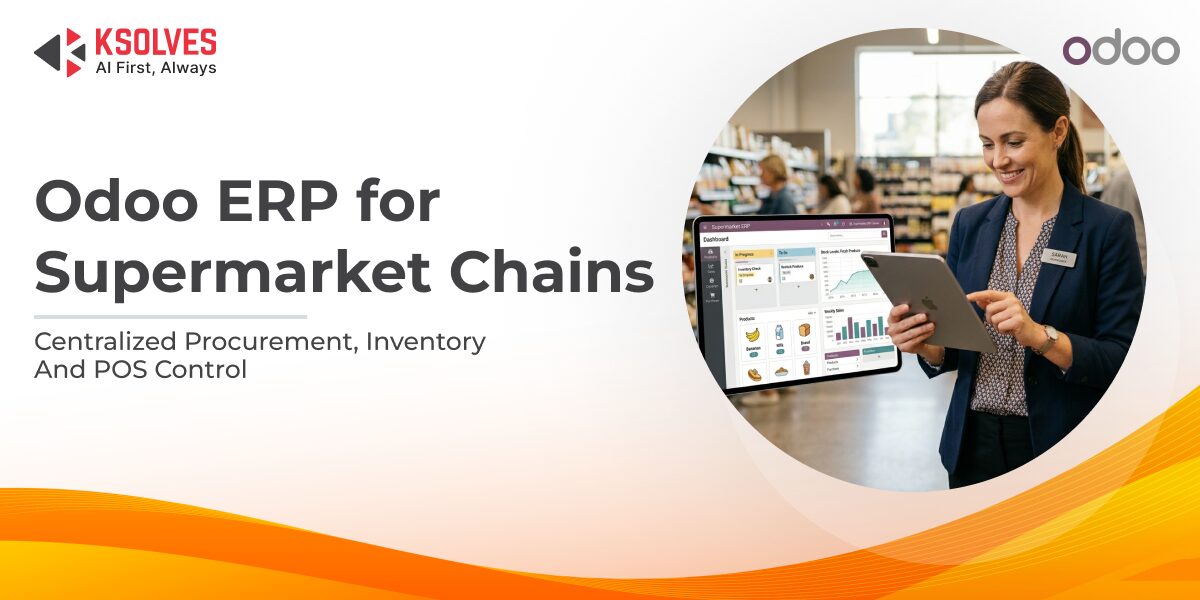
As supermarket chains expand, operational complexity grows exponentially. One store may struggle with stockouts of high-demand items, while another deals with excess or near-expiry inventory. Procurement decisions are often made without real-time sales visibility, and leadership teams wait for consolidated reports to understand what’s happening across the chain.
This isn’t a store-level problem, but it’s an intelligence problem. And that’s exactly what Odoo + AI solves.
Supermarket chains operate in a high-pressure environment defined by thin margins, perishable inventory, and high transaction volumes. When procurement, inventory, POS, and finance run on disconnected systems, inefficiencies multiply. This results in inconsistent execution, delayed decisions, and preventable losses.
To operate efficiently at scale, supermarket chains need real-time visibility and centralized control from procurement to POS. Odoo ERP enables this by unifying core retail operations on a single platform, ensuring every store operates with the same data and processes.
In this blog, we explore the key challenges supermarket chains face and how Odoo helps centralize operations across procurement, inventory, POS, and finance.
Why Supermarket Chains Need Centralized Control
As supermarket chains grow, operational complexity grows with them. Each new store introduces challenges around stock availability, pricing consistency, vendor coordination, and financial tracking. When systems operate in isolation, leaders lack a single source of truth to manage performance at scale.
Centralized control enables supermarket chains to:
- Standardize operations across all outlets.
- Optimize procurement and inventory decisions.
- Maintain pricing and promotion consistency.
- Gain real-time insights into store and chain-level performance.
Odoo brings these capabilities together in one integrated ERP platform, designed to support high-volume, multi-location retail environments.
Key Challenges Faced by Supermarket Chains
As supermarket chains scale, operational complexity increases across procurement, inventory, sales, and finance. Without centralized systems, even well-run stores struggle to operate in sync, leading to inefficiencies that directly impact margins, customer experience, and growth plans.
1. Fragmented Procurement and Supplier Management
Supermarket chains typically work with multiple vendors offering varying prices, lead times, and contractual terms across locations. Without centralized procurement, teams lack visibility into supplier performance, negotiated pricing, and purchase volumes.
This makes it difficult to control costs, leverage bulk purchasing power, and plan replenishment effectively, often resulting in emergency purchases, inconsistent pricing, and margin erosion. A gap that costs mid-size supermarket chains an estimated 3–5% in annual procurement spend.
2. Inventory Imbalance Across Stores
Inventory imbalance remains one of the most persistent challenges in supermarket operations. While some stores face frequent stockouts of fast-moving items, others carry excess or near-expiry inventory.
For FMCG and perishable goods, limited real-time visibility across locations leads to higher wastage, increased markdowns, and lost sales opportunities. Industry data suggests perishable wastage accounts for 4–8% of revenue in chains without real-time stock tracking.
3. Disconnected POS and Back-Office Operations
When POS systems operate in isolation from inventory and accounting, sales data is delayed or requires manual reconciliation. This creates inaccuracies in stock levels, inconsistencies in pricing and promotions, and delays in financial reporting.
As a result, store teams and management are forced into reactive decision-making instead of proactively managing demand and profitability.
4. Limited Management Visibility
Without consolidated, real-time dashboards, leadership teams lack a single source of truth across stores. Insights into sales performance, margins, inventory turnover, and store-level profitability arrive too late to influence timely decisions.
This limited visibility slows down pricing adjustments, replenishment strategies, and expansion planning, making scale harder to manage.
How Odoo Helps Supermarket Chains Centralize Operations
Centralization is not just about using one system but about ensuring every operational function works with the same real-time data and standardized processes.
Odoo achieves this by tightly integrating procurement, inventory, POS, and finance on a single ERP platform, enabling supermarket chains to operate as one unified organization rather than a collection of independent stores.
1. Centralized Procurement and Vendor Management (Odoo Purchase)
Odoo consolidates supplier data, contract pricing, and purchasing workflows across all stores and warehouses. Vendor agreements, lead times, minimum order quantities, and bulk pricing are managed from a unified dashboard.
Purchase orders are automatically generated based on live demand signals, inventory thresholds, and forecasting rules, reducing manual planning and minimizing stock risks.
Built-in supplier performance analytics help track delivery timelines, pricing trends, and quality metrics, empowering supermarket chains to negotiate better terms and optimize procurement spend.
2. Live Multi-Store Inventory Synchronization (Odoo Inventory)
Odoo provides real-time inventory updates across stores, warehouses, and distribution centers. Every POS transaction, goods receipt, stock transfer, or return updates the system instantly, ensuring complete stock accuracy.
Key capabilities include:
- Batch, lot, and expiry tracking for perishable goods.
- FIFO and FEFO strategies to minimize wastage.
- Automated replenishment and stock balancing.
- Barcode scanning and mobile warehouse operations.
- Real-time stock availability visibility across locations.
- Dashboard Ninja AI goes further – it proactively alerts store managers when specific SKUs are trending toward expiry or stockout, 48–72 hours in advance.
This ensures optimal inventory turnover, reduced shrinkage, and tighter margin control.
3. Centralized Promotion & Combo/Pack Management (Odoo POS + Inventory)
Supermarkets frequently run bundled offers, seasonal packs, and promotional pricing campaigns. Odoo allows centralized configuration of:
- Combo products and bundled SKUs.
- “Buy X Get Y” offers.
- Volume-based discounts.
- Category-level promotions.
- Limited-time campaign pricing.
These promotions are instantly synchronized across all POS terminals, ensuring pricing consistency and brand uniformity across every store.
4. Seamless POS with Multi-Currency & Offline Support (Odoo POS)
Odoo POS standardizes checkout operations across outlets with centralized control over pricing, taxes, and product catalogs.
Advanced retail capabilities include:
- Multi-currency payment support for tourist-heavy or cross-border regions.
- Multiple payment methods (cash, card, digital wallets).
- Offline functionality with auto-sync upon reconnection.
- Integrated loyalty programs and gift cards.
- Real-time sales-to-inventory-to-accounting synchronization.
Every sale updates inventory and financial records instantly, eliminating reconciliation gaps and improving reporting accuracy.
5. Automated Financial Control and Consolidation (Odoo Accounting)
Odoo Accounting automatically records transactions generated from procurement, inventory, and POS activities.
Supermarket chains gain:
- Store-wise and consolidated financial statements.
- Category-level margin analysis.
- Real-time cash flow tracking.
- Multi-company and multi-tax compliance support.
- Faster month-end and year-end closures.
Finance teams close faster, with AI anomaly detection flagging variance before audits, reducing month-end close time by up to 40%.
5. Real-Time Dashboards and Data-Driven Decision-Making
Odoo’s role-based dashboards provide tailored insights for store managers, procurement teams, finance leaders, and executives. Key KPIs such as stock turnover, sales per store, supplier lead times, inventory aging, and gross margins are available in real time.
With actionable insights always at hand, supermarket chains can move from reactive firefighting to proactive planning. This leads to optimized replenishment, pricing, promotions, and expansion decisions with confidence.
Add-on: Dashboard Ninja with AI
While Odoo provides strong native dashboards, supermarket chains dealing with high volumes, multiple stores, and complex KPIs often need deeper, faster, and more intuitive insights. This is where Dashboard Ninja with AI elevates decision-making.
Dashboard Ninja with AI extends Odoo’s reporting capabilities by combining advanced data visualization with AI-driven intelligence. It enables supermarket leaders to analyze large volumes of operational data across stores without relying on manual reports or complex queries.
With Dashboard Ninja with AI, supermarket chains can:
- Create dynamic, role-based dashboards for executives, store managers, procurement, and finance teams.
- Use AI-powered insights to detect trends, anomalies, and performance gaps.
- Track multi-store KPIs such as sales performance, inventory aging, margins, and supplier efficiency.
- Monitor order volumes, peak-hour sales, and average basket size in real time.
- Analyze return management metrics, including refund trends and product return rates.
Instead of static reports, decision-makers gain interactive, real-time dashboards that turn operational data into clear, actionable intelligence across every store.
7. Scalable Architecture for Rapid Expansion
As supermarket chains grow, Odoo allows seamless onboarding of new stores, warehouses, and regions without system duplication.
Standardized workflows, centralized master data, and unified reporting ensure that expansion does not create operational chaos. The ERP scales with the business, supporting long-term growth without increasing complexity.
How Ksolves Helps Supermarket Chains Maximize Odoo Value
Implementing Odoo is only the first step. The real challenge and opportunity lies in transforming it into a system that can handle the speed, scale, and complexity of supermarket operations. This is where Ksolves, a trusted Odoo Gold Partner and Best Partner India 2025, delivers measurable value.
Ksolves, the best Odoo implementation partner, brings a deep understanding of supermarket workflows combined with proven Odoo implementation expertise. We don’t treat supermarkets like generic retail businesses, but we design Odoo solutions specifically for multi-store operations, high transaction volumes, and perishable inventory environments.
Why Supermarket Chains Choose Ksolves
- ERP Designed Around Store Reality
We map Odoo to how your supermarkets actually function, like daily replenishment cycles, centralized procurement, store-level POS operations, and real-time reporting. The result is an ERP that supports operations instead of slowing them down.
- Precision Configuration Across Core Odoo Modules
Ksolves configures various Odoo modules, like Purchase, Inventory, POS, and Accounting, to work as one synchronized system. From automated procurement to instant financial visibility, every module is optimized to eliminate delays, manual work, and data inconsistencies.
- Actionable Insights, Not Just Reports
With Dashboard Ninja with AI, reporting moves beyond static dashboards to intelligent, role-based insights tailored for store managers, operations leaders, and executives. Real-time visibility into KPIs such as inventory turnover, store-level margins, sales trends, and supplier performance enables faster issue detection, smarter decisions, and confident action across every store.
- Seamless Integrations Without Disruption
Whether it’s POS hardware, barcode scanners, weighing scales, payment terminals, or third-party payment providers, Ksolves ensures Odoo integrates seamlessly into your existing retail ecosystem, without interrupting daily store operations.
From legacy systems to modern digital payment gateways, every integration is configured to maintain real-time data flow, transactional accuracy, and operational continuity across all store locations.
Final Words
Running a supermarket chain at scale requires centralized control, real-time visibility, and smarter decision-making across procurement, inventory, POS, and finance. Disconnected systems simply can’t keep up with the pace of modern supermarket operations.
Odoo ERP brings these functions together on a single platform, while Dashboard Ninja with AI transforms operational data into actionable insights. With the right implementation approach, this combination enables supermarket chains to reduce inefficiencies, improve margins, and scale with confidence.
With proven retail expertise, Ksolves helps supermarket chains unlock the full value of Odoo, delivering a future-ready ERP built for growth and long-term ROI.
Ready to centralize and scale your supermarket operations? Partner with Ksolves!































AUTHOR
Odoo
Share with