Project Name
How Ksolves Helped a Telecom Provider Set Up Kafka Disaster Recovery Across AWS and Azure

For a telecom provider, real-time data streaming is not just infrastructure. It is the product. When a cloud region goes down or a Kafka broker fails, the impact is immediate: message queues stop, downstream applications lose their data feed, and SLA breach timers start running.
That was the situation for one leading telecom provider. They had Kafka workloads running across distributed systems but no cross-cloud failover in place. If AWS or Azure went down, there was no automatic recovery. Applications would fail, data would be lost, and SLA commitments would be broken.
Ksolves, an AI-first company, was brought in to fix this. Using AI-assisted tools to model the architecture and test failure scenarios before anything was built, the team designed and delivered a cross-cloud Kafka DR setup with confirmed RTO and RPO from day one.
The client had six risks that needed to be addressed before any solution could be built:
- No Failover if a Cloud Goes Down: All Kafka traffic ran on one cloud at a time. If that cloud had an outage, there was no backup and no automated way to switch. Engineers would have to fix it manually under pressure.
- Risk of Losing Data During an Outage: Without replication running across both clouds, any messages in flight at the time of a failure would be lost permanently. This meant gaps in billing data, dashboards, and compliance records.
- Replication Must Not Slow Down Live Data: Adding cross-cloud replication cannot introduce delays to the live data stream. Real-time SLAs are strict in telecom, and any added latency would mean broken commitments to downstream teams.
- Security Across Two Cloud Networks: Sending data between AWS and Azure over the internet creates security risks. Every connection needed to be encrypted and authenticated end to end.
- Active-Active Setup Can Cause Infinite Loops: When both clusters are active and replicating to each other, a message can bounce back and forth endlessly if loop detection is not set up correctly. This corrupts data and inflates storage.
- No Proof the DR Setup Actually Works: Having a DR architecture on paper is not enough. Without real failure testing, the client had no confirmed RTO or RPO to show regulators or enterprise customers.
Ksolves designed the cross-cloud Kafka architecture using an AI-first approach, using AI-assisted tools to model replication topologies and validate failover behavior before any production configuration was written. This compressed what would normally take weeks of manual testing into days.
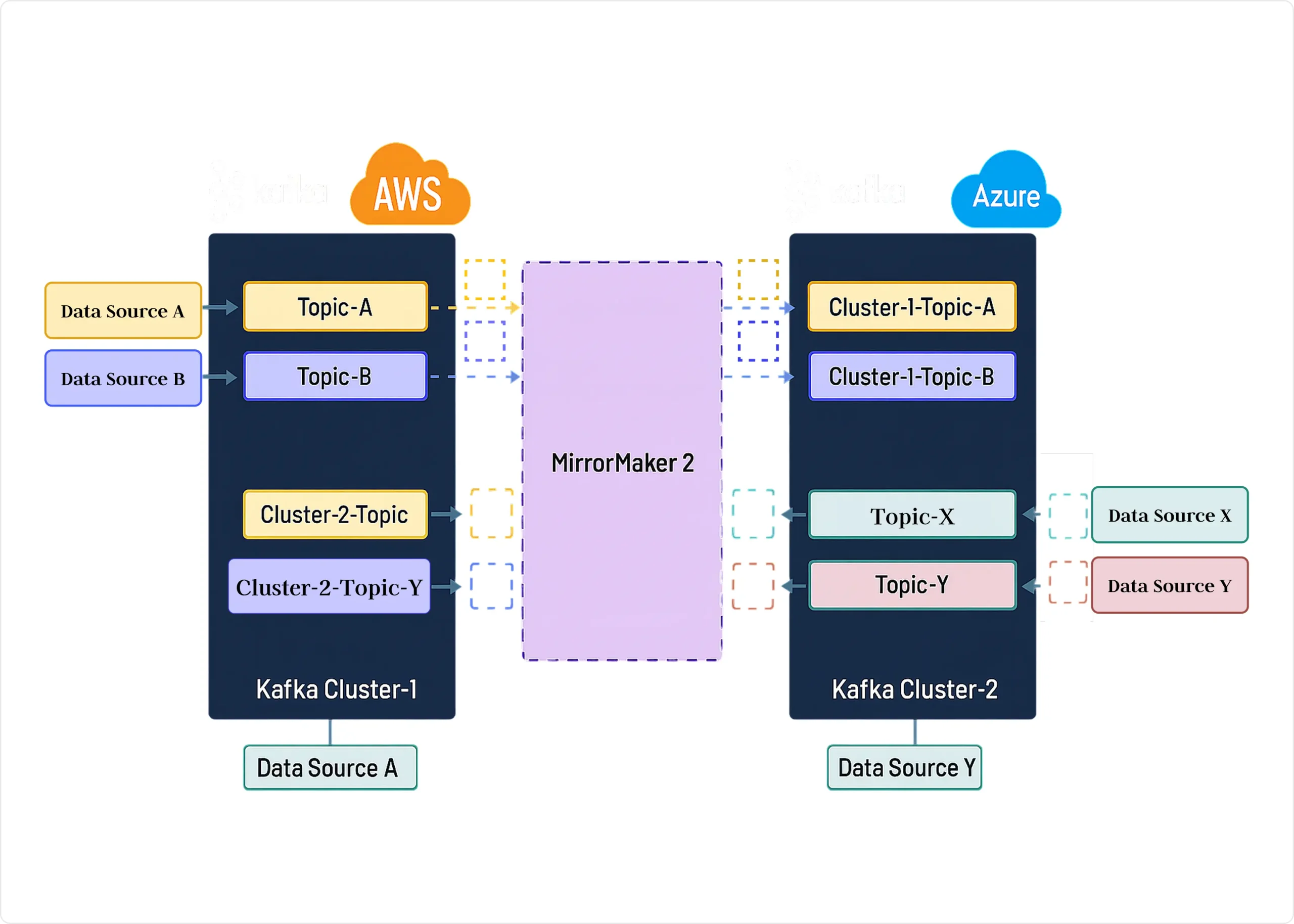
- Two Kafka Clusters, One on Each Cloud: Kafka Cluster-1 was deployed on AWS and Kafka Cluster-2 on Azure, each configured for its respective cloud environment.
- Bidirectional Replication with MirrorMaker 2: Kafka MirrorMaker 2 was set up to replicate data in both directions between the two clusters in real time. Loop detection was configured to prevent messages from bouncing back and forth endlessly.
- Only the Right Topics Get Replicated: Replication was limited to DR-critical business topics, including Topic-A, Topic-B, Topic-X, and Topic-Y. This kept replication overhead low and inter-cloud data transfer costs down.
- Automatic Failover: Consumer and producer connections were configured to switch automatically to the healthy cluster during an outage, with no changes needed at the application level.
- TLS Encryption Across the Cloud Link: All data moving between AWS and Azure was encrypted end to end using TLS, with strict access policies applied to the replication channel.
- Real Failure Testing: Simulated cloud outages, network partitions, and broker failures were run to confirm actual RTO and RPO numbers, giving the client proof they could use with regulators and enterprise customers.
Technology Stack
| Component | Details |
|---|---|
| Streaming Platform | Apache Kafka |
| Replication Engine | Kafka MirrorMaker 2 |
| Cloud Platform 1 | AWS (Kafka Cluster-1) |
| Cloud Platform 2 | Microsoft Azure (Kafka Cluster-2) |
| Replication Mode | Active-Active, bidirectional |
| Security | TLS encryption, policy-based access control |
| Topics Replicated | Topic-A, Topic-B, Topic-X, Topic-Y and DR-critical topics |
| Failure Testing | Simulated cloud outages, network partitions, broker failures |
| AI Tooling | AI-assisted topology modeling, failover scenario validation |
After deployment and failure testing, the platform delivered the following outcomes:
- Sub-30-Second RTO Confirmed: Failure testing confirmed that producer and consumer connections switched to the healthy cluster in under 30 seconds, with no manual intervention needed.
- Near-Zero RPO Across All Failure Scenarios: Bidirectional replication maintained near-zero data loss across all simulated failure scenarios, including cloud outages, network partitions, and broker failures.
- Active-Active Replication with Zero Loops: DR-critical topics maintained continuous replication across both clouds with zero replication loops or data conflicts since go-live.
- Zero Application Changes Needed for Failover: Consumer and producer redirection completed transparently during testing. No application-layer code needed to be changed.
- Zero Security Incidents Since Launch: TLS encryption and access controls have secured all inter-cluster traffic since deployment, with no security incidents recorded on the cross-cloud channel.
- Faster Delivery with AI: Ksolves AI-first approach compressed architecture modeling and failure testing significantly, delivering confirmed RTO and RPO metrics within weeks of starting the project.
“We had SLA obligations across multiple downstream applications with no automated recovery path. Ksolves delivered a cross-cloud architecture that gave us confirmed sub-30-second RTO validated under real failure conditions. We now have a DR posture we can actually defend to our customers.”
— Head of Infrastructure Engineering, Leading Telecommunications Provider
Before this engagement, any cloud-level failure on AWS or Azure would have meant application outages, lost data, and broken SLA commitments with no automated way out. Today that risk is gone.
Ksolves, with its AI-first delivery approach, designed and validated a cross-cloud Kafka setup that keeps data flowing between AWS and Azure at all times. With sub-30-second RTO, near-zero RPO, and zero security incidents since launch, the client has a DR posture they can demonstrate to regulators and enterprise customers.
As their streaming workloads grow, the architecture scales without needing to be rebuilt. For telecom providers and enterprises running mission-critical Kafka workloads on a single cloud, explore Ksolves Apache Kafka Services and find out how to protect your infrastructure from a cloud-level failure.
Simplify Complex Kafka Deployments Across Multi-Cloud Environments with Ksolves!