



SOA vs Microservices: Choosing the Right Architecture for Your Business
Microservices
5 MIN READ
December 16, 2025

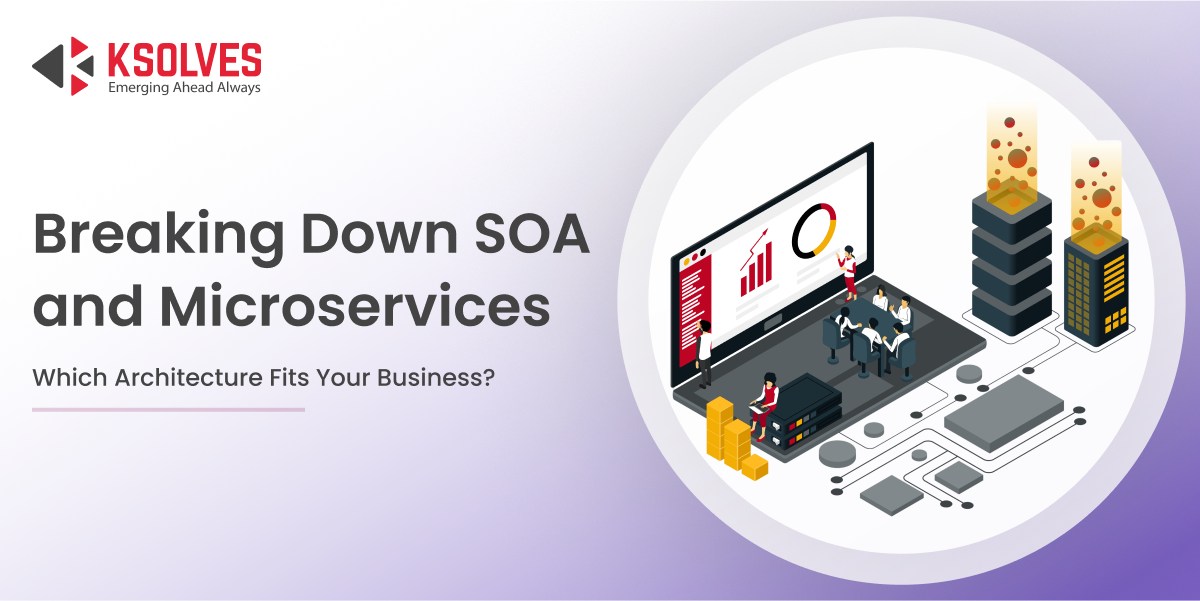
Imagine your engineering team debating architecture: Should we go microservices or stick with Service-Oriented Architecture (SOA)? One promises speed and autonomy; the other, control and integration. Both aim to untangle the complexity of large systems, yet they differ profoundly in how they break them apart, communicate, and evolve over time.
In today’s cloud-native era, this distinction shapes how fast your teams can deliver, scale, and recover from failure. While SOA laid the foundation for distributed systems, Microservices redefined it for a world driven by APIs, containers, and CI/CD.
In this blog, we’ll cover the core differences between SOA and Microservices, exploring their principles, trade-offs, and practical use cases. You’ll walk away with clear definitions, a side-by-side comparison, migration guidance, and real-world pitfalls to avoid so you can choose the right architecture for your enterprise with confidence.
Quick Definitions of SOA and Microservices
Service-Oriented Architecture (SOA)
Service-Oriented Architecture (SOA) is an enterprise-grade architectural approach focused on integrating diverse systems across an organization. It typically leverages an Enterprise Service Bus (ESB) or similar middleware to coordinate communication between services and enforce shared schemas, contracts, and governance standards.
SOA services are generally coarse-grained, encapsulating multiple business functions, and are designed for reusability and interoperability across enterprise applications.
Microservices Architecture
Microservices architecture structures applications as a collection of small, autonomous, and independently deployable services, each aligned to a specific business capability or team. Each microservice manages its own code, data, and runtime, communicating with others via lightweight protocols such as REST, gRPC, or event-driven messaging.
Microservices emphasize loose coupling, high cohesion, and polyglot technology support, enabling faster development, continuous deployment, and scalable systems.
Key Differences Between Microservices and SOA
Let’s now explore the major differences between SOA architecture andvs microservices across different parameters.
1. Service Granularity
SOA: Services are coarse-grained, often spanning multiple business functions or domains. They aim for enterprise-wide reuse and integration rather than fine-tuned modularity.
Microservices: Services are fine-grained, adhering to the single-responsibility principle. Each service encapsulates a single bounded context, focusing on a specific business capability.
2. Communication Style
SOA: Communication is typically synchronous and mediated through an ESB or central broker, often using canonical data models to standardize message exchange across heterogeneous systems.
Microservices: Communication is decentralized, often API-first and event-driven where appropriate (e.g., Kafka, SNS/SQS). Microservices support polyglot protocols, giving teams flexibility to choose the best communication mechanism per service.
3. Data Ownership & Persistence
SOA: Services often rely on shared enterprise data models with centralized databases, which can simplify consistency but increase coupling.
Microservices: Each service owns its data, enabling polyglot persistence. Data consistency is maintained asynchronously where needed, with eventual consistency patterns and change-data-capture mechanisms.
4. Governance & Standards
SOA: Governance is centralized and top-down, with shared contracts, XSDs, and enterprise-wide policies enforcing consistency and interoperability.
Microservices: Governance is federated, with teams following “golden paths” for best practices. Contracts are tested via consumer-driven contracts, and APIs evolve independently while maintaining backward compatibility.
5. Deployment & Operations
SOA: Deployment often follows release trains, with heavy middleware coordination and centralized change management.
Microservices: Services are independently deployable, supported by CI/CD pipelines, containerized environments, service meshes, and progressive delivery techniques such as canary or blue-green deployments.
6. Team Topology
SOA: Teams are often functionally siloed (e.g., separate application and integration teams), which can slow decision-making and deployments.
Microservices: Teams are stream-aligned, owning both code and runtime operations, embracing DevOps and SRE practices to accelerate delivery and improve reliability.
Microservices vs SOA: A Head-to-Head Comparison
| Feature | SOA | Microservices |
| Service Size | Large, coarse-grained | Small, fine-grained |
| Communication | Often via ESB, heavy middleware | Lightweight protocols like REST, gRPC |
| Deployment | Centralized, often integrated | Independent deployment per service |
| Data Management | Shared database, centralized | Decentralized, per service |
| Scalability | Vertical scaling | Horizontal scaling |
| Governance | Strong central governance | Decentralized governance |
| Technology Stack | Usually homogeneous | Polyglot (multiple languages/technologies) |
Benefits of Choosing Microservices
- Accelerated Development Cycles: Small, focused teams can build, test, and deploy services independently, speeding up time-to-market.
- Flexible Scalability: Individual services can be scaled up or down based on demand, optimizing performance and resource usage.
- Enhanced Fault Isolation: Failures in one service remain contained, reducing the risk of system-wide outages.
- DevOps & Cloud-Ready: Perfectly aligned with CI/CD pipelines, automated testing, and cloud-native deployments for continuous innovation.
Benefits of Choosing SOA
- Seamless Legacy Integration: Easily connects with existing enterprise systems, preserving prior investments.
- Reusable Services Across Projects: Shared services reduce redundancy and streamline development across multiple applications.
- Centralized Governance & Security: Strong oversight ensures compliance, standardization, and robust security controls.
- Ideal for Complex Processes: Excels at managing structured, enterprise-wide workflows and business operations.
When to Choose SOA vs Microservices
Choosing between SOA and Microservices isn’t always a black-and-white decision. Many organizations adopt a hybrid approach, depending on the systems, business needs, and technical constraints. Here’s a practical guide:
Choose SOA When:
- Heavy Legacy Integration: You need to connect with ERP, CRM, or other legacy systems that require structured workflows.
- Strict Enterprise Standards: Centralized governance, security policies, and data standards are essential.
- Batch & Hub-and-Spoke Flows: Ideal for orchestrating complex business processes that depend on centralized service communication.
Choose Microservices When:
- Product Velocity is Key: Your teams need to release features rapidly without affecting the entire system.
- Frequent Updates & Agile Delivery: Services can be deployed independently, supporting CI/CD pipelines and DevOps practices.
- Cloud-Native Scalability: Applications require horizontal scaling to handle variable loads efficiently.
- Clear Domain Boundaries: Each service has a well-defined responsibility, minimizing interdependencies.
The Hybrid Reality
In practice, many enterprises combine the best of both worlds:
- Microservices at the Edge: For new, customer-facing applications or digital products that need agility and scalability.
- SOA-Like Integration for Legacy Cores: For critical legacy systems that require stability, standardization, and centralized governance.
This approach allows businesses to innovate quickly at the edges while maintaining robust control over their core systems, delivering both flexibility and reliability.
Final Words
Both SOA and Microservices offer powerful ways to design modular, maintainable, and scalable applications, but they serve different purposes. SOA excels in integrating legacy systems, enforcing enterprise standards, and managing complex workflows. In contrast, microservices architecture is the best fit in cloud-native environments, agile product development, and fast-paced digital innovation.
Choosing the right architecture is about aligning with business goals, team capabilities, and long-term growth strategies.
Ready to modernize your applications? Partner with Ksolves to design scalable, resilient, and future-ready solutions using Microservices, SOA, or a hybrid approach tailored to your enterprise needs.































AUTHOR
Microservices
Share with