



Microservices Communication Patterns Explained
Microservices
5 MIN READ
March 23, 2026


Most microservices migrations fail not because the architecture is wrong, but because communication between services was treated as a secondary concern. Teams spend months decomposing a monolith into well-defined services, only to find that those services recreate the very coupling they were meant to eliminate, this time across a network instead of a codebase. The result is a distributed system that inherits all the complexity of microservices without gaining any of the resilience.
How services communicate shapes availability, data consistency, deployment independence, and the ability to diagnose failures. Choosing the right pattern for each interaction is one of the more consequential architectural decisions a team makes, and it is rarely reversible without significant rework. For teams already familiar with the core benefits of microservices architecture, this is the layer beneath the surface, the one that determines whether the system behaves in production the way it was designed on paper.
Why Microservices Communication Patterns Determine Architecture Health
In a monolith, internal calls share process memory. When that system is decomposed, every call becomes a network request with a different failure profile entirely. Timeouts, partial responses, and silent failures compound across service chains in ways that are difficult to predict.
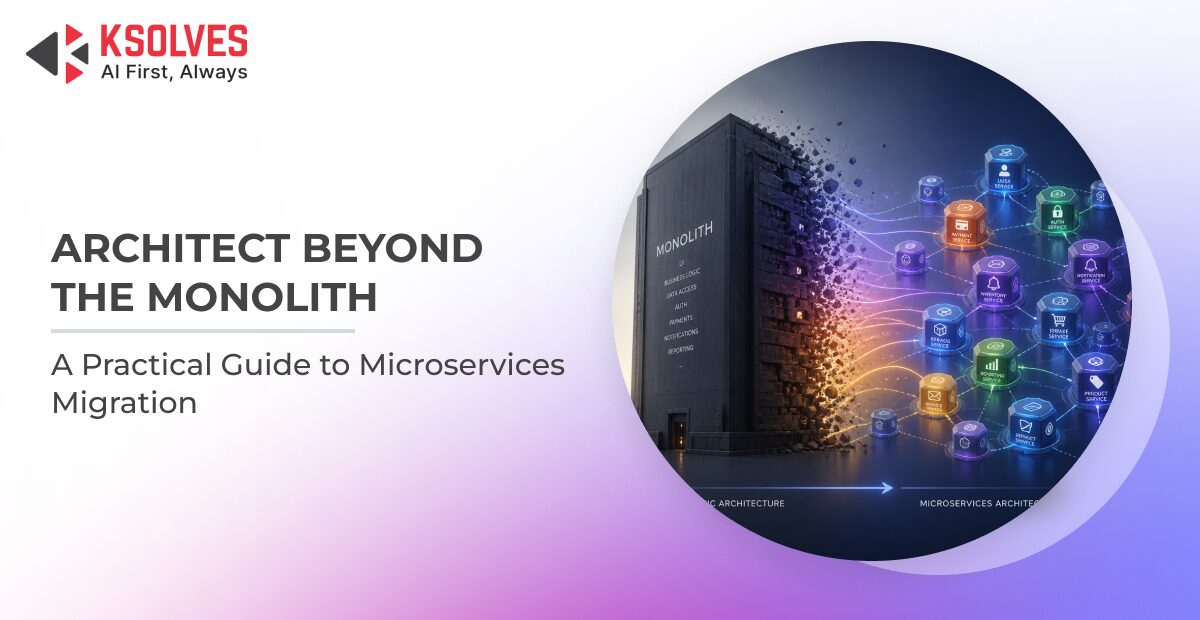
The most common early failure is the distributed monolith. As our breakdown of monolithic vs. microservices architecture covers, tight coupling does not disappear because services now run in separate containers. When Service A calls B synchronously, which calls C, which calls D, the availability of A becomes a function of the entire chain. Four services each at 99.9% uptime produce roughly 99.6% composite availability at best. Getting microservices communication patterns right is what separates an architecture that gains from decomposition from one that merely adds operational surface area.
Synchronous Patterns: REST and gRPC
Synchronous microservices communication follows a request-reply model. The caller sends a request and waits for a response before proceeding. REST over HTTP is the most widely used implementation, well-suited to external-facing APIs and services with straightforward request-response contracts.
For internal high-throughput communication, gRPC offers meaningful advantages: binary serialization via Protocol Buffers, strongly typed contracts, and multiplexed connections over HTTP/2. It also supports bidirectional streaming natively, making it viable beyond simple unary request-reply. Teams building on Java with Spring Boot commonly use gRPC for internal service communication, the Ksolves Java development practice covers RESTful API design and microservices integration patterns in detail.
The structural limitation of synchronous patterns is temporal coupling. A service waiting for a downstream response is only as available as that dependency. Circuit breakers, retry logic with exponential backoff, and explicit timeout budgets are the minimum infrastructure needed to prevent a slow dependency from cascading into a wider outage.
Asynchronous Patterns: Message Queues
Asynchronous microservices communication patterns change the contract between services. The producer places a message on a queue and continues executing. The consumer processes it independently, on its own schedule. RabbitMQ and Amazon SQS are the most widely deployed implementations, suited to workloads where reliability matters more than immediacy: payment processing, order fulfillment, and notification delivery.
When a consumer goes down, messages accumulate and are processed on recovery. Producers are insulated from downstream slowness without needing their own circuit breaker logic. The trade-off is that error handling, dead-letter queues, and eventual consistency must all be designed explicitly. Distributed tracing becomes essential for understanding failures in a system with no synchronous response path.
For a production example of this pattern in practice, the Ksolves financial system case study details how dead-letter handling, the Saga pattern for distributed transactions, and circuit breaker logic were implemented together in a high-concurrency transaction system using Apache Kafka and Kubernetes.
Event-Driven Patterns: Kafka, CQRS, and Sagas
Event-driven architecture is the most decoupled of the core microservices communication patterns. Services publish events to a shared log and any number of downstream consumers react independently, with no knowledge of each other. Apache Kafka is the dominant platform at scale, offering a durable, replayable event log suited to audit trails, compliance requirements, and real-time analytics. The Ksolves blog on Kafka integration with Java microservices covers how decoupled communication, horizontal scalability, and fault isolation work together in this pattern.
CQRS (Command Query Responsibility Segregation) separates the read and write models of a system and can be applied independently wherever read and write scalability need to be addressed separately. Event sourcing stores the full sequence of events that produced state rather than state itself. The two are related but distinct: CQRS does not require event sourcing, but event sourcing effectively requires CQRS, because an event log alone cannot serve complex queries without a separate read model.
Distributed transactions in event-driven systems use the Saga pattern in place of two-phase commit, coordinating multi-step operations through local transactions and compensating actions on failure.
Service Mesh: Cross-Cutting Communication Infrastructure
As microservices environments grow, concerns like mutual TLS, traffic routing, circuit breaking, and distributed tracing become common to every service. Implementing them in application code creates duplication and inconsistency. Service mesh tools like Istio and Linkerd move this responsibility to the infrastructure layer through sidecar proxies, enforcing communication policy uniformly without touching application code. The Ksolves Kubernetes consulting practice covers service mesh setup alongside cluster architecture, namespace isolation, and CI/CD pipeline integration.
An API gateway handles north-south traffic from external clients into the platform. A service mesh handles east-west traffic between services inside it. The two serve different purposes. Conflating them leaves either the internal network underprotected or the gateway burdened with concerns it was not designed for.
How to Choose the Right Microservices Communication Pattern?
Use synchronous patterns when the caller needs an immediate response. Use async messaging when reliability matters more than immediacy and the consumer is a single known service. Use event-driven patterns when multiple independent consumers need to react to the same event, or when a replayable audit trail is required.
Across all microservices communication patterns, missing distributed tracing makes failures nearly impossible to diagnose, a point teams migrating from SOA vs. microservices architectures often learn after the fact. The communication design decisions made earliest in a migration are the hardest to revisit later. By the time failure modes surface, those patterns are embedded across a dozen services and several teams.
Is Your Communication Architecture Production-Ready?
The communication design decisions made earliest in a microservices migration are the hardest to revisit later. By the time failure modes are visible, the patterns are embedded across a dozen services and several teams.
Ksolves’ microservices architecture consulting practice works with engineering leaders to assess and design communication patterns before those decisions become structural constraints.
































AUTHOR
Microservices
Share with