Project Name
How Ksolves Eliminated Prometheus Outages and Cut Storage Costs by 60% for a North American Distributor
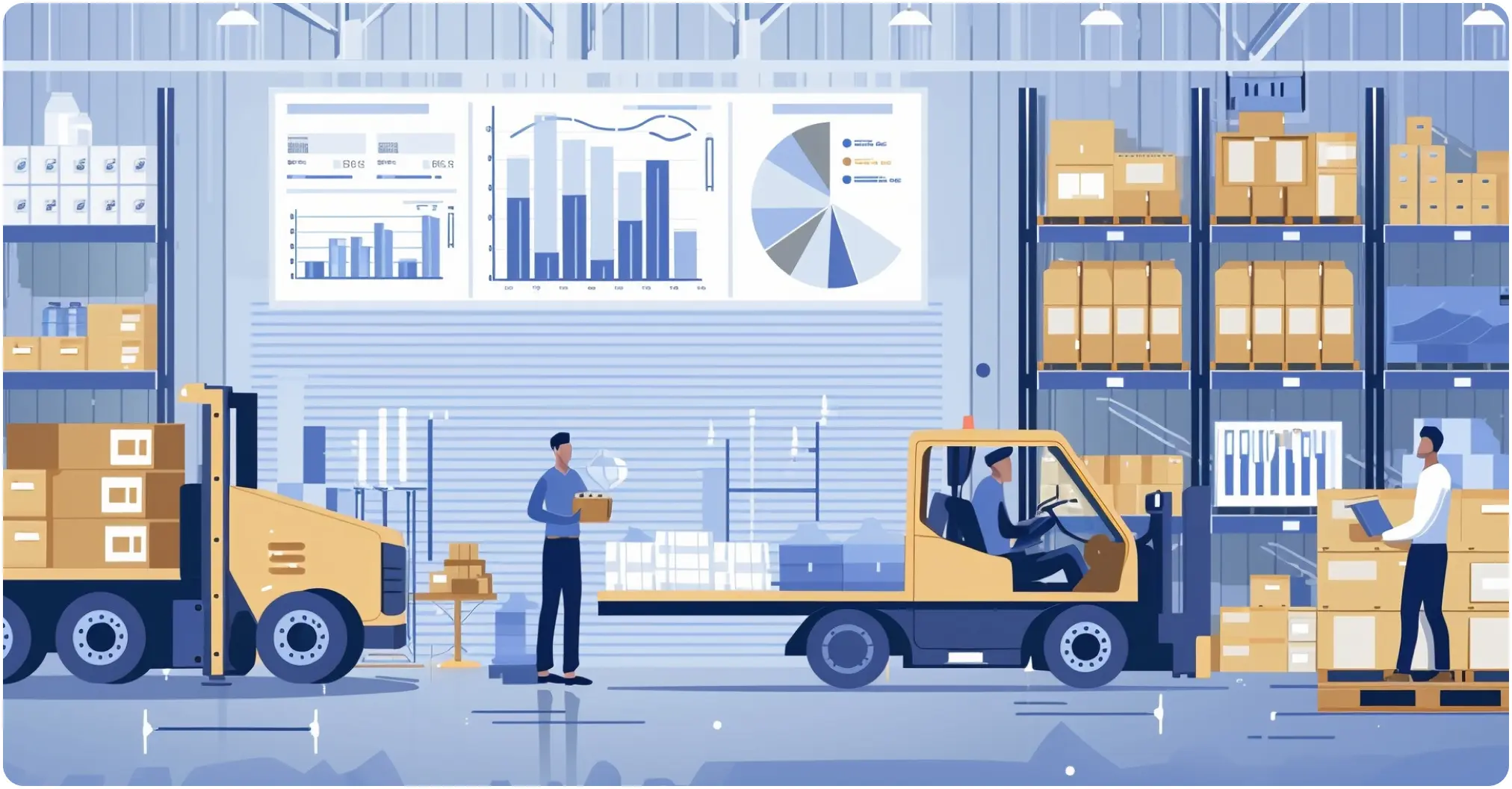

When your enterprise monitoring stack hits 100% disk utilization at 2 AM, every downstream system is at risk. That was the reality for a leading North American distributor of shipping, industrial, and packaging materials. Recurring Prometheus outages caused by WAL directory overflows were cascading into full service shutdowns. Thanos store servers were grinding to a halt under thousands of unmanaged TSDB blocks. With no automated compaction, no cloud offloading, and Grafana dashboards timing out on queries as short as five days, their observability platform had become an active liability.
The client is a B2B supply chain organization operating across North America, serving enterprise accounts across manufacturing, logistics, and retail verticals. Their infrastructure team was managing large-scale telemetry across distributed operations, but their monitoring environment had grown faster than their ability to govern it. Every new data source added more pressure to a stack that was already at its limit.
Ksolves was brought in to fix the immediate outages and rebuild the observability foundation from the ground up. Working with an AI-first delivery model, the team used AI-assisted diagnostic tooling to compress root cause analysis from days to hours before any remediation work began.
The client's observability environment presented nine compounding problems across storage, performance, reliability, and data integrity:
- Prometheus WAL Overflow Causing Outages: WAL directory overflows were triggering critical Prometheus failures, cascading into complete monitoring blackouts across the infrastructure.
- Thanos Store Overloaded with Unmanaged TSDB Blocks: Thousands of uncompacted TSDB blocks had accumulated in Thanos store servers, causing severe query degradation and pushing disk utilization to 100%.
- No Automated Compaction: Without Thanos Compactor running correctly, blocks were never merged or downsampled, causing exponential storage growth with every passing day.
- Grafana Dashboard Timeouts: Queries spanning even five-day windows were timing out in Grafana, making the dashboards the team relied on for operational visibility effectively unusable.
- Storage Bottlenecks with No Cloud Offloading: Historical time-series data had no offload path. Everything was stored on-premise with no connection to cloud object storage, creating a hard capacity ceiling with no scalable alternative.
- Downsampling Pipeline Failures: A bug in the downsampling pipeline was corrupting resolution tiers, breaking the integrity of historical data across 5-minute granular and 1-hour rollup levels.
- Granular Metric Overload: Excessively high scrape frequency across all targets was generating metric volume the stack could not process, compounding the storage and query performance problems.
- No High Availability Architecture: The observability stack had no redundancy. A single component failure brought down visibility across the entire infrastructure with no fallback.
- Security and Access Control Gaps: Credential management and access controls across Prometheus and Thanos were inconsistent, creating compliance exposure in a regulated distribution environment.
Ksolves applied AI-powered diagnostic analysis to identify root causes across all nine failure points before any remediation began, reducing the scoping phase from weeks to days. The rebuild was executed in structured phases, each validated before the next began.
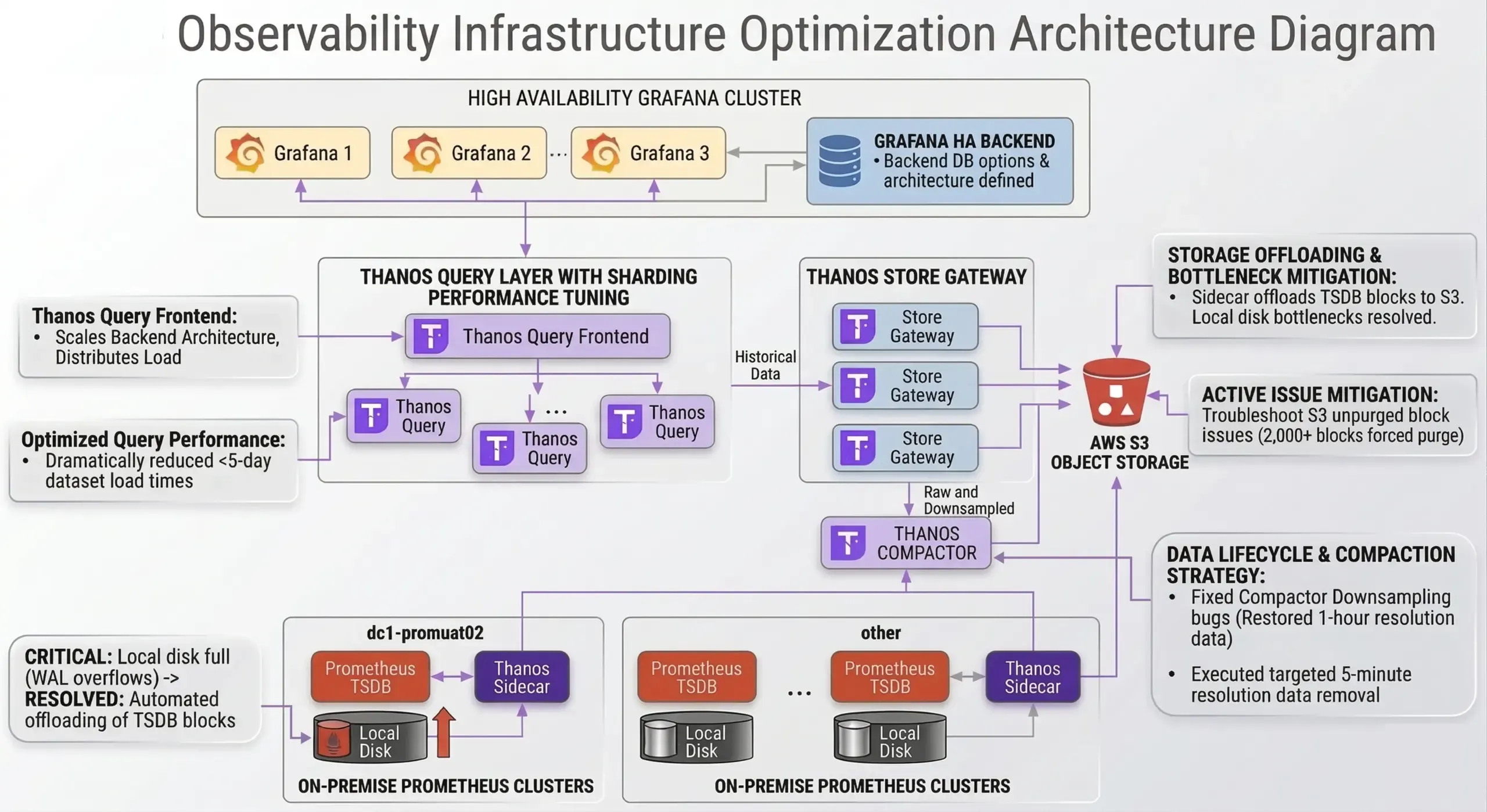
- WAL Overflow Fix: The root cause of Prometheus WAL overflows was identified and patched, eliminating the primary source of monitoring outages. Scrape intervals and retention configurations were recalibrated to prevent recurrence under growing data volumes.
- Thanos Compactor Deployment and TSDB Block Cleanup: Thanos Compactor was deployed and configured to run automated compaction and downsampling on a defined schedule. Over 2,000 accumulated TSDB blocks were processed and consolidated, restoring Thanos store performance and freeing significant disk capacity.
- AWS S3 Offloading for Historical Data: Long-term time-series data was offloaded to AWS S3 using Thanos Sidecar integration, eliminating the on-premise storage ceiling and reducing infrastructure storage costs by 60% compared to local retention.
- Downsampling Bug Fix: The corrupted downsampling pipeline was diagnosed and repaired, restoring data integrity across all resolution tiers. Source-based retention policies were implemented to ensure consistent data quality across all time-series resolution tiers.
- Grafana Query Performance Restoration: With TSDB blocks compacted and Thanos store load reduced, Grafana dashboard query times dropped from timeouts to sub-second responses for standard operational windows.
- Scrape Frequency Optimization: Target scrape intervals were tuned across all Prometheus instances to match actual monitoring requirements, reducing unnecessary metric generation and relieving query and storage pressure across the stack.
- High Availability Architecture Design: A full Grafana HA blueprint was designed and documented, providing the client with an implementation-ready roadmap for redundancy across Prometheus, Thanos, and Grafana components.
- Security and Credential Hardening: Access controls, credential management, and secrets handling were standardized across the stack, closing the compliance gaps identified during the initial assessment.
Technology Stack
| Component | Details |
|---|---|
| Metrics Collection | Prometheus |
| Long-Term Storage | Thanos (Sidecar, Compactor, Store Gateway) |
| Cloud Object Storage | AWS S3 |
| Visualization | Grafana |
| Compaction | Thanos Compactor, automated scheduling |
| Downsampling | Thanos resolution tiers (5-min, 1-hour) |
| HA Blueprint | Grafana High Availability architecture |
| Deployment | Distributed, cloud-connected on-premise |
The observability rebuild delivered measurable improvements across uptime, storage, query performance, and data integrity:
- Prometheus Outages Eliminated: Recurring monitoring outages caused by WAL overflows were reduced to zero. The infrastructure team regained continuous, uninterrupted visibility across all systems.
- 60% Reduction in Storage Costs: Offloading historical data to AWS S3 eliminated recurring on-premise storage expansion costs, delivering a 60% reduction in observability infrastructure spend.
- 2,000+ TSDB Blocks Cleared: Over 2,000 unmanaged TSDB blocks were compacted and consolidated, dropping Thanos store disk utilization from 100% to under 40% and restoring query performance across the stack.
- Grafana Dashboards Restored to Sub-Second Response: Dashboard queries that were timing out on five-day windows now return in under a second, giving operations teams the real-time visibility they previously could not access.
- 100% Data Integrity Restored: The downsampling bug fix and source-based retention policies ensured zero data loss across all resolution tiers, both 5-minute granular and 1-hour historical.
- AI-Accelerated Delivery: Ksolves' AI-first diagnostic approach compressed root cause analysis and solution modeling by an estimated 60% versus a conventional manual engagement, delivering results in weeks rather than months.
- HA Architecture Roadmap Delivered: The client received a fully documented, implementation-ready Grafana HA blueprint, enabling future infrastructure redundancy without additional scoping time or vendor dependency.
“Ksolves didn’t just fix our Prometheus issues. They rebuilt the foundation of our observability stack in a way we couldn’t have done alone. The AI-assisted approach meant we saw results in weeks, not months. We went from 100% disk saturation and daily outages to a clean, stable platform we can actually trust.”
— Head of Infrastructure, Leading North American Distribution Group
By diagnosing and resolving nine compounding failures across Prometheus, Thanos, and Grafana, Ksolves, with its AI-first delivery approach, transformed an observability platform that was actively causing outages into a stable, scalable, cost-efficient monitoring foundation.
The client now has zero monitoring outages, 60% lower storage costs, fully functional Grafana dashboards, and a clear HA architecture roadmap for future growth. As their infrastructure scales and telemetry volumes grow, the rebuilt observability stack is built to grow alongside it without hitting the same limits again.
For supply chain operators, distributors, and any enterprise team managing large-scale telemetry on Prometheus and Thanos, contact experts at Ksolves, a leading Big Data and Infrastructure Consulting Company, and find out what a production-grade observability architecture looks like for your environment.
Is Your Observability Stack Showing the Same Warning Signs?