



OpenShift Resource Management: Pods, Nodes, and Clusters
OpenShift
5 MIN READ
April 14, 2026

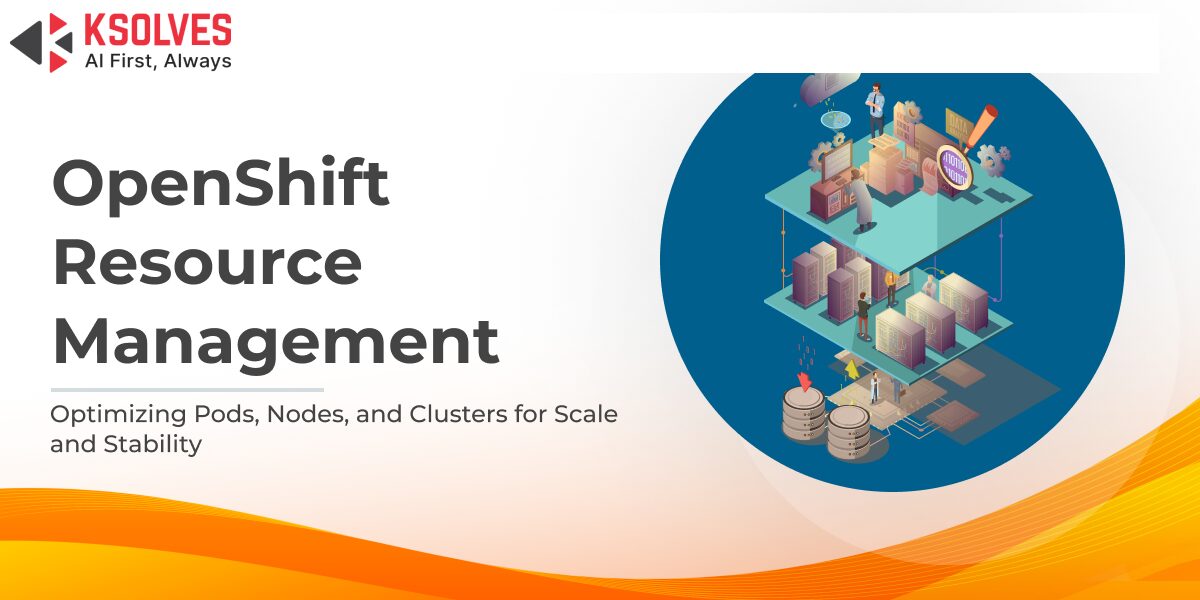
As organizations scale containerized workloads, resource management becomes one of the most critical aspects of running OpenShift reliably and cost-effectively. Poorly managed resources can lead to performance degradation, unexpected outages, inflated infrastructure costs, and operational friction between teams.
OpenShift, built on Kubernetes, provides a robust framework for managing compute resources across pods, nodes, and clusters. However, leveraging these capabilities correctly requires a clear understanding of how resources are requested, scheduled, enforced, and monitored.
This blog explores how resource management works in OpenShift at the pod, node, and cluster levels, and outlines practical approaches to building stable, scalable, and governed OpenShift environments.
Why Resource Management is Critical in OpenShift
In Kubernetes-based platforms like OpenShift, resources are shared by default. Multiple applications, teams, and platform components compete for the same CPU and memory pools. Without well-defined controls, this shared model can quickly introduce risks such as:
- Resource contention that impacts application performance.
- Unpredictable pod evictions during peak load.
- Over-provisioning that drives up infrastructure or cloud costs.
- Limited visibility into actual resource consumption.
OpenShift adds enterprise-grade governance, security, and observability on top of Kubernetes, but resource efficiency still depends on how workloads are designed and configured.
OpenShift Resource Architecture: A High-Level View
At its core, OpenShift follows Kubernetes’ resource hierarchy:
- Pods define how applications consume CPU and memory.
- Nodes provide the physical or virtual infrastructure capacity.
- Clusters coordinate scheduling, isolation, and governance across workloads.
The OpenShift control plane manages scheduling and enforcement, while worker nodes execute application workloads. Resource management decisions made at one layer directly affect behavior at the others, making a holistic approach essential.
Also Read: 10 Common Challenges in OpenShift Adoption and How to Overcome Them
Pod-Level Resource Management
Pod-level configuration determines how applications request and consume resources, and how they behave under pressure.
1. Resource Requests and Limits
Each container within a pod can define:
- Requests: The minimum CPU and memory required for scheduling.
- Limits: The maximum resources the container is allowed to consume.
The Kubernetes scheduler uses requests to place pods on nodes, while limits are enforced at runtime. Misconfigured values can lead to CPU throttling or out-of-memory (OOM) terminations.
Defining realistic requests and limits ensures:
- Predictable scheduling
- Fair resource sharing
- Reduced risk of node-level pressure
2. Quality of Service (QoS) Classes
Based on request and limit definitions, OpenShift assigns pods a QoS class:
- Guaranteed: Requests equal limits for all containers.
- Burstable: Requests lower than limits.
- BestEffort: No requests or limits defined.
QoS classes influence eviction priority when nodes experience memory pressure. In production environments, explicitly defined resources help ensure critical workloads are less likely to be evicted.
3. Pod Scheduling Controls
OpenShift supports standard Kubernetes scheduling mechanisms, including:
- Node selectors and affinities for targeted placement.
- Anti-affinities to improve availability.
- Taints and tolerations to isolate specific workloads.
These controls are commonly used to separate infrastructure components, regulated workloads, or latency-sensitive applications.
Also Read: Top 10 Questions to Ask Before Choosing an OpenShift Consulting Partner (With Checklist)
Node-Level Resource Management
While pods define consumption, nodes define capacity. Effective node-level management is essential to maintain cluster stability.
1. Capacity vs Allocatable Resources
Node capacity represents total available CPU and memory, while allocatable resources account for:
- Operating system overhead.
- Kubernetes system components.
- OpenShift platform services.
Scheduling decisions are based on allocatable resources, not raw capacity. Ignoring this distinction can result in failed pod scheduling or unstable nodes.
2. CPU and Memory Behavior
- CPU is a compressible resource and subject to throttling.
- Memory is non-compressible; exceeding limits results in pod termination.
OpenShift follows Kubernetes eviction policies to protect node stability during resource pressure, prioritizing pods based on QoS class.
3. Node Roles and Workload Placement
In enterprise clusters, nodes are commonly categorized as:
- Control plane nodes.
- Application worker nodes.
- Infrastructure nodes (routers, monitoring, registry).
Separating these roles improves reliability and reduces the risk of platform components competing with application workloads.
Also Read – OpenShift Role-Based Access Control (RBAC) Explained
Cluster-Level Resource Governance
As clusters grow, governance becomes as important as performance.
1. Projects and Namespace Isolation
OpenShift projects extend Kubernetes namespaces by adding:
- Role-based access control (RBAC).
- Network isolation defaults.
- Resource governance capabilities.
This structure supports multi-team and multi-application environments without compromising isolation.
2. ResourceQuotas and LimitRanges
- ResourceQuotas restrict total resource usage per project.
- LimitRanges enforce default and maximum resource values per pod.
Together, they prevent accidental overconsumption and promote consistent configuration across teams.
3. Scheduler Fairness
The OpenShift scheduler balances workloads across nodes based on availability and constraints, helping avoid hotspots and improving overall cluster utilization.
Autoscaling in OpenShift
Autoscaling in OpenShift enables clusters to respond dynamically to workload demand, reducing the need for constant manual capacity adjustments. When implemented correctly, autoscaling helps maintain application performance while improving infrastructure efficiency.
Horizontal Pod Autoscaler (HPA)
The Horizontal Pod Autoscaler automatically adjusts the number of pod replicas based on observed metrics such as CPU and memory utilization. It is best suited for stateless workloads that can scale horizontally without impacting application behavior.
HPA effectiveness depends heavily on:
- Accurate CPU and memory requests defined at the pod level.
- Reliable metrics collection through OpenShift’s monitoring stack.
- Applications designed to handle scaling events gracefully.
Without properly defined resource requests, HPA decisions can become unpredictable or ineffective.
Also Read – Top 10 Questions to Ask Before Choosing an OpenShift Consulting Partner
Cluster Autoscaler
The Cluster Autoscaler manages capacity at the infrastructure layer by adding or removing worker nodes in response to pending pods and overall resource demand. It integrates with supported cloud providers and selected on-premises environments to ensure sufficient capacity is available when workloads scale.
When combined with HPA, the Cluster Autoscaler helps:
- Prevent scheduling failures caused by insufficient node resources.
- Reduce over-provisioning during periods of low demand.
- Balance performance requirements with infrastructure cost.
Key Scaling Considerations
Autoscaling is not a replacement for sound resource planning. Poorly defined resource requests or missing limits can lead to:
- Excessive scaling events.
- Inefficient node utilization.
- Increased risk of instability during traffic spikes.
Successful autoscaling requires well-designed workloads, realistic resource definitions, and continuous observation.
How Ksolves Helps Optimize OpenShift Resource Management
Ksolves, a trusted OpenShift consulting partner, works with enterprises to build disciplined, scalable, and well-governed OpenShift environments by optimizing how resources are planned, consumed, and monitored across pods, nodes, and clusters. Our approach is grounded in practical platform engineering experience and aligns technical decisions with business priorities.
Our OpenShift resource management support includes:
- Comprehensive cluster assessments to identify resource inefficiencies, misconfigurations, and potential stability risks across workloads and infrastructure.
- Workload-aware resource strategy design, ensuring CPU and memory requests, limits, and placement policies reflect real application behavior and criticality.
- Implementation of quotas, LimitRanges, and autoscaling configurations that enforce governance while preserving developer flexibility.
- Monitoring-driven optimization, using OpenShift’s native observability stack to continuously refine resource usage based on actual consumption patterns.
- Ongoing governance and operational support, helping teams maintain cost control, performance consistency, and platform maturity as environments evolve.
By combining deep OpenShift expertise with hands-on operational insight, Ksolves enables organizations to reduce resource waste, improve cluster stability, and scale OpenShift with confidence.
Final Words
Effective resource management is at the core of running OpenShift successfully at scale. When pods, nodes, and clusters are configured with realistic resource definitions, supported by autoscaling and continuous monitoring, organizations gain the stability, efficiency, and predictability required for modern enterprise workloads.
OpenShift provides the necessary mechanisms, but realizing their full value requires disciplined design, ongoing optimization, and strong governance. By treating resource management as a continuous operational practice rather than a one-time configuration, teams can control costs, reduce risk, and support sustainable growth.
With the right strategy and expertise, OpenShift becomes not just a container platform but a resilient foundation for long-term digital transformation.































AUTHOR
OpenShift
Share with