



Integrating ReactJS Frontends Seamlessly with Odoo, SAP, or Salesforce Backends
ReactJS
5 MIN READ
April 16, 2026

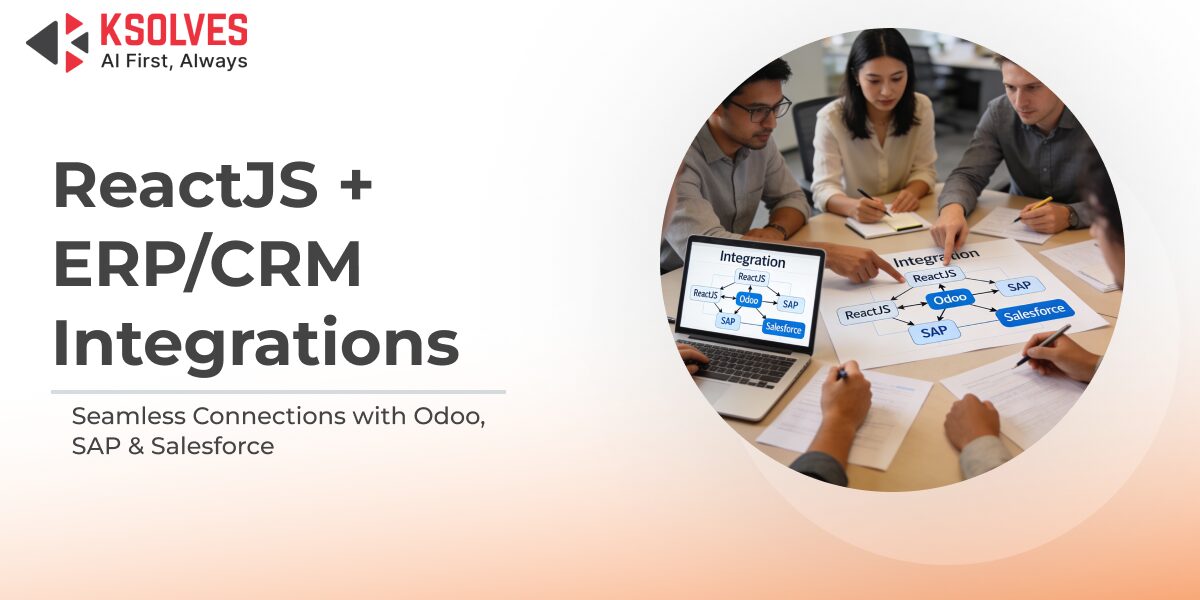
Modern enterprises are no longer satisfied with rigid, monolithic applications. Users expect fast, intuitive, and responsive interfaces, while businesses demand scalability, security, and integration with mission-critical systems. This shift has accelerated the adoption of ReactJS as a modern frontend layer, paired with powerful enterprise platforms like Odoo, SAP, and Salesforce on the backend.
However, integrating a JavaScript-based frontend with complex ERP and CRM systems is not a plug-and-play exercise. It requires thoughtful architecture, robust API strategies, and strong governance to ensure performance, security, and long-term maintainability.
This blog explores how ReactJS can be seamlessly integrated with Odoo, SAP, and Salesforce, the architectural patterns that work best, and the technical best practices enterprises should follow.
Why ReactJS Is the Preferred Choice for Enterprise Frontends
1. Faster, More Responsive User Experiences
ReactJS uses a virtual DOM and efficient reconciliation algorithms to minimize unnecessary UI updates. This results in faster rendering, smoother interactions, and better responsiveness, especially important for data-heavy enterprise dashboards, forms, and workflows.
For ERP and CRM applications where users interact with large datasets and multi-step processes, ReactJS enables:
- Real-time UI updates without full page reloads.
- Smooth navigation across complex modules.
- Better perceived performance for end users.
2. Component-Based Architecture for Scalability
ReactJS applications are built using reusable, self-contained components, which aligns well with enterprise needs:
- UI components can map directly to business modules (orders, invoices, leads, inventory).
- Teams can develop, test, and deploy features independently.
- Long-term maintenance becomes easier as applications grow in size and complexity.
3. Decoupling Frontend from Backend Systems
ReactJS supports headless and API-driven architectures, allowing enterprises to:
- Modernize user interfaces without disrupting backend logic.
- Serve multiple frontends (web portals, mobile apps, partner systems) from the same ERP or CRM.
- Reduce dependency on backend UI frameworks that limit customization.
Also Read: 15+ Most Popular ReactJS Libraries to Boost Your Frontend Development
Understanding the Backend Ecosystem: Odoo, SAP, and Salesforce
Modern ReactJS applications rarely operate in isolation. Their effectiveness depends on how well they integrate with enterprise-grade backend platforms. Odoo, SAP, and Salesforce each represent a distinct backend ecosystem, with unique architectures, integration patterns, and constraints that must be carefully considered when designing a ReactJS frontend.
1. Odoo: A Modular, Open-Source ERP Built for Extensibility
Odoo is a highly modular ERP platform that supports core business functions such as finance, sales, inventory, manufacturing, HR, and supply chain operations. Its open-source foundation and modular design make it well-suited for customized frontend experiences.
From an integration perspective:
- Odoo exposes business functionality primarily through JSON-RPC and XML-RPC APIs, which allow secure interaction with models, workflows, and server-side logic.
- For modern applications, REST-style APIs are commonly implemented via custom modules or middleware, enabling cleaner API contracts for ReactJS consumption.
- All business rules, validations, and workflows remain enforced on the Odoo server, ensuring data integrity while the ReactJS frontend focuses purely on presentation and user interaction.
Common ReactJS + Odoo implementations include:
- Customer and vendor portals with simplified, role-based access.
- Custom management dashboards that surface real-time KPIs.
- Industry-specific frontends built on top of standard Odoo modules without modifying core ERP logic.
This approach allows organizations to modernize user experiences without disrupting Odoo’s underlying business processes.
2. SAP: Enterprise-Grade Systems for High-Scale, Mission-Critical Operations
SAP platforms such as ECC and S/4HANA serve as the backbone for finance, manufacturing, logistics, and enterprise operations in large organizations. Integrating ReactJS with SAP requires a disciplined, standards-driven approach due to system scale and data sensitivity.
Typical ReactJS–SAP integrations rely on:
- OData services exposed through SAP Gateway, providing structured and governed API access.
- CDS (Core Data Services) views to model, optimize, and control data exposure.
- Integration layer,s such as SAP Business Technology Platform (BTP) to manage security, orchestration, and extensions.
Given the volume and criticality of SAP workloads, integrations must be designed with:
- Strict performance controls, including server-side filtering, pagination, and batching.
- Robust role-based access management aligned with SAP authorization concepts.
- Clear separation between UI logic and core SAP business processing to avoid risk and ensure system stability.
ReactJS enables modern, intuitive user interfaces while SAP continues to handle mission-critical logic and transactions securely.
3. Salesforce: Cloud-Native CRM with a Rich API Ecosystem
Salesforce is a multi-tenant, cloud-native CRM platform designed for scalability, extensibility, and integration. Its API-first approach makes it particularly well-suited for ReactJS-based frontend applications.
ReactJS integrations with Salesforce typically leverage:
- Salesforce REST APIs for real-time transactional operations.
- Bulk APIs for high-volume data processing and synchronization.
- Streaming APIs, Platform Events, and Change Data Capture (CDC) for near real-time, event-driven updates.
Common ReactJS + Salesforce use cases include:
- Customer self-service portals with personalized data views.
- Partner and reseller platforms extending CRM functionality beyond internal users.
- Custom sales analytics and reporting interfaces that go beyond standard Salesforce UI capabilities.
By pairing ReactJS with Salesforce APIs, organizations can deliver tailored, high-performance user experiences while fully leveraging Salesforce’s cloud-native backend.
Core Integration Approaches for ReactJS with Enterprise Backends
1. API-First Architecture
In an API-first approach:
- Backend systems expose well-defined APIs.
- ReactJS consumes APIs without direct coupling to backend internals.
- API contracts become the backbone of frontend-backend communication.
This approach improves flexibility, testability, and long-term scalability.
2. Headless ERP and CRM Implementations
Headless architecture decouples:
- Business logic and data (ERP/CRM backend).
- Presentation layer (ReactJS frontend).
Benefits include:
- Full control over UI and UX.
- Easier frontend upgrades without backend changes.
- Support for omnichannel delivery (web, mobile, kiosks).
3. Middleware-Based Integration Layer
Many enterprises introduce a middleware layer (Node.js, Java Spring Boot, SAP BTP, MuleSoft) between ReactJS and backend systems to:
- Aggregate data from multiple systems.
- Handle protocol differences (REST, OData, RPC).
- Centralize authentication, logging, and transformations.
This reduces frontend complexity and improves governance.
Also Read – The Importance of ReactJS Support Services in Long-Term Product Success
Integrating ReactJS with the Odoo Backend
Odoo’s modular ERP architecture makes it well-suited for modern, decoupled frontend implementations. When paired with ReactJS, the focus is on delivering a superior user experience while preserving Odoo’s core business logic and security controls.
- Authentication and Authorization
Odoo primarily uses session-based authentication, which is less suited for single-page applications. In ReactJS integrations, enterprises commonly adopt token-based authentication using JWT or implement OAuth 2.0 via custom modules or a middleware layer for better scalability and SSO support.
Access control is always enforced at the Odoo model and record level, ensuring users can only access authorized data and operations. The ReactJS frontend never interacts directly with the database – all communication happens through secured APIs.
- Data Access and Business Logic
ReactJS consumes Odoo APIs for all read and write operations, while validations, workflows, and business rules remain within Odoo. This clear separation allows the frontend to focus on UX, state management, and data visualization without duplicating core logic.
- Performance Considerations
To ensure performance at scale:
- Server-side pagination and filtering handle large datasets efficiently.
- APIs are designed to avoid over-fetching unnecessary data.
- Frequently used reference data is cached to reduce repeated calls.
This approach keeps ReactJS applications responsive while maintaining ERP reliability.
With expertise in ReactJS and Odoo, Ksolves helps businesses create custom, high-performance frontends that enhance usability while preserving ERP stability. From API-driven integrations to secure, scalable architectures, Ksolves delivers end-to-end Odoo solutions tailored to your business needs.
Integrating ReactJS with the SAP Backend
SAP systems such as ECC and S/4HANA support mission-critical enterprise operations, making stability, security, and performance non-negotiable. When integrating ReactJS with SAP, the goal is to modernize the user experience without impacting core business processes.
- API Enablement Strategies
ReactJS integrations with SAP are built on governed and standardized APIs. Business data is typically exposed through OData services generated via SAP Gateway, with CDS views used to model and optimize data access.
To maintain performance and reliability, SAP handles filtering, sorting, and pagination at the backend, minimizing payload sizes and reducing frontend processing. ReactJS interacts only with approved APIs, ensuring controlled access and long-term system stability.
- Enterprise-Grade Security
Security is a foundational requirement in SAP integrations. Common implementations include OAuth 2.0 or SAML-based single sign-on, often managed through an integration or middleware layer.
Authorization aligns with SAP role and authorization concepts, ensuring consistent access control across systems. While ReactJS may conditionally render UI elements based on user roles, all authorization decisions are ultimately enforced by the SAP backend.
- Managing Data Volume and Complexity
SAP environments often deal with large datasets and high transaction volumes. To handle this effectively:
- Batch APIs are used for high-volume data operations.
- Validations and error handling remain backend-driven.
- A clear separation between transactional and analytical workloads ensures predictable performance.
This approach allows ReactJS to deliver modern, responsive interfaces while SAP continues to manage enterprise-scale processing securely and efficiently.
Ksolves combines ReactJS expertise with deep SAP integration experience to build secure, scalable, and high-performance frontends. From API-first architectures to optimized data workflows, Ksolves helps enterprises modernize SAP applications, improve usability, and deliver an exceptional user experience without disrupting critical operations.
Integrating ReactJS with the Salesforce Backend
Salesforce’s cloud-native architecture and API-first design make it a strong backend for ReactJS-based applications. The key to successful integration lies in choosing the right APIs, managing identity securely, and supporting event-driven user experiences.
- Choosing the Right Salesforce APIs
Salesforce provides multiple API options, each suited to different use cases:
- REST APIs are used for real-time, transactional operations.
- Bulk APIs support large-scale data imports and exports.
- Streaming APIs enable event-driven updates.
Selecting the appropriate API depends on data volume, request frequency, and real-time requirements, ensuring both performance and reliability.
- Authentication and Identity Management
ReactJS integrations with Salesforce rely on OAuth 2.0 authentication flows, using access and refresh tokens to manage secure API access. Tokens must be handled carefully, often through a middleware layer, to avoid exposure on the client side.
In enterprise scenarios, integrations may also need to support multiple Salesforce orgs, requiring clear tenant separation and controlled token lifecycle management.
- Event-Driven Integrations
For real-time or near-real-time experiences, ReactJS applications can respond to Salesforce Platform Events and Change Data Capture (CDC). These mechanisms allow the UI to reflect backend changes as they happen, reducing the need for constant polling and improving overall responsiveness.
Ksolves helps enterprises build modern, responsive frontends on top of Salesforce, leveraging API-first and event-driven integrations. Our solutions ensure that Salesforce data is presented securely, efficiently, and in a way that enhances user engagement, productivity, and overall business agility.
Also Read – How to Choose The Best ReactJS Development Company?
How Ksolves Enables Seamless ReactJS-ERP and CRM Integrations
At Ksolves, a leading ReactJS development company, we help enterprises unlock the full value of their ERP and CRM platforms by pairing them with modern, high-performance ReactJS frontends. Our ReactJS developers understand both sides of the equation – clean ReactJS architecture and the realities of complex systems like Odoo, SAP, and Salesforce.
What sets our approach apart:
- Enterprise-ready integration architectures designed for security, scalability, and long-term growth.
- API-first and headless implementations that give businesses complete control over user experience without risking backend stability.
- End-to-end ownership, from strategy and solution design to implementation, optimization, and post-go-live support.
The result is faster user adoption, greater agility, and modern applications that evolve as your business does, without replacing the systems you already trust.
Final Words
Modern enterprises no longer need to choose between powerful backend systems and great user experiences. By integrating ReactJS with platforms like Odoo, SAP, and Salesforce, organizations can modernize their applications, improve usability, and stay agile, without disrupting mission-critical operations.
With the right integration strategy, ReactJS becomes more than a frontend framework; it becomes a catalyst for faster adoption, better productivity, and scalable digital growth. Partnering with an experienced team like Ksolves ensures these integrations are secure, future-ready, and built to deliver real business impact.

































AUTHOR
ReactJS
Share with