



Talend 7.3 Support Ending Dec 2026-What to Do Next
Big Data
5 MIN READ
April 23, 2026

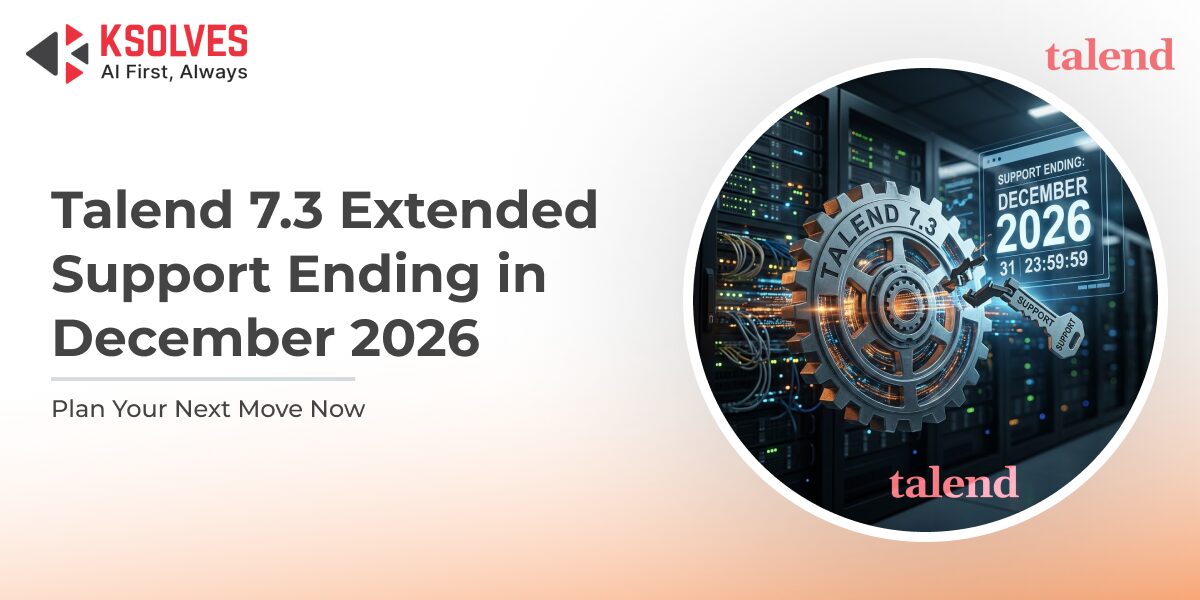
How much migration time do you actually have left? If your organization is still running Talend 7.3.1, the answer depends on what you think “extended support” means. That program, the last one available, runs through December 2026, but it only covers Severity 1 production-blocking issues, excludes fixes for unsupported third-party components, and cannot be renewed. Talend 7.3.1 reached end-of-life in November 2024. Talend 8 now requires Java 17, and Qlik has announced that Studio 2026-06 will move to Java 21. Every month of delay compresses your testing window and increases cutover risk. This guide covers the timeline, the real technical work involved, and the three paths forward.
Talend 7.3 End-of-Support Timeline Explained
Qlik defines three distinct lifecycle phases for Talend 7.3.1. Understanding each one clarifies exactly what your organization has already lost – and what little remains.
- Retirement (May 2023): Active development ended. Limited bug fixes continued, but no new features. This was the point at which organizations should have started evaluating upgrade paths.
- End-of-Life (November 30, 2024): Standard technical support ended. Talend 8.0 became the only fully maintained version. Any organization that had not purchased extended support lost all vendor recourse on this date.
- Limited Extended Support (Through December 2026): A separately purchasable program that gives customers additional migration time beyond the November 2024 end-of-life date. It covers only Severity 1 production-blocking issues and does not include fixes for unsupported third-party components. Qlik’s official lifecycle page confirms extended support is available through December 2026. After that date, there is no successor program and no further extension.
| Talend 7.3 Lifecycle at a Glance | |
| Lifecycle Phase | Date / Detail |
| Original Release | February 2020 |
| Retired | May 2023 – no new features from this point |
| End-of-Life | November 30, 2024 – standard support ended |
| Extended Support Round 1 | Through December 31, 2025 (Severity 1 only, purchased separately) |
| Extended Support Round 2 | Through December 2026 (final window, purchased separately) |
| After December 2026 | No patches, no fixes, no vendor support of any kind |
| Qlik Talend Cloud Compatibility | Requires Talend 8. Talend 7.3.1 is not compatible |
| Free Talend 8 License | Included with every active subscription at no extra cost |
What happens when Talend 7.3 support ends?
Operating a data integration platform on an unsupported version is not simply a vendor relations problem. The key question is what happens when Talend 7.3 support ends? It creates four concrete, measurable risks that directly affect your operations, finances, and legal standing.
- Unpatched Security Vulnerabilities
The final patch cycles of Talend 7.3.1 resolved a significant backlog of critical CVEs, including CVE-2023-46604 in Apache ActiveMQ, CVE-2022-40664 and CVE-2022-32532 in Apache Shiro, CVE-2023-26049 and CVE-2023-26048 in Jetty HTTP, and CVE-2023-20863 and CVE-2023-20861 in Spring Expression. After December 2026, new vulnerabilities discovered in these same underlying components will receive no patches from Qlik. Your data pipelines will become an increasingly exploitable target with no vendor remediation path available.
- Regulatory and Compliance Exposure
GDPR, HIPAA, SOC 2 Type II, and ISO 27001 all carry explicit requirements around actively maintained software in data processing environments. An audit finding that your ETL infrastructure runs on an unsupported, unpatched version is a material compliance gap. Depending on your industry, this can result in regulatory fines, failed certifications, and contractual breaches with enterprise customers who require evidence of current software maintenance.
- Connector Drift and Integration Failures
Talend 7.3 was designed for the technology landscape of 2020. Cloud storage APIs, database drivers, message queue protocols, and SaaS connector schemas have all evolved since then. As the platforms your pipelines connect to release updates, Talend 7.3 connectors will progressively lose compatibility, with no official resolution path available after December 2026.
- Complete Loss of Vendor Support
After December 2026, any critical failure in your Talend 7.3 production environment must be diagnosed and resolved entirely by your internal team. There is no support ticket queue, no hotfix release process, and no escalation path to Qlik engineers, regardless of severity.
Your Three Talend 7.3 Migration Options
There is no single correct path forward. The right migration strategy depends on your pipeline complexity, technical team depth, cloud maturity, and budget.
- Option 1: Upgrade to Talend 8 On-Premises
The most direct transition for organizations satisfied with the Talend platform. Talend 8 introduces a modular Studio installation, monthly in-Studio updates, and a built-in migration utility that handles certain breaking changes automatically. Every active Talend subscription is entitled to a Talend 8 license at no additional cost. Request it through the Qlik Customer Support portal if you have not already received one.
Key technical requirements to plan for: Java 17 (mandatory from the 2024-05 Studio release onward), Talend CI Builder 8.0.27 or above, Maven 3.6.3 or higher, and a full Talend Runtime reinstallation (no in-place upgrade path on major LTS versions). Important: Qlik has announced that Talend Studio 2026-06 will require Java 21 to launch – any migration plan targeting a post-June 2026 go-live must account for this additional step. A TAC database export and reimport on the new infrastructure is also required before cutover.
- Option 2: Move to Qlik Talend Cloud
For organizations ready to eliminate on-premises infrastructure management entirely. Qlik Talend Cloud is a fully managed, cloud-native integration environment that offloads patching and scaling to Qlik. One important prerequisite: Qlik Talend Cloud requires Talend 8. Organizations choosing this route are effectively executing two sequential migrations – from Talend 7.3 to Talend 8, then from Talend 8 to the cloud. Planning your timeline accordingly will prevent deadline compression.
- Option 3: Migrate to a Modern Alternative Platform
Some organizations use the December 2026 deadline as a strategic trigger to re-evaluate their entire data integration architecture. For real-time streaming and event-driven pipelines, Apache Kafka or Apache Flink are strong architectural fits. For large-scale batch processing in cloud environments, Azure Data Factory or Apache Spark-based pipelines may align better with existing infrastructure investments. Apache NiFi is well-suited to complex data routing and flow management workloads. This option carries the highest upfront complexity but also the greatest long-term architectural flexibility.
In case you are planning for Talend to NiFi migration, Ksolves experts can help you.
Key Technical Challenges to Plan For
Regardless of migration path, the following areas consistently require the most planning and testing effort:
- Job and component compatibility: Components deprecated, renamed, or restructured between Talend 7.3 and 8 must be individually reviewed and validated.
- Runtime reinstallation: Talend Runtime cannot be upgraded in place on a major LTS version change. All configurations, bundle installations, and deployed service definitions must be catalogued and migrated to the new runtime.
- Java and build toolchain: Talend Studio 8 has required Java 17 since the 2024-05 release – a significant jump from the Java 8 and Java 11 environments common in Talend 7.3.1 deployments. CI/CD pipelines must use Talend CI Builder 8.0.27 or above and Maven 3.6.3 or higher. Additionally, Qlik has announced that Talend Studio 2026-06 will move to Java 21 – teams targeting a post-June 2026 go-live should plan for this extra step.
- TAC database migration: The Talend Administration Center database must be exported, restored on the new infrastructure, and reconnected through the TAC web interface before the upgraded system is operational.
- Git and CI/CD validation: All repository structures, branch configurations, and deployment triggers must be verified in the Talend 8 environment before decommissioning Talend 7.3.
A phased migration approach is strongly recommended: audit all pipelines first, stand up a parallel Talend 8 test environment, migrate workloads in prioritized batches, validate each batch rigorously, and decommission Talend 7.3 only once every pipeline is confirmed at full parity in production.
How Ksolves Can Help?
Ksolves is an IT services company with over a decade of experience in data engineering. Our Big Data team holds deep expertise across Talend, Apache Kafka, Apache Spark, Apache NiFi, and Snowflake, and has guided organizations through migrations of every scale. We also help businesses understand and mitigate the risks of running Talend 7.3 after support ends, including security vulnerabilities, compliance challenges, and a lack of vendor support. We offer end-to-end migration services across four key areas:
- Pipeline and environment audit: Systematic inventory of your Talend 7.3 jobs, routes, and metadata configurations to identify risk before any work begins
- Migration roadmap and timeline planning: A phased plan mapped to your organizational deadlines, keeping production pipelines running throughout
- Upgrade execution: Full technical migration including TAC database migration, Runtime reinstallation, Java 17 configuration, and job validation
- Post-migration monitoring: 24×7 Big Data monitoring after go-live for performance tuning and incident response
Start Planning Your Talend Migration Today
Qlik has been signalling the end of Talend 7.3 since its retirement in May 2023. Talend 7.3 extended support end date 2026 deadline is the final point on that timeline. After it passes, security vulnerabilities will accumulate, compliance gaps will widen, and connector failures will multiply – with no vendor assistance of any kind.
A structured, phased Talend 7.3 migration is fully achievable before December 2026 if planning begins today. Contact the Ksolves Big Data team to schedule your initial assessment and get a Talend migration plan built around your timeline and budget.
Frequently Asked Questions
What exactly happens when Talend 7.3 extended support ends in December 2026?
After December 2026, Qlik provides zero support—no patches, no bug fixes, and no security updates. All production issues must be handled entirely by your internal team.
Is Talend 7.3 compatible with Qlik Talend Cloud?
No. Qlik Talend Cloud is only compatible with Talend 8. There is no cloud option for Talend 7.3.1.
What is the difference between end-of-life and extended support?
End-of-life (November 30, 2024) ended all regular maintenance. Extended support is a paid add-on covering only Severity 1 issues, available through December 2026.
Do I need to purchase a new Talend 8 license to upgrade?
No. Every active Talend subscription includes a Talend 8 license at no extra cost. You can request it through the Qlik Customer Support portal.
How long does a Talend 7.3 to Talend 8 migration typically take?
Small environments usually migrate in 4–8 weeks. Large enterprise setups with many custom jobs and CI/CD pipelines can take 3–6 months, including testing.
What is the risk of staying on Talend 7.3 past December 2026?
Unpatched CVEs will build up with no fixes, connector compatibility will degrade, compliance audits may flag the unsupported version, and any production failure must be resolved without vendor support.






























Author
About the Author Editorial Team The Ksolves Editorial Team includes certified Salesforce experts, Big Data engineers, AI/ML specialists, Zoho consultants, and experienced technology writers focused on delivering clear, actionable insights for modern businesses. With hands-on experience across Salesforce, Big Data platforms, AI/ML solutions, application development, software testing, and Zoho ERP/CRM, the team publishes practical guides, real-world use cases, and industry updates that support smarter decisions and faster growth. Every article is created to solve business challenges, guide technology adoption, and keep organizations aligned with evolving digital ecosystems.
Share with