



How Kubernetes Improves Application Reliability and Uptime
Kubernetes
5 MIN READ
April 27, 2026

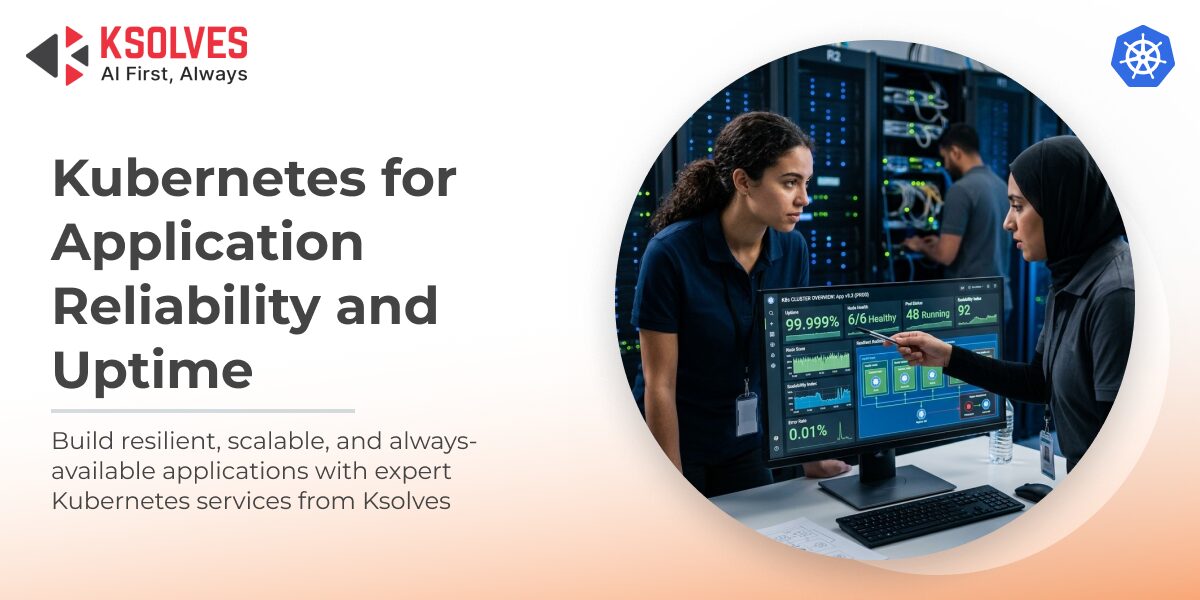
In an era where even minutes of downtime can lead to significant revenue loss, customer frustration, and brand damage, application reliability and uptime have become critical success factors for any digital business. Studies consistently show that high-availability applications drive better user retention and higher satisfaction. This is where Kubernetes (often abbreviated as K8s) shines as the industry-standard container orchestration platform. It automates the deployment, scaling, and management of containerized applications, turning potentially fragile systems into highly resilient ones.
As a provider of professional Kubernetes services, we’ve helped numerous organizations achieve near-perfect uptime while simplifying operations. In this comprehensive guide, we’ll dive deep into the many ways Kubernetes enhances application reliability and uptime, backed by real-world mechanisms and benefits.
1. Self-Healing Capabilities: Automatic Detection and Recovery
Kubernetes is designed with failure in mind, offering powerful self-healing features that minimize human intervention.
- Health Probes and Automatic Restarts: Liveness probes check if a container is running correctly, while readiness probes determine if it’s ready to serve traffic. If a probe fails, Kubernetes automatically restarts the pod or removes it from service.
- ReplicaSets and Controllers: By defining a desired number of replicas, Kubernetes ensures that if a pod crashes due to bugs, memory leaks, or transient errors, it’s immediately replaced. This keeps your application at full capacity without manual fixes.
- Node-Level Resilience: When a worker node fails or becomes unreachable, the kubelet and control plane detect it and evict pods, rescheduling them on healthy nodes. Features like pod disruption budgets further protect critical workloads during node maintenance.
These mechanisms drastically reduce mean time to recovery (MTTR), often resolving issues in seconds rather than hours.
Also Read – How a Telecom Provider Streamlined Kubernetes Deployment with an End-to-End Management Platform
2. Intelligent Autoscaling: Adapting to Demand in Real Time
Traffic isn’t constant; spikes from marketing campaigns, viral events, or seasonal trends can overwhelm traditional setups. Kubernetes handles this gracefully.
- Horizontal Pod Autoscaler (HPA): Automatically scales the number of pods based on CPU, memory, or custom metrics (e.g., requests per second via Prometheus).
- Vertical Pod Autoscaler (VPA): Adjusts resource requests and limits for individual pods, optimizing usage without over-provisioning.
- Cluster Autoscaler: Scales the underlying cluster nodes up or down based on workload needs, ensuring resources are available when required.
This multi-layered scaling prevents overload-induced crashes while optimizing costs, helping organizations maintain 99.99%+ uptime even during unpredictable traffic surges.
Also Read – How Kubernetes Master Setup on AWS Ensures High Availability & Resilience
3. Zero-Downtime Deployments and Safe Rollbacks
Deploying new features or fixes shouldn’t mean taking your application offline. Kubernetes makes continuous delivery reliable.
- Rolling Updates: Gradually replace old pods with new ones, monitoring health at each step. MaxSurge and MaxUnavailable parameters give fine control over how much disruption (if any) occurs.
- Canary and Blue-Green Deployments: Using tools like Istio or Flagger on top of Kubernetes, you can route a small percentage of traffic to new versions, catching issues early.
- Instant Rollbacks: If a deployment fails validation or causes errors, a single command rolls back to the previous stable revision, restoring service immediately.
Many of our clients have reduced deployment-related incidents by 90% after adopting Kubernetes-native CI/CD practices.
Also Read – Kubernetes for Healthcare – Enabling Secure, Scalable, and Compliant Digital Care
4. Robust Resource Management and Isolation
Resource contention is a silent killer of reliability. Kubernetes provides sophisticated controls to prevent it.
- Title Resource Requests and Limits subtitle : Guarantee minimum resources while capping maximum usage, preventing one application from starving others.
- LimitRanges and ResourceQuotas: Enforce policies at the namespace or cluster level, ensuring fair distribution and preventing exhaustion.
- Pod Priority and Preemption: Critical workloads get precedence over less important ones during resource shortages.
- Topology-Aware Scheduling: Spread pods across availability zones or nodes to avoid correlated failures.
These features create a predictable, stable environment where applications perform consistently under load.
Also Read – How Kubernetes Transforms Live Streaming Performance
5. Declarative Configuration and GitOps Integration
Human error during manual configuration changes is a leading cause of outages. Kubernetes shifts to a declarative model:
- Everything as code: Define your desired state in YAML manifests stored in Git.
- Reconciliation Loop: The control plane continuously compares actual vs. desired state and corrects drifts automatically.
- GitOps Tools (ArgoCD, Flux): Automatically apply changes from Git, providing audit trails and easy reversions.
This approach eliminates configuration drift, reduces operator errors, and enables faster, safer recoveries, key to long-term reliability.
Also Read – Cloud to On-Premises Kubernetes: Top Reasons, Challenges, & Best Practices
6. Advanced Networking and Service Discovery
Reliable communication between services is essential for distributed applications.
- Built-in Service Abstraction: Kubernetes Services provide stable IPs and DNS names, load-balancing traffic across pods even as they scale or move.
- Network Policies: Enforce micro-segmentation, allowing only necessary traffic and reducing the impact of compromises or misconfigurations.
- Service Mesh Integration (Istio, Linkerd): Adds observability, retry logic, circuit breakers, and fault injection, further enhancing resilience.
By handling networking complexities automatically, Kubernetes ensures services remain reachable and responsive.
Also Read – How Ksolves Built a Modern Kubernetes Platform to Strengthen Reliability and Speed for a Fintech Company
7. Comprehensive Observability and Proactive Monitoring
You can’t fix what you can’t see. Kubernetes integrates seamlessly with modern observability stacks.
- Metrics via Metrics Server and Prometheus: Expose detailed resource and application metrics.
- Logging with Fluentd/Fluent Bit or Loki: Centralized logs for troubleshooting.
- Tracing with Jaeger or OpenTelemetry: Understand request flows across microservices.
- Alerting and Dashboards: Tools like Grafana provide real-time visibility, enabling proactive intervention before issues affect users.
Many organizations achieve sub-minute detection and resolution times with these integrations.
Also Read – Optimizing Spark Performance On Kubernetes
8. Multi-Cloud and Hybrid Resilience
Locking into a single provider increases risk. Kubernetes is cloud-agnostic and portable.
- Run the same workloads on AWS (EKS), Azure (AKS), Google Cloud (GKE), or on-premises (via OpenShift, Tanzu, or vanilla K8s).
- Disaster recovery becomes simpler—replicate configurations across regions or clouds.
- Tools like Velero enable cluster backups and restores, ensuring business continuity.
This flexibility protects against provider outages and geopolitical risks.
Conclusion: Build Antifragile Applications with Kubernetes
Kubernetes transforms application management from a reactive firefighting exercise into a proactive, automated discipline. Its combination of self-healing, intelligent scaling, safe deployments, resource controls, declarative operations, robust networking, observability, and portability delivers unprecedented levels of reliability and uptime.
At our company, we offer end-to-end Kubernetes services from architecture design and cluster setup to migration, optimization, 24/7 managed operations, and custom GitOps implementations. We’ve helped clients across industries achieve five-nines availability while reducing operational overhead.
Ready to make downtime a thing of the past?
Contact us today for a no-obligation assessment of your current setup and a tailored roadmap to Kubernetes-powered resilience. Your applications and your users deserve nothing less.































AUTHOR
Kubernetes
Share with