



The Hidden Costs of Microservices Architecture: How Ksolves Uses AI to Drive Efficiency and Control
Microservices
5 MIN READ
May 4, 2026


Microservices architecture has become a standard approach for building modern, scalable applications. Organizations have widely adopted it to improve agility, enable independent deployments, and support cloud-native transformation.
However, as systems scale, microservices often introduce challenges that are not immediately visible during adoption. These challenges are not failures of the architecture itself but a result of increased distribution, operational overhead, and system complexity.
This blog explores the real-world costs of microservices architecture and how AI-driven engineering practices adopted by Ksolves can help organizations improve efficiency, observability, and control across distributed systems.
Why Microservices Became the Standard Architecture
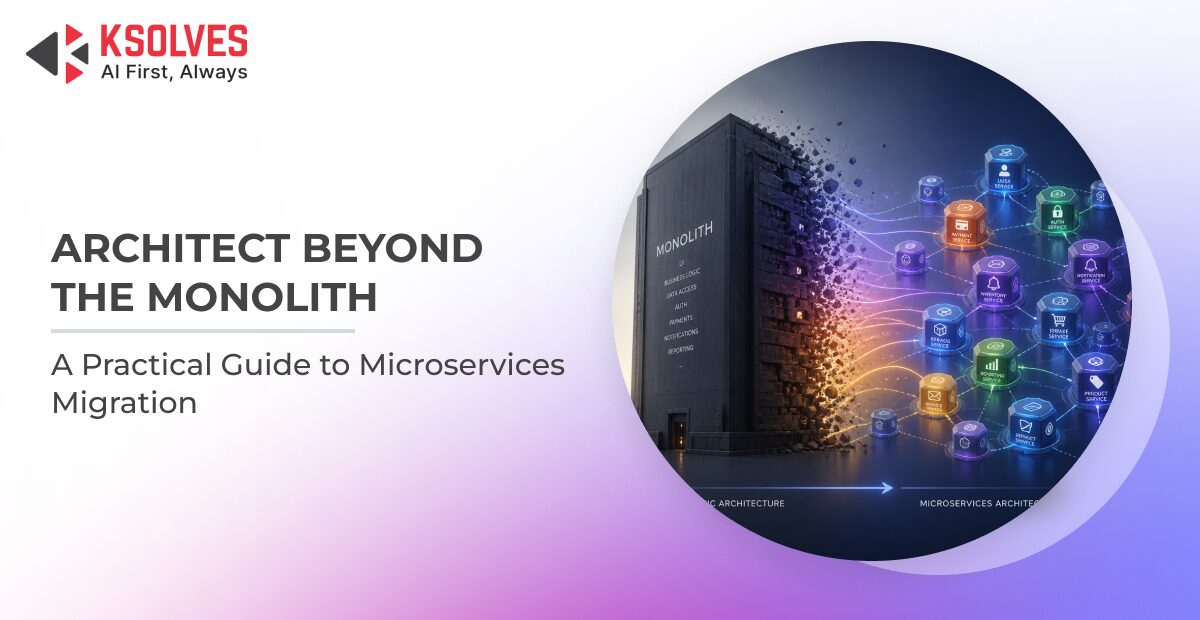
Microservices architecture emerged as a natural evolution from the constraints of monolithic systems. In traditional monolithic applications, all functionalities are tightly coupled within a single codebase, which often leads to challenges in scaling individual components, slower release cycles, and increased complexity in maintaining or updating the system without impacting the entire application.
Microservices address these limitations by decomposing applications into smaller, independent services, each responsible for a specific business capability. This structural shift enables:
- Independent deployment of services without affecting the entire system.
- Horizontal scaling of individual components based on demand.
- Flexibility to use different technologies or frameworks for different services.
- Faster and more iterative development cycles through parallel team ownership.
This modular approach aligns closely with modern DevOps practices and cloud-native ecosystems such as Kubernetes, where containerization, orchestration, and automated deployments are foundational. As a result, microservices have become a preferred architectural choice for enterprises aiming to build scalable, resilient, and continuously evolving digital systems.
Also Read: Monolithic vs Microservices: What’s the Major Difference?
The Hidden Costs of Microservices Architecture
While microservices effectively address scalability, flexibility, and faster delivery, they also introduce operational and architectural challenges that become increasingly significant as systems grow in size and complexity.
1. Operational Complexity Increases Significantly
In monolithic architectures, components operate within a single codebase and runtime environment, making system behavior relatively straightforward to manage. In contrast, microservices distribute functionality across multiple independently deployable services, each with its own lifecycle.
This shift introduces several operational challenges:
- Managing communication between multiple services over the network.
- Handling distributed configuration management across environments.
- Ensuring reliable service discovery and routing mechanisms.
- Coordinating deployments across interdependent services.
As the number of services increases, operational complexity grows disproportionately. Without strong governance, standardization, and automation, maintaining consistency across environments becomes increasingly difficult.
2. Observability Becomes a Core Engineering Requirement
In distributed systems, a single user request may traverse multiple services before completing. As a result, failures are rarely isolated and often span multiple layers of the architecture.
This creates significant challenges in:
- End-to-end request tracing across services.
- Centralized aggregation and analysis of logs.
- Real-time monitoring of system health across distributed components.
- Accurate root cause analysis in complex failure scenarios.
Without a mature observability strategy that combines logs, metrics, and distributed tracing, debugging becomes time-consuming and inefficient, directly impacting system reliability and user experience.
Common tools such as Prometheus, Grafana, OpenTelemetry, and ELK stacks help address these challenges, but they require careful integration, standardization, and ongoing operational governance to be effective at scale.
3. Infrastructure and Cloud Costs Can Escalate
Microservices are commonly deployed using container orchestration platforms like Kubernetes, which enable elastic scaling and high availability. However, without proper optimization, these environments can lead to inefficient resource utilization.
Typical cost drivers include:
- Over-provisioned compute resources across clusters.
- Idle or underutilized containers running continuously.
- Inefficient autoscaling configurations.
- Increased network overhead due to frequent inter-service communication.
In large-scale distributed systems, these inefficiencies compound over time, leading to higher-than-expected cloud infrastructure costs if not continuously monitored and optimized.
Also Read – Cost Benefits of OpenShift for Enterprises: How Ksolves’ AI-Led Approach Maximizes ROI and Reduces Spend
4. Security Complexity Expands Across Distributed Systems
Each microservice increases the overall attack surface of the application. Unlike monolithic systems, where security boundaries are more centralized, microservices require security to be enforced at multiple levels.
Key security challenges include:
- Managing authentication and authorization across distributed services.
- Securing service-to-service communication channels.
- Safely handling secrets, tokens, and configuration data.
- Maintaining compliance across multiple independent services.
To address these concerns, organizations often adopt zero-trust security models and service mesh technologies such as Istio. While effective, these solutions introduce additional configuration complexity and operational overhead.
5. CI/CD Pipelines Become More Complex
Microservices enable independent deployment cycles, which improves development velocity. However, this also introduces significant complexity in build and release management.
Common challenges include:
- Managing dependencies between independently deployed services.
- Designing robust integration and contract testing strategies.
- Handling version compatibility across multiple services.
- Coordinating rollback strategies during multi-service failures.
Without mature CI/CD automation and governance, release processes can become fragmented, increasing the risk of deployment failures and inconsistencies across environments.
6. Skill Requirements and Cross-Team Coordination Increase
Microservices architectures demand a broader and deeper skill set compared to monolithic systems. Teams are expected to be proficient in multiple domains, including:
- Container orchestration platforms such as Kubernetes.
- Distributed system design principles.
- DevOps practices and CI/CD automation pipelines.
- Observability and monitoring frameworks.
In addition to technical skills, effective coordination between multiple teams becomes essential. Each team often owns one or more services, and without strong communication and alignment practices, development velocity can slow down despite architectural flexibility.
Also Read: Top 10 Benefits of Microservices: How Modern Architecture Boosts Business Agility
How Ksolves Uses AI to Improve Microservices Efficiency and Control
Ksolves, an AI-first microservices development company, combines deep expertise in microservices architecture with AI-driven engineering practices to address the core challenges of distributed systems. These challenges include operational complexity, limited observability, rising infrastructure costs, and governance gaps.
Instead of treating AI as an add-on, the approach integrates intelligence into key stages of the microservices lifecycle to improve decision-making, automation, and system visibility. The goal is not to replace microservices, but to make them easier to operate, scale, and optimize in real-world enterprise environments.
1. AI-Assisted Architecture Assessment and Planning
Before building or modernizing a microservices ecosystem, architectural decisions play a critical role in long-term stability and performance. AI-assisted analysis helps engineers make data-informed design choices.
Key capabilities include:
- Mapping service dependencies across existing systems.
- Identifying performance bottlenecks and tightly coupled components.
- Recommending optimal service boundaries for decomposition.
- Analyzing workload distribution and traffic patterns.
Business value:
- Reduces architectural rework during later stages.
- Improves service granularity decisions.
- Supports scalable and maintainable system design from the start.
2. Intelligent Observability and Anomaly Detection
Microservices generate large volumes of logs, metrics, and traces across distributed components. Manually analyzing this data becomes impractical at scale.
AI-driven observability enhances system monitoring by:
- Detecting anomalies in logs, metrics, and traces in real time.
- Correlating events across multiple services to identify root causes.
- Filtering and prioritizing alerts to reduce noise and alert fatigue.
- Identifying early warning signals before failures impact users.
Business value:
- Faster incident detection and resolution.
- Improved system uptime and reliability.
- Reduced dependency on manual debugging processes.
3. AI-Driven Resource Optimization and Cost Control
In containerized environments such as Kubernetes, resource allocation directly impacts both performance and cost efficiency. Without optimization, systems often suffer from over-provisioning or inefficient scaling.
AI-based optimization helps by:
- Forecasting workload demand based on historical usage patterns.
- Fine-tuning autoscaling policies for better efficiency.
- Identifying underutilized compute and storage resources.
- Recommending cost-optimized infrastructure configurations.
Business value:
- Lower cloud infrastructure costs.
- Improved resource utilization efficiency.
- Better alignment between performance and spending.
Also Read – Leveraging AI/ML Workloads on OpenShift: Building the Intelligent Enterprise
4. AI-Enhanced Security Monitoring and Risk Detection
Security in microservices is distributed across multiple services, APIs, and communication layers. This increases the need for continuous, real-time monitoring.
AI-assisted security analysis strengthens system protection by:
- Detecting abnormal API behavior and access patterns.
- Identifying potential misconfigurations across services.
- Highlighting unusual authentication or authorization activity.
- Supporting continuous vulnerability detection across the system.
Business value:
- Stronger security posture across distributed systems.
- Faster detection of potential threats or misconfigurations.
- Improved compliance readiness through continuous monitoring.
5. Smarter CI/CD and Deployment Optimization
Microservices environments rely on independent deployment pipelines for each service, which increases release flexibility but also introduces complexity.
AI-driven optimization enhances CI/CD workflows by:
- Predicting potential deployment failures before execution.
- Detecting integration conflicts between services early in the pipeline.
- Optimizing test coverage based on risk and impact analysis.
- Reducing rollback frequency through pre-deployment validation.
Business value:
- More stable and predictable release cycles.
- Reduced deployment failures and production issues.
- Faster and safer delivery of new features.
Final Words
Microservices offer clear advantages in scalability, flexibility, and faster delivery, but their complexity increases significantly as systems expand. Without the right operational strategy, challenges such as rising costs, limited visibility, and deployment inefficiencies can outweigh the benefits.
The key to sustainable microservices adoption lies in combining architecture with intelligence, bringing automation, observability, and optimization together to manage distributed systems effectively.
Ksolves, an AI-first microservices development company, enables this balance by integrating AI-driven capabilities into microservices environments, helping organizations improve performance, reduce operational overhead, and maintain better control at scale.
Looking to reduce microservices complexity and improve system efficiency? Partner with Ksolves!
































AUTHOR
Microservices
Share with