



AI Agents in RAG Chatbots: Role and Implementations
AI
5 MIN READ
May 12, 2026

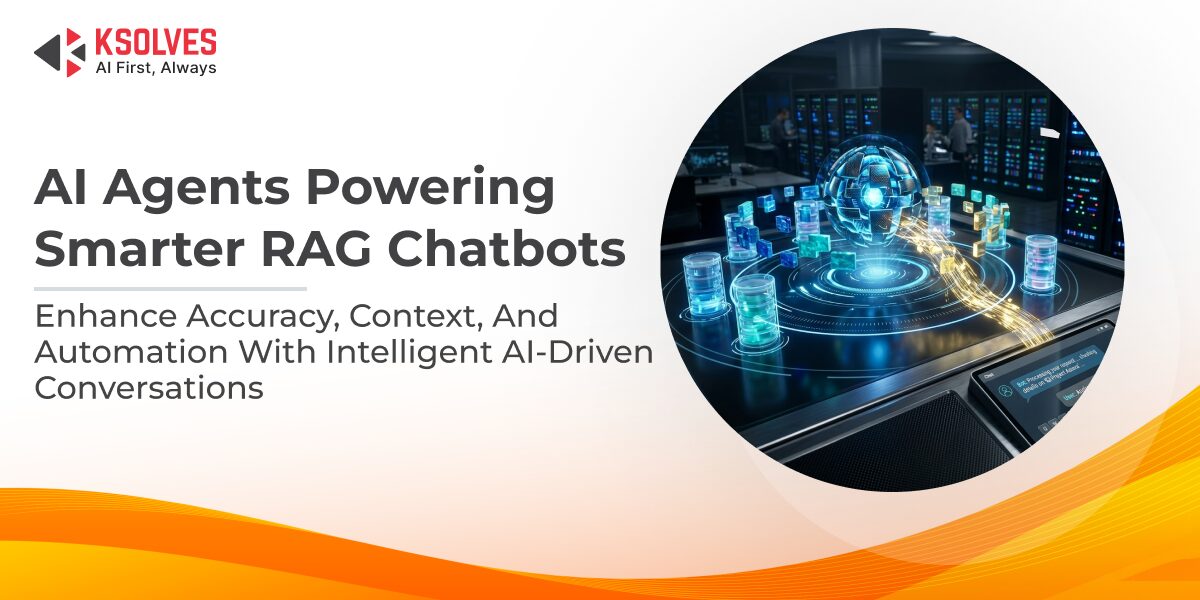
Artificial Intelligence (AI) has revolutionized the way businesses interact with customers, and chatbots are among the most visible examples of this transformation. The emergence of Retrieval-Augmented Generation (RAG) chatbots has further redefined conversational AI, allowing systems to combine the best of information retrieval and generative models. Within this setup, AI agents play a crucial role in enhancing reasoning, contextual understanding, and real-time adaptability.
In this blog, we’ll explore the role of AI agents in RAG chatbots, their implementations, and how businesses can leverage them to create next-gen conversational experiences.
Understanding RAG Chatbots
Traditional chatbots rely on either retrieval-based or generative approaches. Retrieval bots fetch predefined responses from a database, while generative bots generate new responses using machine learning models such as GPT or LLaMA.
RAG (Retrieval-Augmented Generation) combines both using retrieval mechanisms to fetch relevant data and generative models to produce natural, contextually appropriate answers. According to a Cambridge University study, RAG models reduce the chance of hallucinations by up to 30% by filling in knowledge gaps just in time. This hybrid approach ensures factual accuracy, real-time access to information, and human-like communication.
For example, a customer support RAG chatbot can retrieve product details from a company’s database and then generate a coherent, conversational response tailored to the user’s query.
What Are AI Agents?
AI agents are intelligent entities capable of perceiving their environment, reasoning about it, and taking autonomous actions to achieve specific goals. In the context of RAG chatbots, these agents don’t just generate responses but also decide how to retrieve, process, and deliver information efficiently.
AI agents can include components like:
- Retrieval agents for fetching domain-specific information.
- Context agents for managing conversation flow and memory.
- Task agents for executing actions like booking, summarizing, or analyzing data.
- Evaluation agents for validating or refining the chatbot’s outputs.
Essentially, AI agents make RAG chatbots more dynamic, multi-functional, and self-improving.
The Role of AI Agents in RAG Chatbots
AI agents act as the cognitive layer that orchestrates different tasks within the RAG pipeline. Let’s examine how they contribute at various stages:
1. Intelligent Information Retrieval
RAG chatbots rely on external knowledge bases, documents, or APIs for factual data. AI agents enhance this process by:
- Selecting the most relevant data sources dynamically.
- Performing semantic search using vector embeddings.
- Filtering out redundant or outdated information.
This ensures that responses are accurate, up-to-date, and contextually meaningful.
2. Context Management and Memory
With agent-based memory or session storage, RAG systems can maintain conversational context over time. This enables retention of user preferences, past interactions, and prior queries to deliver more personalized and relevant responses.
For instance, in an HR chatbot, an AI agent can recall an employee’s previous leave requests or policy queries, ensuring continuity in the conversation.
3. Adaptive Reasoning and Decision-Making
AI agents use reasoning mechanisms (like ReAct or Chain-of-Thought models) to decide whether to generate a response, fetch new data, or trigger an external action. This makes RAG chatbots more autonomous and capable of solving complex, multi-step tasks, such as generating a report summary from a live database.
4. Response Validation and Improvement
Agents can act as internal reviewers, evaluating the chatbot’s generated responses for factual accuracy and tone. By cross-checking data against retrieved information, AI agents reduce hallucinations, a common issue in generative models.
5. Real-Time Task Automation
Through agentic workflows, chatbots can perform tasks such as scheduling, updating CRM entries, or analyzing documents. For example, a financial assistant chatbot can use agents to fetch portfolio data, interpret it, and suggest next actions, all in a conversational interface.
Also Read: Chatbots in Different Industries: Powering the Next Wave of Digital Transformation
Implementations of AI Agents in RAG Chatbots
AI agents can be implemented across industries depending on the chatbot’s purpose and complexity. Some practical examples include:
1. Customer Support Chatbots
In e-commerce, AI agents help RAG chatbots fetch order details, process refunds, and answer product-related queries. They dynamically retrieve information from ERP or CRM systems and generate personalized responses.
2. Healthcare Assistants
AI agents enable RAG chatbots to interpret medical data, retrieve insights, and provide symptom-related guidance while ensuring HIPAA compliance without replacing professional medical advice.
3. Banking and Finance Bots
These chatbots use agents to fetch transaction histories, calculate loan eligibility, and detect anomalies in spending patterns, all with secure access to backend systems.
4. Enterprise Knowledge Management
RAG chatbots equipped with AI agents can help employees search across vast internal documentation. Agents prioritize recent, reliable, and role-specific data to deliver precise answers, boosting workplace productivity.
5. Education and E-Learning Platforms
AI agents in RAG chatbots can provide personalized tutoring by retrieving content from multiple educational resources and generating adaptive learning pathways for students.
Building Intelligent Chatbots with Ksolves
Developing a RAG chatbot integrated with AI agents requires deep expertise in NLP, vector databases, prompt engineering, and orchestration frameworks like LangChain or LlamaIndex. That’s where expert partners like Ksolves can help.
With years of experience in AI and ML services, Ksolves builds AI-driven conversational solutions tailored to your business processes. From integrating RAG architecture to deploying multi-agent workflows, our developers ensure scalability, security, and superior user experience.
Whether you need a customer support bot, an enterprise assistant, or a domain-specific chatbot, we can help you design intelligent conversational systems that deliver measurable ROI. Contact our AI experts today, or you can even send us your query at [email protected].
Conclusion
AI agents have emerged as the backbone of modern RAG chatbots, bridging the gap between data retrieval and intelligent response generation. Their ability to reason, adapt, and learn makes them invaluable for delivering contextually rich, accurate, and human-like interactions. As enterprises embrace AI-driven transformation, combining RAG models with agentic intelligence will redefine digital engagement. Moreover, partnering with experts like Ksolves for cutting-edge AI and ML services ensures scalable, secure, and high-performing chatbot ecosystems that drive long-term business success.

































AUTHOR
AI
Mayank Shukla, a seasoned Technical Project Manager at Ksolves with 8+ years of experience, specializes in AI/ML and Generative AI technologies. With a robust foundation in software development, he leads innovative projects that redefine technology solutions, blending expertise in AI to create scalable, user-focused products.
Share with