



How Agentic AI is Transforming Proactive Patient Care Coordination in Healthcare
AI
5 MIN READ
May 6, 2026

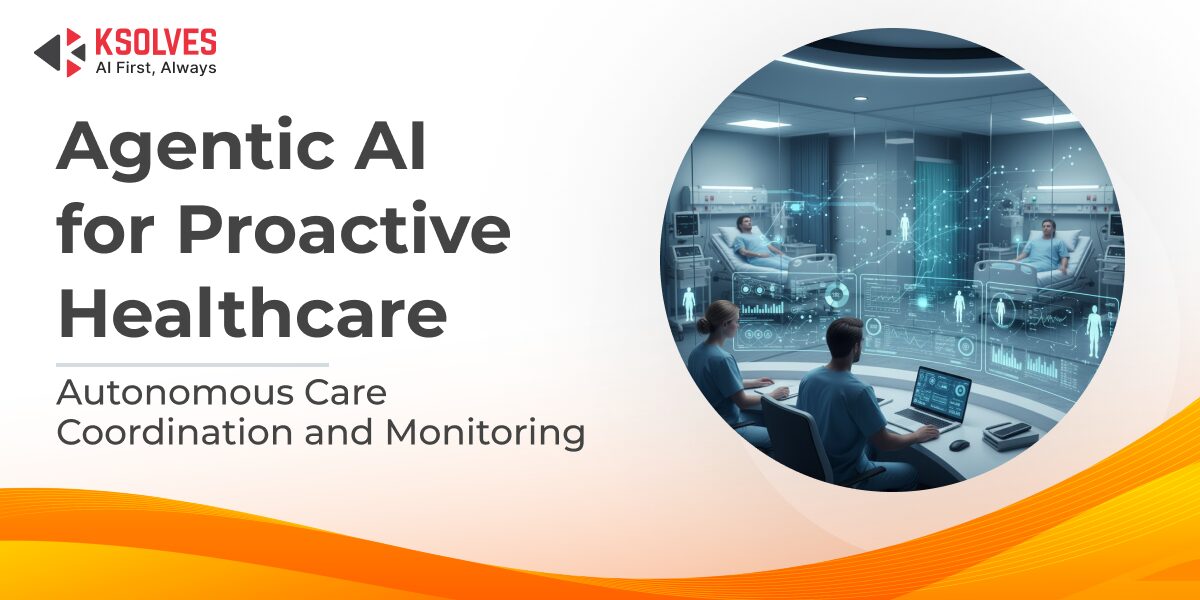
The healthcare industry continues to grapple with fragmented care delivery. Patients managing chronic conditions frequently navigate multiple providers, leading to disjointed data, delayed interventions, communication gaps, and elevated readmission rates. Traditional care coordination relies on manual processes that are labor-intensive, error-prone, and constrained by availability. Agentic AI represents a fundamental shift by introducing autonomous, goal-oriented intelligence capable of independent reasoning, planning, and action execution.
Unlike generative AI, which responds reactively to prompts, agentic AI operates proactively. It monitors patient data streams in real time, anticipates clinical needs, and initiates multi-step workflows without constant human oversight. These systems integrate electronic health records (EHRs), wearable device data, lab results, imaging, and claims information to deliver intelligent, preventive care coordination. This blog will cover the technical foundations of agentic AI and explain how it enables proactive care coordination.
Understanding Agentic AI: Technical Foundations
Agentic AI systems achieve autonomy through sophisticated architectures:
- Reasoning Engines: Large language models fine-tuned for healthcare (e.g., Med-PaLM 2, Llama 3 variants, or BioGPT) perform clinical reasoning and decision-making.
- Multi-Agent Frameworks: Specialized agents collaborate on tasks, one agent aggregates data via FHIR APIs, another applies predictive models for risk stratification, and a coordinator orchestrates workflow execution.
- Persistent Memory and Tool Integration: Agents maintain context across interactions and use tools to access external resources, including EHR systems (Epic, Cerner), databases, and third-party APIs.
- Planning and Reflection Loops: Agents follow ReAct (Reason + Act) or similar paradigms, observe the current state, reason about optimal actions, execute via tools, reflect on outcomes, and iterate as needed.
- Uncertainty Handling: Probabilistic reasoning and confidence scoring enable safe escalation to human clinicians when confidence falls below predefined thresholds.
Security and compliance features include audit trails, data encryption, differential privacy, and bias detection algorithms to meet HIPAA and GDPR requirements.
How Agentic AI Drives Proactive Care Coordination
Proactive care coordination focuses on preventing complications rather than treating them after onset. Agentic AI achieves this by continuously processing real-time and historical patient data from wearables, EHR updates, remote monitoring devices, and claims systems.
Consider a patient with chronic obstructive pulmonary disease (COPD). An agent monitors oxygen saturation, respiratory rate, and self-reported symptoms. Upon detecting a downward trend:
- The agent analyzes patterns against the patient’s baseline and clinical guidelines (e.g., GOLD 2025 criteria).
- It runs predictive models to estimate exacerbation risk.
- It autonomously schedules a telehealth visit, notifies the primary care team, adjusts medication orders if authorized, and updates the longitudinal care plan.
Multi-agent systems address complex workflows by dividing responsibilities where one agent manages discharge planning, another secures payer authorizations, and a third ensures post-discharge follow-up and adherence monitoring. Integration with FHIR-compliant EHRs ensures seamless, bidirectional data exchange.
In emergency departments, agentic systems monitor hundreds of data points simultaneously to identify early signs of deterioration, such as sepsis, enabling interventions hours before traditional protocols would trigger alerts. This level of autonomy supports 24×7 vigilance, personalized care pathways, and resource optimization.
Real-World Example: Mayo Clinic Laboratories’ AI Transformation in Laboratory Medicine
In October 2025, Mayo Clinic Laboratories highlighted AI’s practical impact on laboratory medicine, including agentic AI as autonomous, collaborative systems that scale expertise, much like human teams. These agents automate complex workflows, such as flow cytometry analysis (reducing hours of manual review to minutes), standardize subjective inspections (e.g., detecting hemolysis or lipemia), and integrate diverse data streams for precision diagnostics.
By automating routine tasks such as data summarization and case triage, agentic AI enables proactive, predictive care by flagging issues early to minimize turnaround times and errors. This empowers laboratorians to focus on patient care, enhancing precision and outcomes amid rising test volumes.
If your healthcare organization wants to implement similar intelligent, proactive patient care coordination using agentic AI, particularly in lab workflows, diagnostics, or multi-agent systems, Ksolves offers expert Agentic AI consulting services. Our team specializes in designing secure, scalable solutions tailored to your needs.
Contact us today to explore how we can help transform your care delivery, or write us your query at [email protected].
Benefits and Challenges of Agentic AI in Care Coordination
Benefits:
- Improved Outcomes: Early detection reduces complications and readmissions.
- Efficiency Gains: Automates administrative tasks, freeing clinicians for high-value care.
- Cost Reduction: Proactive interventions lower hospitalization rates.
- Patient Experience: Personalized, timely engagement increases adherence.
- Scalability: Handles high volumes without proportional staffing increases.
Challenges:
- Data Privacy and Security: Requires robust HIPAA/GDPR compliance.
- Integration with Legacy Systems: Interoperability issues in older EHRs.
- Ethical Concerns: Model bias, overreliance on AI.
- Regulatory Hurdles: FDA approvals for high-risk applications.
- Implementation Costs: Upfront investment in infrastructure and training.
Conclusion
Agentic AI is redefining patient care coordination as an intelligent, proactive ecosystem. By automating complex tasks, predicting risks, and orchestrating seamless workflows, it empowers clinicians, enhances outcomes, and supports value-based care. As 2025 deployments mature, organizations embracing agentic AI will lead in efficiency and patient-centered innovation. The future lies in hybrid human-AI teams that combine machine precision with clinical judgment for better health.































Author
About the Author Editorial Team The Ksolves Editorial Team includes certified Salesforce experts, Big Data engineers, AI/ML specialists, Zoho consultants, and experienced technology writers focused on delivering clear, actionable insights for modern businesses. With hands-on experience across Salesforce, Big Data platforms, AI/ML solutions, application development, software testing, and Zoho ERP/CRM, the team publishes practical guides, real-world use cases, and industry updates that support smarter decisions and faster growth. Every article is created to solve business challenges, guide technology adoption, and keep organizations aligned with evolving digital ecosystems.
Share with