



AI Data Pipeline Strategy: Why Infrastructure Beats Model Selection Every Time
AI
5 MIN READ
May 26, 2026

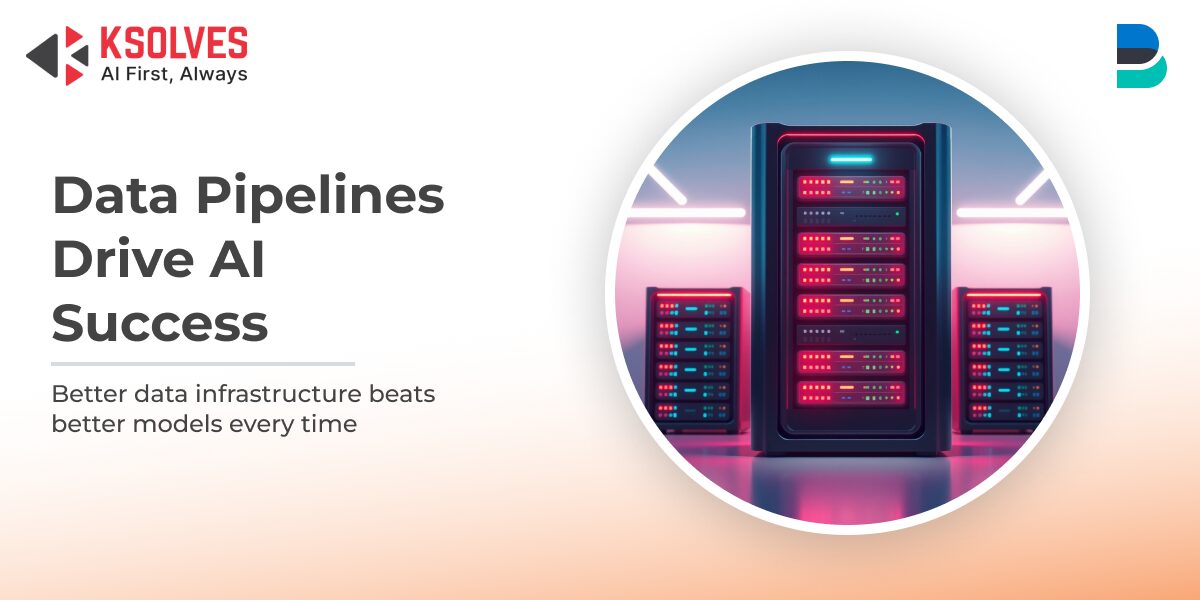
Boardrooms across industries are approving AI budgets at a record pace. The conversations almost always orbit the same question: which model should we use? GPT? Gemini? An open-source alternative? But the enterprises actually generating returns from AI are asking a different question entirely: how strong is the pipeline delivering data to that model?
An AI model without a reliable data pipeline is like a Formula One car running on contaminated fuel. The engine may be world-class, but the output will be unpredictable at best and catastrophic at worst. The real competitive layer in enterprise AI is not the model sitting at the center of the stack. It is the data pipeline above it that feeds it, governs it, and continuously improves it.
This blog examines why that layer matters more than model selection, what separates high-value pipelines from average ones, and what enterprises need to do differently to close the gap.
The Data Readiness Gap Enterprises Cannot Afford to Ignore
The numbers tell a story that most AI vendor conversations actively avoid. A Harvard Business Review Analytic Services survey of 362 global professionals found that 91% agree that having a reliable data foundation is essential to successfully adopt AI, yet only 55% say their organization’s data foundation is actually reliable.
The same study found that only 10% of organizations feel completely ready to adopt AI at an enterprise level. Adding further weight to this, another study predicts that by 2026, organizations will abandon 60% of AI projects unsupported by AI-ready data, with 63% of organizations either lacking or uncertain about whether they have the right data management practices for AI at all.
These organizations are not failing because they chose the wrong model. They are failing because the pipeline beneath the model was never built to support production-grade AI in the first place.
Why the Data Pipeline Is the Real Value Driver
When an AI model produces inconsistent, biased, or unreliable outputs, the instinct is to blame the model. In most enterprise cases, the actual culprit is upstream: stale data, incomplete records, unvalidated schemas, or features that were engineered months ago and never refreshed.
The data pipeline is responsible for everything that happens between raw data and model inference. It determines what data the model sees, how fresh that data is, how clean it is, and how consistently it is structured. A model trained on precise, well-governed, and continuously updated data will outperform a more powerful model trained on fragmented, inconsistent inputs every single time.
This is why companies like Amazon, Netflix, and Uber do not compete solely on model architecture. They compete on data infrastructure. Amazon’s recommendation engine does not win because it uses a superior algorithm. It wins because the pipeline behind it captures behavioral signals in real time and structures them to make model decisions highly accurate and highly contextual. The same principle applies to any enterprise serious about AI ROI.
What Separates a High-Value Pipeline From an Average One
Most enterprise data pipelines were not built for AI. They were built for reporting. Adapting them for model serving requires rethinking several foundational layers.
Freshness of data at inference time is the first dividing line. Batch pipelines that update overnight are acceptable for dashboards. For AI systems making decisions on customers, inventory, or risk in real time, that lag is a structural liability. High-value pipelines use event-driven architectures, such as Apache Kafka or AWS Kinesis, to ensure that model inputs reflect the current state of the business.
Feature consistency across training and serving is where many enterprise pipelines silently fail. A model trained on features computed one way but served features computed slightly differently will degrade in production even if the underlying data quality is fine. Unified feature stores like Feast or Tecton solve this by maintaining a single definition of every feature used by every model, ensuring consistency between training and inference.
Data contracts between producers and consumers prevent the kind of silent schema drift that corrupts model performance without triggering any visible alert. When upstream teams change a field name, remove a column, or alter a data type without notification, downstream models receive inputs they were not trained on. Formal data contracts enforce schema agreements programmatically, catching breaking changes before they reach production.
Pipeline observability closes the loop between data quality and model performance. Without it, teams cannot determine whether a drop in model accuracy is due to a genuine distribution shift or simply to a broken ingestion job upstream. Latency dashboards, anomaly detection on feature distributions, and model drift alerts need to be native to the pipeline, not built as a separate afterthought.
Governance embedded at the architecture level is the final differentiator. Regulatory scrutiny of AI is intensifying in every major market. Pipelines that treat compliance as a bolt-on layer become liabilities as those requirements tighten. Lineage tracking, field-level access controls, and immutable audit logs need to be designed into the pipeline from the start, not retrofitted after a compliance review.
Where Pipeline Quality Shows Up in Business Results
The ROI difference between a strong and a weak pipeline is not theoretical. A logistics company running AI-based demand forecasting saw model accuracy degrade significantly over a 90-day period after launch, not because the model changed, but because a supplier data feed had silently shifted formats. The pipeline had no schema enforcement to catch it.
A financial services firm building a credit risk model found that its model performed well in testing but underperformed in production. The root cause: training data used a clean, deduplicated version of customer records, while serving used a raw feed with duplicates intact. A unified feature store resolved the inconsistency within one sprint.
In both cases, the model was not the problem. The pipeline was. And in both cases, fixing the pipeline was faster, cheaper, and more impactful than retraining the model.
How Ksolves Helps Enterprises Build Pipeline-First AI
Most AI initiatives stall not because of a lack of ambition or the wrong model choice, but because the data infrastructure underneath was never built to support production AI. As a trusted AI/ML consulting partner, Ksolves works with enterprises to design and build production-grade, compliance-ready data pipelines specifically for AI workloads.
From event-driven ingestion and feature store implementation to observability frameworks and governance architecture, Ksolves brings deep technical expertise and practical delivery experience to every engagement. Whether your organization is modernizing a legacy data stack or building a new AI data platform from the ground up, the work begins with getting the pipeline layer right.
Conclusion
Enterprises that keep treating the AI model as the primary lever will continue to see disappointing returns. The organizations pulling ahead are the ones investing in the layer that actually determines what the model can do: the data pipeline above it. Clean data, fresh features, enforced contracts, and governed infrastructure are not supporting concerns. They are the core of any AI strategy built to last. The model is replaceable. A well-architected data pipeline is a durable, competitive asset.
Ready to build an AI data pipeline that delivers consistent, measurable results? Connect with Ksolves today or send us your query at [email protected].
































Author
About the Author Editorial Team The Ksolves Editorial Team includes certified Salesforce experts, Big Data engineers, AI/ML specialists, Zoho consultants, and experienced technology writers focused on delivering clear, actionable insights for modern businesses. With hands-on experience across Salesforce, Big Data platforms, AI/ML solutions, application development, software testing, and Zoho ERP/CRM, the team publishes practical guides, real-world use cases, and industry updates that support smarter decisions and faster growth. Every article is created to solve business challenges, guide technology adoption, and keep organizations aligned with evolving digital ecosystems.
Share with