



Deep Learning in Retail: Demand Forecasting and Customer Behavior Modeling
AI
5 MIN READ
May 23, 2026

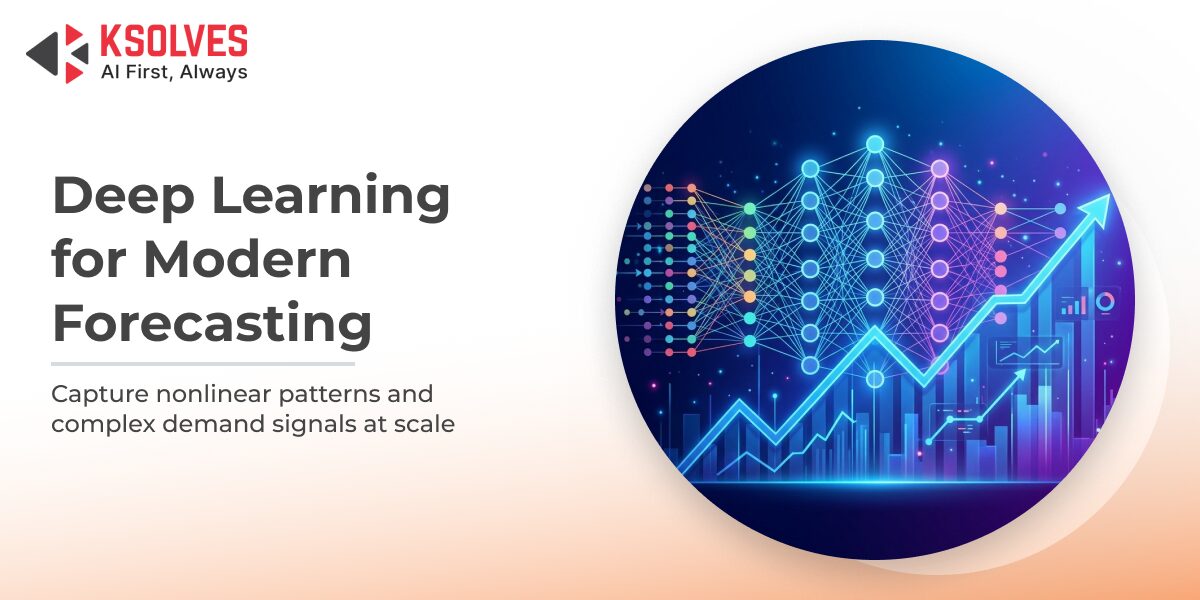
Retail has entered a new phase of intelligent automation and advanced analytics. Traditional retail strategies depended on rule-based forecasting and intuition driven by limited datasets. Today, the scale and variety of retail data from point of sale systems and inventory records to customer browsing behavior and social sentiment require more advanced analytical techniques. Deep learning has emerged as a powerful solution in retail analytics. Its ability to model complex nonlinear relationships and extract patterns from high-dimensional data enables better decision-making across key functions like demand forecasting and customer behavior modeling.
This blog explores how deep learning is reshaping these critical areas and which specific models and methods are used.
The Importance of Accurate Demand Forecasting in Retail
Demand forecasting lies at the core of retail operations. Retailers need to estimate future product demand to optimize inventory, control costs, avoid stockouts, and reduce waste. Poor forecasting leads to overstocking that ties up capital and understocking that drives lost sales and dissatisfied customers.
Traditional forecasting methods such as moving averages, ARIMA, and exponential smoothing perform well for stable, linear time series but struggle when data exhibit complex patterns, multiple seasonal cycles, promotional effects, and sudden demand shifts. These limitations become more evident in e-commerce and omnichannel retail environments where customer preferences change rapidly, and data volumes are large.
Deep learning models address these limitations by learning patterns directly from data without strong assumptions about linearity. Their ability to incorporate multiple features, temporal dependencies, and nonlinear interactions makes them well-suited for modern retail forecasting.
Deep Learning and Demand Forecasting: Improved Accuracy and Deeper Insights
Deep learning models such as Long Short-Term Memory networks, Gated Recurrent Units, Convolutional Neural Networks, and Transformer-based architectures have demonstrated strong performance on time series forecasting tasks relevant to retail.
For example, LSTM networks are specialized recurrent neural networks that can learn long-range temporal dependencies. In retail demand forecasting, they can identify patterns across multiple seasons, promotional cycles, and product life cycles. Convolutional Neural Networks can capture local temporal features in time series data and are increasingly adapted for forecasting tasks.
More recently, Transformer-based time-series models leveraging self-attention mechanisms have gained prominence, as they can analyze large volumes of historical data in parallel and handle complex demand patterns at scale.
A peer-reviewed study also compared deep neural networks with traditional statistical models for retail demand forecasting and found that deep learning architectures consistently outperformed classical approaches across multiple retail datasets.
Key Results
- 15 to 35 percent lower forecasting error
- Better performance on seasonal demand spikes
- Improved accuracy in multi-item retail datasets
These findings reinforce the practical value of deep learning in production retail systems. Lower forecasting error directly impacts safety stock calculations, procurement decisions, and replenishment cycles.
Customer Behavior Modeling with Deep Learning
Beyond forecasting, understanding customer behavior is equally critical. Retailers must identify buying patterns, predict churn, and deliver personalized recommendations across channels. Traditional segmentation methods rely on static attributes such as demographics or purchase frequency. These approaches fail to capture sequential behavior, contextual signals, and latent preferences embedded in customer journeys.
Deep learning models enable dynamic behavioral modeling by processing sequential and high-dimensional data.
- Recurrent Neural Networks analyze purchase sequences over time.
- Autoencoders generate compressed embeddings that represent customer preferences.
- Attention mechanisms focus on the most relevant historical interactions when predicting future purchases.
For example, a deep learning based recommendation engine can analyze browsing history, cart activity, time of day, device usage, and purchase intervals simultaneously. Instead of suggesting products based only on recent activity, it identifies long-term affinity patterns.
Implementation Considerations in Retail Environments
Despite its advantages, deep learning adoption requires careful planning.
Data Integration is often the first challenge. Retail data exists across ERP systems, CRM platforms, POS terminals, and digital channels. Consolidating these sources into a unified analytics pipeline is critical.
Model Interpretability is another concern. Retail stakeholders require explainable insights into demand shifts and customer behavior. Techniques such as SHAP values and feature attribution methods help improve transparency.
Infrastructure Requirements must also be addressed. Training deep learning models at scale requires robust computing environments and efficient data engineering frameworks.
A structured deployment strategy that includes feature engineering pipelines, model validation processes, and continuous retraining ensures long term success.
Why Deep Learning Consulting Services Accelerate Retail Success
Implementing advanced demand forecasting and customer behavior modeling systems requires both technical expertise and a deep understanding of retail operations. At Ksolves, our Deep Learning Consulting Services are designed to help retailers architect scalable solutions that align directly with business objectives.
Our team works closely with retail enterprises to build robust data pipelines, select the most suitable deep learning frameworks such as LSTM and transformer-based models, and integrate predictive outputs seamlessly into ERP, POS, and e-commerce systems. From model experimentation and validation to production deployment and continuous monitoring, we ensure performance stability and measurable improvements in accuracy.
By partnering with Ksolves, retailers move beyond reactive reporting toward predictive and prescriptive intelligence that supports smarter inventory decisions, personalized customer engagement, and sustained revenue growth.
Also Read: The Impact Of Deep Learning in Healthcare
Conclusion
Deep learning is transforming retail analytics by delivering measurable improvements in demand forecasting accuracy and in the precision of customer behavior modeling. From reducing forecasting errors to enabling intelligent personalization, its impact is both operational and strategic.
Retailers that invest in structured implementation and expert guidance are positioned to gain sustained competitive advantage in an increasingly data-driven market. If your organization is looking to modernize retail forecasting systems, improve personalization strategies, or deploy production-ready AI models, Ksolves can help. Our Deep Learning Consulting Services are designed to help retailers build scalable, accurate, and business-aligned solutions that drive measurable outcomes. Contact Us Today!


































AUTHOR
AI
Mayank Shukla, a seasoned Technical Project Manager at Ksolves with 8+ years of experience, specializes in AI/ML and Generative AI technologies. With a robust foundation in software development, he leads innovative projects that redefine technology solutions, blending expertise in AI to create scalable, user-focused products.
Share with