Project Name
7-Year Salesforce Org Rebuilt and Two MSP Portals Consolidated for a Global Endpoint Integrator

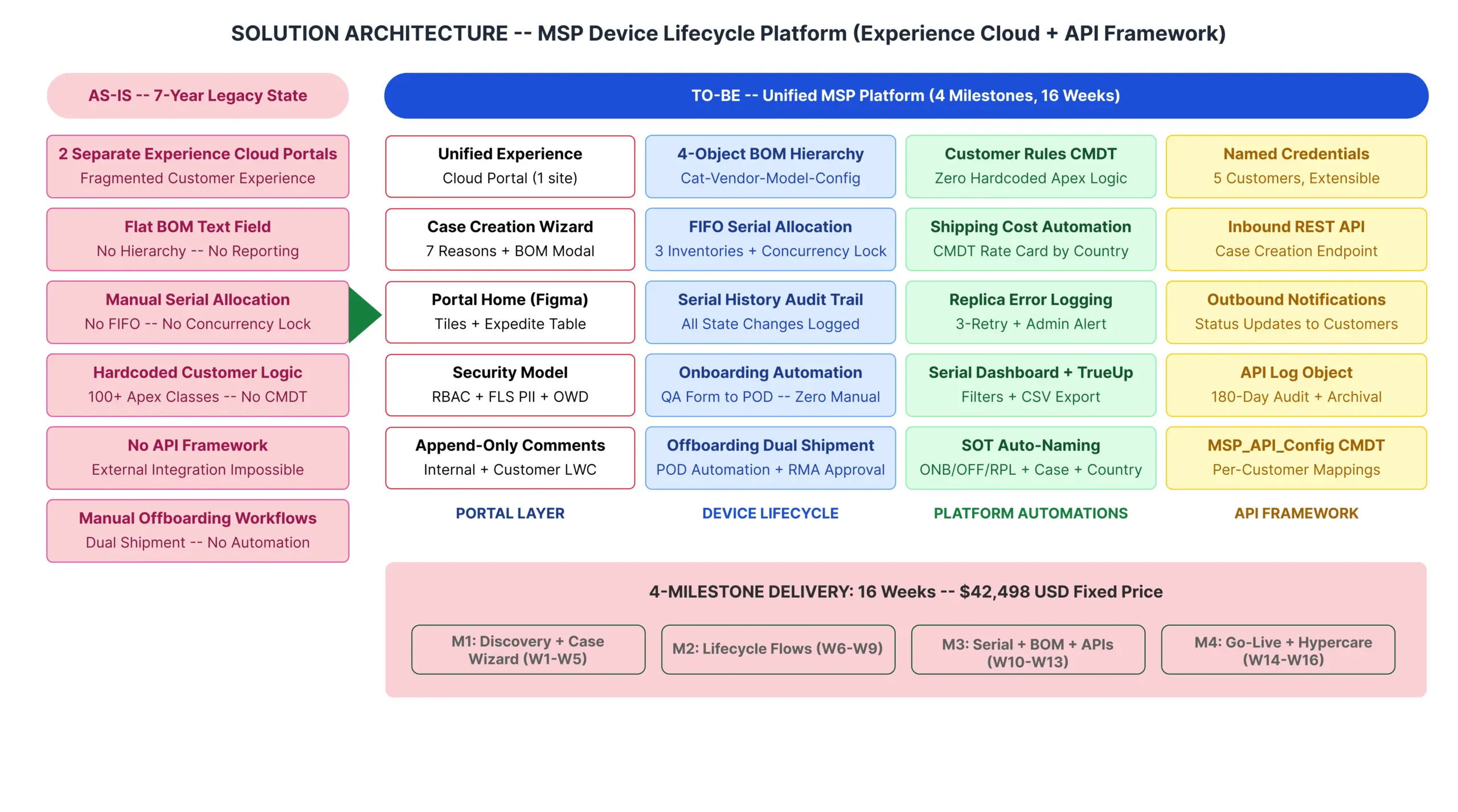
A US-based global endpoint solutions integrator managing the complete device lifecycle for hundreds of enterprise MSP clients had been running entirely on a single Salesforce org for seven years. The platform had accumulated serious structural debt: two fragmented Experience Cloud portals, a flat BOM text field, manual serial allocation across three inventory pools with no concurrency protection, and 100+ Apex classes full of hardcoded customer logic, making every new client onboarding a code deployment. Applying its AI-First approach, Ksolves delivered the full platform revamp across 31 scope items, four milestones, 16 weeks, and a fixed-price SOW of $42,498 USD.
- Two Fragmented Portals: MSP customers accessed separate Experience Cloud sites with inconsistent branding, divergent navigation, different feature sets, and double the maintenance overhead.
- Flat BOM Text Field: Device configurations stored as an unstructured text string - impossible to filter, report on, automate against, or validate.
- Manual Serial Allocation With No Concurrency Protection: Serials allocated manually across three pools with no FIFO ordering, no protection against two users allocating the same serial simultaneously, and no automated release for abandoned reservations.
- 100+ Apex Classes With Hardcoded Customer Logic: Named-customer conditions scattered across over a hundred classes. Any rule change or new customer required a code change and production deployment.
- No API Framework for External Integrations: No Named Credentials, no per-customer configuration, no inbound REST endpoint, no outbound notifications, and no logging - every integration was a one-off custom build.
- Offboarding Requiring Manual Status Updates: Device return flow required manual status updates at every stage, with no approval process for write-offs and no automation preventing early case closure.
Ksolves delivered the full modernisation across four milestones. Every structural problem was addressed at its root: two portals became one, a flat BOM became a 4-object hierarchy, manual serial allocation became FIFO-automated with concurrency locking, hardcoded logic became metadata-driven, and external integration became a governed REST API framework.
- Unified Experience Cloud Portal: Two separate sites consolidated into one with audience-based targeting - case creation wizard, 4-level LWC BOM modal, serial dashboard with TrueUp export, service availability map, and escalation matrix. Full feature parity verified across all customer accounts.
- 4-Object BOM Hierarchy: Four custom objects - BOM_Category__c, BOM_Vendor__c, BOM_Type_Model__c, BOM_Identity_Attribute__c - with a lookup chain enforcing valid parent-child combinations and a 4-level LWC modal on portal and internal layouts, with backward-compatible text concatenation for legacy data.
- FIFO Serial Allocation With Concurrency Lock: FIFO serial search across three inventory pools with a FOR UPDATE row-level lock preventing double-allocation. Schedulable Apex job releases abandoned reservations every 30 minutes. Serial_History__c captures every state change with full lifecycle traceability.
- Customer Rules CMDT Replacing Hardcoded Apex Logic: Customer_Rules__mdt replaces every hardcoded customer condition across 100+ Apex classes. New customer onboarding requires one CMDT record, zero code deployment.
- REST API Framework: Named Credentials, MSP_API_Config__mdt for per-customer field mappings, inbound REST endpoint for case creation, outbound webhooks, and API_Log__c with 180-day archival. Adding a new integration requires only a Named Credential and a CMDT record.
- End-to-End Offboarding Automation: Dual shipment creation, POD upload triggers automated status progression, IC team validation workflow, and a formal Salesforce Approval Process for RMA/Decom with 48-hour reminder, 10-day expiry, and full approval history on every case.
Technology Stack
| Category | Technology |
|---|---|
| Platform | Salesforce Experience Cloud |
| Architecture | 4-Object BOM Hierarchy |
| Automation | FIFO Serial Allocation + Concurrency Lock |
| Integration | REST API Framework + Named Credentials |
| DevOps | Customer Rules CMDT + Platform Events |
- Two Portals Consolidated Into One: Single Experience Cloud site with audience-targeted navigation serves all MSP customers - feature parity verified, maintenance overhead eliminated, all new capabilities in one deployment.
- BOM Text Field Replaced With 4-Object Hierarchy: Category-Vendor-Model-Config hierarchy with parent-child enforcement, LWC selection modal, and migrated existing data - BOM-driven reporting and automation enabled for the first time.
- Double-Allocation Eliminated: FOR UPDATE concurrency lock prevents simultaneous serial conflicts. Abandoned reservations released within 30 minutes. Serial_History__c delivers full lifecycle traceability from first receipt to final disposition.
- Zero Hardcoded Customer Logic Remaining: Customer_Rules__mdt centralises all configuration - new customer onboarding is one CMDT record, zero code deployment, zero hardcoded references in the Apex codebase.
- External Integrations Now a Governed Service: Named Credentials, per-customer CMDT mappings, inbound REST endpoint, outbound webhooks, and 180-day API logging replace one-off custom builds with a scalable, metadata-driven integration framework.
A global endpoint MSP running a 7-year-old Salesforce org with two fragmented portals, a flat BOM text field, manual serial allocation, and 100+ Apex classes of hardcoded customer logic was fully modernised through Ksolves Salesforce platform services. In 16 weeks at a fixed price of $42,498 USD, two portals became one, a text field became a 4-object BOM hierarchy, FIFO serial allocation with concurrency locking eliminated double-allocation, metadata-driven CMDT replaced all hardcoded logic, and a governed REST API framework enabled external integrations at scale, with Agentforce-powered device lifecycle automation scoped for the next phase.
Salesforce Org Carrying Years of Technical Debt With No Clear Modernisation Path?