



From Rule-Based to Generative: The Evolution of Chatbots
AI
5 MIN READ
April 3, 2026

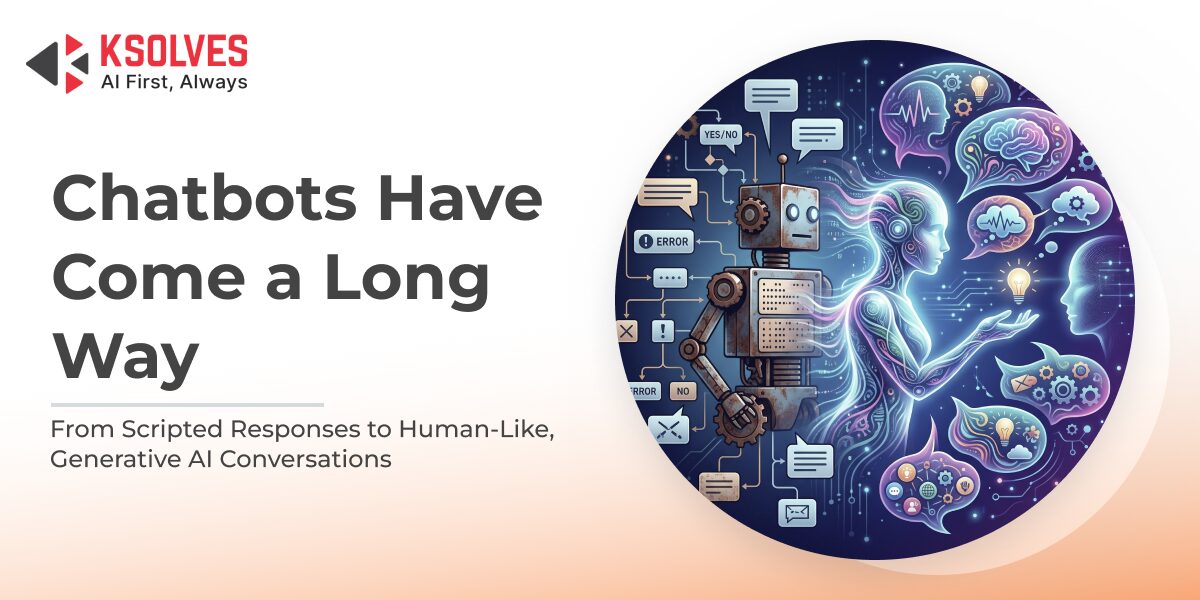
In the age of digital transformation, chatbots have become integral to customer engagement, business automation, and user interaction. Their evolution from rigid, rule-based systems to intelligent, generative AI models mirrors the rapid advancements in artificial intelligence and machine learning.
In this blog, we explore the journey of chatbot technology, its transformation through different generations, and how businesses can leverage modern chatbots for enhanced performance and user satisfaction.
What Are Rule-Based Chatbots?
Rule-based chatbots, also known as decision-tree chatbots, operate using predefined rules and scripts. These bots follow a fixed flow of conversation based on if-then-else logic. They can answer FAQs, assist in basic troubleshooting, or guide users through structured processes. Example: A common use case is in banking, where a rule-based chatbot helps customers quickly check account balances, view recent transactions, or find answers to fixed FAQs like “What are the ATM withdrawal limits?” Similarly, airlines use rule-based bots to let users check ticket status or baggage allowance without involving a support agent.
Key Features:
- Depend on predefined keywords
- No understanding of user intent beyond programmed responses
- Cannot handle unexpected inputs or complex queries
Limitations:
- Lack of flexibility
- Poor scalability for complex scenarios
- Require extensive manual updates for new use-cases
While rule-based bots served their purpose during the early phases of chatbot development, they failed to provide a truly human-like conversational experience.
The Rise of AI-Powered Chatbots
With the integration of Natural Language Processing (NLP) and Machine Learning (ML), chatbots began to evolve into more intelligent entities capable of understanding context and user intent. These AI-driven bots use intent classification to identify what a user wants and entity extraction to pick out important details such as dates, amounts, or product names.
How AI Chatbots Changed the Game:
- Analyze and interpret user input beyond keywords
- Learn from past interactions
- Provide personalized and dynamic responses
- Support multilingual capabilities
This leap allowed industries like eCommerce, healthcare, banking, and customer service to automate tasks while maintaining a high level of user satisfaction.
The Shift to Generative Chatbots
Generative chatbots are powered by advanced AI models like GPT-4, LLaMA, and other large language models (LLMs). These bots do not rely on pre-written scripts; instead, they generate human-like text in real-time, based on the context of the conversation.
What Makes Generative Chatbots Stand Out:
- Better handle nuance, context, and conversational tone compared to previous generations
- Create responses that are coherent and contextually rich
- Handle complex, open-ended conversations
- Integrate easily with systems like CRM, ERP, and helpdesks
Examples of Generative AI in Chatbots:
- ChatGPT by OpenAI
- Gemini by Google
- Claude by Anthropic
Generative AI has ushered in a new era where chatbots can act as virtual assistants, customer service agents, sales reps, and more.
Also Read: How Chatbots Understand You with NLP?
Comparing Chatbot Technologies
| Feature | Rule-Based Chatbots | AI-Powered Chatbots | Generative Chatbots |
| Flexibility | Low | Medium | High (if fine-tuning LLMs) / Low (if using prompt engineering with existing APIs) |
| Learning Ability | None | Limited | Advanced |
| Personalization | No | Partial | Full |
| Use Case | Static Queries | Dynamic FAQs, Support | Human-like Interactions, Sales |
| Training Required | Minimal (only rules and flows) | Moderate (intent classification + entity models) | High (if fine-tuning LLMs) / Minimal (if using prompt engineering with existing APIs) |
| Cost to Maintain | Low (simple updates) | Medium (model updates + retraining) | High (infrastructure, API usage, continuous optimization) |
| Data Security / Privacy | High (everything is rule-based and controlled) | Medium (data used for ML models) | Variable (depends on provider, compliance controls, and deployment type, like on-premises vs cloud) |
This progression clearly shows how businesses have moved from basic automation to intelligent, adaptive solutions.
Benefits of Modern Chatbots for Businesses
Adopting generative chatbots provides several advantages:
1. 24×7 Customer Support
With intelligent chatbots, businesses can provide round-the-clock assistance without the need for large support teams.
2. Cost Efficiency
Automating common queries reduces the need for live agents, lowering operational costs.
3. Lead Generation and Qualification
Chatbots can engage users, ask qualifying questions, and even book appointments, thereby improving conversion rates.
4. Seamless Integration
Modern bots can integrate with Odoo ERP, CRM systems, and e-commerce platforms to streamline operations.
Partner With Ksolves for Chatbot Development Services
At Ksolves, our team specializes in advanced chatbot development services that leverage the latest generative AI techniques, from GPT-powered assistants integrated directly into your Odoo modules to custom LLM fine-tuning and RAG-based knowledge architectures for domain-specific accuracy.
As an AI-first company, we bring AI-enabled tools and AI-trained professionals to every engagement, with a delivery model built around intelligent automation from day one. Whether your goal is customer support automation, lead qualification, or internal workflow assistance, we design, build, and optimize chatbot systems that are scalable, compliant, and aligned to your business outcomes. We handle the full stack: LLM selection, prompt engineering, integration with existing platforms, and ongoing performance optimization.
The Future of Chatbots: What’s Next?
As AI continues to evolve, chatbots will become even more intelligent and emotionally aware. Future advancements include:
- Emotion AI: Recognizing user emotions through text and voice
- Multimodal Interaction: Using images, videos, and voice in conversations
- Deeper Personalization: Using user history, preferences, and real-time data for hyper-personal responses
- Autonomous Agents: Bots that take actions, not just answer questions
Companies embracing these technologies now will lead in customer experience, automation, and digital transformation. By 2027, Gartner estimates that 40% of enterprise applications will feature task-specific AI agents, up from less than 5% in 2025. Companies building their chatbot infrastructure now will be significantly better positioned as this shift accelerates.
At Ksolves, we are already preparing for this future. As an AI-first company with an AI-enabled workforce, our professionals actively work with emerging agentic frameworks, multimodal models, and real-time personalization pipelines. This means clients do not just get a chatbot built for today but also get a solution architected to evolve alongside the technology.
Conclusion
The journey from rule-based to generative chatbots showcases how technology is reshaping the way we interact with machines. Today’s chatbots are no longer just support tools; they are digital partners that offer smarter, faster, and more human-like experiences.
By integrating generative chatbots with platforms like Odoo, businesses unlock powerful efficiencies and elevate customer engagement. Now is the time to future-proof your business with intelligent automation and AI-powered solutions.
Ready to transform your business? Explore expert Odoo Development Services with Ksolves today!
Frequently Asked Questions
What is the difference between rule-based and generative chatbots?
What happens if a business keeps using a rule-based chatbot instead of upgrading to generative AI?
How do you integrate a generative AI chatbot with an ERP system like Odoo?
How do AI-powered chatbots differ from generative chatbots?
When should a business consider upgrading from a rule-based chatbot to a generative AI chatbot?
Which company can help build and deploy a generative AI chatbot for my business?
What is the cost and effort involved in deploying a generative AI chatbot?
Have more questions? Contact our team































Author
About the Author Editorial Team The Ksolves Editorial Team includes certified Salesforce experts, Big Data engineers, AI/ML specialists, Zoho consultants, and experienced technology writers focused on delivering clear, actionable insights for modern businesses. With hands-on experience across Salesforce, Big Data platforms, AI/ML solutions, application development, software testing, and Zoho ERP/CRM, the team publishes practical guides, real-world use cases, and industry updates that support smarter decisions and faster growth. Every article is created to solve business challenges, guide technology adoption, and keep organizations aligned with evolving digital ecosystems.
Share with