



Leveraging AI to Enhance Performance and Resilience of Java Applications
Java
5 MIN READ
May 5, 2026

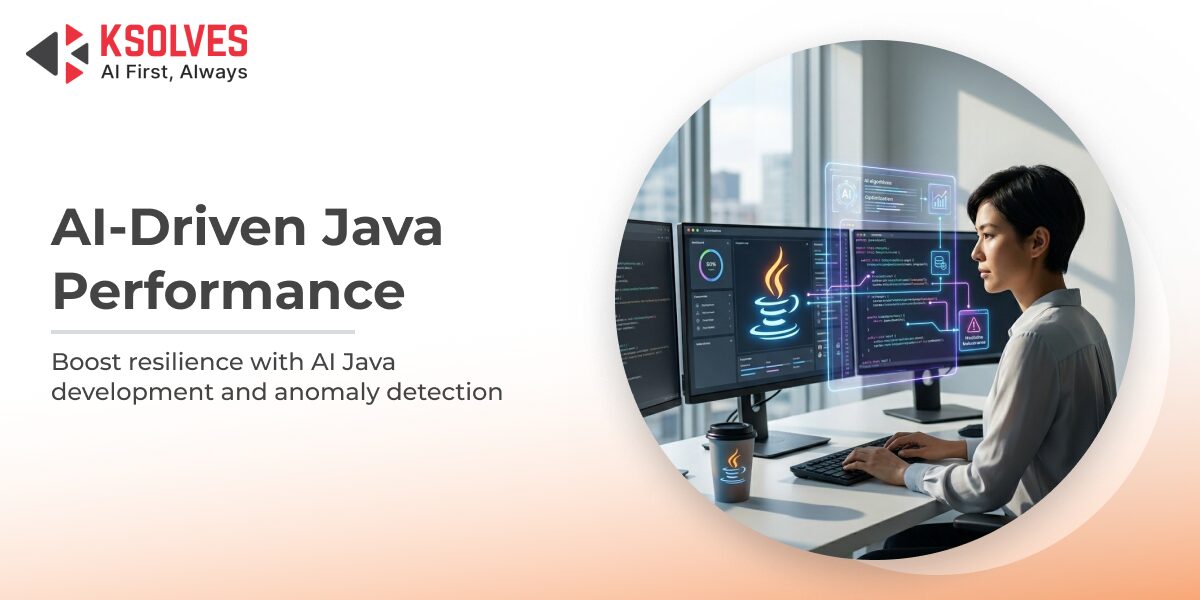
Java has powered enterprise backends for over two decades, but the demands placed on modern applications have grown far beyond what traditional development practices can handle alone. Latency spikes, memory leaks, unpredictable failures, and scalability ceilings are challenges every Java architect faces. Artificial Intelligence is now changing that equation, giving development teams a smarter, faster, and more proactive toolkit to build Java applications that not only function but genuinely thrive under pressure.
This blog explores the key ways AI is transforming Java application performance and resilience, and why the intersection of these two technologies is one of the most valuable frontiers in enterprise software today.
The Business Case for AI-Driven Java Performance
Before diving into the “how,” the “why” is worth establishing clearly. According to a landmark study by Harvard Business School in collaboration with Boston Consulting Group, professionals leveraging AI tools completed tasks 25.1% faster and produced results of over 40% higher quality than those working without AI. Applying that productivity multiplier to Java development, and the downstream impact is clear: faster release cycles, fewer production incidents, and applications that cost significantly less to maintain. For enterprises running Java at scale, this is not a theoretical benefit but a measurable competitive edge.
Intelligent Performance Monitoring and Anomaly Detection
Traditional APM (Application Performance Monitoring) tools are reactive. They alert you after the problem surfaces. AI flips this model entirely. By training machine learning models on historical performance telemetry, heap usage, garbage collection cycles, thread counts, and response times, AI systems learn the normal operating signature of a Java application and flag deviations before they escalate into outages.
Tools like Dynatrace and Elastic APM now embed AI-driven anomaly detection directly into Java environments. These systems can identify patterns invisible to rule-based alerts, such as a slow JVM memory leak that manifests only under specific load conditions, or a downstream service dependency that occasionally degrades without crossing a threshold. For Java-heavy enterprise workloads, this shift from reactive monitoring to predictive observability can significantly reduce mean time to detection (MTTD).
Also Read – Common Java Development Mistakes and How to Avoid Them
AI-Powered Code Analysis and Refactoring
One of the most immediately impactful applications of AI in Java development is automated code analysis. AI-certified experts at forward-thinking companies like Ksolves now use tools powered by large language models to scan codebases for performance anti-patterns such as inefficient collection usage, excessive object creation, or blocking I/O in reactive chains; thread safety issues that only surface under concurrency load; deprecated API usage that creates security or compatibility risk; and suboptimal query construction in ORM layers like Hibernate.
This is not simple linting. Modern AI code analysis tools understand context, recognize cascading implications, and suggest refactors that a static analyzer would miss entirely. For large legacy Java codebases, this capability alone can compress months of technical debt remediation into weeks.
Predictive Autoscaling and Load Management
AI models integrated with Kubernetes and cloud-native Java deployments, such as Spring Boot microservices on AWS or GCP, can predict traffic spikes before they hit and trigger proactive autoscaling. Rather than waiting for CPU thresholds to breach, a trained model analyzes historical usage curves, seasonal patterns, and upstream signals to scale resources ahead of demand.
The result is a Java application that remains resilient under variable load without over-provisioning infrastructure during quiet periods. For fintech, e-commerce, and healthcare platforms built on Java, this balance of performance and cost efficiency is business-critical.
Also Read – Java Security Best Practices: Building Secure Applications in 2026
AI-Enhanced Testing and Resilience Engineering
Resilience is not just about handling what you know will break; it is about surviving what you did not anticipate. AI is transforming Java testing through intelligent test case generation that targets edge cases and high-risk code paths, chaos engineering augmentation where AI recommends targeted fault injections based on actual dependency risk profiles, and self-healing test suites that automatically update when APIs or contracts change.
These capabilities close the gap between testing in controlled environments and real-world production behavior, giving Java teams far greater confidence in release quality.
How Ksolves Helps You Build Smarter Java Applications
As an AI-first company, Ksolves brings together deep Java engineering expertise and AI-native thinking to help enterprises unlock the full potential of their applications. Our AI-certified experts design and implement intelligent solutions across performance optimization, predictive monitoring, automated code quality, and resilience engineering, all tailored to your specific Java stack and business objectives.
Whether you are modernizing a legacy Java monolith, scaling a microservices architecture, or building a new enterprise application from the ground up, our Java Development Services are engineered to deliver performance, reliability, and long-term maintainability. We do not apply generic fixes; we understand your workload, failure modes, and growth trajectory.
Partner with Ksolves and bring the power of AI-certified expertise to your Java development roadmap!
Conclusion
AI is no longer a future capability for Java development. It is a present-day advantage that high-performing engineering teams are already deploying to ship faster, scale smarter, and fail less. From predictive observability to AI-driven code analysis and intelligent autoscaling, the tools available today enable the development of Java applications of a fundamentally higher caliber.
Ksolves AI-certified experts are ready to partner with your team and make that transformation real. Connect with us today or send us your query at [email protected].































AUTHOR
Java
Share with